
Intro
Week 5 of pregnancy is often the moment when a missed period, a positive home test, and the first wave of physical changes make pregnancy feel real. Medically, this is still very early: dating is usually counted from the first day of the last menstrual period, so the embryo itself is only about three weeks post-conception. Even so, important developmental events are already underway.
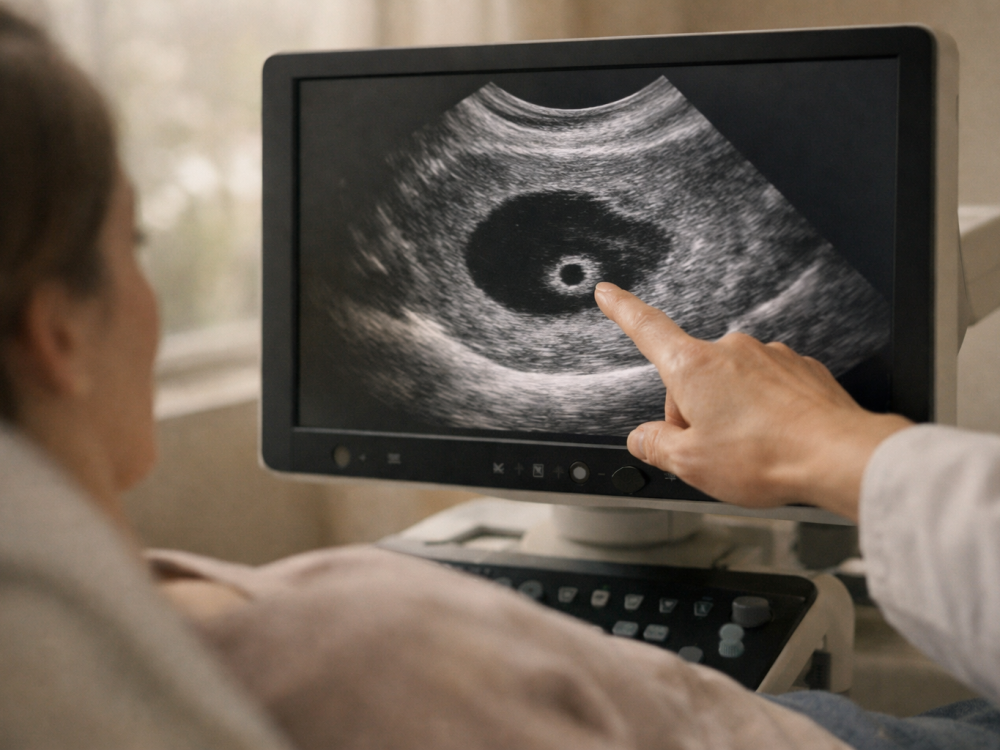
At this stage, the embryo is tiny, but rapidly organizing. The neural tube, which will form the brain and spinal cord, is developing; the early heart region is beginning rhythmic activity; and the gestational sac may be visible on transvaginal ultrasound. It is also normal for ultrasound findings to vary by a few days, especially if ovulation occurred later than expected. Supportive follow-up with a midwife, obstetrician, family doctor, or fertility clinic can help interpret what is seen in context.
Highlights
At 5 weeks, the embryo is very small, but development is fast, especially in the neural tube and early cardiovascular structures.
A transvaginal ultrasound may show a gestational sac, and sometimes a yolk sac, but it may be too early to see an embryo or heartbeat reliably.
Symptoms can range from mild to intense, and absence of symptoms does not necessarily mean something is wrong.
Because early findings can be ambiguous, repeat ultrasound and serial hCG testing may be used by clinicians when dating or viability is uncertain.
What is happening in week 5?
Week 5 is part of the nic period, a time of foundational organ formation. Although pregnancy is counted as five s the ]], typically occurred around three s earlier in a 28-day cycle. This distinction matters because appearances and blood hormone levels can differ substantially if ovulation or happened earlier or later than average.
The is often described as very small, roughly the size of a sesame seed or a tiny grain, depending on the exact day and dating method. The body plan is beginning to take shape. Cells are differentiating into specialized tissues, and the is folding a flatter disc-like structure into a three-dimensional form. These changes are microscopic but biologically significant.
Around this time, the placenta is also developing. It is not yet fully mature, but the placental tissue is producing human chorionic gonadotropin, or hCG, the hormone detected by pregnancy s. hCG supports the corpus luteum in the ovary so it continues producing progesterone, which helps maintain the uterine lining.
Embryo growth and early body organization
The fifth week is marked by rapid cellular growth and structural patterning. The develops along a head-to-tail axis, and segments begin to organize tissues that will contribute to muscles, bones, nerves, and connective structures. The head region grows prominently because the developing nervous system is advancing quickly.
Several essential systems begin forming in parallel:
- Nervous system: The neural plate folds into the neural tube, the precursor to the and spinal cord.
- Cardiovascular system: Early heart tissue begins to organize and may start rhythmic activity around this general stage.
- Digestive and respiratory precursors: Primitive internal structures are beginning to outline future .
- Placental support: Early placental tissue and the yolk sac support nutrient exchange before the placenta becomes more established.
These changes do not mean the ]] is fully formed; rather, the templates are being laid down. This is why the is especially sensitive to certain exposures, including some medications, alcohol, high-dose radiation, and uncontrolled conditions. If you take prescribed medicines, do not stop them abruptly without advice. Instead, contact your healthcare professional promptly to review safety in pregnancy.
The neural tube: why this week is important
The neural tube is one of the most important structures developing at this stage. It forms when a specialized sheet of cells folds and closes, eventually becoming the central nervous system: the brain, spinal cord, and related structures. Closure of the neural tube occurs very early in pregnancy, often before many have their first prenatal appointment.
This is the reason folic acid is emphasized before conception and during early pregnancy. Adequate folate status reduces the risk of neural tube defects. Many guidelines recommend that who may become pregnant take folic acid before conception and in the , although the exact dose can vary depending on personal risk factors, medical history, medications, and prior pregnancies. A clinician can advise on the appropriate amount for your situation.
It is understandable to anxious if you did not know you were pregnant and were not taking prenatal vitamins. Many pregnancies are unplanned, and many start supplementation only after a positive test. The most helpful next step is to begin a pregnancy-appropriate prenatal vitamin, discuss your circumstances a healthcare professional, and avoid self-blame. Early pregnancy is a time for support, not judgment.
Early heart activity: what “heartbeat” means at 5 weeks
Sources often describe the heart as beginning to beat around week 5. More precisely, early cells may begin coordinated rhythmic contractions as the primitive heart tube develops. This is not the same as a fully formed four-chambered heart; it is an early functional stage of cardiovascular development.
On , visible cardiac may not yet be detectable at exactly 5 weeks. Detection depends on gestational age, image quality, equipment, the route of , uterine position, body habitus, and the skill of the examiner. Transvaginal is generally more sensitive than abdominal this early.
If no heartbeat is seen at 5 weeks, that can be completely expected. Clinicians typically interpret early in relation to structures seen, mean sac diameter, crown-rump length if an is visible, symptoms, and sometimes serial hCG results. A repeat scan in 7 to 14 days may provide much clearer information than a single very early scan.
What an ultrasound may show at 5 weeks
An early at 5 weeks is often performed after fertility treatment, uncertain dating, pain or , prior ectopic pregnancy, recurrent loss, or for reassurance. However, it can also create uncertainty because normal pregnancies may look different from one day to the next at this stage.
Possible ultrasound findings include:
- Gestational sac: Often the sign of an intrauterine pregnancy. It appears as a small fluid-filled structure within the uterus.
- Yolk sac: This may become visible around this time or shortly afterward. It helps support the early on and is an important reassuring structure when seen in the correct context.
- nic pole: The tiny may be seen later in week 5 or closer to week 6, depending on dating.
- Cardiac activity: Sometimes visible near the end of week 5 or in week 6, but not reliably present on a very early scan.
One key goal of early ultrasound is confirming the location of the pregnancy. Seeing a gestational sac inside the uterus is reassuring, but interpretation can be nuanced. In some cases, clinicians may use repeat imaging and hCG trends to distinguish a very early intrauterine pregnancy from other possibilities. This is especially important if there is significant pain, bleeding, or a history of ectopic pregnancy.
Symptoms you may notice this week
Pregnancy symptoms at 5 weeks are driven largely by hormonal ]], especially rising hCG and progesterone. Some people feel very pregnant; others feel almost nothing. Both experiences can occur in healthy pregnancies.
Common symptoms may include bre tenderness, fatigue, mild cramping, bloating, nausea, food aversions, heightened sense of smell, more frequent urination, mood ]], and light spotting. Mild uterine cramping can occur as the uterus and supporting tissues respond to pregnancy, but pain that is severe, one-sided, worsening, or associated with heavy bleeding deserves prompt medical assessment.
Nausea may begin now or in the coming weeks. Eating small, frequent meals, staying hydrated, and avoiding strong triggers may help some people, but persistent vomiting, inability to keep fluids down, dizziness, or signs of dehydration should be discussed with a healthcare professional.
Practical steps for week 5
This week is a good time to establish care and review health basics. If you have not already done so, contact a midwife, obstetrician, family doctor, or pregnancy clinic to ask when your appointment should be scheduled. Timing varies by country, risk factors, symptoms, and prior history.
Helpful steps include:
- Start or continue a prenatal vitamin containing folic acid, unless your clinician has advised a specific alternative.
- Review prescription and over-the-counter medicines with a healthcare professional or pharmacist.
- Avoid alcohol, smoking, vaping, and non-prescribed recreational drugs.
- Limit exposure to foods with higher infection risk, and follow local food safety guidance for pregnancy.
- Seek individualized advice if you have diabetes, epilepsy, thyroid disease, hypertension, autoimmune disease, kidney disease, or a history of pregnancy complications.
If you are feeling anxious, especially after a previous loss or fertility treatment, that anxiety is valid. Early pregnancy can involve waiting, uncertainty, and repeated tests. Ask your care team what findings they are looking for, when follow-up is appropriate, and which symptoms should prompt urgent review.
Seek medical help promptly if
- You have severe or worsening abdominal or pelvic pain, especially if one-sided.
- You experience heavy bleeding, passing clots, fainting, or shoulder-tip pain.
- You have dizziness, collapse, or symptoms concerning for ectopic pregnancy.
- You cannot keep fluids down or show signs of dehydration.
- You have fever, severe illness, or concerns about medication or harmful exposure.
Tools & Assistance
- Book an appointment with a midwife, obstetrician, family doctor, or pregnancy clinic.
- Use a pregnancy dating calculator based on the first day of your last menstrual period, then confirm dates clinically.
- Prepare a medication and supplement list for your first prenatal contact.
- Ask your clinician whether early ultrasound or serial hCG testing is appropriate for your situation.
- Contact urgent care or emergency services for severe pain, heavy bleeding, fainting, or suspected ectopic pregnancy.
FAQ
Is it normal not to see a heartbeat at 5 weeks?
Yes. At exactly 5 weeks, it may be too early to detect cardiac activity, even in a normally developing pregnancy. A repeat ultrasound may be recommended.
What is usually the first ultrasound sign of pregnancy?
The gestational sac is often the earliest visible sign of an intrauterine pregnancy on transvaginal ultrasound, followed by the yolk sac and then the embryo.
How big is the embryo at week 5?
The embryo is very small, often described as only a few millimeters or comparable to a tiny seed, depending on exact dating.
Why is folic acid important now?
The neural tube, which becomes the brain and spinal cord, develops very early. Folic acid supports neural tube development and reduces the risk of neural tube defects.
Does light spotting mean miscarriage?
Not always. Light spotting can occur in early pregnancy, but heavy bleeding, significant pain, dizziness, or one-sided pain should be assessed urgently.
Sources
- Cleveland Clinic — Fetal Development: Week-by-Week Stages of Pregnancy
- NHS — 5 weeks pregnant guide - Best Start in Life
- Charlotte Lozier Institute — Week 5
Disclaimer
This article is for general informational purposes only and is not a diagnosis or treatment plan. Always consult a qualified healthcare professional for personal medical advice, urgent symptoms, or concerns about pregnancy.


















Please log in to leave a comment.