
Intro
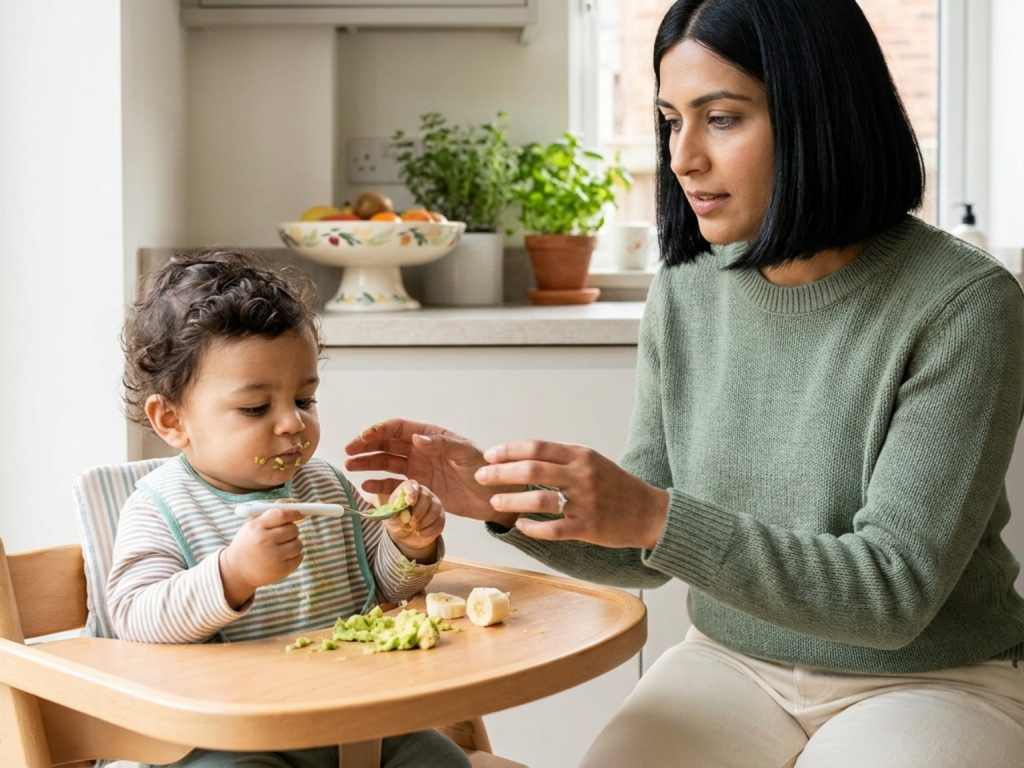
Self-feeding is a gradual developmental skill rather than a single milestone. Babies and toddlers learn by touching, grasping, bringing food to the mouth, chewing, and adjusting their movements through repeated practice. Mess, variable intake, and occasional refusal are normal parts of this learning process.
The caregiver’s role is to provide developmentally appropriate foods, a safe eating environment, and responsive support. Children can be encouraged to participate in feeding while caregivers continue to protect nutritional adequacy and monitor safety.
Highlights
Self-feeding develops through repeated, low-pressure opportunities to handle and taste food.
Readiness, posture, food texture, and close supervision are central to safer practice.
Responsive feeding allows the child to follow internal hunger and satiety cues while the caregiver provides suitable choices.
Mess and inconsistent amounts eaten are expected during skill development.
Persistent coughing, choking, fatigue, or difficulty swallowing warrants prompt professional advice.
Understand what self-feeding involves
Self-feeding includes more than picking up food. It requires postural stability, visual attention, hand-to-mouth coordination, graded grasp, oral-motor control, and the ability to manage different textures. Early attempts may involve raking food toward the palm, dropping pieces, mouthing objects, or using the whole hand. With practice, many children develop a pincer grasp, in which the thumb and index finger pick up smaller pieces, and later learn to load a spoon and guide it to the mouth.
Development varies substantially. Some children show interest in holding food but are not yet efficient eaters; others prefer finger foods before accepting a utensil. A child may also demonstrate a skill inconsistently when tired, ill, teething, or distracted. These fluctuations do not necessarily indicate a problem.
Caregivers can support progress by treating meals as opportunities for participation rather than tests of performance. Offer an appropriate food, allow time for exploration, and expect that much of the food may be touched, smeared, or discarded. The learning value is not limited to the amount swallowed.
Self-feeding can be promoted alongside a varied, nutritious diet. Evidence on infant and toddler feeding behaviors indicates that offering a variety of foods can encourage emerging independence without inherently compromising energy or nutrient adequacy. Continued breast milk or formula, as appropriate for the child’s age and individual plan, remains important during the transition to complementary foods.
Look for developmental readiness
Readiness is best considered as a pattern of abilities rather than a precise age. Many infants begin complementary feeding around 6 months, but timing should be individualized with guidance from a pediatric healthcare professional, particularly when there is prematurity, neuromuscular disease, oral-motor difficulty, or another medical consideration.
Before offering opportunities for independent eating, look for signs such as:
- Stable head and neck control and the ability to sit upright with appropriate support.
- Interest in food and willingness to bring objects toward the mouth.
- Improved coordination between reaching, grasping, and oral exploration.
- Ability to manage food in the mouth without persistent distress.
- Reduced extrusion of solids with the tongue, although occasional pushing out can still occur.
Position the child upright in a stable high chair with the pelvis, trunk, and feet supported when possible. Good alignment helps the child coordinate reaching and swallowing and allows the caregiver to observe the face and mouth. Avoid feeding while the child is reclined, walking, crawling, or sitting in a moving vehicle.
Readiness does not mean that a child can safely eat every texture or food. Texture should advance gradually and should match the child’s oral-motor abilities. Advice from a pediatrician, speech-language pathologist, or occupational therapist with feeding expertise may be useful when readiness is uncertain.
Offer manageable foods and utensils
Start with foods that are soft enough to compress easily between the fingers and large enough for an early grasp. Appropriately prepared strips or wedges of soft vegetables, ripe fruit, tender shredded meat, toast with a thin spread, or other suitable family foods may provide useful practice. As the child’s grasp becomes more precise, smaller soft pieces can be introduced. Preparation must account for the individual child’s abilities and the food’s shape, firmness, and elasticity.
Food should be cooked or modified to reduce hardness and should not be offered in forms that are round, cylindrical, sticky, tough, or difficult to break apart. Whole grapes, raw firm vegetables, nuts, popcorn, chunks of meat or cheese, hard sweets, and spoonfuls of thick nut butter are examples of foods that can create choking hazards unless they are prepared in a safer form. A caregiver should remain within arm’s reach and actively watch throughout eating.
Utensils can be introduced before a child can use them efficiently. A short, thick-handled spoon is often easier to grasp than a long narrow one. Preloading a spoon and placing it within reach lets the child attempt the movement while the caregiver provides additional bites if needed. Two spoons can also be practical: the child holds one while the caregiver uses another. This preserves participation without allowing the meal to become a struggle.
Open cups or developmentally appropriate cups can be offered with small amounts of liquid and direct supervision. Expect spilling. Use stable, easy-to-clean equipment and place a washable mat beneath the chair if that reduces caregiver stress. A calm caregiver is better able to observe swallowing and respond promptly.
Use responsive feeding to build autonomy
Responsive feeding is a reciprocal approach in which the caregiver structures the meal and responds to the child’s cues. The adult decides what foods are offered, when meals and snacks occur, and where eating takes place. The child is supported in deciding whether to eat and how much to consume from the available options. This division of responsibility can encourage autonomy while preserving a predictable nutritional framework.
Look for hunger cues such as reaching toward food, opening the mouth, becoming more attentive when food appears, or vocalizing. Satiety cues may include turning the head away, closing the mouth, slowing down, pushing food away, or losing interest. Cues are not always clear, especially during illness or developmental transitions, so observe the overall pattern rather than relying on one behavior.
Offer a small portion and allow the child time to inspect it. Describe what is happening without pressure: “You are holding the banana,” or “You touched the spoon.” Avoid insisting on one more bite, using dessert as a reward, distracting with screens, or framing eating as good or bad. Pressure can interfere with the child’s ability to respond to internal appetite signals and may make food exploration more difficult.
A responsive feeding intervention study found increased self-feeding and maternal responsiveness without a corresponding increase in weight gain. This supports the idea that encouraging self-feeding is primarily about responsive interaction and skill-building, not about making a child eat more. Growth should be assessed in context by the child’s healthcare professional rather than inferred from an individual meal.
Protect nutrition while skills develop
Early self-feeding is inefficient. A child may consume very little independently even after spending considerable time at the table. Continue offering regular meals and snacks suited to the child’s age, and include foods from different groups over the course of the day. Nutrient-dense choices are especially useful when portions are small. Depending on age and medical guidance, these may include iron-rich foods, eggs, legumes, dairy products, fish low in mercury, soft meats, and energy-dense foods prepared in safe textures.
Do not assume that one disliked food represents a permanent preference. Repeated, neutral exposure can help children become familiar with new tastes and textures. Present a familiar food alongside a less familiar one, and avoid preparing a separate replacement immediately after refusal. The aim is to offer opportunities without coercion.
Milk feeding remains part of the nutritional picture during infancy. Breast milk or iron-fortified formula generally provides important nutrients while complementary foods are being established. Water may be introduced in an appropriate cup as advised by the child’s healthcare professional. Avoid using juice or sweetened drinks to encourage intake.
Growth, wet diapers, stooling, activity, and the child’s overall feeding pattern provide more useful information than a single meal. Discuss concerns about poor weight gain, reduced urine output, recurrent vomiting, prolonged meals, or a markedly restricted diet with a pediatric clinician. A registered dietitian can help evaluate nutrient intake when a child’s diet is unusually limited.
Make safety part of every meal
Choking and gagging are different events. Gagging is a protective response that may include noisy coughing, retching, or watery eyes as the child learns to manage food. Choking may be silent or involve ineffective coughing and difficulty breathing. Caregivers should learn age-appropriate first aid and cardiopulmonary resuscitation from a recognized training provider, and they should know how to contact emergency services.
Remain close enough to intervene. Do not leave a child alone with food, feed in a stroller or car seat, or allow eating while playing. Check the eating area for non-food choking hazards, including small toy parts, coins, batteries, and loose household objects. Older siblings and other caregivers should understand the same rules.
Food allergy is another reason to observe carefully when introducing a new food. Symptoms such as hives, facial or lip swelling, repeated vomiting, wheezing, breathing difficulty, pallor, or sudden lethargy require urgent medical attention. Follow individualized advice if the child has eczema, a known allergy, or a family history that changes the recommended introduction plan.
Oral feeding should be paused and assessed when there is persistent coughing during meals, wet or gurgly breathing after swallowing, frequent choking episodes, marked fatigue, recurrent respiratory infections, or apparent pain. These signs do not establish a diagnosis, but they justify consultation with a pediatrician and possibly a feeding or swallowing specialist.
Troubleshoot common challenges
“My child only plays with food.” Exploration is part of learning. Keep portions small, model eating, and give the child a reasonable amount of time. If no food is swallowed, calmly end the meal and offer the next planned opportunity rather than turning the interaction into a negotiation.
“Meals are extremely messy.” Mess decreases as motor control improves. Use a stable chair, a limited portion, a washable bib, and a floor mat. Avoid correcting every movement, because frequent interruption can reduce the child’s willingness to practice.
“My child wants to self-feed but eats too slowly.” Offer self-feeding at the start of the meal when the child is alert, then provide assistance as attention or energy declines. Keep meals developmentally appropriate in length and discuss persistent fatigue or very prolonged meals with a clinician.
“My child refuses utensils.” Continue placing a utensil nearby without insisting. Try different handle shapes, allow dry practice outside meals, and let the child watch adults use utensils. Finger foods remain a valid route to independence while utensil skills mature.
“I am worried about intake.” Track patterns rather than isolated bites. Bring a short food and behavior record to the child’s pediatric appointment if concerns persist. Professional assessment is particularly important when feeding difficulties affect hydration, growth, family functioning, or the child’s emotional response to meals.
Safety reminders
- Always supervise a child who is eating and keep the child upright.
- Modify food texture and shape according to developmental abilities.
- Learn choking first aid and cardiopulmonary resuscitation.
- Seek urgent help for breathing difficulty, facial swelling, or severe lethargy.
- Contact a healthcare professional for persistent coughing, choking, or swallowing concerns.
Tools & Assistance
- Stable high chair with upright positioning and foot support
- Short, thick-handled toddler spoons
- Washable floor mat and bib for low-stress practice
- Age-appropriate choking first-aid and CPR training
- Pediatrician, registered dietitian, or feeding and swallowing specialist
FAQ
When can a baby start self-feeding?
Many babies begin exploring soft finger foods around 6 months when they show developmental readiness, including stable head control, upright sitting with support, and interest in bringing objects to the mouth. Timing should be individualized with a healthcare professional.
Should I help my baby eat if self-feeding is slow?
Yes. You can allow independent attempts and then offer assistance when the child becomes tired, hungry, or frustrated. Shared feeding and self-feeding can occur during the same meal.
How much food should a self-feeding baby eat?
Intake varies widely. Offer small portions at regular opportunities and observe patterns over time. A pediatric clinician can assess growth, hydration, and nutritional adequacy if intake is concerning.
Is gagging during self-feeding normal?
Gagging can occur as babies learn to manage textures and is often noisy. Choking can be silent or involve breathing difficulty. Supervise closely, learn first aid, and seek professional guidance about recurrent or severe episodes.
What if my child refuses to self-feed?
Keep offering low-pressure opportunities, model eating, and try different safe textures and utensils. Persistent refusal, distress, fatigue, or a restricted diet should be discussed with a pediatric healthcare professional.
Sources
- PubMed — Developmental milestones and self-feeding behaviors in infants and toddlers
- PubMed — A responsive feeding intervention increases children's self-feeding and maternal responsiveness but not weight gain
- MedlinePlus — Feeding patterns and diet - children 6 months to 2 years
Disclaimer
This article provides general educational information and does not diagnose, treat, or replace advice from a qualified healthcare professional. Seek prompt medical care for choking, breathing difficulty, allergic reactions, or other urgent concerns.














Please log in to leave a comment.