
Intro
Choosing school products can feel like a small administrative task until you are standing in an aisle or scrolling through dozens of nearly identical options. For children, supplies are not just objects; they can influence comfort, participation, independence, fine motor practice, attention, and even emotional readiness for school.
A supportive approach combines practical organization with quality checks, developmental fit, safety awareness, and respect for the child’s needs. The goal is not to buy everything, but to choose tools that help the child learn with less friction and fewer avoidable stressors.
Highlights
Quality school products should be safe, durable, developmentally appropriate, and useful across more than one learning context.
Organizing supplies by subject, routine, and child-accessibility reduces morning stress and supports executive function.
For children with allergies, sensory sensitivities, motor delays, chronic conditions, or neurodevelopmental differences, product choices may need individualized planning with school and healthcare professionals.
Vendor transparency, warranties, replacement policies, and evidence-informed educational value matter as much as price.
Sustainable and reusable supplies can reduce waste while still supporting classroom function and family budgets.
Start with the child, not the shopping list
A school supply list is useful, but it is only the starting point. A child’s age, developmental stage, sensory profile, motor skills, school environment, and health needs should shape what is purchased and how it is organized. For example, a first grader who is still developing pencil grip may benefit from triangular pencils, easy-open folders, and a lightweight backpack. An older child managing multiple classes may need color-coded binders, a planner, or digital reminders to support working memory and task initiation.
Think of school products as part of the child’s learning environment. The best items reduce cognitive load: they make it easier to find, carry, use, clean, and put away materials. This is especially relevant for children with attention-deficit/hyperactivity disorder, developmental coordination disorder, autism spectrum differences, anxiety, visual impairment, or chronic medical conditions. Product choices should not be used to diagnose these conditions, but repeated struggles with organization, handwriting pain, avoidance, or distress may justify a conversation with the child’s teacher, pediatrician, occupational therapist, or school support team.
Before buying, ask three questions: What task does this product support? Can the child use it independently? Will it still be useful after the first week of school? This simple filter prevents overbuying and helps families choose developmentally appropriate child products rather than trend-driven items.
Define quality in practical, child-centered terms
Quality is not the same as expensive. A high-quality school product is fit for purpose, safe under normal use, durable enough for the child’s routine, and compatible with the school’s expectations. For instructional materials, quality also includes alignment with learning objectives and evidence-informed practice. Educational leaders often evaluate curriculum by defining criteria, reviewing evidence, and considering whether materials fit the actual student population and school culture. Families can apply a smaller version of that logic to everyday supplies.
For notebooks, folders, backpacks, lunch containers, headphones, art supplies, or learning manipulatives, quality checks include:
- Durability: reinforced seams, sturdy zippers, pages that do not tear easily, and materials that tolerate repeated cleaning.
- Usability: easy-to-open clasps, readable labels, comfortable grips, and sizes appropriate for the child’s hands and body.
- Safety: non-toxic art supplies for children, age-appropriate parts, no sharp edges, and no small detachable magnets or choking hazards for younger children.
- Educational value: products that support active learning, such as whiteboards, math manipulatives, measuring tools, and organized writing materials.
- Adaptability: items that can be used across subjects instead of single-purpose products that quickly become clutter.
For younger children, avoid products that look playful but are difficult to use, overly heavy, or distracting in class. For older students, prioritize systems that support autonomy, such as clear binders, refillable supplies, and planners with enough space for assignments, medication reminders if applicable, and activity schedules.
Build an organization system that matches real routines
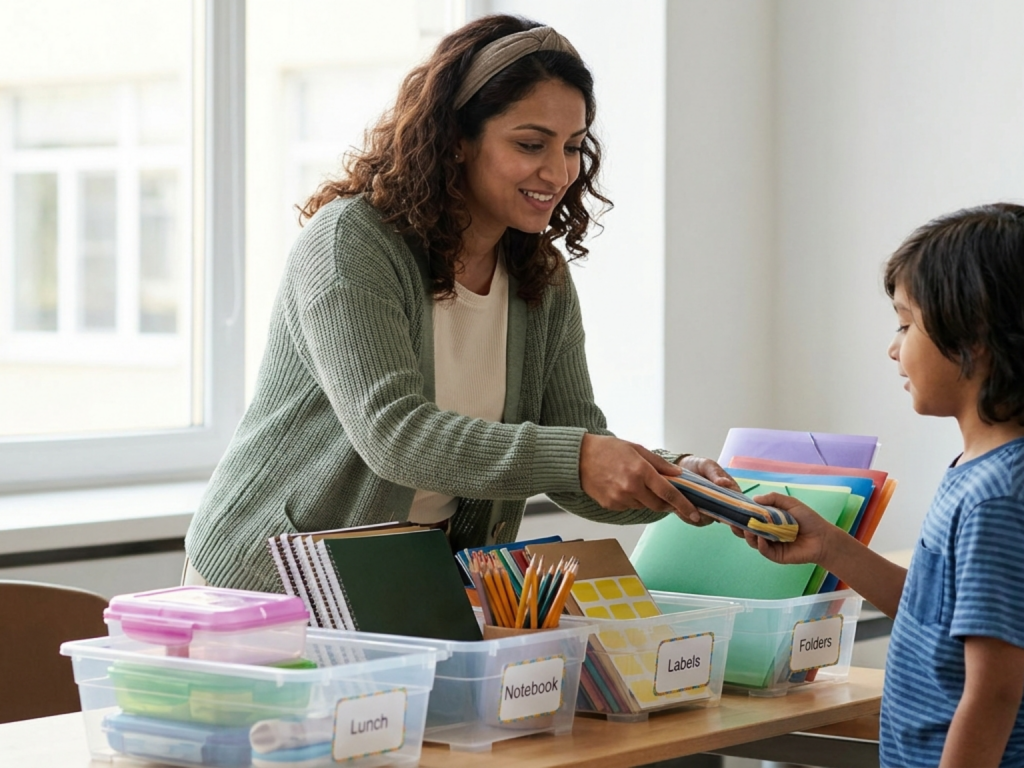
Organizing school supplies works best when it follows daily behavior, not an idealized routine. Children often need a system that is visible, repeatable, and forgiving. At home, create one consistent location for school materials: a shelf, cart, drawer, or labeled bin. Keep frequently used items at the child’s reach and store backup supplies separately so the everyday space does not become overwhelming.
One effective method is to group supplies by function: writing, reading, math, art, technology, lunch, health, and return-to-school paperwork. Another is to group by time of day: morning backpack station, homework station, after-school drop zone, and next-day preparation area. For many school-age children, school-age organization tools such as color-coded folders, visual checklists, pencil pouches, and weekly planners can support executive function without requiring constant adult prompting.
At school, teachers often benefit from organizing requests by curriculum area and learning objective. Instead of asking for general supplies, a list might identify notebooks for science observation, dry-erase boards for math practice, or recycled paper for writing workshops. This makes the need clearer and can help justify funding, donations, or grant requests.
Children should help maintain the system in small steps. A five-minute Sunday reset may be more effective than a long, frustrating cleanup after supplies are lost. Families can use photos or simple labels for younger children and written checklists for older children. If a child repeatedly cannot manage the system, simplify it before assuming noncompliance. Too many folders, tiny compartments, or complicated binder rules can overwhelm working memory and increase avoidance.
Health and safety considerations parents should not ignore
School products come into close contact with children’s skin, airways, mouths, and musculoskeletal system. Most children use supplies safely, but thoughtful selection can reduce preventable problems. For art and craft materials, choose products labeled non-toxic and appropriate for the child’s age. Younger children or children who mouth objects need closer supervision and avoidance of small parts, button batteries, high-powered magnets, and caps that can become choking hazards.
Backpacks deserve special attention. A backpack should fit close to the body, have two padded shoulder straps, and not force the child to lean forward. Excessive load can contribute to discomfort, although persistent back pain, weakness, gait changes, numbness, or pain that wakes a child from sleep should be discussed with a healthcare professional. Rolling bags may help some children but can be difficult on stairs or crowded buses, so school layout matters.
Children with asthma, eczema, allergic rhinitis, food allergy, migraine, or sensory sensitivities may react to fragrances, dust-collecting fabrics, latex, strong odors, or noisy materials. Fragrance-free, washable, and clearly labeled products can help. For children with food allergies, lunch containers should seal reliably, be easy to clean, and avoid confusing shared containers. Allergy-aware preschool packing is especially important when younger children cannot reliably identify unsafe foods or communicate symptoms.
Handwriting fatigue, pain, or avoidance may reflect normal adjustment, but it can also be associated with fine motor difficulty, visual strain, joint hypermobility, or developmental coordination challenges. Families should avoid self-diagnosing. If concerns persist, ask the school about occupational therapy screening or consult the child’s clinician. Ergonomic products can support comfort, but they should not replace professional evaluation when functional impairment is significant.
Choose vendors and brands with transparent standards
Whether a family is buying one backpack or a school is selecting classroom technology, vendor quality matters. A reliable vendor should be transparent about materials, safety standards, warranties, return policies, response times, and total costs. Schools should ask for case studies, education-sector experience, quality control measures, and detailed cost breakdowns before committing to large purchases.
For families, the same principles apply at a smaller scale. Read product descriptions carefully, check whether replacement parts are available, and look for clear cleaning instructions. A very cheap item that breaks quickly can become more expensive than a moderately priced durable product. Conversely, a premium item is not automatically better if it is heavy, hard to clean, or incompatible with classroom rules.
When evaluating educational products such as learning apps, curriculum kits, or workbooks, look beyond marketing promises. Good materials should align with the child’s curriculum, provide meaningful practice, and avoid overstimulation. Evidence-based ratings, peer-reviewed education research, and professional organizations can help schools compare instructional quality. Families can ask teachers which products genuinely support classroom goals before purchasing extras.
For technology, consider privacy, durability, repair options, and accessibility features. Headphones should fit comfortably and allow safe volume practices. Devices and chargers should meet school specifications to avoid compatibility problems. If assistive technology is involved, selection should include the child, family, school team, and relevant professionals so the tool supports participation rather than becoming another burden.
Plan purchases to reduce waste and financial pressure
Buying school products under time pressure often leads to duplicates, poor-quality substitutions, and unnecessary spending. Planning ahead allows families to compare options, use seasonal sales, share supplies, and choose sustainable products. Teachers and schools can also plan purchases around curriculum needs, grants, donation drives, and bulk buying.
A practical purchasing plan has three tiers. First are essentials required from the school list: notebooks, writing tools, folders, and any specified materials. Second are support items that make routines easier: labels, a homework tray, a water bottle, or a visual checklist. Third are optional extras, such as decorative accessories, backup art supplies, or specialty organizers. This structure helps children participate in choices while keeping boundaries clear.
Sustainable choices can be both ethical and practical. Consider recycled paper notebooks, refillable pens, pencils from sustainable wood, durable lunch containers, and washable pencil cases. Reuse last year’s scissors, rulers, binders, and backpacks when they remain safe and functional. Before replacing an item, check whether it can be cleaned, repaired, relabeled, or repurposed.
For families facing financial strain, it is appropriate to ask the school about supply assistance, community drives, or classroom-shared materials. Children should not be made to feel ashamed about using donated or reused supplies. The emotional climate around school preparation matters; calm, respectful planning can protect a child’s confidence as much as any product can.
Involve children without turning supplies into a power struggle
Children are more likely to use and care for school products when they have some ownership. However, unlimited choice can overwhelm them and lead to conflict. Offer structured choices: two backpack options that both fit correctly, three folder colors, or a choice between a pencil box and a soft pouch. This supports autonomy while preserving quality and safety standards.
For younger children, practice using supplies before school starts. Let them open containers, zip the backpack, sharpen pencils safely, place papers in folders, and pack a lunchbox. These small rehearsals build procedural memory and reduce first-week anxiety. For older children, involve them in designing their own organization system, then review it after two weeks to see what is working.
Some children have strong preferences related to texture, sound, smell, or visual design. These preferences are not necessarily misbehavior. A scratchy backpack strap, squeaky marker, strong plastic smell, or cluttered binder may be genuinely dysregulating for a child with sensory sensitivities. When possible, validate the discomfort and problem-solve. If sensory distress interferes with attendance, learning, eating, or sleep, consult the school team or a pediatric healthcare professional.
Finally, keep school products emotionally neutral. Lost pencils, messy folders, and forgotten notebooks are common in childhood. They are opportunities to adjust systems, teach routines, and build resilience. A compassionate approach helps children learn that organization is a skill, not a character test.
When to seek extra guidance
- Persistent pain, numbness, weakness, or gait changes related to carrying school items should be discussed with a healthcare professional.
- Recurrent choking risk, mouthing of supplies, or unsafe use of small parts requires closer supervision and age-appropriate product changes.
- Food allergy, asthma, eczema, or severe sensory reactions may require individualized planning with school staff and clinicians.
- Do not use school product struggles to diagnose ADHD, autism, anxiety, or motor disorders; ask for professional assessment if concerns persist.
- Avoid high-powered magnets, button batteries, and poorly labeled chemical products in children’s school supplies.
Tools & Assistance
- Create a labeled home supply station with separate everyday and backup materials.
- Use a seasonal school-supply audit before buying new items.
- Ask teachers which supplies directly support current curriculum goals.
- Check product safety labels, cleaning instructions, warranties, and return policies.
- Consult a pediatrician, occupational therapist, allergist, or school nurse when health needs affect supply choices.
FAQ
How do I know if a school product is good quality?
Look for durability, age-appropriate design, safe materials, ease of use, clear cleaning instructions, and a purpose that matches the child’s school tasks.
Should I buy everything on the school list immediately?
Buy required essentials first, then wait to see what the teacher emphasizes. This can prevent duplicates and reduce unnecessary spending.
What if my child refuses certain supplies because of texture or smell?
Take the concern seriously and try reasonable alternatives. If sensory distress is intense or affects school participation, discuss it with the school team or a healthcare professional.
Are expensive school supplies safer or better?
Not always. Price does not guarantee safety or usability. A moderately priced, durable, washable, age-appropriate item may be the best choice.
How can I help a disorganized child manage supplies?
Use fewer categories, visible labels, color-coding, and a short weekly reset. If organization problems are persistent and impair learning, ask about school-based supports.
Sources
- Novera Education — How to Select High-Quality Curriculum for Your School District
- Presentation Solutions — How to Choose the Best School Vendor
- Structural Learning — School Supplies: A Teacher's Guide
Disclaimer
This article is for informational purposes only and does not replace medical, developmental, educational, or safety advice. Consult qualified healthcare professionals or school specialists for concerns about a child’s symptoms, allergies, motor skills, behavior, or learning needs.














Please log in to leave a comment.