
Intro
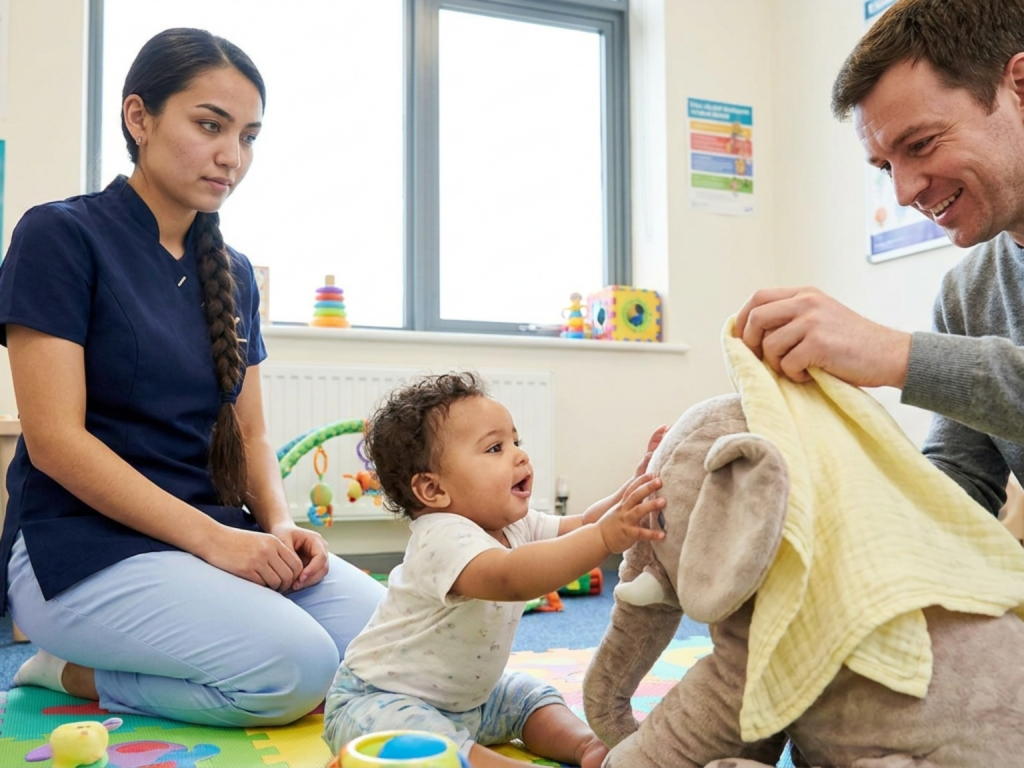
Object permanence is the developing understanding that a person or object continues to exist even when it is temporarily out of sight. For babies, this concept is closely connected with memory, attention, perception, problem-solving, and emotional expectations. A baby who looks for a toy hidden under a cloth is beginning to demonstrate a mental representation: an internal idea that the toy is still present despite the change in visual information.
Object permanence does not appear as a single, all-or-nothing milestone. It develops gradually, varies across situations, and is influenced by motor skills, attention, familiarity, and the way an object is hidden. Contemporary research also suggests that some perceptual foundations may emerge earlier than classic interpretations of Piaget's theory proposed. Understanding this progression can help caregivers respond supportively without turning ordinary developmental variation into a source of anxiety.
Highlights
Object permanence develops gradually rather than appearing on one predictable day.
Babies may show evidence of understanding hidden objects before they can reliably search for them.
Perception, memory, attention, and motor coordination all contribute to early thinking.
A baby's temporary failure to find a hidden object does not by itself indicate a developmental problem.
Responsive play and everyday caregiving provide natural opportunities for cognitive learning.
What Object Permanence Means
Object permanence refers to the understanding that an object or person continues to exist when it cannot currently be seen, heard, or touched. For an infant, this is a major shift from responding primarily to immediate sensory information toward maintaining an internal representation of something that is absent from the current field of perception. The idea applies to toys, caregivers, household objects, and familiar routines.
It is useful to distinguish object permanence from a simple preference for a visible object. A young baby may watch a toy disappear because the movement is interesting, yet may not search for it once it is fully covered. Later, the baby may pull away a cloth, reach behind a barrier, or look toward the place where the toy was hidden. These behaviors suggest increasing coordination among visual memory, attention, expectation, and purposeful action.
Object permanence is also related to, but not identical with, separation-related distress. A baby may remember a caregiver who has left the room while still becoming upset because the caregiver is unavailable. Emotional reactions, memory, and search behavior can develop on partly different timelines. Similarly, a baby can understand that an object exists without yet having the balance, hand control, or planning needed to retrieve it.
From Perception to Mental Representation
Early thinking is built from repeated perceptual experiences. During the first months of life, babies learn regularities about how objects move, disappear behind other objects, reappear, and remain stable in size and shape as they change position. Research in developmental psychology has proposed that perceptual developments during the first six months may provide important foundations for later object permanence. These early abilities do not necessarily mean that a baby can solve every hidden-object task, but they show that cognition begins with increasingly organized perception.
Infants attend to continuity, movement, and physical boundaries. For example, when part of a toy remains visible behind a screen, a baby may treat the visible portion as belonging to one complete object. Babies also become increasingly able to distinguish an object from the background and to anticipate where a moving object will emerge. Such expectations are sometimes studied through looking-time methods, including violations-of-expectation experiments. If an event appears physically impossible, an infant may look longer, suggesting that the event differs from an emerging expectation.
These findings have shaped an ongoing scientific discussion. Some evidence suggests that rudimentary knowledge of object persistence may occur earlier than the age traditionally associated with Piagetian object permanence. Other researchers emphasize that different tasks measure different abilities. A baby may perceive that an object remains present but lack the working memory or motor planning required to search successfully. Therefore, early perceptual evidence should be interpreted as part of a developmental pathway, not as proof of a fully mature concept.
Piagetian Theory and Modern Evidence
Jean Piaget described infant cognition within the sensorimotor period, when babies learn through perception and action. In his account, object permanence develops in an ordered sequence. Earlier behaviors include following a disappearing object with the eyes; later behaviors include recovering a partially hidden object and eventually searching for an object that has been moved from one hiding place to another. Classic research often interpreted an infant’s failure to search as evidence that the infant did not yet understand the object’s continued existence.
Later studies refined the methodology used to examine this question. Researchers have considered the visibility of the object, the delay before searching, the number of hiding locations, the baby’s experience with the task, and the physical demands of reaching. Studies examining the sequence of object-permanence behaviors have provided evidence for an orderly progression in some aspects of performance, while also showing that results depend on the specific procedure.
A developmental-difference perspective is particularly helpful. Infants do not all use the same strategy at the same time, and a single task may place demands on several systems simultaneously. Attention, inhibition, memory, spatial representation, motivation, and motor control can each affect the result. Current interpretations therefore tend to avoid a simple question such as, “Does the baby have object permanence?” A more precise question is, “Which aspect of object persistence can the baby represent and act on under these conditions?” This approach recognizes competence while respecting normal variability.
How Skills Change During Infancy
Developmental ages are approximate, and individual trajectories differ. In the early months, many babies watch a moving object and may continue looking briefly after it disappears. They may enjoy repeated appearances and disappearances, especially when the event is predictable. At this stage, looking behavior can reveal learning even when the baby does not reach or search.
During the middle of the first year, a baby may try to recover an object that is partly visible. Pulling a cloth, moving a barrier, or reaching around an obstruction requires more than memory: it also requires coordination between visual information and hand movement. A baby may succeed one day and not the next depending on fatigue, hunger, distraction, or the complexity of the hiding place.
Later in the first year, many babies begin to search for an object that has been completely covered. They may lift a cloth, look underneath, or repeat the search when the toy is hidden in the same place. A more advanced challenge occurs when an object is visibly moved from one location to another. Babies can sometimes make an inaccurate “A-not-B” search, repeatedly reaching to the first hiding place even after watching the object move. This error reflects the interaction of memory, habit, attention, and inhibitory control rather than a simple absence of understanding.
Across the second year, toddlers generally become more flexible. They can remember hidden objects for longer periods, search in multiple locations, use containers and barriers, and plan several actions. Pretend play also becomes more sophisticated, showing that mental representations are supporting thought beyond immediate perception.
Why Looking and Searching May Differ
One of the most important principles in interpreting infant behavior is that looking and acting are different measures of cognition. A baby may look longer when a hidden object appears to vanish impossibly, yet fail to retrieve the same object when asked to reach for it. Looking requires attention and visual expectation. Searching adds motor control, spatial planning, memory over a delay, and the ability to suppress a previously rewarded response.
Task difficulty matters as well. A familiar toy hidden under a lightweight cloth may be easier than a novel object placed behind an opaque screen. A short delay may be easier than a longer one. A baby who is sitting steadily may search more effectively than the same baby when lying down or reaching from an awkward position. The emotional context also matters: a tired, overstimulated, or unwell infant may show less persistence.
Caregivers can therefore avoid using a single game as a pass-or-fail test. Developmental surveillance by a pediatric clinician considers patterns across time and across domains, including social communication, gross and fine motor skills, hearing, vision, and adaptive behavior. A broad view is more informative than comparing a baby with another child of the same age or expecting every research behavior to appear in daily life.
Supporting Early Thinking Through Play
Everyday play can support object permanence without formal instruction. Begin with simple, enjoyable interactions in which the baby can see what is happening. Peekaboo, briefly hiding a familiar toy under a transparent or lightweight cloth, and moving an object slowly behind a barrier all create opportunities to notice disappearance and reappearance. Pause long enough for the baby to look, vocalize, reach, or attempt a search.
Gradually adjust only one feature at a time. A caregiver might first leave part of the toy visible, then cover it completely, or move from one hiding place to two. Follow the baby’s cues and stop when attention fades. Repetition is useful because babies learn through predictable cycles, but excessive testing can make an activity frustrating rather than engaging.
Safe setup is essential. Use large objects that cannot fit into the baby’s mouth, avoid loose plastic film, cords, small detachable parts, and heavy containers, and provide close supervision. The activity should occur on a stable surface, with age-appropriate movement opportunities and no expectation that the baby must perform on demand.
Responsive caregiving is itself a cognitive resource. When an adult notices what the baby is watching, responds to a gesture, names an object, and waits for a turn, the baby receives repeated information about continuity, agency, and shared attention. These interactions complement physical exploration and help connect perception with memory and early problem-solving.
When to Seek Developmental Guidance
Variation in object-permanence play is common. Some babies are highly interested in searching, while others prefer social interaction, movement, or sensory exploration. A baby may understand that a caregiver remains present but show little interest in retrieving a toy. Prematurity, differences in opportunity for floor play, vision or hearing differences, temperament, and temporary changes in health can all affect observed behavior.
Discuss concerns with a pediatrician, family physician, child health nurse, or another qualified healthcare professional when a baby appears to lose previously acquired skills, shows little response to people or objects, has persistent difficulty tracking movement, uses one side of the body much less than the other, or has broader concerns involving communication, movement, feeding, hearing, vision, or social engagement. These signs are not a diagnosis, but they warrant professional assessment.
Clinicians may review the baby’s medical and developmental history, perform an age-appropriate examination, check sensory function, and use standardized developmental screening tools. For a baby born preterm, corrected age may be relevant when discussing developmental expectations. Early assessment is intended to clarify needs and connect families with appropriate support, not to label normal variation. Caregivers can help by recording specific observations, including what was hidden, how long the baby had to wait, and whether the baby was alert and comfortable.
When to Contact a Clinician
- Seek advice if your baby loses a skill that was previously present.
- Discuss persistent difficulty tracking objects or responding to faces and sounds.
- Ask about concerns involving movement asymmetry, reaching, or coordination.
- Mention broader concerns about communication, social engagement, feeding, hearing, or vision.
- Use professional developmental screening rather than home games to judge overall development.
Tools & Assistance
- Keep a brief observation log of new skills, context, and changes over time.
- Use age-appropriate developmental screening at routine pediatric visits.
- Ask a pediatrician, family physician, or child health nurse about specific concerns.
- Choose large, safe toys and supervise all hidden-object play closely.
- Seek early-intervention services when recommended by a healthcare professional.
FAQ
At what age does object permanence develop?
It develops gradually across infancy and the toddler period rather than at one exact age. Looking expectations may appear before reliable searching, and performance varies with the task and the baby's motor abilities.
Does a baby have object permanence if they do not search for a hidden toy?
Not necessarily. Searching also requires attention, memory, motivation, spatial planning, and motor coordination. A single unsuccessful attempt cannot determine what a baby understands.
Is peekaboo good for object permanence?
Yes, peekaboo provides a simple, social example of disappearance and return. Keep it gentle, follow the baby's cues, and treat it as play rather than a test.
What is the A-not-B error?
It is a common pattern in which a baby repeatedly searches in an earlier hiding place even after seeing an object moved elsewhere. The behavior reflects interacting memory, habit, attention, and inhibitory-control demands.
Should I worry if my baby seems uninterested in hidden-object games?
Usually not by itself. Babies have different interests and temperaments. Discuss concerns with a healthcare professional if there are additional issues, skill loss, or persistent concerns about vision, movement, communication, or social engagement.
Sources
- PubMed Central — New findings on object permanence: A developmental difference perspective
- Child Development Perspectives — Perception of Object Persistence: The Origins of Object Permanence in Infancy
- PubMed / Child Development — Infants' development of object permanence: a refined methodology and new evidence of Piaget's hypothesized ordinality
Disclaimer
This article is for general educational purposes and does not diagnose, treat, or replace advice from a qualified healthcare professional. Contact your baby's healthcare professional for individualized developmental guidance or urgent concerns.














Please log in to leave a comment.