
Intro
Babies learn to move through a continuous interaction between their developing nervous system, growing bodies, sensory experiences, and the opportunities their environment provides. Movement is not simply a sequence of skills that unfolds on a fixed timetable. Each infant experiments, receives feedback, adapts, and gradually becomes better able to control posture, balance, strength, and coordination.
Rolling, reaching, sitting, crawling, pulling to stand, and walking are visible outcomes of this learning process. They may appear in different orders or at different ages. Understanding the principles behind movement can help caregivers offer supportive experiences without turning normal variation into a source of pressure.
Highlights
Early movement is shaped by the interaction of maturation, practice, sensory feedback, and the physical environment.
Babies learn through active exploration, including repeated attempts that may look awkward or unsuccessful.
Floor-based play and supervised movement opportunities support emerging strength, coordination, and postural control.
Milestones are useful observations, but individual variation is common and should be interpreted in context.
Movement begins with the nervous system and the senses
Newborn movement is strongly influenced by the nervous system’s early organization. Primitive reflexes, such as the rooting, grasp, and stepping reflexes, are automatic responses that support early survival and provide the groundwork for later voluntary control. A newborn does not yet plan a reach or deliberately adjust posture in the way an older infant can. Instead, movement emerges from interactions among muscle tone, reflex activity, gravity, sensory input, and the infant’s current state of alertness.
Vision, touch, the vestibular system, and proprioception all contribute to motor learning. The vestibular system detects head movement and orientation, while proprioception provides information about limb position and muscle tension. When a baby turns the head toward a caregiver, feels the supporting surface beneath the chest, or notices a toy moving within reach, these sensory signals help the brain build an internal model of the body and its possibilities.
Over time, the brain becomes better at combining these inputs. A movement that initially produces an unpredictable result may become increasingly purposeful. Reaching is a useful example: the infant first waves the arms, then notices that certain arm and hand movements bring an object closer, and eventually adjusts direction, speed, and grasp according to the object’s location.
Babies learn by acting and receiving feedback
Motor learning is an active process. Babies do not merely wait for muscles and neural pathways to mature; they also explore what happens when they move. A kick may make a mobile sway. A shift of weight may cause a toy to come within reach. Pressing the feet against a firm surface may change the position of the trunk. These predictable sensory consequences can reinforce repeated attempts and help the infant discover more effective strategies.
Repetition matters, but repetition does not mean drilling. Infants often practice naturally during short periods of alert, comfortable play. They may reach for the same object repeatedly, turn toward a familiar voice, or alternate between effort and rest. Each attempt provides information about force, timing, balance, and the relationship between action and outcome.
Errors are part of the learning process. A baby may overshoot a toy, lose balance while sitting, or rotate the trunk in an inefficient way before finding a more stable solution. The developing brain uses these discrepancies to update motor commands. This is one reason a calm, responsive environment is helpful: the infant can attempt a movement without being hurried or physically placed into a position they cannot yet control.
Posture creates the foundation for mobility
Before a baby can move efficiently through space, the infant must develop increasing control of the head, trunk, pelvis, and limbs. Postural control allows the body to remain stable while another part moves. For example, reaching while lying on the stomach requires the infant to support the chest, stabilize the shoulder, and shift weight without collapsing. Sitting requires coordinated control of the trunk and pelvis, as well as protective responses when balance is lost.
Development often progresses from greater control of the head and upper body toward more complex whole-body coordination. However, this is not a rigid one-way staircase. A baby may use several strategies depending on the surface, clothing, fatigue, motivation, and the position of an interesting object. Rolling may begin accidentally, then become intentional. Crawling may involve a commando-style belly movement, hands-and-knees crawling, bottom shuffling, pivoting, or another effective pattern.
Variability in strategy does not automatically indicate a problem. Infants have different body proportions, temperaments, muscle strength, experiences, and opportunities to move. The clinically meaningful question is usually not whether a baby uses one particular style, but whether the baby is making progress, using both sides of the body in a broadly coordinated way, and gaining functional abilities over time.
Changing bodies and environments change the task
Motor development is adaptive because the body and surroundings are constantly changing. An infant’s center of mass shifts as the head, trunk, and limbs grow. Muscle strength and joint stability also change. A movement that worked last week may need adjustment after a growth spurt, when the infant is tired, or when the surface changes from a firm floor to a soft mattress.
The environment supplies both constraints and opportunities. A firm, open floor makes it easier to push, pivot, roll, and reach than a restrictive position. A nearby caregiver’s face or an appealing toy can motivate an infant to turn or shift weight. As mobility develops, the baby must also learn how objects, surfaces, distances, and obstacles affect movement. Walking, for instance, requires more than leg strength. It involves anticipatory postural adjustments, balance reactions, visual guidance, coordination between the limbs, and the ability to adapt to uneven or changing surfaces.
This interaction explains why movement may look different from one setting to another. A baby who sits steadily on the floor may be less stable when placed on a changing table or soft bed. A newly walking toddler may manage a familiar room but hesitate on grass. Such differences reflect the complexity of motor control rather than a simple measure of ability.
How caregivers can support movement safely
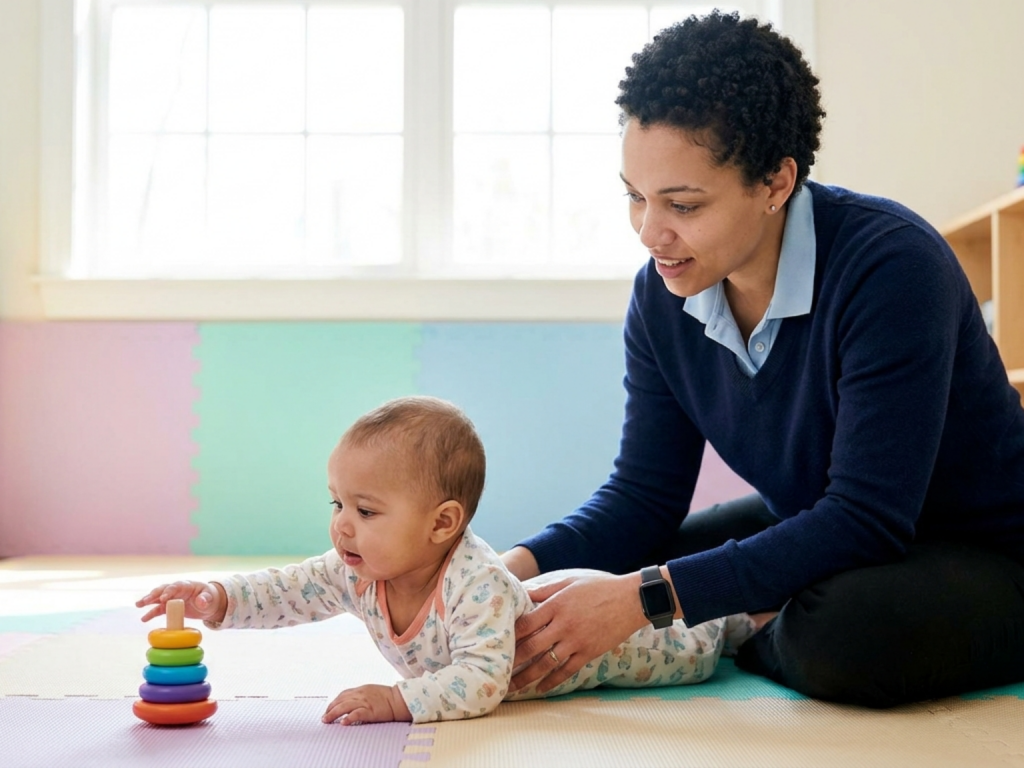
Caregivers can support motor learning by offering regular, supervised opportunities for free movement while responding to the infant’s cues. Floor play allows babies to move their limbs, shift weight, and explore positions without being held in one posture. For infants who tolerate it, supervised tummy time while awake helps develop muscles involved in head, neck, shoulder, and trunk control. It can begin in brief intervals and build gradually according to the baby’s comfort.
Helpful activities include placing an interesting object within view but not always directly in the hands, talking from different directions to encourage head turning, and allowing kicking against a safe surface. As skills emerge, caregivers can provide clear floor space and stable objects that are appropriate for supervised exploration. Interaction is valuable: a familiar voice, face, or gentle response can sustain attention and motivation.
Safety remains essential. Babies should sleep on their backs on a firm, flat surface, and tummy time should occur only when they are awake and watched. Caregivers should avoid elevated surfaces, walkers, unsafe furniture, and equipment that restricts movement or creates a fall risk. An adult’s hands-on support may help an infant explore a position, but the baby should not be forced into sitting, standing, or walking before they can participate actively.
Movement opportunities should fit the infant’s state. A hungry, ill, overstimulated, or very tired baby may not be ready to practice. Pausing, changing position, or offering comfort is part of responsive care, not a failure of training. The goal is a rich but low-pressure environment in which movement is safe, interesting, and self-directed.
Milestones describe patterns, not a competition
Milestones provide broad reference points for observing how skills usually emerge, but they are not precise deadlines. One infant may roll early and walk later; another may spend little time crawling and move from sitting to pulling up. Cultural practices, opportunities for floor play, prematurity, medical history, and individual temperament can all influence the pattern.
For babies born prematurely, clinicians may interpret progress using corrected age for preterm babies, particularly during the early period when differences in maturation are expected. Caregivers can ask the child’s healthcare professional which age reference is appropriate and how the baby’s overall trajectory should be assessed.
It is more useful to observe trends than to compare babies. Consider whether the infant is becoming more purposeful, stable, symmetrical, and able to participate in everyday activities. Also note whether a skill that had been acquired is lost, whether one side is consistently used much more than the other, or whether movement appears unusually stiff, floppy, painful, or difficult. These observations do not establish a diagnosis, but they are valuable information for a pediatric clinician or other qualified healthcare professional.
When to seek professional guidance
Parents and caregivers should raise concerns whenever something about movement feels persistently unusual or when progress seems to stop. A healthcare professional can review the infant’s medical and birth history, observe spontaneous movement, assess tone and reflexes, and decide whether developmental screening, physiotherapy, or another evaluation is appropriate.
Prompt advice is especially important after a loss of previously acquired motor skills, persistent marked asymmetry, repeated difficulty using one limb, or movement associated with apparent pain. Concerns about feeding, vision, hearing, alertness, muscle tone, or general growth may also affect how movement is understood. The appropriate response is assessment rather than trying to correct the pattern at home.
Professional guidance is also useful when caregivers are unsure how to provide tummy time, adapt play for a baby with a physical limitation, or support an infant who was born preterm. Early discussion can offer reassurance when variation is typical and can connect families with support when additional help is needed. Seeking advice does not mean that a problem is certain; it means that the baby’s development is being considered carefully and in context.
When to contact a healthcare professional
- A baby loses a movement skill that had previously been acquired.
- One side of the body is persistently used much more than the other.
- Movement appears unusually stiff, floppy, painful, or difficult.
- The infant rarely moves a limb or repeatedly struggles to support the head or trunk.
- You have ongoing concerns about progress, coordination, or the baby's ability to participate in play.
Tools & Assistance
- Keep a brief record of new movement skills and the situations in which they appear.
- Discuss developmental observations during routine pediatric appointments.
- Ask a health visitor, pediatrician, family physician, or pediatric physiotherapist about safe positioning and play.
- Use a clear, supervised floor area for daily movement opportunities.
- Review current infant safety guidance for sleep, falls, furniture, and mobility equipment.
FAQ
Does every baby need to crawl before walking?
No. Crawling is common and offers valuable practice with weight shifting and coordination, but babies use varied mobility strategies. Some move in other ways or begin walking without a prolonged hands-and-knees crawling phase.
How much tummy time should a baby have?
Tummy time should be supervised, occur only while the baby is awake, and be introduced in short, comfortable periods that gradually increase. Ask a healthcare professional for individualized advice, especially if the baby was premature or has a medical condition.
Should caregivers teach a baby to walk?
Caregivers can encourage safe opportunities to pull up, cruise, balance, and explore, but should not force standing or walking. Babies generally learn through active participation, repetition, and feedback at their own pace.
Is an unusual crawling style always a concern?
No. Different crawling and mobility patterns can be normal. Persistent asymmetry, regression, pain, marked stiffness or floppiness, or a lack of progress should be discussed with a qualified healthcare professional.
Why does my baby move differently when tired?
Fatigue, hunger, illness, and overstimulation can temporarily affect attention, muscle control, and coordination. Look at the overall pattern over time and seek advice if a concerning movement pattern persists when the baby is comfortable and alert.
Sources
- PubMed Central — Learning to Move in a Changing Body in a Changing World
- PubMed — Learning to move, moving to learn: A quarter century of insights into infant motor development
- NHS — How to keep your baby or toddler active
Disclaimer
This article is for general educational purposes and does not diagnose, treat, or replace advice from a qualified healthcare professional. Contact your baby's clinician with individual concerns or urgent symptoms.
















Please log in to leave a comment.