
Intro
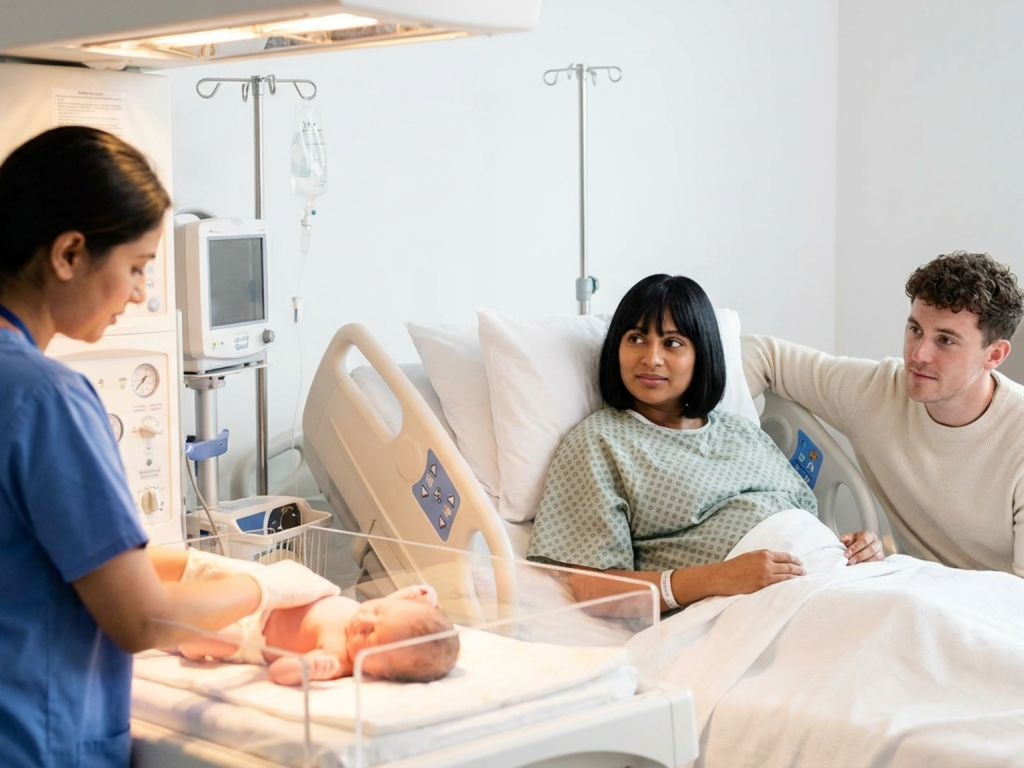
Skin-to-skin contact is usually encouraged as soon as possible after birth because it supports newborn temperature regulation, cardiorespiratory transition, early feeding, and parent–baby connection. However, there are circumstances in which immediate contact is not the safest priority.
A delay can be frightening or disappointing, especially when skin-to-skin was central to your birth preferences. In most cases, separation reflects a temporary need to stabilize the baby, care for the birthing parent, or manage the clinical environment. Skin-to-skin can usually begin or resume when both are medically stable.
Highlights
Immediate skin-to-skin is recommended for stable parents and newborns, but advanced neonatal resuscitation or maternal emergency care takes priority.
Cesarean delivery does not automatically rule out early contact; operating-room skin-to-skin may be possible when the parent is alert and adequate staff are available.
If contact is delayed, a stable partner may sometimes provide supervised skin-to-skin until the birthing parent is ready.
A delayed first cuddle does not mean that bonding, breastfeeding, or milk production has been permanently harmed.
Early contact is the goal, but safety comes first
For a vigorous, medically stable newborn and an alert, stable parent, skin-to-skin contact should generally begin as soon as possible after birth. The baby is dried, placed upright and prone on the parent’s bare chest, and covered with a warm blanket while clinicians observe breathing, color, tone, temperature, and positioning. Routine care such as identification, assessment, and often vitamin administration can usually be organized around uninterrupted contact.
The Canadian Paediatric Society advises that skin-to-skin should remain uninterrupted unless advanced neonatal resuscitation is required. This distinction matters: routine observation or a brief initial assessment does not necessarily require separation, whereas respiratory or cardiovascular support may require equipment and access that cannot be provided safely on a parent’s chest.
Recommendations describe an ideal approach rather than a test of parental commitment. When immediate contact is unsafe, the clinical priority is stabilization. Questions about the Benefits and duration of skin-to-skin can be revisited once the urgent situation has passed; there is still meaningful value in beginning later.
When a newborn needs urgent assessment or resuscitation
A newborn who is not breathing effectively, has poor tone, persistent cyanosis, significant bradycardia, or another sign of difficult transition may need to move to a radiant warmer. The neonatal team may provide airway positioning, positive-pressure ventilation, supplemental oxygen guided by pulse oximetry, chest compressions, vascular access, medication, or other advanced interventions. These measures require rapid access to the baby and take precedence over skin-to-skin.
Separation may also be necessary when clinicians suspect respiratory distress, sepsis, major congenital anomalies, birth trauma, severe hypoglycemia, clinically significant hypothermia, or seizures. Depending on the condition and local resources, the baby may need laboratory testing, imaging, continuous monitoring, respiratory support, or transfer to a neonatal unit. Not every concern leads to prolonged separation, and some monitoring can occur during supervised contact after initial stabilization.
Parents can ask for concise updates about what support is being given, whether they may see or touch the baby, and what clinical milestones must be reached before holding becomes possible. A partner or support person may be able to accompany the baby if hospital policy and the clinical situation allow. When contact begins, staff should continue monitoring safe newborn positioning during skin-to-skin, particularly after respiratory instability.
Maternal complications can also postpone contact
Sometimes the newborn is stable but the birthing parent needs urgent treatment. A postpartum hemorrhage may require uterine massage, medication, intravenous fluids, blood products, examination for retained placental tissue or genital tract injury, and occasionally an operative procedure. Severe hypertension, eclampsia, cardiopulmonary instability, loss of consciousness, or an unexpected surgical complication can likewise make holding a newborn unsafe.
Even without a major emergency, temporary separation may be appropriate if the parent is heavily sedated, vomiting repeatedly, experiencing uncontrolled shaking, unable to maintain a safe position, or too unwell to respond to the baby. Staff should reassess rather than assume that separation must continue for a fixed period. Many postpartum procedures can be completed while a stable, alert parent remains in contact, provided another adult is directly supporting the baby and the treatment area remains accessible.
If urgent care is underway, families can ask whether the baby may remain nearby, whether a partner can provide supervised skin-to-skin, and when the parent’s alertness and physiological stability will be reviewed. Treatment should never be delayed to preserve contact, but avoidable separation can often be reduced through coordinated maternity and neonatal care.
Cesarean birth and anesthesia-related delays
Cesarean delivery is a common setting for delayed contact because the operating room has sterility requirements, monitoring equipment, surgical drapes, intravenous lines, and limited space. Nevertheless, operating-room skin-to-skin after cesarean may be feasible when the newborn is stable, the parent is awake and responsive, and a designated staff member can support the baby continuously.
With neuraxial anesthesia, such as spinal or epidural anesthesia, the parent may remain alert but have restricted arm movement, nausea, hypotension, shaking, or discomfort. These factors may require assistance or a short delay. General anesthesia usually means contact waits until the parent is conscious, responsive, physiologically stable, and able to participate safely. Research on cesarean birth commonly describes early contact beginning once the mother is awake and responsive.
Families interested in family-centred cesarean birth can discuss preferences before delivery, recognizing that staffing and clinical circumstances may change. If maternal contact is not yet possible, partner skin-to-skin after cesarean may offer warmth and closeness for a stable newborn. The baby should be upright with the face visible, neck neutral, nose and mouth unobstructed, and should never be left on a sleeping or sedated adult.
Prematurity and neonatal intensive care
Babies born preterm may need respiratory support, thermal stabilization, vascular access, glucose management, or close observation soon after birth. Very preterm or critically unwell infants are commonly transferred to a neonatal intensive care unit before skin-to-skin can begin. NICU admission after early birth does not mean contact will be impossible; it means timing and handling must be matched to the baby’s physiological stability.
In neonatal care, skin-to-skin is often called kangaroo care. Once the team considers transfer from the incubator or warmer safe, even a baby with monitoring leads, a feeding tube, or certain forms of respiratory support may be eligible for supported holding. This depends on gestational age, airway security, oxygen needs, blood pressure, temperature, and the unit’s expertise. Parents should not reposition equipment themselves.
Ask the neonatal team what stability criteria they use, how long a first session might last, and how staff will transfer the baby. Before holding is possible, parents may be invited to speak softly, provide comforting touch, participate in care, or offer expressed colostrum when clinically appropriate.
Supporting feeding when direct contact must wait
Early skin-to-skin can support feeding cues and breastfeeding initiation, but a delay does not determine the eventual feeding outcome. Birth complications, prematurity, anesthesia, maternal illness, and newborn illness can all affect early feeding independently of skin-to-skin. Families deserve individualized lactation and neonatal support rather than blame.
If breastfeeding or human-milk feeding is planned and the baby cannot feed at the breast, ask the clinical team when breast stimulation is appropriate. Hand expression after cesarean or another complicated birth may be offered when the parent is medically able, followed by pumping if separation continues. The timing and frequency should be individualized with a midwife, nurse, lactation professional, or physician, especially when the parent is critically unwell or receiving medications that require review.
Expressed colostrum may sometimes be collected, labeled, stored, and given according to hospital policy and the baby’s clinical condition. If expression cannot begin immediately, this is not a parental failure. Restoring contact, supporting recovery, and establishing feeding are gradual processes. Formula or donor human milk may be medically recommended in some circumstances; the neonatal team can explain the indication, alternatives, and plan for reassessment.
Reuniting and processing an unexpected separation
Once parent and baby are stable, ask whether skin-to-skin can begin immediately in the recovery room, postnatal ward, or neonatal unit. Staff can help move lines, protect an incision, position the baby, and provide continuous observation. The adult holding the baby should be awake, able to respond, and supported in a semi-reclined position. The baby’s head should remain turned to one side, with the face visible and airway unobstructed.
It is reasonable to request an explanation of why contact was delayed, which interventions were necessary, and whether any separation could have been shortened. A birth debrief with the obstetric, midwifery, anesthesia, or neonatal team may help families understand a fast-moving emergency. Medical necessity and emotional impact can coexist: a separation may have been clinically appropriate and still feel painful.
Bonding is not confined to a single moment after birth. Repeated skin-to-skin contact, responsive feeding, holding, talking, and comforting all contribute to familiarity and connection over time. If grief, anxiety, intrusive memories, guilt, or distress persist after the birth, speak with a healthcare professional. Perinatal mental health support can be an important part of recovery.
Seek immediate clinical help when
- A baby has difficulty breathing, appears blue or very pale, is unusually limp, or is hard to wake.
- The baby’s face becomes covered, the neck is sharply flexed, or the nose or mouth is obstructed during holding.
- The adult holding the baby becomes drowsy, faint, confused, or unable to maintain a secure position.
- The birthing parent has heavy bleeding, chest pain, severe breathlessness, collapse, or a seizure.
- Monitoring alarms sound or neonatal lines, tubes, or respiratory equipment become displaced.
Tools & Assistance
- Ask the maternity or neonatal team for the specific reason contact is delayed and the criteria for starting it safely.
- Include skin-to-skin preferences and a partner backup plan in birth discussions before delivery.
- Request support from a neonatal nurse, midwife, or lactation professional when reunification begins.
- Arrange a post-birth debrief if events were unexpected, frightening, or difficult to understand.
- Contact a perinatal mental health service if separation-related distress persists.
FAQ
Will delayed skin-to-skin prevent bonding?
No. Bonding develops through repeated responsive interactions over time. A delayed first contact can be upsetting, but it does not eliminate the opportunity for a strong parent–baby relationship.
Can a partner provide skin-to-skin instead?
Often yes, if the newborn is stable, the partner is awake and well, and staff can ensure safe positioning and observation. Availability depends on the clinical setting and hospital policy.
Does every cesarean birth require delayed contact?
No. Early contact may be possible during or soon after cesarean delivery when the parent and baby are stable and a staff member can support them safely.
Can skin-to-skin happen in the NICU?
Frequently, yes. Timing depends on the baby’s gestational age, temperature, cardiorespiratory stability, equipment, and the neonatal team’s assessment.
Should routine weighing delay skin-to-skin?
For a stable newborn, many routine measurements and procedures can usually wait or be organized around early contact. Ask the local team which care is medically time-sensitive.
Sources
- Canadian Paediatric Society — Skin-to-skin care (SSC) for term and preterm infants
- World Health Organization — Early skin-to-skin contact for mothers and their healthy newborn infants
- PubMed — Immediate or early skin-to-skin contact after a Caesarean section
Disclaimer
This article provides general medical information and is not a substitute for individualized advice. Consult your maternity, neonatal, or primary healthcare team about your specific circumstances.

















Please log in to leave a comment.