
Intro
When mobility is limited in pregnancy, labor, or the immediate birth setting, the goal is not to force a single ideal posture. The better question is which position gives the best balance of comfort, alignment, access for care, and maternal-fetal safety at that moment. In clinical practice, that usually means adapting classic positions such as supine, lateral, Sims, Fowler's, or prone to the person's range of motion, pain level, monitoring needs, and stamina.
For medically literate readers, the key idea is simple: positioning is a therapy, not a ritual. Small changes in hip angle, trunk support, and bed height can alter pressure distribution, breathing mechanics, and the ability to rest or bear down. The safest plan is individualized and should be reviewed with obstetric clinicians, nurses, and, when helpful, rehabilitation staff.
Highlights
The best position is the one the patient can tolerate while still meeting clinical needs for labor, monitoring, and delivery.
Side-lying and supported back-lying setups often offer the most practical mix of access, rest, and pressure relief.
Fowler's position can help when upright support is possible and breathing or upper-body control matters.
Sims and lateral positions are useful for offloading pressure, preserving alignment, and reducing strain on the sacrum.
Frequent reassessment matters because pain, fatigue, anesthesia, and fetal monitoring can change the safest option.
Why positioning matters when mobility is limited
In the birth setting, limited mobility can come from pain, neurologic or musculoskeletal impairment, fatigue, injury, obesity, prior surgery, medical monitoring, or recovery from anesthesia. Whatever the cause, the practical problem is the same: if a person cannot move freely, they are at higher risk of pressure injury, joint strain, airway discomfort, and exhaustion. They may also have fewer options for coping with contractions or for changing positions during the second stage of labor.
This is why the best position is rarely a fixed prescription. It is a clinical compromise between comfort and function. A posture that is perfect for rest may be poor for breathing. A posture that gives easier access for the clinician may increase sacral pressure. The most useful approach is to start with the person’s current tolerance, then adjust gradually. In many cases, the right choice is a supported version of a familiar position rather than a dramatic change.
That is also why nurses and clinicians often think in terms of pressure redistribution, neutral alignment, and task-specific access. If the person needs fetal monitoring, an exam, assisted pushing, or a transfer to the operating room, the position may need to change. The goal is not independence at all costs. The goal is safe, deliberate support.
The positions most often used
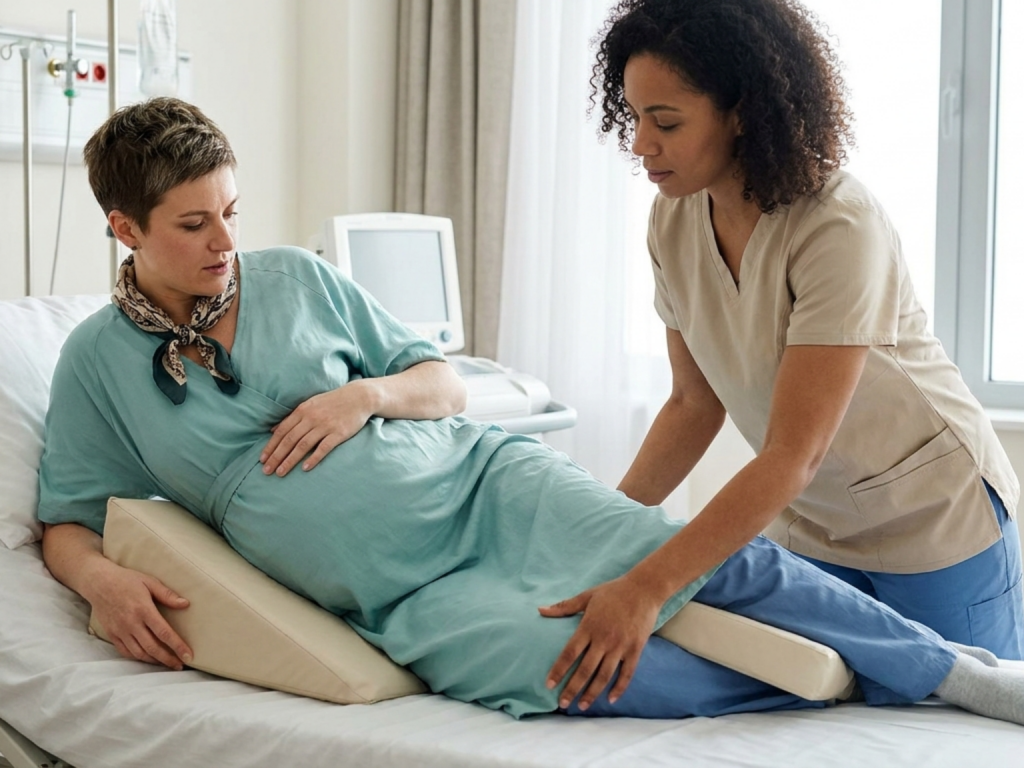
Lateral, or side-lying, is often the most versatile choice for limited mobility. It reduces direct pressure on the sacrum and can be maintained with pillows between the knees, under the abdomen, or behind the back. In labor, the side-lying pushing position can also conserve energy during the second stage of labor positioning, especially when standing, squatting, or kneeling is not realistic.
Supine means lying flat on the back. It is not always the most comfortable posture in labor, but it may be necessary for exams, certain procedures, or urgent access. When used, it is usually better to support the trunk and legs rather than leave the person fully flat and tense.
Fowler’s position places the upper body at a semi-upright angle. For some people, this improves respiratory mechanics and makes it easier to rest, communicate, or bear down with less trunk strain. It can be especially useful when a full upright posture is possible only in a modified form.
Sims position is a semi-prone side-lying posture that can relieve pressure on the back and sacrum. It is often comfortable for rest periods and can be easier to maintain than a full lateral position in someone with limited trunk control. Prone positioning is much less common in active birth care, but in select non-pushing situations it may provide a brief change in pressure distribution if the patient’s condition allows it.
How to choose the safest setup for labor or birth
The safest position depends on the reason mobility is limited, the stage of labor, and the kind of support available. A patient with good upper-body strength may tolerate a modified Fowler’s posture. Someone with hip pain or unilateral weakness may do better in lateral support. A person who tires quickly may need a position that reduces active muscular work rather than one that looks more “optimal” on paper.
For many patients, the decision is less about a single posture than about how to adapt it. A pillow under the upper leg can reduce pelvic tension in the side-lying position. A wedge behind the back can prevent rolling and add stability. Bed height, rail position, and leg support can make a procedure easier without forcing the patient to recruit unstable muscles. If the person is using the side-lying pushing position, staff may need to support the upper leg and protect the shoulders so effort is directed through the pelvis rather than the spine.
Clinicians also have to think about access. Some positions are chosen because they allow the nurse, midwife, or physician to assess progress, apply monitoring, or respond quickly if the situation changes. The best position is therefore both biomechanically reasonable and operationally workable. That balance matters more than any generic recommendation.
Comfort, pressure relief, and alignment
Limited mobility makes pressure management a central part of care. Sustained load on one area of skin or bone increases discomfort and raises the risk of breakdown. That is why lateral and Sims positions are so useful: they redistribute weight away from the sacrum and buttocks, and they can also reduce the sense of being pinned in place.
Alignment matters for the same reason. If the head, trunk, pelvis, and legs are not supported in a roughly neutral line, the person will compensate with muscle tension. In labor, that tension can be exhausting. In recovery, it can worsen pain and stiffness. Good support means making the bed and pillow arrangement do some of the work that the body cannot do comfortably on its own.
Breathing is another practical issue. A semi-recumbent setup can help some patients expand the chest more easily than a fully flat posture. Others breathe better on their side because abdominal pressure is lower. There is no universal rule. The useful question is whether the position lets the person relax the neck, jaw, shoulders, and lower back. If it does not, it probably needs adjustment.
Special situations in labor and the immediate postpartum period
In the second stage of labor, the best position is usually the one that lets the patient participate without excess strain. For someone with limited mobility, that may mean the body is not fully upright, but it should still be well supported. The side-lying pushing position is often practical because it preserves rest between contractions and avoids the demand of supporting body weight against gravity.
Supported back-lying in labor can also be appropriate when the care team needs access, when the patient cannot sustain a side position, or when fetal or maternal monitoring is easier from the back. The important point is to avoid leaving the person flat and poorly supported if a slight tilt, wedge, or leg support would improve comfort and uterine blood flow.
After birth, the same principles still apply. Feeding, perineal comfort, incision care, and transfers can be easier in lateral or semi-recumbent positions. A patient who was using one posture for pushing may need a different one for skin-to-skin contact, nursing, or rest. Repositioning should remain deliberate, because fatigue often peaks after delivery and mobility may worsen before it improves.
Working with the care team and when to change course
The most useful positioning plans are made collaboratively. Obstetric clinicians define what is medically necessary. Nurses help translate that into bed setup, turning assistance, and monitoring logistics. Physical therapy or rehabilitation input can be valuable when the patient has chronic weakness, contractures, joint instability, or a mobility aid such as a wheelchair or walker. The aim is not a generic labor posture; it is a person-specific plan that can be repeated safely.
Position changes should happen whenever the current setup stops working. Warning signs include increasing pain, numbness, dizziness, shortness of breath, skin pressure, or inability to relax between contractions. If a position interferes with monitoring, worsens fetal tracing interpretation, or blocks urgent access, it should be revised promptly. In some situations, the right answer is to stop improvising and switch to the team-recommended posture.
In practice, the best positions with limited mobility are the ones that can be maintained, adjusted, and abandoned safely. That may sound modest, but it is the standard that protects comfort and clinical stability at the same time.
When to seek urgent help
- Do not force a posture that causes severe pain, numbness, faintness, or breathing difficulty.
- Get immediate obstetric review for heavy bleeding, severe abdominal pain, or sudden clinical deterioration.
- Follow team instructions if fetal monitoring, anesthesia, surgery, or bleeding requires a specific position.
- Ask for assistance before transferring, turning, or lowering the bed if balance or strength is limited.
Tools & Assistance
- Ask your obstetrician or midwife for an individualized positioning plan before labor if mobility is already limited.
- Use labor and delivery nursing support for assisted turns, leg support, wedges, and bed adjustments.
- Request physical therapy or rehabilitation input if you have chronic weakness, joint instability, or a mobility aid.
- Keep pillows, wedges, and a call bell within reach so position changes can happen early rather than after pain escalates.
FAQ
Is there one best position for every person with limited mobility?
No. The best position depends on the reason mobility is limited, the stage of labor, and what the care team needs to monitor or access.
Is side-lying usually a good option?
Often yes. Side-lying can improve pressure relief, conserve energy, and work well for supported pushing when full upright movement is not realistic.
When is Fowler's position useful?
It can help when a semi-upright posture improves breathing, comfort, communication, or access while still giving the patient support.
Is prone positioning used during birth?
It is uncommon in active labor and usually reserved for specific clinical reasons outside the main pushing phase.
Should positions be changed often?
Usually yes, as long as the changes are safe and tolerated. Reassessment matters because pain, fatigue, and monitoring needs can change quickly.
Sources
- NCBI Bookshelf — Chapter 13 Mobility - Nursing Fundamentals
- NCBI Bookshelf — Chapter 8: Utilize Principles of Mobility to Assist Clients
- McGraw Hill Medical — Positioning Your Patient for Mobility
Disclaimer
This article is for general information only and does not replace assessment or advice from an obstetric clinician. Seek urgent medical care for heavy bleeding, severe pain, breathing difficulty, fainting, or decreased fetal movement.
















Please log in to leave a comment.