
Intro
Back labor refers to intense discomfort felt predominantly in the lower back, sacrum, or pelvic area during contractions. It can be exhausting and emotionally overwhelming, particularly when the pain continues between contractions or makes it difficult to find a comfortable posture. Your experience is valid, and needing substantial support or analgesia is not a sign that you are coping poorly.
There is no single best position for back labor. Comfort often improves through a combination of movement, forward-leaning postures, touch, warmth, water, breathing, and individualized clinical care. Discuss mobility, monitoring, analgesia, and safety limitations with your midwife, obstetrician, nurse, or birth team throughout labor.
Highlights
Changing position regularly may reduce strain and help you identify what feels most tolerable at each stage of labor.
Forward-leaning and hands-and-knees postures can shift pressure away from the lower back for some laboring people.
Firm sacral counterpressure, warmth, water, rhythmic movement, and calm breathing are practical non-pharmacologic comfort measures.
If pain is severe, persistent, or accompanied by concerning symptoms, ask the clinical team for assessment rather than assuming it is routine back labor.
Understanding back labor and setting realistic expectations
Back labor is a description of where labor discomfort is concentrated, not a diagnosis by itself. Some people feel pressure or aching in the lumbar region and sacrum during contractions; others experience a deep, intense sensation that radiates through the pelvis or remains present between contractions. The pattern may change as the cervix dilates, the fetus descends, and the uterus contracts more strongly.
It is useful to approach comfort as an experiment rather than a test. A posture that feels helpful for one contraction may become uncomfortable several minutes later. Labor is dynamic, so alternating upright, kneeling, side-lying, and supported resting positions can be more realistic than trying to maintain one “perfect” position. Tell your care team where the pain is located, whether it is continuous, and which movements worsen or relieve it.
Back labor can occur with different fetal positions and does not, by itself, establish a problem with labor progress. Your clinicians can assess fetal heart rate, contraction pattern, cervical change, maternal vital signs, and other relevant findings when needed.
Forward-leaning and upright positions
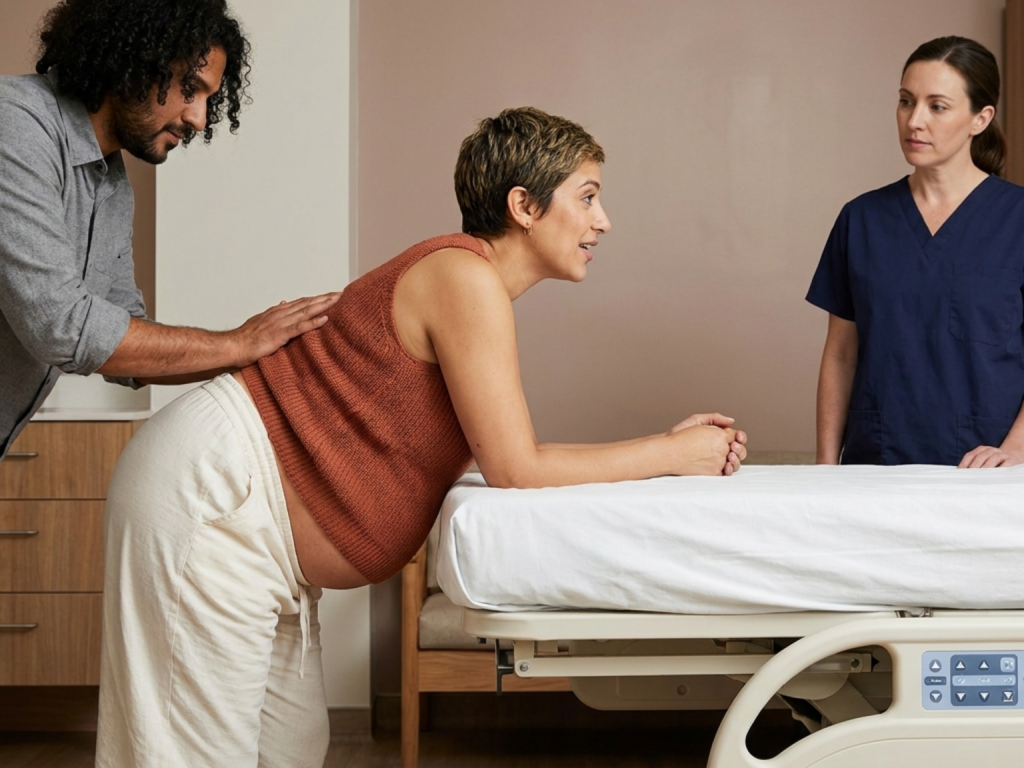
Forward-leaning positions are often useful because they allow the abdomen and pelvis to relax while giving a support person access to the lower back. Try standing beside the bed, leaning over its raised head, resting on a birth ball, or placing the forearms on a counter or sturdy chair. Keep the knees comfortably bent and allow the pelvis to sway or circle if that feels soothing. A support person should stabilize the surface rather than pulling on your arms.
Slow dancing combines an upright posture with gentle weight shifting. Stand facing a partner, wrap your arms around their shoulders if comfortable, and move slowly from side to side during or between contractions. This can provide emotional reassurance as well as rhythmic motion. If standing becomes tiring, lean over the back of a chair while kneeling on a padded surface; this creates a supported kneeling posture without requiring you to bear weight through the legs.
Some people prefer a standing or kneeling asymmetrical lunge. Place one foot or knee slightly forward and support your weight with the bed, a wall, or a companion. The change in pelvic angle may feel relieving, but it should never create sharp pain, dizziness, knee strain, or instability. Switch sides if one position becomes uncomfortable.
Hands-and-knees, kneeling, and pelvic movement
The hands-and-knees position for back labor can be performed on a bed, floor mat, or other secure padded surface. Place the hands beneath or slightly ahead of the shoulders and the knees beneath the hips, then adjust the width of the knees to a comfortable distance. You may remain still, rock the pelvis gently, or make small circles. Some people prefer lowering the chest onto pillows or a birth ball while keeping the knees supported.
Supported kneeling can reduce the effort required to hold the posture. Ask a partner or clinician to place pillows under the chest, hips, or forearms, and use a non-slip surface. Avoid locking the elbows or arching the lumbar spine forcefully. If the wrists become painful, make fists, rest on the forearms, or choose a different position.
Gentle pelvic mobility may include side-to-side rocking, slow hip circles, or small anterior and posterior pelvic tilts. Movement should remain voluntary and coordinated with breathing. Stop if it increases pain, causes numbness, produces uterine or pelvic symptoms that concern you, or makes you feel faint. A nurse or midwife can help adapt the posture if you have an intravenous line, urinary catheter, blood-pressure concerns, or continuous monitoring.
Side-lying, sitting, and supported rest
When fatigue becomes significant, side-lying can provide recovery without requiring complete immobility. Lie on either side with the upper leg supported by one or more pillows between the knees and ankles. A pillow beneath the abdomen or behind the back may improve alignment. Keep the spine in a neutral, comfortable position rather than twisting the torso. Change sides if permitted and if one side becomes uncomfortable.
Side-lying is also useful when upright activity is no longer tolerable, when rest is needed between contractions, or when an epidural or other treatment limits independent movement. A peanut-shaped positioning ball may be used in some settings, but only under staff guidance, particularly when sensation or leg strength is reduced.
Sitting backward on a chair can combine rest with forward leaning: sit facing the chair back and place the arms or chest over a pillow. A birth ball may offer similar support if it is the correct height and positioned away from slippery surfaces. For general back support, clinicians may recommend a small cushion at the lumbar region, but avoid forcing the spine into an exaggerated curve. Changing positions regularly is generally more useful than remaining in any posture that progressively increases discomfort.
Lying flat on the back is not the only resting option. If a back-lying position is medically necessary or personally preferred, ask whether the head and upper body can be elevated and whether the knees can be supported. Your team will determine the safest arrangement for your circumstances.
Hands-on, heat, water, and breathing techniques
Sacral counterpressure during contractions is a common hands-on strategy. A partner or clinician applies firm, steady pressure over the sacrum with the heel of the hand, a closed fist, or a double hip squeeze, depending on what feels helpful. Some people prefer broad pressure; others prefer a focused point or massage between contractions. Communicate clearly: “more,” “less,” “hold,” or “stop.” Pressure should not cause bruising, skin injury, or intolerable pain.
Warmth may be soothing. A warm—not hot—compress can be placed over the lower back, or a shower can direct water toward the lumbar region if the facility permits. A supported birth tub may offer buoyancy and allow kneeling, squatting, or forward leaning. Follow the birth setting’s infection-control, temperature, hydration, and fetal or maternal monitoring policies. Do not use a heating device at a temperature that could burn numb skin.
Slow breathing can reduce unnecessary muscle tension and help maintain a sense of control. Try a relaxed inhalation followed by a longer, unforced exhalation, with the jaw, shoulders, hands, and pelvic floor as relaxed as possible. Low vocalization, music, dim lighting, and a quiet support person can reduce sensory load. These approaches do not guarantee pain elimination; their value is often improved tolerability and the ability to focus from one contraction to the next.
Adapting positions to monitoring, epidural analgesia, and clinical care
Position choices must be individualized when continuous fetal monitoring, an intravenous infusion, induction or augmentation, hypertension, bleeding, fever, reduced mobility, or other clinical concerns are present. Ask whether the monitoring equipment is wireless or whether the team can help you move safely while maintaining an adequate tracing. Never disconnect equipment or stand unassisted without permission.
After epidural analgesia, numbness and reduced leg strength can increase fall risk. A clinical team should assist with turning, side-lying, supported kneeling, or other approved positions. Regular repositioning may still be possible, but it should occur according to local protocols and the anesthesiologist’s or obstetric team’s guidance. A wedge, pillows, or a peanut ball may help maintain alignment while you remain in bed.
Analgesia is another legitimate component of back-labor care. Nitrous oxide, systemic medication, neuraxial analgesia, and non-pharmacologic measures have different benefits, limitations, contraindications, and monitoring requirements. Ask your clinicians to explain options in the context of your medical history and labor status. Requesting pain relief does not invalidate the use of movement or position changes, and using position changes does not require you to refuse medication.
Creating a flexible back-labor comfort plan
Before labor, discuss your preferences with the birth team and support person, while recognizing that the plan may need to change. A practical sequence might include a forward lean during early contractions, hands-and-knees or kneeling during more intense back pressure, side-lying for rest, and warmth or water when available. Identify two or three backup options for times when mobility, monitoring, fatigue, or analgesia changes what is feasible.
Prepare the support person to offer options without demanding performance. They can help protect privacy, provide sips of fluid when permitted, adjust pillows, apply counterpressure, and remind you to relax the shoulders and exhale. Ask before touching, and stop immediately when requested. A simple record of what helps—such as “firm pressure over the sacrum” or “leaning forward between contractions”—can make communication easier when speaking is difficult.
Comfort measures should complement, not replace, clinical assessment. Tell the team if the pain becomes suddenly different, constant, one-sided, associated with heavy bleeding, fever, faintness, shortness of breath, severe headache, visual changes, loss of movement, or any concern about your or the baby’s wellbeing. The team can determine whether additional evaluation or treatment is needed.
Safety warnings
- Ask for assistance before standing or walking if you have an epidural, dizziness, weakness, intravenous lines, or monitoring equipment.
- Do not use very hot water, heating devices, or compresses on numb skin or without appropriate supervision.
- Report sudden severe pain, persistent pain between contractions, heavy bleeding, fever, fainting, or reduced fetal movement immediately.
- Do not force a position that causes sharp pain, shortness of breath, numbness, weakness, or instability.
- Follow your maternity unit’s instructions about hydration, tub use, fetal monitoring, and movement restrictions.
Tools & Assistance
- A birth ball, sturdy chair, bed rail, pillows, and non-slip floor padding
- Warm compresses or access to a supervised shower or birth tub
- A support person prepared to provide sacral counterpressure and verbal encouragement
- A written comfort-position plan shared with the midwife, obstetrician, nurse, and anesthesiologist
- A hospital or birth-center assessment when pain, mobility, or fetal movement raises concern
FAQ
What is the best position for back labor?
There is no universally best position. Many people try hands-and-knees, forward leaning, kneeling, slow dancing, or side-lying, then change according to comfort, fatigue, monitoring, and clinical guidance.
Does hands-and-knees position correct the baby’s position?
It may feel more comfortable for some people, but no position guarantees a change in fetal position or labor progress. Your care team can assess the clinical situation.
Can I use counterpressure if I have an epidural?
Often, gentle or firm back pressure may still be possible, but reduced sensation and mobility require caution. Ask the clinical team to guide touch, turning, and the safe use of pillows or positioning devices.
Should I lie on my back during labor?
Back-lying may be appropriate in some circumstances, including examinations or procedures, but it is not the only resting option. Ask whether side-lying or a supported, elevated posture is suitable for you.
When should I ask for medical help?
Contact your maternity team promptly for sudden or unusual pain, heavy bleeding, fever, faintness, breathing difficulty, severe headache or visual changes, reduced fetal movement, or any concern about your wellbeing or the baby.
Sources
- Lamaze International — Best Labor Positions for Back Pain
- MyHealth.Alberta.ca — Back Pain: Care Instructions
- Cleveland Clinic — Low Back Pain Coping Tips
Disclaimer
This article provides general educational information and is not a diagnosis, individualized treatment plan, or substitute for advice from your maternity care professionals. Follow the instructions of your obstetric, midwifery, nursing, and anesthesia teams.
















Please log in to leave a comment.