
Intro
Empathy is not a single lesson children either pass or fail. It is a developmental capacity that grows through repeated experiences of being understood, watching adults respond kindly, and practicing how to notice another person’s inner world. For parents, this can feel both hopeful and demanding: children learn compassion most powerfully in ordinary moments, including conflicts over toys, bedtime frustrations, sibling jealousy, and small opportunities to help.
From a developmental and neurobiological perspective, empathy involves several overlapping skills: emotional recognition, affective resonance, perspective-taking, impulse control, and prosocial behavior. Young children are still building the brain networks that support self-regulation and mentalization, meaning the ability to understand that other people have thoughts, feelings, and intentions different from their own. Compassion grows best when adults combine warmth, boundaries, and steady modeling rather than lectures or shame.
Highlights
Children learn empathy first by receiving empathy from emotionally responsive adults, especially during stress or misbehavior.
Compassion is built through practice: naming feelings, reading stories, pretend play, repairing harm, and noticing real chances to help.
Developmentally appropriate expectations matter; toddlers, school-age children, and adolescents show empathy in different ways.
Firm boundaries and kindness can coexist. A child can be guided to make amends without being labeled as mean or selfish.
Persistent emotional, behavioral, or social difficulties should be discussed with qualified healthcare or mental health professionals.
Empathy develops in stages, not all at once
Empathy in children is often misunderstood. A toddler who grabs a toy or a preschooler who laughs when another child falls is not necessarily cruel. Early childhood is marked by egocentrism, limited inhibitory control, and rapidly changing emotional states. The prefrontal cortex, which supports impulse control, planning, and flexible perspective-taking, matures gradually across childhood and adolescence.
In infancy and toddlerhood, children often show early affective empathy: they may cry when another baby cries or look worried when a caregiver is upset. However, they may not yet know what to do with that feeling. Preschoolers begin to label emotions and can offer simple comfort, such as bringing a blanket or toy. School-age children become better at understanding causes of feelings, fairness, and social rules. Adolescents can think more abstractly about injustice, loyalty, identity, and moral responsibility.
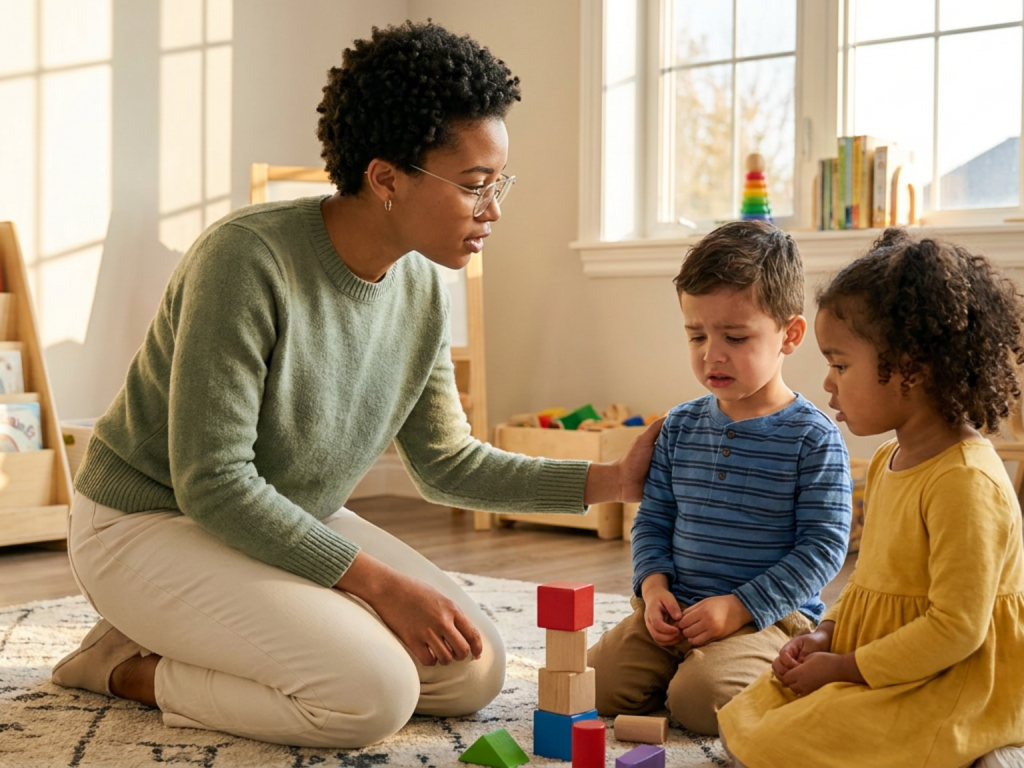
This is why developmentally appropriate expectations are essential. A young child may need an adult to translate the situation: “Maya is crying because the block tower fell. She feels disappointed. Let’s ask if she wants help rebuilding.” This type of clear language for behavioral boundaries teaches both emotional vocabulary and practical compassion.
Children learn empathy by receiving empathy
One of the strongest messages from relationship-centered child development is that children learn empathy through being empathized with. When a caregiver responds to distress with attunement, the child experiences an internal template: my feelings can be noticed, named, tolerated, and soothed. Over time, this supports co-regulation during child distress and eventually self-regulation.
Empathy does not mean permissiveness. A parent can say, “You are very angry that your sister took the marker, and I won’t let you hit.” This combines emotional validation with a firm limit. The child is not shamed for having a feeling, but the harmful behavior is stopped. This distinction is crucial because shame often activates defensiveness, while attuned limits help the nervous system settle enough to learn.
Secure, responsive caregiving also teaches children that relationships can be repaired. If you lose patience, you can return and say, “I yelled earlier. That may have felt scary. I’m sorry. I’m going to try again.” Parent-child repair after conflict models accountability, humility, and compassion more effectively than pretending adults are always calm.
Modeling respectful behavior is the daily curriculum
Children observe how adults treat restaurant workers, relatives, strangers in traffic, animals, and themselves. Modeling respectful behavior is not about performing perfection; it is about making your values visible. A child who hears adults speak with contempt may learn that kindness is conditional. A child who sees adults pause, apologize, and include others learns that compassion is practical and relational.
Try narrating your compassionate choices without turning them into a lecture. For example: “Our neighbor is recovering from surgery, so I’m going to bring soup,” or “That cashier made a mistake, but everyone has hard days. We can be patient.” These brief comments connect inner perspective-taking with outer action.
Children also learn from how you talk about them. Labels such as “selfish,” “dramatic,” or “bad” can become part of a child’s self-concept. More useful language describes the behavior and the needed skill: “You wanted the first turn, and grabbing hurt your friend. Let’s practice asking and waiting.” This keeps the child’s dignity intact while still teaching responsibility.
Use stories, books, and pretend play to build perspective-taking
Stories are a powerful, low-pressure way to practice empathy because they let children explore emotions at a safe distance. While reading, watching a scene, or telling a family story, pause to ask: “What do you think this character is feeling?” “Why might they have done that?” “Does another character see it differently?” These questions build mentalization and cognitive empathy.
Harvard’s family guidance on empathy through storytelling emphasizes making this a regular conversational habit. The goal is not to interrogate the child or demand the “right” answer. Instead, invite curiosity about multiple perspectives. A child might first say, “He’s just mean.” You can gently expand: “Maybe he acted mean. I wonder if he felt left out or embarrassed.”
Pretend play offers similar practice. When children care for a doll, run a pretend clinic, rescue stuffed animals, or act out a disagreement between toy figures, they rehearse noticing needs and responding. Parents can join by adding emotional language: “The bear looks nervous about the loud thunder. What could help him feel safe?”
Teach compassion through concrete helping actions
Empathy becomes compassion when a child learns to respond to another person’s need. Young children benefit from simple, concrete actions: getting a tissue, offering a turn, drawing a picture for someone who is ill, helping clean a spill, or checking whether a sibling wants space. These actions help children experience themselves as capable of contributing.
It is usually more effective to coach than to command. Instead of “Say sorry right now,” try, “Look at Sam’s face. He looks hurt. What could help repair this? You could say sorry, give the toy back, or help rebuild.” This supports moral reasoning in childhood because the child is learning to connect action, impact, and repair.
For older children and adolescents, compassion can include broader forms of responsibility: including a lonely peer, questioning unfairness, volunteering, caring for a pet, or participating in family decisions about helping others. The key is to avoid using compassion as a performance metric. Children need to feel that kindness is part of family identity, not a way to earn love.
When a child does not seem empathetic
Many parents worry when a child appears indifferent to another person’s distress. Before assuming a serious problem, consider the context. A child may be overwhelmed, embarrassed, sensory overloaded, frightened of getting in trouble, unsure what to do, or developmentally unable to coordinate feeling and action in the moment. Some children freeze rather than comfort.
Respond with calm structure. You might say, “Your brother is crying. I’m going to help him first. Then we’ll talk about what happened.” Later, when the child is regulated, revisit the event: “What did you notice? What do you think he felt? What can we do now?” This sequence protects the injured child while preserving the learning opportunity.
It is also important to recognize that social-emotional development varies. Neurodevelopmental differences, anxiety, trauma exposure, sleep deprivation, language delays, hearing problems, or family stress can affect how a child reads and responds to emotions. These possibilities do not define the child’s character. If concerns persist, consult a pediatrician, child psychologist, developmental-behavioral pediatrician, or qualified mental health clinician for individualized guidance.
Create a family culture where compassion is normal
Compassion grows in a family climate that balances warmth, accountability, and predictability. Regular routines, respectful conversation, and supportive family health routines make it easier for children’s nervous systems to stay regulated enough to notice others. Chronic stress, harsh criticism, or inconsistent boundaries can make empathy harder because the child’s attention is pulled toward self-protection.
Simple family habits can help:
- At meals or bedtime, ask, “Who needed kindness today?” or “Who helped you today?”
- Use emotion words often: disappointed, embarrassed, proud, worried, relieved, jealous, lonely.
- Notice compassionate behavior specifically: “You saw that she was left out and invited her in.”
- Practice gratitude without forcing cheerfulness: “That was hard, and I’m glad we helped each other.”
- Make repair normal: apologize, replace, rebuild, comfort, or try again.
Children do not need perfect parents to learn empathy. They need adults who keep returning to connection, who protect others from harm, and who believe that compassion is a skill children can practice across childhood.
When to seek extra support
- A child repeatedly harms animals, peers, or siblings and does not respond to supervision or limits.
- Aggression, cruelty, severe withdrawal, or lack of remorse is persistent, escalating, or occurs across settings.
- Your child has sudden changes in mood, sleep, school functioning, or social behavior.
- Empathy difficulties appear alongside developmental delays, trauma exposure, intense anxiety, or sensory concerns.
- Caregivers feel unsafe, overwhelmed, or unsure how to manage behavior; professional support is appropriate.
Tools & Assistance
- Emotion-labeling during everyday moments: "You look frustrated," "She seems disappointed," "I feel relieved."
- Story-based empathy questions during books, films, or family conversations.
- Repair scripts: "What happened? Who was affected? What can we do to help now?"
- Pediatric or child mental health consultation if social-emotional concerns persist.
- Family routines that include helping tasks, gratitude, and calm conflict resolution.
FAQ
At what age do children start showing empathy?
Early signs can appear in infancy and toddlerhood, such as distress when another child cries. More mature perspective-taking and compassionate problem-solving develop gradually through preschool, school age, and adolescence.
Should I force my child to apologize?
A forced apology may teach a social script but not necessarily empathy. It is often better to guide repair: help the child notice the impact, offer choices for making amends, and practice sincere words when they are regulated.
Can empathy be taught if my child seems naturally intense or impulsive?
Yes. Children with intense emotions or impulsivity can still learn compassion, but they may need more co-regulation, repetition, and concrete coaching. If impulsivity or aggression is persistent or impairing, seek professional guidance.
How can I encourage compassion without raising a child who ignores their own needs?
Teach that compassion includes self-respect and boundaries. Children can care about others while also saying no, asking for help, and protecting their own physical and emotional safety.
What if siblings keep hurting each other?
Prioritize safety and supervision, avoid labeling one child as the "mean" one, and coach repair after everyone is calm. If sibling aggression is frequent, severe, or frightening, consult a pediatrician or child mental health professional.
Sources
- ZERO TO THREE — How to Help Your Child Develop Empathy
- Harvard Graduate School of Education — How to Use Stories to Help Kids Develop Empathy
- Circle of Security International — How Children Learn Empathy
Disclaimer
This article is for general educational purposes and is not a diagnosis, treatment plan, or substitute for professional care. Consult a pediatrician or qualified mental health professional for concerns about your child’s development, behavior, or safety.
















Please log in to leave a comment.