
Intro
Teaching discipline and self-control values is one of the most meaningful, and sometimes exhausting, parts of parenting. Children are not born with adult-level impulse control, frustration tolerance, or long-term planning. These capacities develop gradually through brain maturation, repeated practice, safe relationships, and environments that make desired behavior easier to repeat.
Highlights
Discipline is most effective when it is understood as teaching, not simply punishment.
Self-control is a trainable set of skills involving attention, emotion regulation, planning, and inhibition.
Warm, consistent, and predictable parenting supports children’s developing executive function.
Environmental supports, routines, and modeling often work better than repeated lectures.
Persistent or severe behavioral concerns may benefit from discussion with a pediatrician, psychologist, or other qualified professional.
Understanding discipline as a teaching relationship
Discipline is often mistaken for getting immediate obedience. In healthy child development, however, discipline is better understood as a teaching relationship: the adult helps the child learn what is safe, respectful, realistic, and socially appropriate. This approach does not mean permissiveness. It means combining warmth with clear boundaries, then following through in ways that help the child build skills.
Research in behavioral and educational settings suggests that discipline practices emphasizing structure, support, and strong adult-child relationships are associated with better self-control and social-emotional outcomes. Children tend to learn more effectively when adults are predictable, emotionally regulated, and respectful, even when the limit is firm.
A useful phrase for parents is: connection first, correction second. A child who feels understood is not automatically ready to cooperate, but their nervous system is often more available for learning. Discipline that teaches self-regulation helps a child understand the rule, practice an alternative behavior, and repair harm when needed.
What self-control really means
Self-control is not just willpower. It includes several neurodevelopmental skills: impulse inhibition, working memory, cognitive flexibility, emotional regulation, and the ability to delay gratification. These skills are related to executive function, a group of higher-order brain processes supported by networks involving the prefrontal cortex and its connections with limbic and reward systems.
Because these brain systems mature over many years, children need developmentally realistic expectations. A toddler who grabs a toy, a preschooler who melts down when tired, and an adolescent who acts impulsively online may all need guidance, but they do not need the same kind of intervention. The goal is to match expectations to developmental capacity while still teaching responsibility.
Self-control also depends on context. Hunger, sleep deprivation, sensory overload, anxiety, illness, family stress, and inconsistent routines can all reduce a child’s ability to pause and choose wisely. Before assuming defiance, it can help to ask: Is this child capable of doing what I am asking right now, and what support would make success more likely?
Modeling: the lesson children absorb every day
Children learn discipline not only from what parents say, but from what they repeatedly see. Parental modeling of self-control is powerful because children observe how adults handle disappointment, delays, mistakes, conflict, screens, food, spending, and anger.
This does not require perfect parenting. In fact, repair after a mistake can be one of the strongest lessons. A parent might say, “I raised my voice. That was not the way I wanted to handle it. I am going to take a breath and try again.” This teaches accountability without humiliation.
Helpful modeling includes:
- Naming emotions without blaming the child for them.
- Pausing before responding to provocation.
- Using calm problem-solving language.
- Keeping promises and apologizing when follow-through fails.
- Showing how to plan ahead for hard moments, such as busy mornings or homework time.
When parents practice self-control visibly, children see discipline as a life skill rather than a power struggle.
Design the environment before demanding willpower
One of the most evidence-informed ways to build self-control is to reduce unnecessary temptations and increase cues for desired behavior. Adults often overestimate how much children can rely on internal motivation alone. Even adults use calendars, reminders, budgets, alarms, and organized spaces to support self-regulation. Children need these supports even more.
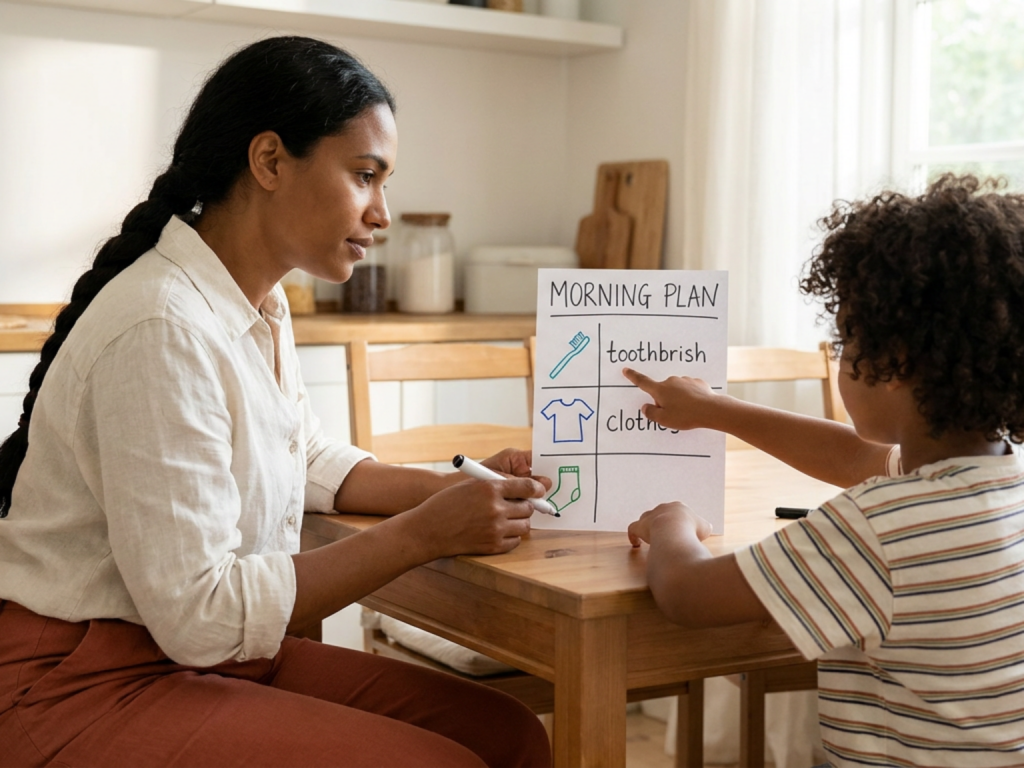
Environmental supports for self-discipline might include placing homework supplies in one predictable location, keeping devices out of bedrooms at night, using visual schedules, preparing school bags the evening before, or offering a snack before a difficult transition. These strategies are not “cheating.” They are scaffolding, which means temporarily supporting a skill while the child gradually internalizes it.
Parents can also make the desired behavior easier than the undesired one. If screen time is a daily conflict, the tablet can charge in a shared space and become available only after a predictable routine. If mornings are chaotic, clothing can be chosen at night and breakfast options simplified. The aim is to conserve the child’s limited self-control for the moments that truly require effort.
Use clear limits and predictable consequences
Children usually do better when rules are simple, specific, and repeated calmly. “Be good” is vague; “Use a quiet voice in the clinic waiting room” is clearer. “Stop being irresponsible” is shaming; “Put the bike in the garage before dinner” gives the child a concrete action.
Consistent consequences for children are most effective when they are related, reasonable, respectful, and brief. A consequence should teach the connection between behavior and outcome. If a child throws blocks, the blocks are put away for a period of time. If a teen breaks an agreement about phone use, the next step might involve a reset of the phone plan and closer supervision, not a long lecture about character.
Effective discipline avoids consequences that are frightening, humiliating, or disproportionate. Fear may produce short-term compliance, but it does not reliably teach internal self-control. Instead, predictable and proportionate consequences help children understand cause and effect while preserving the relationship needed for learning.
Teach calming skills before a crisis
It is difficult for a child to learn a calming strategy in the middle of a meltdown. The nervous system is already highly activated, and the child’s access to language, reasoning, and inhibition may be reduced. Calming skills before a crisis are best practiced during neutral moments, then gently prompted during stressful ones.
Useful skills may include slow breathing, counting, taking a movement break, using a feelings chart, squeezing a stress ball, going to a quiet corner, or asking for help with a scripted phrase. For younger children, co-regulation comes first: the adult’s calm voice, steady presence, and reduced verbal demands help the child’s physiology settle.
Parents can say, “Your body looks very angry. I will keep everyone safe. Let’s breathe together, and then we will solve the problem.” This validates the emotion without allowing unsafe behavior. Over time, children learn that feelings are acceptable, but actions still have limits.
Build self-control through planning and practice
Self-control improves when children rehearse specific responses before the difficult moment. Instead of saying, “Make better choices,” parents can help a child plan: “When your brother takes a toy, what can you do first? What can you say? When should you get an adult?” Planning turns an abstract value into an actionable sequence.
Practice can be playful. Role-play waiting for a turn, asking to join a game, handling losing, or stopping screen time. For adolescents, planning might include how to respond to peer pressure, how to pause before posting online, or how to break a large assignment into smaller steps.
Praise should focus on effort, strategy, and recovery, not just outcomes. “You were angry and you still walked away” is more instructive than “Good boy.” “You remembered the plan after one reminder” teaches the child what worked. This kind of feedback supports a growth-oriented view of self-control: it is a skill to strengthen, not a fixed trait a child either has or lacks.
Respect, culture, and the child’s temperament
Families differ in values, culture, faith traditions, and expectations for independence, obedience, emotional expression, and respect. Discipline strategies should fit the family’s values while still protecting the child’s dignity and psychological safety. A discipline and respect balance is possible when adults maintain authority without using shame or intimidation.
Temperament also matters. Some children are naturally more cautious, persistent, intense, distractible, sensitive to sensory input, or novelty-seeking. These traits are not moral failures. They influence how much support a child may need to meet the same expectation. A highly impulsive child may require more visual cues, shorter instructions, and closer supervision. A child prone to anxiety may need reassurance and gradual exposure to challenges rather than harsh pressure.
If a child’s behavior is persistently unsafe, highly impairing, or associated with major mood changes, sleep disruption, developmental regression, trauma exposure, or school failure, parents should consult a qualified healthcare or mental health professional. This article cannot determine whether symptoms reflect typical development, stress, neurodevelopmental differences, or another health concern.
When extra caution is needed
- Seek urgent help if a child is at risk of harming themselves or others.
- Do not use physical punishment, humiliation, threats of abandonment, or frightening discipline methods.
- Consult a pediatrician or child mental health professional for severe aggression, persistent school impairment, or sudden major behavior changes.
- Consider medical contributors such as poor sleep, pain, medication effects, sensory overload, or chronic stress.
- If parental stress feels unmanageable, getting support is a protective step, not a failure.
Tools & Assistance
- Create a short family routine chart for mornings, homework, bedtime, and screen time.
- Use a calm-down plan practiced when everyone is relaxed.
- Schedule a parent-teacher conversation to align expectations and supports.
- Discuss persistent concerns with a pediatrician, licensed therapist, or school psychologist.
- Keep a brief behavior log noting sleep, meals, triggers, setting, response, and recovery.
FAQ
At what age can children learn self-control?
Self-control begins developing early, but it is gradual. Toddlers need co-regulation and simple limits, school-age children can practice routines and problem-solving, and adolescents still need guidance for planning, risk assessment, and emotional regulation.
Is strict discipline better for teaching self-control?
Strictness alone is not the key. Children generally benefit from warmth, structure, predictable rules, and respectful follow-through. Harsh or frightening discipline may suppress behavior temporarily without teaching lasting self-regulation.
What should I do when my child keeps breaking the same rule?
Look for patterns: timing, fatigue, hunger, unclear expectations, excessive temptation, or skills the child has not yet mastered. Then simplify the rule, add environmental supports, practice the replacement behavior, and use brief related consequences.
How can I teach discipline without shaming my child?
Separate the child’s worth from the behavior. Use language such as, “I love you, and I will not let you hit,” or “That choice caused a problem; let’s repair it.” The goal is accountability with dignity.
When should I seek professional help?
Consider professional guidance if behavior is dangerous, escalating, causing major impairment, linked with intense anxiety or mood symptoms, or if family stress is overwhelming. A clinician can help assess contributing factors and recommend appropriate support.
Sources
- Review of Educational Research / SAGE Journals — The Association Between School Discipline and Self-Control From Meta-Analyses of Behavioral and Educational Research
- National Center for Biotechnology Information / PubMed Central — The Science and Practice of Self-Control
- Parenting Science — Teaching self-control: Evidence-based tips
Disclaimer
This article is for general educational purposes only and does not diagnose, treat, or replace medical or mental health care. Consult a qualified healthcare professional for concerns about a child’s behavior, development, safety, or emotional wellbeing.
















Please log in to leave a comment.