
Intro
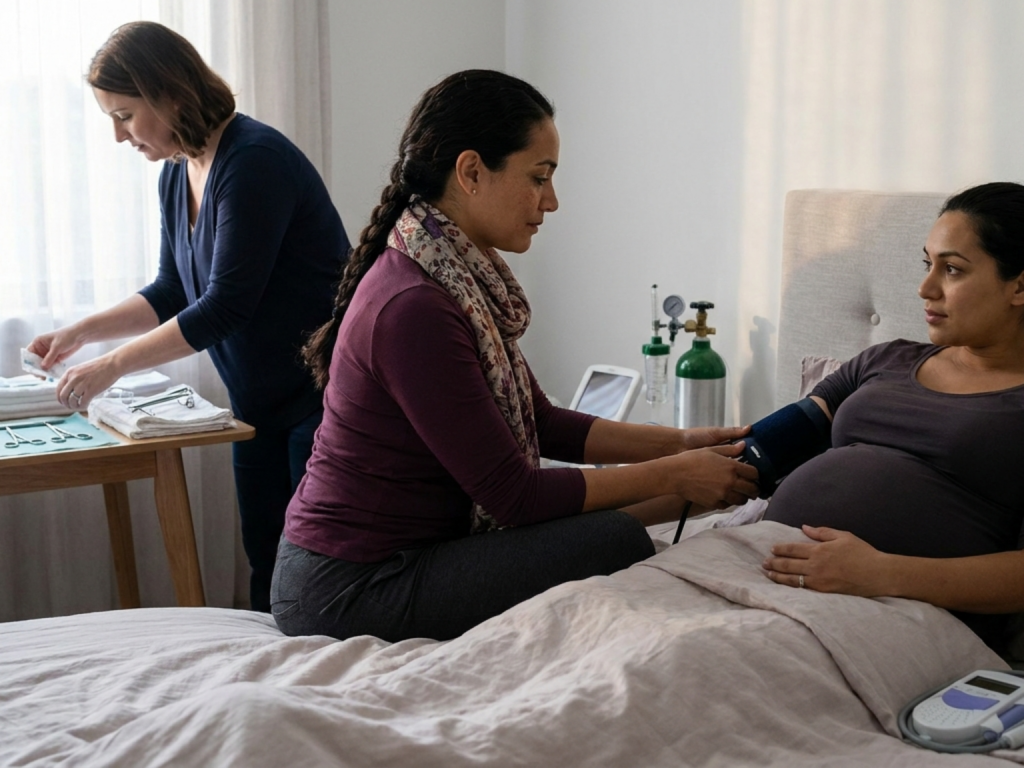
A home birth can be a calm and clinically structured setting when it is planned carefully and attended by a skilled midwife. The midwife is not simply present to witness labor; she or he provides assessment, surveillance, hands-on obstetric care, risk recognition, and rapid escalation when the situation moves beyond normal physiology.
For healthy term pregnant people with a singleton fetus, planned home birth with skilled attendance has been associated with positive outcomes and lower intervention rates in the right clinical context. The key issue is not the address itself. It is whether the birth is appropriately selected, well prepared, and supported by competent maternity care.
Highlights
The midwife is the primary clinician at a planned home birth, responsible for both physiologic support and clinical surveillance.
Safe home birth begins before labor with home birth eligibility screening, shared decision-making, and a clear transfer pathway.
During labor, the midwife monitors maternal and fetal status while minimizing unnecessary intervention.
After birth, the midwife stays for early postpartum observation, bleeding assessment, newborn review, and feeding support.
A well-run home birth depends on readiness for escalation, including postpartum hemorrhage preparation and neonatal resuscitation readiness.
The midwife's core role in a home birth
The midwife is the clinician who helps turn a home birth from an idea into a supervised maternity care plan. In practice, that means combining labor support with medical judgment. The midwife assesses whether the pregnancy is suitable for planned home birth, reviews the birthing person’s preferences and concerns, and explains what the home setting can and cannot safely provide.
Evidence reviews and comparative studies suggest that, for carefully selected low-risk patients, midwife-attended planned home births can be associated with low intervention rates and good outcomes. That does not mean home birth is ideal for everyone. It means the midwife’s role is to identify when physiologic birth at home is reasonable and when hospital care is the safer choice.
At the bedside, the midwife is often both a clinical observer and a calm guide. She or he tracks progress, supports coping, notices early deviations from normal labor, and keeps the overall plan aligned with informed consent. In a good home-birth model, the midwife is responsible not just for comfort, but for clinical safety.
Before labor: screening, planning, and preparation
Preparation begins well before contractions start. The midwife reviews maternal history, previous births, gestational age, fetal presentation, placenta-related concerns, blood pressure trends, and any factors that could raise the probability of transfer. This is where home birth eligibility screening matters. Healthy term pregnancy, singleton fetus, and low obstetric risk are the classic features considered in studies of planned home birth.
Planning also includes practical readiness. The home should have a clean area for assessment, supplies for routine birth care, equipment for maternal observations, and tools for newborn evaluation. A written home birth emergency transfer plan is essential. It should cover when transfer would be recommended, where the receiving hospital is, and how transport would occur if labor changes course. Good planning reduces delay if the situation becomes urgent.
This stage is also where informed consent is shaped. The midwife explains the expected course of labor, the limits of home-based care, and the possibility that the birth may still need a hospital if bleeding, fetal concerns, or stalled labor develop. That conversation is part of respectful care, not a formality.
During labor: monitoring, assessment, and labor support
Once labor begins, the midwife’s work becomes continuous and highly specific. The clinician assesses contractions, maternal comfort, hydration, urine output when relevant, and overall labor progress. Maternal observations such as pulse, blood pressure, temperature, and pain response help reveal whether labor is proceeding normally or whether another process may be emerging. These maternal vital signs during labor are not paperwork; they are a way to detect early warning signs before they become emergencies.
Fetal well-being is followed with appropriate methods for a low-risk home birth, often including intermittent fetal heart rate monitoring. The aim is to identify concerning patterns while still allowing the laboring person to move, change position, eat or drink as advised, and use upright or resting postures that support physiologic labor. The midwife also helps with nonpharmacologic comfort measures, coaching through contractions, sacral pressure if requested, and reassurance without taking over the laboring person’s autonomy.
Equally important is judgment. A skilled midwife knows when the story of labor has changed: contractions may be less effective than expected, bleeding may increase, or fetal heart findings may no longer fit a low-risk picture. Good care at home is active care, not passive observation.
At the birth: immediate care for mother and baby
When the baby is ready to be born, the midwife’s role shifts from surveillance to close hands-on support of the second stage and immediate transition. The clinician may guide pushing only when needed, protect the perineum if appropriate, and watch for a slow or difficult delivery that could require urgent escalation. The delivery itself can be quiet and physiologic, but the midwife remains alert for abnormal bleeding, shoulder dystocia, or a newborn that does not transition well.
Immediately after birth, the baby is assessed for tone, breathing, color, and response. This newborn transition assessment helps determine whether the infant is settling into extrauterine life normally or needs support. In a well-prepared home birth, neonatal resuscitation readiness means the midwife has the equipment and skills needed for initial newborn stabilization while awaiting further help if required.
The midwife also evaluates the placenta, checks maternal bleeding, and watches for uterine tone. This is where postpartum hemorrhage preparation becomes more than a phrase. It is a practical readiness to recognize excessive blood loss early, act quickly, and transfer without hesitation if bleeding is not controlled. The priority is not preserving the home setting at all costs. The priority is maternal and neonatal safety.
After birth: early postpartum care and recovery
Many people think the midwife leaves soon after the baby is born. In reality, the early postpartum period is a major part of home-birth care. The midwife remains to observe bleeding, check maternal recovery, support first feeding, and confirm that both parent and baby are stable before stepping back. This observation period is clinically important because the first hours after birth can reveal issues that were not visible during labor.
For the birthing person, the midwife checks uterine firmness, vital signs, pain, perineal comfort, and signs of excess bleeding or dizziness. For the newborn, feeding behavior, temperature stability, breathing, and tone are reviewed. If the family is breastfeeding, the midwife can support early latch and positioning and can normalize the first few attempts, which are often imperfect even in uncomplicated births.
This is also a time for emotional support. The tone should be calm, respectful, and grounded. After labor ends, many families need clear explanations of what happened, what was normal, and what needs follow-up. A good midwife leaves the household with a documented plan for postpartum review and a sense that care is still ongoing, not abruptly over.
When home birth is not the right setting
The midwife’s clinical responsibility includes recognizing when home birth is no longer appropriate. A low-risk plan can change if maternal blood pressure becomes concerning, labor stalls, the baby shows abnormal heart rate patterns, membranes and fever suggest infection, or bleeding exceeds expected amounts. In those circumstances, the correct response is reassessment and transfer, not persistence out of habit or ideology.
Transfer is not a failure. It is part of safe maternity care. The best home-birth services are built around that reality, with communication pathways, transport logistics, and receiving-hospital coordination already understood. Families often feel safer when this is discussed before labor, because it turns an emergency into a rehearsed process rather than a surprise.
For medically literate readers, the key concept is selection plus escalation. Planned home birth can be reasonable in the right low-risk context with a qualified home birth midwife, but it depends on skilled judgment throughout labor. The midwife’s role is to preserve the benefits of home while remaining ready to move into hospital-based care the moment the clinical picture changes.
When to seek urgent review
- Heavy bleeding, faintness, or a uterus that does not seem to contract well after birth needs urgent attention.
- Reduced fetal movement before labor, abnormal fetal heart findings, or labor that suddenly changes pattern should be reviewed quickly.
- Fever, severe headache, chest pain, or shortness of breath are not normal home-birth findings.
- If transfer has been recommended, do not delay while waiting for symptoms to improve.
Tools & Assistance
- Discuss home birth eligibility screening with a qualified midwife or obstetric clinician.
- Ask for a written home birth emergency transfer plan before labor begins.
- Review what monitoring, neonatal, and bleeding-response equipment will be present at the birth.
- Arrange postpartum follow-up for both parent and newborn in advance.
FAQ
What is the midwife's main job at a home birth?
The midwife combines labor support with clinical surveillance, monitoring mother and baby, supporting physiologic birth, and escalating care if risk increases.
Do midwives stay after the baby is born?
Yes. In many services, the midwife remains for early postpartum observation, newborn transition assessment, feeding support, and checks for maternal bleeding.
Can a midwife manage emergencies at home?
A midwife can start immediate stabilization and follow an emergency plan, but some situations require hospital transfer for definitive care.
How many midwives attend a home birth?
That depends on the service and the birth plan. Some systems commonly attend in pairs to improve safety and allow one midwife to focus on the mother while the other assists.
Sources
- PubMed — Midwifery Provision of Home Birth Services
- PubMed — Midwife-attended planned home births versus planned hospital ...
- Northern Lincolnshire and Goole NHS Foundation Trust — Planning for your home birth
Disclaimer
This article is for general educational purposes only and is not a substitute for individualized medical advice. Home birth planning, eligibility, and transfer decisions should be made with qualified maternity professionals.

















Please log in to leave a comment.