
Intro
Cardio workouts during pregnancy can be a reassuring way to stay connected to your body while supporting cardiovascular fitness, circulation, sleep, mood, and functional stamina. For many people, the goal is not to train harder; it is to stay comfortably active in a way that fits the physiologic changes of pregnancy.
That said, pregnancy is not the time to ignore symptoms or treat every workout as a test of endurance. The most useful approach is individualized, moderate, and adaptable, with input from your obstetric clinician when needed.
Highlights
Most pregnant people benefit from regular aerobic activity when it is matched to their symptoms, baseline fitness, and obstetric risk profile.
ACOG recommends at least 150 minutes of moderate-intensity aerobic activity each week during pregnancy and postpartum, spread through the week.
Walking, stationary cycling, swimming, water workouts, and water aerobics are well-studied options that often feel manageable.
Evidence summarized in StatPearls suggests aerobic exercise in uncomplicated singleton pregnancies was not linked to higher preterm birth or low birth weight risk.
Safety matters as much as fitness: overheating, falls, contact sports, scuba diving, and warning signs deserve prompt attention.
Why cardio can be valuable in pregnancy
Cardio during pregnancy is usually about preserving function rather than chasing performance. Regular aerobic activity can help maintain cardiorespiratory fitness, support glucose metabolism, and reduce the deconditioning that sometimes comes with fatigue or reduced movement. Many people also notice benefits in mood, sleep quality, and day-to-day stamina, all of which matter when your body is doing the additional work of pregnancy.
The evidence base is reassuring in the setting of uncomplicated singleton pregnancies. A review summarized in StatPearls reports that aerobic exercise and moderate-intensity strength or toning exercise were not associated with increased risk of preterm birth or low birth weight in those pregnancies. That does not mean every pregnancy should follow the same plan, but it does support the idea that appropriately chosen exercise is generally compatible with a healthy pregnancy.
Pregnancy changes blood volume, heart rate, joint laxity, balance, and thermoregulation. A good cardio plan respects those changes rather than fighting them. In practice, that means choosing movements that feel sustainable, adjusting when symptoms shift, and prioritizing consistency over intensity.
How much exercise is recommended, and what does moderate intensity mean?
ACOG recommends at least 150 minutes of moderate-intensity aerobic activity each week during pregnancy and postpartum, ideally spread throughout the week. For someone already active, that target may feel familiar. For someone starting from a lower baseline, it is often more realistic to begin with short, repeatable sessions and build gradually after medical clearance.
The phrase moderate-intensity exercise in pregnancy is useful because it centers effort rather than speed. You should feel your breathing and heart rate rise, but you should still be able to speak in full sentences and remain in control of the movement. If a workout consistently leaves you breathless, overheated, dizzy, or unable to recover, the dose is probably too high for that day.
There is also value in distribution. Three 10- to 20-minute bouts can be easier to tolerate than one long session, especially when nausea, pelvic discomfort, or fatigue fluctuate. A brief warm-up and cool-down can make cardio feel safer and less abrupt, while hydration and a cooler environment can improve comfort. The point is not to max out your effort; it is to create a dependable pattern that supports your body over time.
Pregnancy-friendly cardio options
ACOG highlights several well-studied aerobic choices that are often appropriate during pregnancy:
- Brisk walking, which is accessible, easy to scale, and usually gentle on joints.
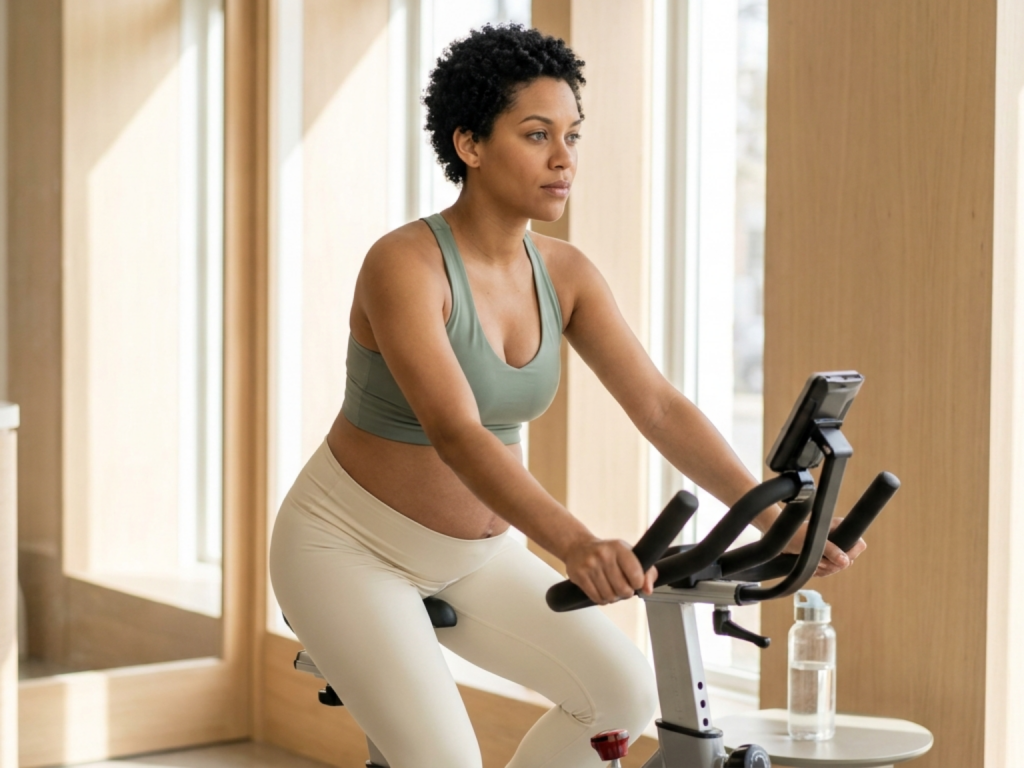
- Stationary cycling in pregnancy, which reduces fall risk compared with outdoor cycling and allows precise control over intensity.
- Swimming, water workouts, and water aerobics, which can feel especially comfortable when pelvic or back discomfort makes land-based exercise harder.
- Dancing or other low-impact aerobic classes that keep movement rhythmic without high impact.
These activities share an important feature: they increase cardiovascular demand without requiring maximal effort, unpredictable terrain, or high-impact jumping. That makes them easier to adapt across different energy levels and symptom patterns. If joint pain is prominent, water-based exercise can reduce load. If time is limited, brisk walking can be a practical default. If you prefer structured exercise, a stationary bike or pool session may feel more reliable than an outdoor route affected by weather or uneven ground.
The best cardio is often the one you can repeat safely and comfortably. If a workout leaves you wiped out, shaky, or overly sore the next day, that is usually a signal to reduce duration, intensity, or impact rather than to force through it.
How cardio needs can change by trimester
In the first trimester, fatigue and nausea can make even familiar exercise feel unexpectedly hard. Shorter sessions, flexible timing, cooler settings, and a gentler warm-up may help. Some people prefer walking or a low-resistance bike ride when appetite, sleep, or morning sickness are changing from day to day. The goal is to stay connected to movement without treating every session as a performance test.
In the second trimester, many people feel more energetic, but the center of gravity begins to shift and ligament laxity may become more noticeable. That is a good time to emphasize predictable, low-impact cardio and to pay attention to posture and balance. If you are doing brisk walking, water workouts, or stationary cycling, you can often maintain a steady routine while still being responsive to symptoms.
By the third trimester, a larger abdomen, pelvic pressure, and slower recovery often make third trimester low-impact exercise the most realistic choice. Walking, pool-based workouts, and stationary cycling are frequently better tolerated than activities with sudden direction changes or jarring impact. Some people find shorter bouts spread across the day easier than one sustained workout. None of this means fitness is disappearing; it usually means your body is asking for a different style of conditioning.
What to avoid, and when to stop exercising
Pregnancy-safe cardio is not only about what to do, but also about what to avoid. Activities with a meaningful fall risk, contact sports, scuba diving, and exercise in extreme heat or at high altitude are generally not appropriate unless a specialist has specifically advised otherwise. Outdoor running on uneven ground, downhill skiing, horseback riding, and workout classes with frequent collisions or balance challenges deserve extra scrutiny. Breath-holding and forceful straining are also poor fits for most prenatal routines.
If you notice warning signs during prenatal exercise, stop and seek medical advice promptly. These can include vaginal bleeding, fluid leakage, regular painful contractions, dizziness, chest pain, shortness of breath before exertion, new headache, calf pain or swelling, or decreased fetal movement after exercise. Uterine tightening can sometimes occur with activity, but persistent or painful contractions should never be ignored. It is safer to pause, hydrate, and contact your obstetric team than to try to finish the workout.
Some people also need additional caution because of placental, hypertensive, cardiac, respiratory, or obstetric complications. If your clinician has given you specific limitations, those instructions should guide your exercise plan even if a general fitness article suggests otherwise.
Building a routine that fits real life and the postpartum transition
For many pregnant people, the best cardio routine is simple, repeatable, and linked to daily life. A walk after meals, a swim on a day with back pain, or a short bike session when energy is higher can be more sustainable than a highly ambitious plan. If you are new to exercise, have been inactive, or have a history of pregnancy complications, the question is not whether movement is allowed at all; it is how to make movement safe and appropriate for your situation.
That conversation belongs with your obstetric clinician, midwife, or maternal-fetal medicine specialist. They can help you decide whether you need modifications, whether certain symptoms are expected, and how to progress at a pace that respects your pregnancy. Self-monitoring matters too: note how quickly you recover, whether you feel overheated, and whether the workout worsens pelvic pressure or pain afterward.
The same ACOG guidance also supports at least 150 minutes of moderate-intensity aerobic activity per week in the postpartum period, again spread across the week. Thinking ahead can make the transition after birth feel less abrupt. A pregnancy routine built around low-friction habits tends to be easier to continue, and continuity often matters more than perfection.
Stop and contact a clinician urgently if you have:
- Vaginal bleeding or fluid leakage
- Regular painful contractions or persistent uterine tightening
- Dizziness, chest pain, or shortness of breath before exertion
- Decreased fetal movement after exercise
- Calf pain, swelling, or a sudden severe headache
Tools & Assistance
- Schedule a pregnancy-exercise check-in with your obstetric clinician or midwife
- Ask for a referral to a maternal-fetal medicine specialist if your pregnancy is high risk
- Consider a certified prenatal fitness professional for exercise modifications
- Keep a simple exercise log with duration, intensity, and symptoms
- Use labor and delivery triage or urgent care if warning signs appear
FAQ
How much cardio is generally recommended in pregnancy?
ACOG recommends at least 150 minutes of moderate-intensity aerobic activity each week during pregnancy, spread throughout the week, unless your clinician advises otherwise.
What are the safest cardio options for most pregnant people?
Brisk walking, stationary cycling, swimming, water workouts, water aerobics, and low-impact dancing are commonly used because they are easier to scale and usually lower risk.
Is it safe to start exercising if I was inactive before pregnancy?
Often yes, but the plan should be individualized. Start with short, gentle sessions only after discussing it with your obstetric clinician, especially if you have any complications or symptoms.
When should I stop exercising and get medical advice?
Stop if you have bleeding, fluid leakage, painful contractions, chest pain, dizziness, decreased fetal movement, or shortness of breath that feels unusual for exertion.
Sources
- American College of Obstetricians and Gynecologists — Physical Activity and Exercise During Pregnancy and the Postpartum Period
- American College of Obstetricians and Gynecologists — Exercise During Pregnancy
- StatPearls, NCBI Bookshelf — Pregnancy And Exercise
Disclaimer
This article is for general educational purposes only and is not a substitute for individualized medical advice. If you are pregnant, ask your obstetric clinician before starting, changing, or continuing an exercise program.
















Please log in to leave a comment.