
Intro
The moments after conception begin a highly coordinated biological sequence. Some changes happen in the embryo itself, while others begin in the mother’s reproductive and endocrine systems as the body prepares to support implantation and early development.
Many of these earliest events are microscopic and cannot be felt. That can be reassuring, because the absence of symptoms does not mean nothing is happening; it often means the process is still at a very early stage.
Highlights
The earliest changes after conception start with fertilization, when sperm and egg form a zygote and cell division begins.
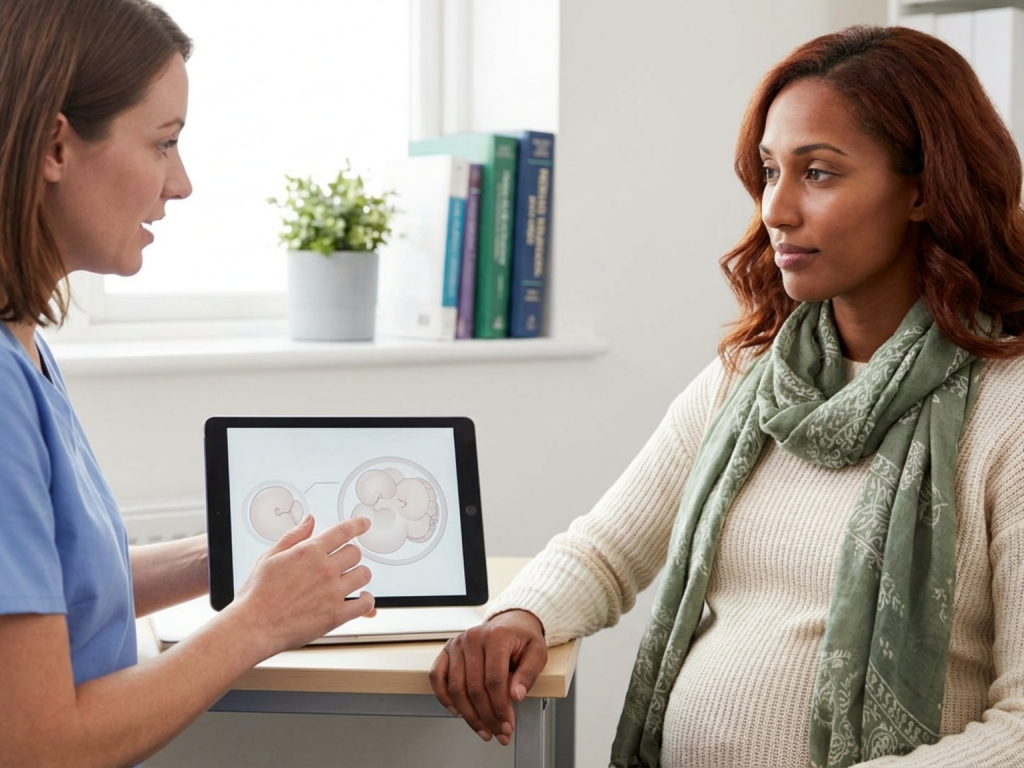
Before pregnancy is visible on ultrasound, the embryo travels through cleavage, morula, and blastocyst stages and then prepares for implantation.
Implantation triggers hCG production, which is the hormone detected by pregnancy tests and a major signal to maintain early pregnancy.
The mother’s body begins endocrine and physiologic adaptation early, especially through progesterone support and changes in the uterine lining.
Most early changes are subtle, but a missed period, mild spotting, or fatigue may appear as pregnancy progresses.
Fertilization: the first new cell
Conception begins when a sperm penetrates the oocyte and the two sets of genetic material combine to form a zygote. This single cell contains a complete genome and marks the start of a new developmental program. In practical terms, this is the first biologic change after conception: a fertilized cell that is already programmed to divide, differentiate, and travel toward the uterus.
Very early on, the zygote undergoes cleavage, a rapid series of mitotic divisions that increase cell number without a large increase in overall size. These divisions create smaller cells called blastomeres. At this stage, the embryo is not yet implanting or producing many of the signals people associate with pregnancy; instead, it is undergoing precise cellular reorganization.
For many medically literate readers, it is helpful to think of this phase as a transition from a gamete-based event to an embryologic process. The biology is active, but it is still mostly cellular and not yet organ-level development.
From cleavage to morula and blastocyst
As cleavage continues, the embryo becomes a compact ball of cells called a morula. Soon after, fluid enters the cell mass and a cavity forms, producing the blastocyst. The blastocyst has two major components: an inner cell mass, which will form the embryo proper, and an outer trophoblast layer, which will contribute to the placenta and implantation interface.
This stage matters because it is the first clear division of labor in early development. The embryo is no longer just dividing; it is beginning to organize into structures with distinct future roles. The trophoblast is particularly important because it later participates in placental development and hormone signaling.
During this journey, the embryo moves from the fallopian tube toward the uterine cavity. The timing is tightly regulated, and the uterine lining must be receptive for implantation to occur successfully. This is one reason the earliest phase of pregnancy depends on both embryonic quality and endometrial readiness.
Implantation and the first hormone signal
When the blastocyst reaches the uterus, it attaches to and invades the endometrium in a process called implantation. This is a pivotal step because it establishes the biological connection between embryo and mother. Without implantation, the pregnancy cannot continue.
After implantation begins, the trophoblast starts producing human chorionic gonadotropin, or hCG. This hormone signals the corpus luteum to keep producing progesterone, which helps maintain the endometrium and supports early pregnancy. In other words, implantation and hCG production are tightly linked events that shift the reproductive system from a pre-pregnancy cycle into a pregnancy-supportive state.
hCG is also the hormone pregnancy tests detect. Its rise is one of the earliest measurable signs that conception has progressed beyond fertilization and into implantation. However, the exact timing varies, so a test taken too early may be negative even in a very early pregnancy.
Maternal endocrine adaptation begins early
Although the embryo is driving the first developmental milestones, the mother’s body also begins adapting almost immediately. The review literature describes early maternal physiologic adaptations in pregnancy as a coordinated response to new hormonal signals. Progesterone, hCG, and later placental hormones influence the uterus, smooth muscle tone, vascular function, and metabolic regulation.
Progesterone is especially important in this period. It helps stabilize the endometrium and reduces uterine contractility, which supports implantation and early placental development. This is one reason people may notice subtle changes such as a warmer basal body temperature, increased cervical mucus, or a sense of fullness or breast sensitivity. These signs are not diagnostic on their own, but they can reflect the body’s shift into a pregnancy-supportive environment.
This is also the stage where it is worth discussing hormonal changes in early pregnancy in a broader sense. The endocrine system is not acting in isolation; it is part of a feedback network that includes the ovary, uterus, placenta-to-be, and maternal circulation.
What people may notice, and why symptoms can be absent
Many people expect immediate symptoms after conception, but the earliest biological changes are often invisible. Some individuals notice no bodily differences for days or even weeks. That is normal. The embryo is extremely small, and the hormonal signals may still be below the threshold that causes obvious symptoms.
As hCG and progesterone rise, common early experiences can include a missed period, breast tenderness, fatigue, mild pelvic heaviness, or occasional spotting around the time of implantation. Some people also report nausea later in the first trimester, though this is not required for a healthy pregnancy.
Because early signs overlap with premenstrual changes, stress, or routine cycle variation, symptom-based interpretation can be unreliable. A pregnancy test and follow-up with a clinician are more meaningful than trying to infer pregnancy from how the body feels alone. This is especially important if cycles are irregular or ovulation timing is uncertain.
If you are looking for a practical mental model, think of the first post-conception changes as a sequence: fertilization, cell division, blastocyst formation, implantation, then a hormonal cascade that begins to reshape maternal physiology.
How the early timeline connects to later development
The first week after conception is not when organs are fully formed, but it sets the stage for everything that follows. Once implantation is underway and hormonal support is established, the embryo can proceed into embryogenesis and later organogenesis. Mayo Clinic notes that the neural tube begins closing around four weeks after conception, illustrating how quickly early development progresses once implantation succeeds.
This timeline helps explain why early pregnancy care focuses on timing, not just symptoms. The placenta is still forming, major organ systems are only beginning to emerge, and the embryo is highly sensitive to its environment. For that reason, clinicians often emphasize early prenatal care, medication review, and individualized risk assessment as soon as pregnancy is suspected or confirmed.
Understanding the earliest biology after conception can also reduce anxiety. It clarifies that pregnancy is not a single moment but a sequence of cellular and hormonal events. That perspective can make the uncertainty of the very beginning feel more structured and less mysterious.
When to seek medical advice
- Heavy bleeding, severe one-sided pain, or fainting needs prompt medical assessment.
- A negative pregnancy test does not always rule out very early pregnancy; timing matters.
- Persistent severe nausea, dehydration, or inability to keep fluids down should be discussed with a clinician.
- If you have an ectopic pregnancy history or fertility treatment, early contact with a healthcare professional is especially important.
- Do not stop prescribed medications without medical guidance.
Tools & Assistance
- Schedule early prenatal counseling with an obstetrician, family physician, or midwife.
- Use a reliable home pregnancy test according to the package timing instructions.
- Keep a simple symptom and cycle log if conception timing is uncertain.
- Ask a pharmacist or clinician to review medications, supplements, and exposures.
- Seek urgent care for heavy bleeding, severe pain, or syncope.
FAQ
How soon do biological changes start after conception?
The first changes start immediately at fertilization, but most maternal signals become noticeable only after implantation and rising hCG.
What is the first hormone produced in early pregnancy?
hCG becomes the key measurable hormone after implantation begins, and it supports continued progesterone production by the corpus luteum.
Can there be pregnancy without symptoms this early?
Yes. Many people have no noticeable symptoms in the first days or even weeks after conception.
Why can a pregnancy test be negative very early on?
Because hCG may still be too low to detect if implantation has only recently occurred or has not happened yet.
Sources
- StatPearls / NCBI Bookshelf (NIH) — Embryology, Week 1
- PubMed Central / NIH — Natural Physiological Changes During Pregnancy
- Mayo Clinic — Fetal development: The first trimester
Disclaimer
This article is for educational purposes only and does not replace personalized medical advice. If you have symptoms, risk factors, or concerns about pregnancy, please consult a qualified healthcare professional.














Please log in to leave a comment.