
Intro
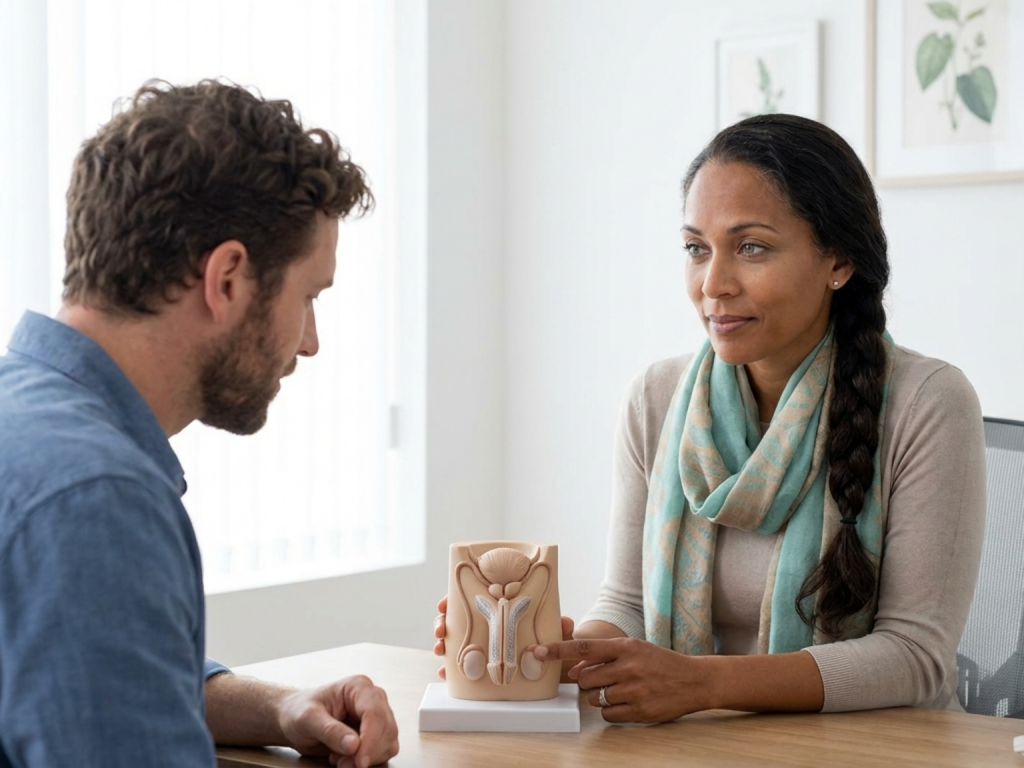
Understanding male reproductive anatomy can make fertility conversations feel less mysterious and less isolating. Sperm delivery depends on coordinated anatomy, hormones, nerves, smooth muscle contractions, glandular secretions, and sexual function; when any step is disrupted, conception may become more difficult, but many causes are evaluable and sometimes treatable.
Highlights
Sperm are produced in the testes, mature in the epididymis, and travel through the vas deferens during ejaculation.
Semen is not just sperm; most of its volume comes from accessory glands that support sperm transport and function.
Hormonal signaling through the hypothalamic-pituitary-testicular axis is essential for spermatogenesis and testosterone production.
Concerns such as low semen volume, painful ejaculation, absent ejaculation, or infertility deserve compassionate medical evaluation rather than blame.
The male reproductive tract as a delivery network
The male reproductive tract is designed to produce sperm, mature and store them, move them efficiently, and deliver them in a fluid medium during ejaculation. Its major components include the testes, epididymides, vas deferens, ejaculatory ducts, accessory sex glands, urethra, penis, and scrotum. Although often discussed as one system, each part has a specialized role, and fertility depends on the sequence working in a coordinated way.
The testes have two central functions: spermatogenesis, meaning sperm production, and endocrine activity, especially testosterone production by Leydig cells. The scrotum positions the testes outside the pelvis, helping maintain a temperature slightly below core body temperature, which supports sperm production and maturation. Within the testes, seminiferous tubules are the tightly coiled sites where developing germ cells become spermatozoa. Sertoli cells inside these tubules provide structural, nutritional, and regulatory support.
After sperm leave the testes, they enter the epididymis, a long coiled duct attached to the testis. The epididymis is not simply a storage tube; it is where sperm acquire progressive motility and functional maturation needed for fertilization. From there, sperm can be propelled through the vas deferens, a muscular duct that carries them toward the pelvis during emission, the first phase of ejaculation.
How sperm are made: spermatogenesis in the testes
Spermatogenesis in the testes is a complex, continuous biological sequence that begins with spermatogonia, the stem-like germ cells near the basement membrane of the seminiferous tubules. These cells divide by mitosis, then enter meiosis as primary and secondary spermatocytes, reducing the chromosome number so that mature sperm carry one set of chromosomes. The resulting spermatids then undergo spermiogenesis, a remodeling phase in which they form a compact head, acrosome, midpiece, and tail.
This transformation is highly dependent on endocrine signaling. Gonadotropin-releasing hormone from the hypothalamus stimulates the pituitary gland to release luteinizing hormone and follicle-stimulating hormone. Luteinizing hormone acts on Leydig cells to support testosterone production, while follicle-stimulating hormone works mainly through Sertoli cells to support germ cell development. Testosterone levels within the testes are much higher than in the bloodstream and are crucial for normal sperm output.
Sperm production and maturation take time. Because sperm seen in an ejaculate reflect events that began weeks earlier, a recent illness, heat exposure, medication change, anabolic steroid use, or hormonal disruption may not be fully reflected immediately. This timing is one reason clinicians often interpret semen analysis results in context and may repeat testing rather than relying on one sample alone.
The epididymis and vas deferens: maturation, storage, and transport
Newly released sperm from the seminiferous tubules are not yet fully motile or fertilization-ready. They pass through small collecting ducts into the epididymis, which is commonly described in three regions: head, body, and tail. During transit, sperm membranes and proteins change, and sperm gain the capacity for progressive movement. The tail of the epididymis also serves as an important storage reservoir before ejaculation.
The vas deferens is a thick-walled muscular tube that begins at the tail of the epididymis and travels through the spermatic cord, into the pelvis, and toward the prostate. During sexual climax, sympathetic nervous system activity triggers rhythmic contractions of the vas deferens. These contractions propel sperm forward as part of emission. This muscular movement matters: sperm do not simply swim the full distance from the testis to the urethra.
A male reproductive tract obstruction can occur at different levels, including the epididymis, vas deferens, ejaculatory ducts, or urethral outflow. Obstruction may be congenital, inflammatory, surgical, or acquired after infection or trauma. It is not something a person can reliably identify without evaluation. If semen volume is very low, sperm are absent from the ejaculate, or ejaculation seems abnormal, a reproductive urologist or fertility specialist can help determine whether anatomy, hormones, medication effects, or sexual function is involved.
Accessory glands and semen formation
Semen is a mixture of sperm cells and secretions from accessory glands. Sperm themselves make up only a small fraction of semen volume. The seminal vesicles contribute a large portion of the fluid, including fructose and other substances that support sperm energy and transport. The prostate adds fluid containing enzymes and proteins that influence semen consistency and liquefaction after ejaculation. Bulbourethral glands release a small amount of lubricating fluid that may help neutralize the urethra before ejaculation.
The ejaculatory ducts form where the vas deferens joins the ducts of the seminal vesicles. These ducts pass through the prostate and open into the prostatic urethra. During emission, sperm from the vas deferens mix with seminal vesicle and prostatic secretions. During expulsion, coordinated contractions of pelvic floor and urethral muscles move semen through the urethra and out through the penis.
Several semen characteristics can provide clues, though they do not diagnose a cause on their own. Low semen volume may relate to collection issues, short abstinence interval, retrograde ejaculation, ejaculatory duct obstruction, androgen deficiency, or other factors. Thick, watery, discolored, bloody, or painful ejaculation should be discussed with a clinician, especially when persistent or accompanied by urinary symptoms, fever, pelvic pain, or fertility concerns.
Erection, emission, ejaculation, and sperm delivery
Sperm delivery requires sexual arousal, penile erection sufficient for intercourse or semen collection, emission, and ejaculation. Erection is mainly a vascular event regulated by autonomic nerves: blood flow into erectile tissue increases while venous outflow is restricted. Ejaculation is a coordinated reflex involving the sympathetic, parasympathetic, and somatic nervous systems.
Emission is the movement of sperm and glandular fluids into the posterior urethra. It involves contraction of the vas deferens, seminal vesicles, and prostate. Expulsion follows, with rhythmic contractions that move semen through the penile urethra. The bladder neck normally closes during ejaculation to help direct semen outward rather than backward into the bladder.
Ejaculatory dysfunction and conception can intersect in several ways. Some people have delayed ejaculation, anejaculation, premature ejaculation, painful ejaculation, or retrograde ejaculation. Causes may include medications, diabetes-related neuropathy, spinal cord conditions, pelvic surgery, prostate procedures, psychological stress, hormonal issues, or relationship factors. These experiences can feel deeply personal, but they are medical concerns that deserve respectful care. A clinician can help distinguish between erectile function, orgasm, emission, and semen delivery problems, because each has different implications for fertility evaluation.
How anatomy relates to fertility evaluation
When pregnancy is taking longer than expected, evaluating the male partner is a standard part of couple-based care. A semen analysis commonly assesses semen volume, sperm concentration, total sperm number, motility, morphology, and sometimes pH or white blood cells. Results are best interpreted by a clinician because values vary between samples and must be considered alongside medical history, timing of collection, medications, prior surgeries, infections, and physical examination.
Clinicians may ask about puberty, testicular injury, undescended testes, mumps orchitis, cancer treatment, anabolic steroid or testosterone use, urinary symptoms, sexual function, prior vasectomy, hernia repair, or pelvic surgery. Physical examination may assess testicular size, epididymal fullness, vas deferens presence, varicocele, and signs of hormonal imbalance. Depending on findings, hormonal testing, genetic testing, scrotal ultrasound, post-ejaculatory urine testing, or specialized reproductive urology evaluation may be considered.
It is also important to approach male factor infertility without blame. Sperm delivery depends on many anatomical and physiological steps that are not under conscious control. Lifestyle factors, heat exposure, systemic illness, medications, endocrine disorders, obstruction, and genetic factors can all affect sperm output or transport. Early, compassionate assessment can reduce uncertainty and may open options such as timed intercourse guidance, medical or surgical treatment, assisted reproduction, or sperm retrieval when appropriate.
When to seek medical advice
- Seek prompt care for sudden severe testicular pain, swelling, or a high-riding testis.
- Discuss blood in semen, painful ejaculation, fever, or persistent pelvic or urinary symptoms with a clinician.
- Consult a healthcare professional if semen volume is consistently very low or ejaculation is absent.
- If pregnancy has not occurred after 12 months of trying, or after 6 months when the female partner is 35 or older, ask about fertility evaluation.
- Do not start or stop testosterone, anabolic steroids, fertility drugs, or supplements for sperm concerns without medical guidance.
Tools & Assistance
- Schedule a semen analysis through a fertility clinic, urologist, or reproductive endocrinology practice.
- Prepare a medication and supplement list, including testosterone, anabolic steroids, finasteride, antidepressants, and recreational substances.
- Track ejaculation concerns, semen volume changes, pain, urinary symptoms, and timing relative to illness or medication changes.
- Consider referral to a reproductive urologist for suspected obstruction, azoospermia, testicular concerns, or complex ejaculation problems.
FAQ
Where are sperm produced?
Sperm are produced in the seminiferous tubules of the testes, with support from Sertoli cells and hormonal signaling involving FSH, LH, and testosterone.
Is semen the same as sperm?
No. Sperm are the reproductive cells, while semen is the fluid mixture that carries them. Most semen volume comes from the seminal vesicles and prostate.
Can a person ejaculate but have no sperm in the semen?
Yes. This is called azoospermia and may be related to low sperm production, obstruction, prior surgery, genetic factors, or hormonal causes. It requires medical evaluation.
How long does sperm production take?
Sperm development and maturation take weeks, so semen results can reflect health, heat, medication, or hormonal exposures from the recent past rather than only the day of testing.
Does erection difficulty always mean infertility?
Not necessarily. Erectile function affects sperm delivery during intercourse, but sperm production may be normal. A clinician can evaluate sexual function and semen parameters separately.
Sources
- NCBI Bookshelf (StatPearls, NIH) — Physiology, Male Reproductive System
- NCBI Bookshelf (Endotext, NIH) — Endocrinology of the Testis and Spermatogenesis
- MedlinePlus (U.S. National Library of Medicine) — Sperm release pathway - Health Video
Disclaimer
This article is for informational purposes only and is not a diagnosis or treatment plan. Consult a qualified healthcare professional for personal medical or fertility concerns.
















Please log in to leave a comment.