

Intro
Trying to understand fertility after 35 or 40 can feel emotionally loaded, especially when statistics are often presented without context. Age matters, but it does not erase possibility. Many people conceive naturally or with medical support in their late 30s and early 40s, while others need evaluation sooner than they expected.
Highlights
Fertility usually declines gradually through the early 30s and more noticeably after 35, largely because egg number and egg quality change with age.
Pregnancy after 35 and 40 is possible, but the chance per menstrual cycle is lower and miscarriage risk is higher than at younger ages.
After 35, most clinicians recommend earlier fertility evaluation if pregnancy has not occurred after 6 months of well-timed intercourse.
Ovarian reserve tests can help guide treatment planning, but they do not perfectly predict whether someone can conceive naturally.
Preconception care, timely evaluation, and individualized counseling are especially important for later-life fertility decisions.
What changes after 35
Age-related fertility decline is a normal biological pattern, not a personal failure. People are born with a finite number of oocytes, and both oocyte quantity and oocyte competence decline over time. The change is usually gradual in the early 30s, becomes more clinically noticeable after 35, and often accelerates in the late 30s and early 40s.
The key issue is not only how many eggs remain, but how many are chromosomally competent. With age, a higher proportion of eggs have meiotic errors that can lead to aneuploid embryos, failed implantation, biochemical pregnancy, miscarriage, or chromosomal conditions in an ongoing pregnancy. This is why cycles may remain regular while fertility is already declining.
Population-level estimates can be useful, but they cannot predict one person’s exact outcome. A systematic review of natural fertility outcomes in women over 35 found that clinically meaningful natural conception still occurs after 35 and even into the early 40s, although probabilities fall with increasing age. Individual factors such as cycle regularity, endometriosis, tubal status, uterine health, prior pregnancies, male partner fertility, and medical conditions can shift the odds substantially.
Chances of pregnancy after 35
At 35, many people still have a realistic chance of conceiving, especially if cycles are regular and there are no major reproductive health conditions. However, fecundability by female age, meaning the probability of pregnancy in a single menstrual cycle, is lower than in the 20s or early 30s. Johns Hopkins Medicine notes that healthy couples in their 20s and early 30s may have about a 25% chance of pregnancy per cycle, while the chance is substantially lower by 40.
After 35, time becomes a more important clinical variable. For people under 35, fertility evaluation is often considered after 12 months of trying. For those 35 or older, many clinicians recommend evaluation after 6 months of regular, unprotected intercourse or donor insemination attempts. Earlier assessment may be appropriate if there are irregular cycles, known endometriosis, pelvic inflammatory disease, prior ovarian surgery, recurrent pregnancy loss, chemotherapy exposure, or a male partner with known semen abnormalities.
Preconception counseling after 35 can be useful even before trying. A clinician may review medications, chronic conditions, immunizations, thyroid status, diabetes risk, blood pressure, genetic carrier screening, folic acid intake, and lifestyle factors. This is not about creating perfect conditions; it is about identifying modifiable risks before pregnancy and avoiding unnecessary delay if fertility evaluation is warranted.
Chances of pregnancy after 40
Pregnancy after 40 is possible, but the chance per cycle is lower and the time window is often shorter. Johns Hopkins Medicine describes the chance of pregnancy per cycle by age 40 as less than 10% for many healthy couples. This estimate is a broad guide, not a guarantee. Some people conceive quickly at 40 or 41, while others with similar cycles and health histories may need assisted reproduction or may not conceive with their own eggs.
Natural conception after age 40 is influenced by more than calendar age. Regular ovulation, tubal patency, sperm count and motility, uterine anatomy, body weight extremes, smoking exposure, and medical conditions can all affect the probability. Because egg quality and chromosomal competence are central limitations, even frequent intercourse and accurate ovulation timing cannot fully overcome age-related changes.
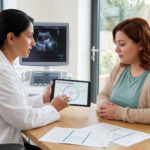
For this reason, many reproductive endocrinologists recommend prompt evaluation for people trying at 40 or older, sometimes immediately rather than waiting several months. Evaluation can include menstrual history, pelvic ultrasound, anti-Mullerian hormone testing, day-3 follicle-stimulating hormone and estradiol in selected cases, thyroid and prolactin testing if indicated, hysterosalpingography or other tubal assessment, and semen analysis. These tests help estimate treatable barriers and guide timing, but they cannot give a perfectly certain forecast.
Miscarriage and chromosomal risk
Miscarriage risk rises with maternal age, largely because chromosomal abnormalities in embryos become more common. Cleveland Clinic summarizes miscarriage risk as approximately 20% at age 35, about 33% to 40% at age 40, and about 57% to 80% at age 45. These numbers can be difficult to read, but they are meant to guide counseling, not to assign blame. Most miscarriages related to chromosomal errors are not caused by anything a person did or failed to do.
In later-life fertility, it is helpful to distinguish conception from ongoing pregnancy or live birth. A positive pregnancy test may occur, but the probability of ongoing pregnancy is affected by embryo chromosomal status, uterine factors, and general health. This is why some age-specific studies report several different outcomes: pregnancy, ongoing pregnancy, and live birth.
Genetic screening and diagnostic options may be discussed in pregnancies after 35 or 40. Noninvasive prenatal screening estimates the risk of certain chromosomal conditions using placental DNA fragments in maternal blood. Diagnostic tests such as chorionic villus sampling or amniocentesis can provide fetal chromosomal information but carry procedural considerations. Decisions about screening or diagnosis are personal and should be made with an obstetric clinician, genetic counselor, or maternal-fetal medicine specialist.
Medical evaluation and treatment options
Fertility evaluation after 35 or 40 is not a commitment to treatment. It is a way to avoid losing time to undetected issues. A basic assessment often looks at ovulation, ovarian reserve, uterine cavity, fallopian tubes, and sperm parameters. Semen analysis in fertility evaluation is important even when the female partner is older, because male-factor infertility can coexist with age-related ovarian changes.
Treatment discussions depend on age, test results, prior pregnancy history, duration of trying, and personal values. Options may include timed intercourse with ovulation tracking, ovulation induction when indicated, intrauterine insemination, in vitro fertilization, preimplantation genetic testing in selected IVF cycles, use of previously frozen eggs, donor eggs, donor sperm, donor embryos, or choosing not to pursue treatment. No option is universally right.
IVF can improve the efficiency of meeting egg and sperm and may help identify embryo development patterns, but success with own eggs still declines with age because IVF cannot reverse egg aging. Donor eggs often have higher success rates because outcomes are more closely tied to the age of the egg donor than the age of the person carrying the pregnancy. These are significant medical, emotional, financial, and ethical decisions, and counseling from a reproductive endocrinologist can help clarify realistic expectations.
Improving readiness without overpromising
Lifestyle changes cannot restore a younger ovarian reserve, but they can support overall reproductive and pregnancy health. Practical steps include stopping smoking and nicotine exposure, limiting alcohol while trying to conceive, reviewing medications for pregnancy compatibility, taking folic acid or a prenatal vitamin as advised, optimizing chronic conditions, and seeking care for irregular bleeding, pelvic pain, or very irregular cycles.
Timing intercourse around ovulation can help maximize the chance in each cycle. For many people with regular cycles, the fertile window includes the 5 days before ovulation and the day of ovulation. Ovulation predictor kits, cervical mucus changes, and cycle tracking may help, though tracking can become stressful. If tracking causes significant anxiety, a clinician can suggest a simpler approach.
It is also reasonable to discuss advanced paternal age and conception when a male partner is older, because sperm quality, DNA fragmentation, and some pregnancy risks may change with age. Later-life fertility is often framed as only a female-age issue, but conception involves both egg and sperm biology, as well as uterine and general medical factors.
Emotionally, later-life trying can feel like a race against time. Supportive care matters. That may mean earlier specialist referral, counseling for grief after losses, financial counseling for treatment choices, or discussing family-building alternatives before decisions feel urgent. Good care should combine medical realism with respect for the person behind the statistics.
When to seek medical advice promptly
- Seek fertility evaluation after 6 months of trying if you are 35 or older, and sooner if you are 40 or older.
- Get medical advice promptly for irregular or absent periods, severe pelvic pain, known endometriosis, or prior pelvic infection.
- Contact a clinician after any positive pregnancy test if you have significant pain, heavy bleeding, dizziness, or a history of ectopic pregnancy.
- Discuss recurrent pregnancy loss with a healthcare professional, even if the losses occurred early.
- Review chronic conditions and medications before pregnancy whenever possible.
Tools & Assistance
- Preconception visit with an obstetrician-gynecologist, midwife, or primary care clinician
- Fertility consultation with a reproductive endocrinologist if trying is taking longer than expected
- Ovulation predictor kits or cycle tracking used in a low-stress, practical way
- Semen analysis for the male partner or sperm source when relevant
- Genetic counseling when there is a family history, recurrent loss, or questions about prenatal screening
FAQ
Can I get pregnant naturally after 40?
Yes, natural conception after age 40 can happen, but the chance per cycle is lower and miscarriage risk is higher. A fertility evaluation is usually recommended sooner rather than waiting a full year.
Does a normal period mean fertility is normal after 35?
Not necessarily. Regular cycles suggest ovulation may be occurring, but egg quality and chromosomal risk still change with age. Ovarian reserve and egg competence are not fully reflected by cycle regularity.
When should I see a fertility specialist after 35?
Many clinicians recommend evaluation after 6 months of trying at 35 or older. At 40 or older, it is reasonable to seek advice promptly, especially if treatment options would be considered.
Can lifestyle changes reverse age-related fertility decline?
Lifestyle changes can support general reproductive health and pregnancy readiness, but they cannot reverse the age-related decline in egg number or egg quality.
Is IVF a guarantee after 40?
No. IVF may improve efficiency and offer additional information, but success with own eggs still declines with age. A fertility specialist can explain realistic probabilities for your situation.
Sources
- PubMed — Age-related natural fertility outcomes in women over 35 years: a systematic review
- Cleveland Clinic — Advanced Maternal Age: Pregnancy After 35
- Johns Hopkins Medicine — Advanced Maternal Age
Disclaimer
This article is for informational purposes only and is not a substitute for medical advice, diagnosis, or treatment. Consult a qualified healthcare professional for guidance based on your health history and fertility goals.















Please log in to leave a comment.