
Intro
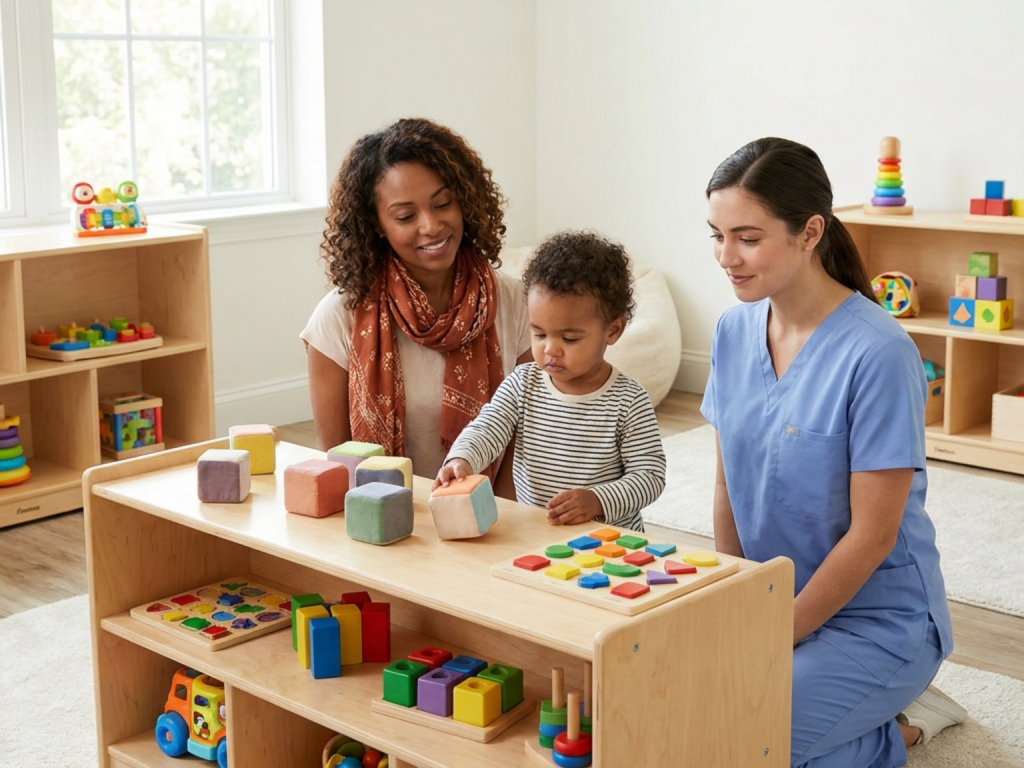
Choosing toys can feel joyful and stressful at the same time. Many caregivers want toys that are safe, engaging, and genuinely helpful for a child’s growth, but age labels, marketing claims, and rapidly changing abilities can make the decision feel less straightforward than it should be.
A helpful way to think about toys is developmental rather than simply commercial: the best toy is one that matches the child’s current motor skills, cognition, language, social awareness, and safety needs while leaving room for imagination. If a child has developmental delays, sensory differences, motor limitations, or medical concerns, individualized guidance from a pediatrician, occupational therapist, speech-language pathologist, or other qualified clinician can be especially valuable.
Highlights
Age-appropriate toys support cognitive, motor, language, social, and emotional growth when they match a child’s current abilities.
Open-ended toys often offer more developmental value than highly automated toys because they invite problem-solving, conversation, pretend play, and caregiver interaction.
Safety matters at every age: choking hazards, magnets, button batteries, cords, projectiles, and unstable climbing equipment require careful attention.
Children may not fully use toys designed for older ages, so a more advanced label does not necessarily mean a better learning opportunity.
Why age matters when choosing toys
Toys are not just entertainment. In early childhood, play is a major route for sensorimotor learning, language exposure, social reciprocity, problem-solving, and self-regulation. The American Academy of Pediatrics emphasizes that toys should encourage imagination, caregiver-child interaction, and language-rich play rather than passive consumption. A toy that allows a child to make choices, test ideas, and involve another person is often more valuable than one that performs the activity for the child.
Age matters because the nervous system, musculoskeletal control, attention span, and symbolic thinking change quickly. A 9-month-old explores primarily through mouthing, banging, dropping, and repeating actions. A 4-year-old may use the same block as a house, a road, or a spaceship, reflecting more advanced symbolic play. A 7-year-old can often follow rules, plan strategies, compare outcomes, and persist through more complex games.
Research on children’s toy utilization suggests that children are less likely to fully use toys targeted to older age groups. This is clinically intuitive: a puzzle, board game, or construction set that exceeds a child’s working memory, fine motor control, or frustration tolerance may create avoidance rather than learning. Developmentally appropriate toys offer a manageable challenge, not a constant sense of failure.
It is also important to consider the individual child. Prematurity, neurodevelopmental differences, visual or hearing impairment, motor disability, chronic illness, and sensory processing differences may change what is appropriate. Age labels can guide safety and broad expectations, but they do not replace observation or professional input when concerns exist.
Birth to 12 months: sensory exploration, attachment, and safe movement
During the first year, toys should support sensory exploration, early motor control, and warm interaction with caregivers. Infants learn through looking, listening, touching, mouthing, reaching, rolling, sitting, crawling, and eventually pulling to stand. Safe objects with varied textures, gentle sounds, and simple cause-and-effect features are usually more useful than complex electronic toys.
Helpful choices include soft rattles, unbreakable mirrors designed for infants, textured teethers, soft fabric books, high-contrast images for young infants, nesting cups, large rings, and toys that can be grasped with the whole hand. As babies gain trunk control, floor play objects that encourage reaching, pivoting, and crawling can support gross motor practice. Supervised tummy time while awake is not a toy itself, but a simple mat and a few interesting objects can make it more engaging.
Caregiver participation is central. A baby benefits when an adult labels objects, imitates sounds, responds to gaze, and creates predictable turn-taking routines. For example, gently rolling a soft ball back and forth with an older infant introduces reciprocity before formal language emerges.
Safety is the dominant issue in this age group. Toys must be too large to choke on, free of detachable small parts, washable, and without cords, sharp edges, button batteries, or loose magnets. Because infants explore with their mouths, damaged toys should be removed. If an infant has feeding, swallowing, respiratory, seizure, or motor concerns, ask a healthcare professional about safe positioning and appropriate play materials.
12 to 24 months: cause and effect, early language, and emerging independence
One-year-olds are active investigators. They enjoy putting objects in and out, stacking, dumping, pushing, pulling, opening, closing, and repeating actions to see what happens. This is a period of rapid receptive language growth, early expressive words, and increasing mobility. Toys should allow experimentation while staying sturdy and safe.
Good options often include large blocks, shape sorters with simple pieces, nesting cups, push-pull toys, bath toys without mold-trapping holes, chunky board books, large-piece simple puzzles, toy telephones, soft dolls, toy vehicles without small parts, and containers for filling and emptying. The goal is not to drill skills but to create meaningful repetition. A caregiver saying, “The cup is in,” “Now it is out,” or “You found the red block” turns simple play into language learning.
At this age, children may also begin pretend actions such as feeding a doll, stirring in a bowl, or pretending to talk on a phone. These actions are early foundations for symbolic play, social understanding, and later narrative language. Toys that reflect everyday routines are often especially engaging because toddlers are highly motivated to imitate adults.
Expect short attention spans and frequent shifts. This is typical, not a sign that a toy has failed. Rotating a small number of toys can reduce overstimulation and help toddlers focus. For families thinking about how children learn by age, toddler play is a reminder that repetition, movement, and responsive adult language are often more powerful than formal instruction.
2 to 3 years: pretend play, fine motor practice, and problem-solving
Between ages 2 and 3, children often show more purposeful pretend play, stronger hand use, better problem-solving, and growing emotional intensity. They may enjoy toys that let them copy real-life roles, build simple structures, draw, sort, match, and solve basic challenges. Frustration can appear quickly because ambition often exceeds motor and language skills.
Useful toys include chunky puzzles with a few large pieces, simple matching games, large crayons, washable markers used with supervision, play kitchens, pretend food, dolls, animal figures, toy tools, large interlocking blocks, simple musical instruments, and balls for kicking or rolling. NAEYC notes that toddlers can benefit from puzzles, pretend play materials, and objects for sorting and building when these match their abilities.
Caregivers can support development by narrating play and adding just enough challenge. If a child stacks three blocks, an adult might wonder aloud whether one more block will fit. If a child pretends to cook, an adult can ask who is hungry or what happens next. This scaffolding strengthens language, sequencing, and flexible thinking without turning play into a test.
Two-year-olds still need close supervision. Small parts, long strings, weak battery compartments, and toys meant for older siblings can be hazardous. Sharing is also limited at this age because self-regulation and perspective-taking are immature. Parallel play, where children play near each other rather than cooperatively, is developmentally normal.
3 to 5 years: imagination, early executive function, and social play
Preschoolers are often ready for richer pretend play, more complex construction, art materials, dress-up items, cooperative games, and early rule-based activities. Their symbolic thinking expands, and they may turn ordinary objects into elaborate scenarios. This makes open-ended materials particularly valuable.
Good choices include construction sets with appropriately sized pieces, wooden blocks, pretend medical kits, dress-up clothes, puppets, play scenes, simple board games, matching or memory games, 4-to-12-piece puzzles depending on ability, child-safe scissors, glue sticks, clay or dough, easels, and outdoor play equipment used with supervision. These toys can support fine motor coordination, visual-spatial reasoning, narrative language, social negotiation, and early executive function in preschool learning.
Preschoolers also benefit from toys that promote cooperative problem-solving. Simple board games can teach turn-taking, waiting, rule-following, and coping with losing. These are neurological skills as much as manners: inhibitory control, working memory, and cognitive flexibility are still developing. Adults can help by keeping games short, modeling calm responses, and adapting rules when needed.
Digital or highly automated toys should not dominate play. When a toy talks constantly, flashes continuously, or dictates the script, children may have fewer opportunities to generate ideas or converse with caregivers. AAP guidance favors toys that encourage imagination and interaction rather than overstimulation. For play-based learning in preschoolers, the adult relationship and the child’s active thinking matter more than the toy’s technical features.
6 to 8 years: rules, strategy, competence, and broader interests
In the early school-age years, many children become more capable of sustained attention, multi-step planning, rule-based games, organized sports, detailed art, science kits, and construction projects. Research on toy utilization identifies older children as better able to use games, puzzles, instructional toys, arts materials, and sports-related toys than younger children, although individual interests and abilities still vary.
Appropriate options may include board games with strategy, card games, larger puzzles, building kits, craft sets, beginner science materials, sports equipment, jump ropes, model-making kits, coding toys with clear safety and privacy protections, and books or props linked to imaginative worlds. These toys can support working memory, planning, persistence, numeracy, spatial reasoning, and social competence.
School-age children often care about mastery. A toy that allows visible progress, such as completing a model, learning a magic trick, improving a jump-rope pattern, or solving a puzzle, can strengthen confidence. At the same time, caregivers should watch for perfectionism or distress. The best challenge is one the child can approach with effort and support, not one that repeatedly leads to shame.
Safety shifts rather than disappears. Art kits, chemistry sets, magnets, projectiles, and sports equipment require age-appropriate rules and supervision. Helmets and protective gear may be needed for wheeled activities. Families may also want to review child safety basics by age as children gain independence outside the home.
Adapting toy choices for individual needs
Age-based guidance is useful, but it should be flexible. A child with delayed fine motor skills may benefit from larger pieces for longer. A child with strong visual-spatial skills may enjoy advanced construction sets earlier, provided safety risks are controlled. A child with sensory sensitivities may prefer quieter toys, predictable textures, or fewer flashing lights. A child with low vision, hearing differences, cerebral palsy, autism spectrum disorder, intellectual disability, or chronic fatigue may need adapted toys or modified play routines.
Helpful adaptation principles include choosing toys that match the child’s current functional skills, reducing unnecessary sensory load, supporting comfortable positioning, and making success visible. Switch-adapted toys, larger grips, Velcro modifications, high-contrast materials, auditory cues, or simplified rules can make play more accessible. Occupational therapists, physical therapists, speech-language pathologists, developmental pediatricians, and early intervention teams can help tailor options.
Caregivers should seek professional advice if play skills regress, a child loses language or social engagement, motor asymmetry is persistent, mouthing of unsafe objects continues beyond expected stages in a dangerous way, or frustration severely limits daily activities. Toys do not diagnose or treat developmental conditions, but play observations can provide useful information for clinicians.
Above all, the child’s relationship with caregivers remains the most powerful part of play. A modest set of safe, flexible toys plus responsive adult attention is usually more beneficial than an overflowing room of expensive products. The aim is not to accelerate childhood but to meet the child with warmth, safety, and opportunities to explore.
Safety cautions
- Avoid toys with button batteries, loose magnets, or detachable small parts for young children unless strict age guidance and supervision are followed.
- Check toys regularly for broken pieces, sharp edges, loose stitching, peeling paint, or weak battery compartments.
- Keep older siblings’ small toys away from infants and toddlers who may mouth objects.
- Use protective gear and close supervision for wheeled toys, climbing equipment, projectiles, and sports equipment.
- Consult a pediatric healthcare professional if play skills regress, motor skills appear asymmetric, or sensory distress significantly limits play.
Tools & Assistance
- Create a small toy rotation to reduce overstimulation and increase focused play.
- Read age labels for safety, then also judge the toy by the child’s current abilities.
- Ask your pediatrician or early intervention program about developmental concerns observed during play.
- Choose open-ended toys that invite conversation, pretending, building, sorting, or movement.
- Inspect toys monthly and remove damaged, recalled, or unsafe items.
FAQ
Are electronic learning toys better for development?
Not necessarily. Toys that invite active play, imagination, caregiver conversation, and problem-solving are often more developmentally useful than toys that mainly flash, talk, or entertain passively.
Should I buy toys labeled for an older age to challenge my child?
Usually it is better to choose a manageable challenge. Toys designed for much older children may be unsafe or too complex, and children may not use them fully.
What if my child prefers toys for a younger age?
This can be normal, especially during stress or transitions. If the preference comes with loss of skills, major social withdrawal, or developmental concerns, discuss it with a healthcare professional.
How many toys does a child need?
Fewer, well-chosen toys are often enough. A small rotation of safe, open-ended toys can support deeper attention and more creative play.
Can toys help with speech and language?
Toys can support language when adults use them for shared attention, naming, turn-taking, pretend play, and conversation. They are not a substitute for speech-language evaluation when delays are suspected.
Sources
- National Institutes of Health (NIH) - PMC — Children's Utilization of Toys is Moderated by Age
- American Academy of Pediatrics — Selecting Appropriate Toys for Young Children in the Medical Home
- National Association for the Education of Young Children — Good Toys for Young Children by Age and Stage
Disclaimer
This article is for general educational purposes and does not provide medical diagnosis or treatment. Consult a qualified healthcare professional for concerns about your child’s development, safety, or medical needs.














Please log in to leave a comment.