
Intro
Teenagers are surrounded by products that promise clearer skin, better hygiene, athletic performance, social confidence, sleep, focus, and self-expression. Many are harmless when used appropriately, but some become risky when they are layered, overused, shared online as trends, or chosen without considering adolescent physiology.
This article focuses on common teen product mistakes, especially skin care and personal care products, while also addressing safety, marketing pressure, and when to involve a healthcare professional. The goal is not to shame teens or parents, but to make product choices calmer, safer, and more evidence-informed.
Highlights
Teen skin is not adult skin; aggressive routines can irritate the epidermal barrier and increase photosensitivity.
Viral product routines often normalize using many active ingredients at once, even when a simpler regimen would be safer.
Personal care products may contain fragrance, preservatives, plasticizers, and antimicrobial chemicals that deserve thoughtful use, especially during puberty.
The safest approach usually starts with fewer products, age-appropriate claims, patch testing when advised, and professional guidance for persistent symptoms.
Why teen product mistakes happen
Teen product mistakes often begin with normal developmental needs: belonging, privacy, body awareness, and experimentation. Adolescence is a period of sebaceous gland activation, hormonal fluctuation, sweating, body odor, acne, menstrual changes for many teens, and intense social comparison. Products can feel like tools for control at a time when the body is changing quickly.
The problem is that marketing and social media rarely separate cosmetic preference from medical need. A teen may see a routine involving cleanser, toner, exfoliating acid, vitamin C serum, retinoid-like product, spot treatment, moisturizer, oil, mask, and sunscreen, then assume more steps mean better care. In reality, more steps increase exposure to irritants, allergens, and incompatible ingredients.
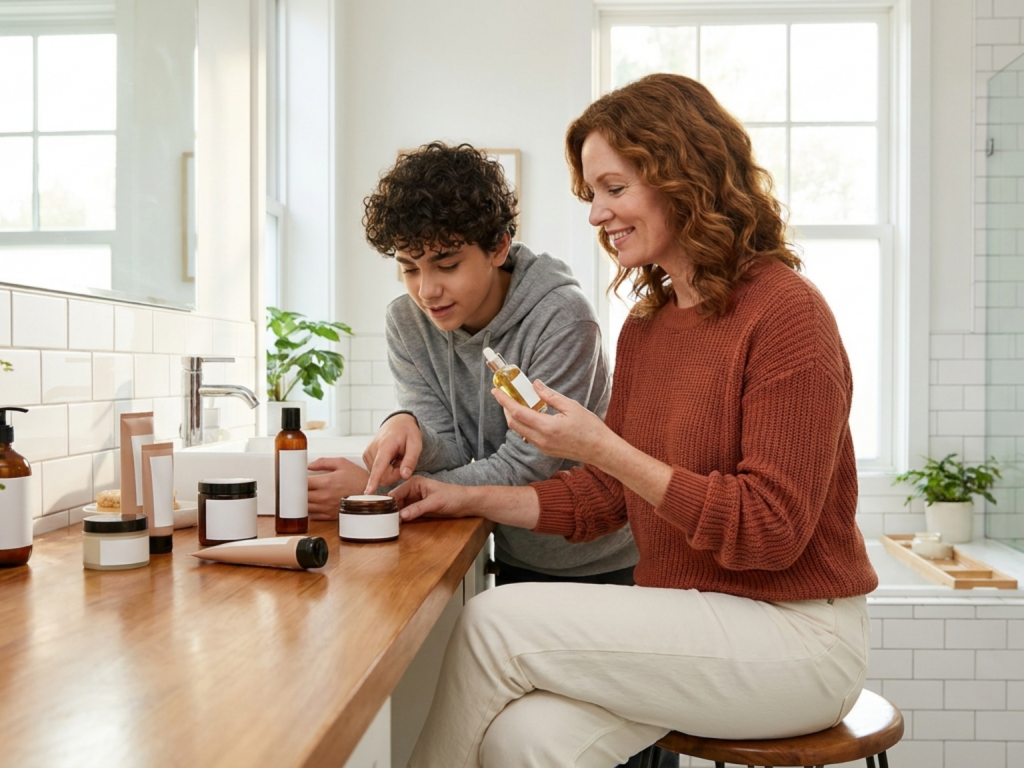
Parents can also unintentionally contribute. Buying adult anti-aging products for a teen, stocking strong acne treatments without guidance, or treating every breakout as a hygiene failure may push adolescents toward harsh routines. A supportive approach asks what the teen wants the product to do, checks whether the claim is realistic, and starts with the least complex option.
Over-layering active skin-care ingredients
One of the most common teen product mistakes is stacking multiple active ingredients. Northwestern University researchers reported that highly viewed TikTok teen skin-care videos included an average of 11 potentially irritating active ingredients, including acids such as salicylic and glycolic acid. These ingredients can be useful in the right context, but adolescent skin may become inflamed when several are used together or applied too often.
The skin barrier, especially the stratum corneum and lipid matrix, limits water loss and blocks irritants. Excess exfoliation can disrupt this barrier, causing burning, stinging, erythema, scaling, tightness, or paradoxical oiliness. Irritant contact dermatitis can resemble acne, which may lead a teen to add even more products. Allergic contact dermatitis is also possible, especially with fragrance, botanicals, preservatives, and repeated exposure.
A safer default is a simple routine: gentle cleansing, non-comedogenic moisturizer if needed, and broad-spectrum sunscreen. If an active ingredient is being considered, it is usually safer to introduce only one at a time and to stop if significant irritation appears. Persistent acne, painful cysts, pigment changes, or scarring risk should be discussed with a clinician rather than treated by escalating random products.
Confusing acne care with aggressive stripping
Acne is common in adolescence and is not caused simply by being dirty. It involves follicular plugging, sebum, Cutibacterium acnes, inflammation, genetics, hormones, and sometimes medication or cosmetic triggers. Teens may scrub, use alcohol-based astringents, wash repeatedly, or combine several acne products because they feel embarrassed or desperate. This can worsen irritation and make adherence harder.
Common acne-product mistakes include using products meant for adult photoaging, applying spot treatments over the entire face without understanding the label, mixing exfoliating acids with retinoid-type products without guidance, and skipping moisturizer because the skin is oily. Another mistake is abandoning sunscreen. Some acne-related ingredients and exfoliants can increase sun sensitivity, and post-inflammatory hyperpigmentation may become more noticeable after ultraviolet exposure.
Families can help by framing acne as a treatable inflammatory skin condition, not a character problem. If over-the-counter products are not helping, if acne is painful, if the teen is distressed, or if there is scarring, a pediatrician or dermatologist can discuss evidence-based options. Teen problems solutions often work best when the emotional impact of visible skin changes is taken as seriously as the physical symptoms.
Ignoring fragrance, preservatives, and endocrine-active chemicals
Personal care products may include fragrance mixtures, parabens, phthalates, musks, triclosan, and other substances used for scent, preservation, texture, or antimicrobial effects. The Environmental Working Group reported that teen girls in its research had body burdens of several hormone-altering cosmetic chemicals, including phthalates, triclosan, parabens, and musks. The concern is not that every exposure causes immediate illness, but that puberty is a hormonally sensitive period and cumulative exposure is difficult for families to evaluate.
Medical readers will recognize that endocrine disruption is complex: dose, timing, route of exposure, metabolism, mixture effects, and individual susceptibility all matter. The practical takeaway is not panic, but selectivity. Products that stay on the skin, are used daily, or are applied to large surface areas deserve more scrutiny than occasional rinse-off products.
Helpful habits include choosing fragrance-free products when possible, avoiding unnecessary antimicrobial body products unless medically advised, using fewer leave-on cosmetics, and checking ingredient lists for known personal allergens. Teens with eczema, asthma, allergic rhinitis, or prior contact dermatitis may be more vulnerable to fragrance-related irritation or allergy and should be especially cautious.
Buying products too young or for the wrong developmental stage
Another mistake is treating tweens and younger teens as miniature adults. News coverage of the Northwestern research highlighted concern that girls as young as 7 were using skin-care treatments considered inappropriate by doctors. Even among teenagers, developmental stage matters. A 13-year-old with mild comedonal acne does not need the same product logic as a 19-year-old managing persistent inflammatory acne under medical care.
Adult anti-aging products are a frequent mismatch. Peptides, strong exfoliants, brightening blends, retinoid-like cosmetics, eye creams, and resurfacing masks are often marketed as sophisticated self-care, but they may provide little benefit for young skin and increase irritation risk. Similarly, heavily scented body sprays, intimate washes, whitening products, and harsh deodorant combinations can provoke dermatitis or mucosal irritation.
Age-appropriate product selection should ask: What problem are we solving? Is there a medical symptom? Is the product necessary, or mainly a trend? Could it interfere with skin barrier function, sleep, breathing, or genital comfort? For younger teens, parent involvement remains appropriate, but it should be collaborative. Respecting a teen’s wish to feel confident makes it easier to set boundaries around unsafe or unnecessary products.
Sunscreen, tanning, and light-based product errors
Teen product mistakes are not limited to creams and serums. Sunscreen is often used too sparingly, applied only on beach days, skipped because it feels greasy, or abandoned when acne develops. Yet ultraviolet exposure contributes to burns, photoaging, dyspigmentation, and long-term skin cancer risk. Teens using exfoliating acids or acne products may be more susceptible to sun sensitivity, making consistent photoprotection even more important.
Indoor tanning products and tanning beds are a separate concern. A cosmetic desire for a tan can normalize avoidable ultraviolet exposure. Self-tanning lotions may be a lower-UV alternative, but they still require attention to ingredients, patch testing for sensitive skin, and sunscreen because they do not provide reliable sun protection.
At-home light devices, pore vacuums, extraction tools, and dermaplaning kits can also cause problems. Burns, bruising, broken capillaries, infection, and scarring are possible when devices are used aggressively or on inflamed skin. If a product seems to promise medical-level results at home, families should pause and consider professional advice before use.
Sharing, borrowing, and hygiene mistakes
Teens often share cosmetics, razors, lip products, hair tools, sports gear, earbuds, and deodorants. Sharing may feel generous or socially normal, but it can transmit microorganisms or irritants. Lip products can spread herpes simplex virus if someone has an active or impending cold sore. Eye makeup can contribute to conjunctivitis or eyelid irritation. Razors can cause microtrauma and may transmit blood-borne pathogens in rare but serious circumstances if contaminated with blood.
Product hygiene matters. Makeup sponges, brushes, and reusable applicators can accumulate oils and microbes. Expired products may separate, lose preservative effectiveness, or irritate. Pump bottles are generally less contamination-prone than jars repeatedly touched with fingers. Teens who play sports may need guidance on laundering gear, showering after heavy sweating, and avoiding occlusive products under helmets or pads if folliculitis develops.
Good hygiene should not become compulsive or punitive. The message is practical: do not share items that touch lips, eyes, broken skin, or mucous membranes; replace visibly changed or expired products; clean applicators; and seek care for spreading redness, pus, fever, painful swelling, or recurrent infections.
How to guide teens without power struggles
Product conversations can quickly become arguments because products are tied to identity, peer belonging, gender expression, and privacy. A teen who feels mocked may hide products or follow online advice more closely. A better strategy is shared decision-making: acknowledge the appeal, review the ingredient or device together, agree on a small trial if reasonable, and define stop signs such as burning, swelling, rash, or worsening acne.
Parents can set a family product budget, require safety checks for new actives or devices, and keep a simple list of what the teen is using. This is especially useful before a dermatology or pediatric visit. If a teen has anxiety, body dysmorphia concerns, disordered eating behaviors, compulsive grooming, or severe distress related to appearance, the product issue may be a visible sign of deeper distress. In that case, compassionate mental health support is appropriate.
Teens deserve autonomy, but autonomy grows best with accurate information. The safest product culture at home is not anti-beauty or anti-self-care. It is pro-skin barrier, pro-evidence, pro-budget, and pro-asking for help when a product causes harm.
Seek professional advice promptly if
- A product causes facial swelling, wheezing, throat tightness, or widespread hives.
- Skin becomes painful, blistered, oozing, or rapidly spreading in redness.
- Acne is scarring, cystic, very painful, or causing significant emotional distress.
- A teen uses bleaching, tanning, intimate, or device-based products in a way that causes injury.
- There are signs of infection, fever, pus, or worsening rash despite stopping the product.
Tools & Assistance
- Keep a written or photo inventory of all products used on the face, hair, body, and intimate areas.
- Use a one-new-product-at-a-time rule so irritation triggers are easier to identify.
- Ask a pediatrician, dermatologist, pharmacist, or allergist about persistent rashes or acne.
- Choose fragrance-free, non-comedogenic, and age-appropriate products when possible.
- Check recall notices and discard expired or visibly changed cosmetics and personal care items.
FAQ
Is a long skin-care routine unsafe for every teen?
Not always, but long routines increase the chance of irritation, allergy, cost, and ingredient overlap. Most teens do better starting simple and adding products only for a clear reason.
Can teens use salicylic acid or glycolic acid?
Some teens can tolerate certain active ingredients, but using several at once or using them too often can damage the skin barrier. A clinician can help if acne or irritation persists.
Are natural or botanical products safer?
Not automatically. Essential oils, plant extracts, and fragrance components can irritate skin or trigger allergic contact dermatitis, especially with repeated use.
When should a teen see a dermatologist?
Consider dermatology care for painful acne, scarring, persistent rash, pigment changes, suspected allergy, or any skin problem that is affecting sleep, school, or mental well-being.
Sources
- Northwestern University — TikTok teen skin-care routines are harmful
- Environmental Working Group — Teen Girls' Body Burden of Hormone-Altering Cosmetics Chemicals
- ABC7 News — Tween skincare: Research finds girls using treatments doctors say should not be used amid TikTok trend
Disclaimer
This article is for informational purposes only and does not diagnose, treat, or replace medical care. Consult a pediatrician, dermatologist, pharmacist, or other qualified healthcare professional for individual advice.
















Please log in to leave a comment.