
Intro
Screen time in adolescence is not simply a parenting issue; it is part of school, friendships, identity, entertainment, and sometimes safety. For teens ages 13 to 18, the goal is usually not total avoidance, but a healthier balance that protects sleep, mental health, movement, learning, and family connection.
Many caregivers feel worried, guilty, or stuck in conflict about devices. A supportive approach works best: understand the pattern, identify what screens are replacing, reduce the highest-risk habits, and involve the teen in practical decisions.
Highlights
High recreational screen use is common in teens, and many adolescents exceed 4 hours per day outside schoolwork.
The strongest concerns are not only total minutes, but late-night use, social media stress, sedentary time, sleep disruption, and displacement of protective activities.
A realistic plan should be collaborative, specific, and flexible enough for school demands, friendships, neurodevelopmental needs, and family circumstances.
Sudden mood changes, sleep deterioration, school decline, or loss of offline interests deserve careful attention and may warrant professional support.
What counts as teen screen time
For ages 13 to 18, screen time includes smartphones, tablets, computers, televisions, gaming consoles, streaming platforms, messaging, video calls, social media, and school-based digital work. It helps to separate required screen use, such as homework or educational platforms, from recreational screen use, such as gaming, scrolling, streaming, and social messaging.
This distinction matters because research findings often focus on non-schoolwork screen time. A teen who spends hours on a laptop for assignments is not in the same risk category as a teen who is awake until 2 a.m. scrolling short-form videos, although both may experience eye strain, sedentary behavior, or sleep delay. Teen recreational screen time is most concerning when it displaces sleep, physical activity, meals, in-person relationships, or emotional recovery.
It is also useful to look at the pattern rather than a single daily number. A weekend gaming session after a week of good sleep, exercise, and school engagement may have a different impact than nightly device use in bed. Families can ask: What is the screen being used for? When is it used? What feelings come before and after? What important activities are being pushed aside?
How much screen time is typical from 13 to 18 years
Current data suggest that high media use is common in adolescence. The American Academy of Pediatrics reports that, from 2015 to 2021, teens ages 13 to 18 averaged about 8 hours and 39 minutes of media use per day. In that report, girls averaged about 8 hours and 2 minutes, while boys averaged about 9 hours and 16 minutes. Teens also spent about 1.5 hours daily on social media platforms such as Instagram and Snapchat.
CDC data on U.S. adolescents found that more than half, 50.4%, reported 4 or more hours of daily non-schoolwork screen time. This matters because the same study found significant associations between 4 or more hours of non-school screen time and several health-related concerns, including depressive symptoms, anxiety symptoms, infrequent physical activity, poor sleep routines, and weight concerns.
These numbers can be reassuring in one way: if your teen uses screens a lot, your family is not unusual. But common does not always mean harmless. Instead of using averages as permission or as a reason for shame, it is better to use them as a starting point for a calmer conversation: “Many teens use screens this much. Let’s see whether it is working for your sleep, mood, school, body, and relationships.”
Health outcomes linked with high screen use
Research does not prove that screen time alone causes every health problem associated with it. Many factors interact, including family stress, sleep schedules, bullying, neurodevelopmental conditions, socioeconomic context, academic pressure, and baseline mental health. Still, the associations are clinically important.
In the CDC study, adolescents with 4 or more hours of daily non-schoolwork screen time had higher reported rates of depressive symptoms and anxiety symptoms than those with less screen time. Depressive symptoms were reported in 25.9% versus 9.5%, and anxiety symptoms in 27.1% versus 12.3%. The same high-screen group was also more likely to report infrequent physical activity, poor sleep routines, and weight concerns.
A review indexed through NIH/PubMed Central describes multiple health consequences associated with excessive screen time in children and adolescents, including obesity, sleep disorders, depression, anxiety, and lower school performance. It notes that each additional hour of screen time was associated with a 13% increase in the chance of obesity in reviewed evidence, and that more than 3 hours per day was associated with increased likelihood of depression and anxiety in adolescents.
Families should interpret these findings with nuance. A teen with depression may retreat into screens because they feel exhausted or socially overwhelmed; screen use can be both a contributor and a coping strategy. The practical response is not blame. It is to reduce risk while also addressing the underlying emotional, social, medical, or academic needs.
Sleep, circadian rhythm, and night-time devices
Sleep is often the first place screen effects become visible. Adolescents naturally develop a later sleep-wake rhythm during puberty, but early school start times can create chronic sleep restriction. Screens can worsen this through time displacement, emotional arousal, gaming reward loops, social pressure to respond, and light exposure that may delay melatonin signaling.
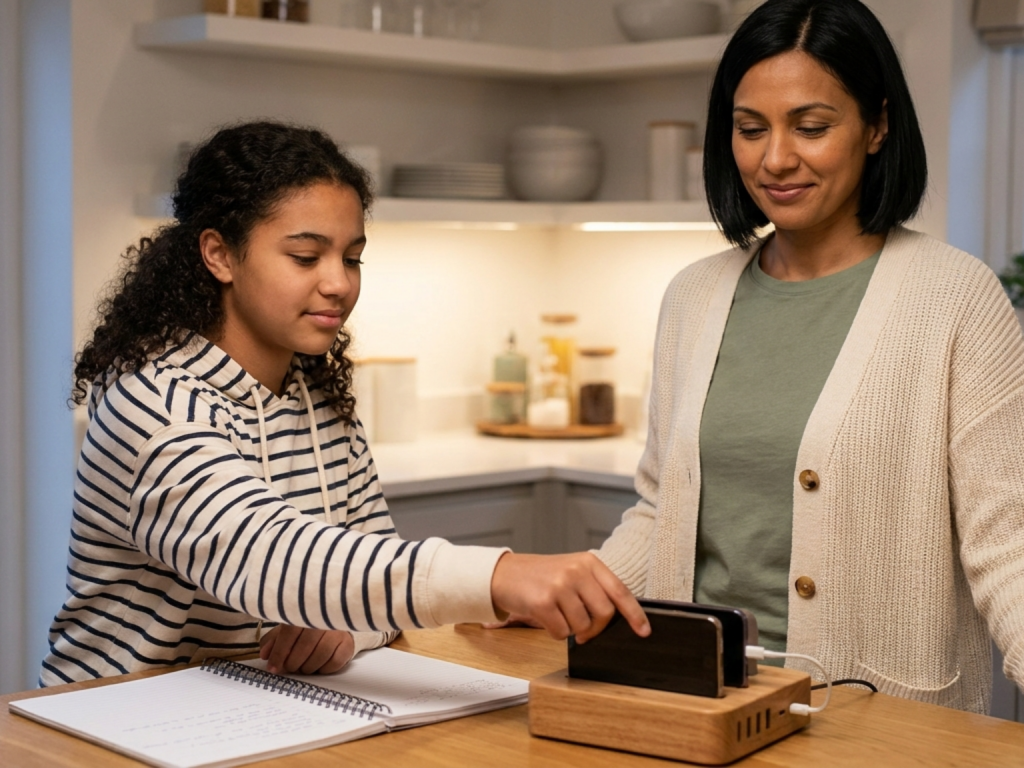
A screen-free time before bed is one of the highest-yield changes. For many families, this means setting a device curfew 30 to 60 minutes before sleep, charging phones outside the bedroom, turning off autoplay, and using a non-phone alarm clock. If that feels too abrupt, start with the most vulnerable nights, such as school nights before tests or early practices.
Sleep-related warning patterns include taking a phone to bed and losing track of time, waking during the night to check notifications, morning headaches or fatigue, falling asleep in class, weekend “catch-up” sleep that is extreme, and escalating conflict when devices are removed overnight. These patterns do not necessarily indicate addiction, but they do suggest that the device environment is interfering with physiologic recovery.
Teens are more likely to cooperate when sleep goals are framed around what they care about: sports performance, mood stability, clearer skin routines, driving safety, concentration, or less morning stress. A rule that sounds like control may be resisted; a rule connected to a valued outcome is easier to test.
Mental health, social media, and emotional regulation
Teen social media risk management is not only about deleting apps. Social platforms can provide belonging, humor, information, creative expression, and support for marginalized teens. They can also intensify comparison, body dissatisfaction, cyberbullying, compulsive checking, fear of missing out, exposure to self-harm content, and sleep disruption.
Families can help teens notice their own physiologic and emotional responses. Useful questions include: Which apps leave you calmer, connected, or inspired? Which ones leave you irritable, ashamed, anxious, or numb? Do you use screens to recover from stress, or to avoid feelings that later become bigger? Do online interactions feel reciprocal, or do they feel performative and exhausting?
Practical steps may include disabling nonessential notifications, removing apps from the home screen, setting app timers, unfollowing accounts that trigger distress, avoiding social media during meals and homework blocks, and agreeing on a plan for cyberbullying or unwanted sexual content. Teens should know they can ask for help without automatically losing all device access; fear of punishment can make them hide serious online harms.
If a teen shows persistent sadness, panic symptoms, self-harm thoughts, severe withdrawal, eating or body-image concerns, or major changes in functioning, screen limits alone are not enough. A pediatrician, adolescent medicine clinician, licensed therapist, or school mental health professional can help assess the broader picture and recommend appropriate care.
Movement, weight concerns, and sedentary behavior
Screen time can affect health through sedentary behavior and displacement of physical activity. A teen may not be harmed by a movie night, but long daily periods of sitting, snacking while distracted, and skipping outdoor or social activities can contribute to weight concerns, reduced cardiorespiratory fitness, musculoskeletal discomfort, and lower mood.
The goal is not to use weight as a source of shame. Weight stigma can worsen mental health and health behaviors. A better approach is to support body function: regular meals, enjoyable movement, strength, stamina, sleep, and confidence. Adolescent physical activity planning should include the teen’s preferences, not only adult ideals. Walking with friends, dance, cycling, gym workouts, martial arts, team sports, active commuting, and recreational games can all be valid.
Families can pair screen boundaries with attractive alternatives rather than simply removing devices. For example: after school snack first, 20 minutes outside, then gaming; streaming only after homework and movement; or a standing stretch break every episode. Some teens benefit from structured belonging in adolescence, such as clubs, sports, volunteering, theater, music, or youth groups, because screens become less central when offline life feels meaningful.
For teens with chronic illness, disability, neurodivergence, or social anxiety, activity plans may need adaptation. A clinician, physical therapist, occupational therapist, or school team can help make movement safe and realistic.
School, attention, and family conflict
Digital schoolwork complicates screen rules. Many teens need devices for assignments, calendars, group projects, and communication with teachers. The challenge is that school platforms sit beside entertainment, messaging, and algorithmic content designed to capture attention.
Helpful strategies include creating separate homework and recreation profiles when possible, using website blockers during study blocks, keeping the phone across the room during assignments, and using short timed intervals with planned breaks. Caregivers can ask to see the assignment portal without monitoring every message. The aim is accountability with dignity.
Family conflict often escalates when rules are vague: “Get off your phone” is less effective than “Phones charge in the kitchen at 10 p.m. on school nights” or “Gaming starts after homework is submitted and dinner is finished.” A Family Media Use Plan can help convert repeated arguments into written expectations. The plan should include school nights, weekends, sleep, meals, car rides, homework, privacy, online safety, and what happens when expectations are not met.
Consequences should be proportionate and predictable. Removing all access for weeks may backfire if it cuts off school communication and healthy peer connection. Shorter resets, collaborative problem-solving, and restoring trust through specific behaviors are usually more sustainable.
A practical reset plan for families
A screen reset does not have to be dramatic. Start with a 7-day observation period: track approximate recreational screen time, bedtime, wake time, mood, physical activity, homework completion, meals, and conflict. Avoid using the data to shame the teen; use it to identify the most important pressure point.
Then choose two or three changes, not ten. High-impact options include:
- Charge devices outside the bedroom on school nights.
- Create a screen-free meal or family connection time most days.
- Set app-specific limits for the platforms that cause the most distress or time loss.
- Protect one daily movement period, even if brief.
- Turn off autoplay and nonessential notifications.
- Agree on a help-seeking plan for cyberbullying, sexual pressure, threats, or self-harm content.
Review the plan after one or two weeks. Ask what improved, what felt unrealistic, and what needs adjustment. Teens are developing autonomy; they need practice managing attention, impulses, privacy, and social pressure. The caregiver’s role is to provide guardrails while gradually transferring responsibility.
If screen use remains uncontrollable despite consistent limits, or if reducing use causes severe distress, aggression, school refusal, or worsening mood, seek professional guidance. The issue may involve anxiety, depression, ADHD, trauma, sleep disorder, family stress, bullying, or another concern that deserves individualized assessment.
Seek help promptly if
- Your teen mentions self-harm, suicide, hopelessness, or feeling unsafe online or offline.
- Screen use is associated with severe sleep loss, school refusal, aggression, or major functional decline.
- There is cyberbullying, sexual coercion, threats, exploitation, or exposure to dangerous online challenges.
- Mood, eating patterns, body image, or anxiety symptoms are worsening.
- Attempts to reduce screen use repeatedly trigger extreme distress or family conflict.
Tools & Assistance
- Create a written Family Media Use Plan with your teen and review it weekly.
- Use device settings for app limits, downtime, notification control, and bedtime charging routines.
- Ask the school about homework platform expectations and attention-support accommodations if needed.
- Consult a pediatrician or adolescent mental health professional when screen use overlaps with mood, sleep, anxiety, or school problems.
- Encourage offline activities that provide belonging, movement, creativity, or mastery.
FAQ
Is there one safe number of screen hours for every teen?
No. Total hours matter, but context matters too: sleep, mood, school, physical activity, online safety, and whether screen use is replacing important developmental activities.
Should phones be kept out of bedrooms overnight?
For many teens, yes. Charging devices outside the bedroom can reduce night-time checking, sleep delay, and notification-related awakenings.
Is social media always harmful for teenagers?
No. It can support connection and creativity, but it can also increase comparison, anxiety, bullying exposure, and sleep disruption. The platform, content, timing, and teen’s response all matter.
What if my teen needs screens for school?
Separate school use from recreation where possible. Use study blocks, website blockers, phone-free homework time, and clear expectations rather than banning necessary academic access.
When should we involve a healthcare professional?
Seek support if screen use is linked with persistent mood symptoms, anxiety, self-harm concerns, severe sleep problems, school decline, disordered eating concerns, or uncontrollable conflict.
Sources
- Centers for Disease Control and Prevention (CDC) — Associations Between Screen Time Use and Health Outcomes Among US Adolescents
- American Academy of Pediatrics (AAP) — Average Amount of Screen Time for Children and Young Adults
- National Institutes of Health / PubMed Central — Screen Time and Its Health Consequences in Children and Adolescents: A Review
Disclaimer
This article is for informational purposes only and does not replace medical, mental health, or educational advice. Consult a qualified professional for concerns about your teen’s sleep, mood, safety, or functioning.


















Please log in to leave a comment.