
Intro
Screen time in the preschool years can feel emotionally loaded. Many families use tablets, television, video calls, or educational apps to get through real life: long appointments, sibling care, meal preparation, travel, illness, or a difficult afternoon. The goal is not perfection or guilt. The goal is to use screens intentionally, in ways that protect sleep, movement, language, vision comfort, attention, and family connection.
Highlights
For children ages 3 to 5, many expert recommendations converge around no more than about one hour per day of high-quality, age-appropriate sedentary screen time, with less often being better.
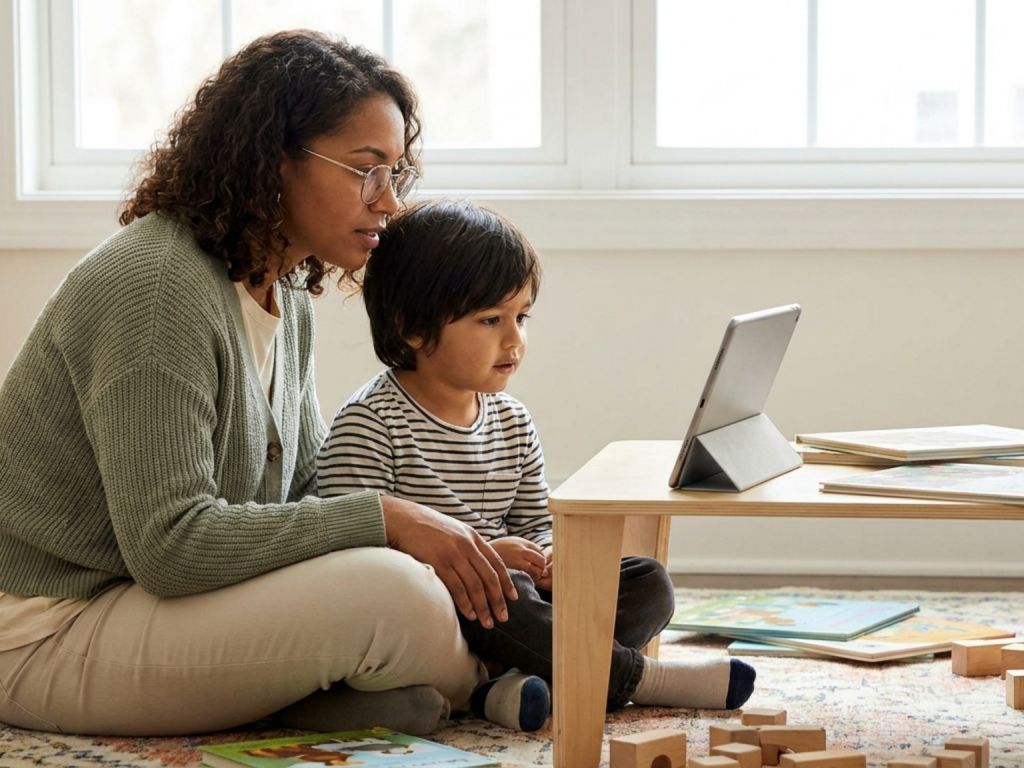
Content and context matter as much as minutes. Co-viewing, talking about what is on screen, and connecting it to real life can make media more developmentally supportive.
Screens are most concerning when they displace sleep, active play, social interaction, outdoor time, reading, or self-regulation practice.
A predictable family media plan is usually more effective than repeated negotiations in the moment.
What counts as screen time in preschoolers
For a 3- to 5-year-old, screen time usually includes television, streaming video, tablets, smartphones, video games, and computer-based activities. It may be passive, such as watching a cartoon; interactive, such as using an app; social, such as video chatting with a grandparent; or background exposure, such as a television playing while the child is eating or playing nearby.
Not all screen exposure has the same developmental meaning. A calm video call with a familiar adult is different from rapidly changing entertainment content. A high-quality story program watched with a parent is different from autoplay videos selected by an algorithm. Educational content can still be overstimulating, commercialized, or poorly matched to a child’s developmental stage.
Preschoolers are in a period of rapid neurodevelopment. They are building receptive and expressive language, executive functions in preschool children, motor planning, social cognition, emotional regulation, and early symbolic thinking. These skills grow best through reciprocal interaction: back-and-forth conversation, pretend play, movement, sensory exploration, shared reading, and real-world problem-solving. Screens are not automatically harmful, but they become a concern when they repeatedly replace these experiences.
Recommended limits for ages 3 to 5
Several major child health and developmental sources recommend limiting screen use for children ages 2 to 5 to about one hour per day of high-quality programming. WHO guidance cited by the American Optometric Association states that children aged 3 to 4 years should have no more than one hour of sedentary screen time per day, and less is preferred. Mayo Clinic similarly advises limiting children ages 2 to 5 to one hour daily of high-quality programming.
These recommendations are best understood as a clinical benchmark, not a moral test. A child who watches more during a sick day, a long flight, or a family emergency is not automatically harmed. The bigger question is the child’s usual pattern over weeks and months. Is the child sleeping adequately? Moving vigorously every day? Having conversations? Playing outdoors? Managing transitions? Participating in meals? Enjoying books, pretend play, and hands-on activities?
For many families, a useful goal is a predictable daily or weekly plan: for example, one planned show after rest time, or a brief video call before dinner, rather than screens appearing whenever a child is bored or upset. Predictability reduces bargaining and helps children understand that screen time is one activity among many, not the center of the day.
Why minutes are only part of the picture
Screen time affects children through several pathways. First, it can displace protective activities. A preschooler has limited waking hours; time spent sitting with a screen may replace outdoor learning for preschoolers, gross motor play, fine-motor activities for preschool children, shared reading, or face-to-face language practice.
Second, media characteristics matter. Fast-paced editing, loud sound effects, intense emotional content, or frightening imagery may be difficult for a preschool nervous system to process. Some children become irritable, dysregulated, or more impulsive after highly stimulating content. Others seem calm during viewing but struggle when the screen stops because the activity has provided strong sensory reward with little effort.
Third, timing matters. Screen time before bedtime can interfere with winding down, especially when content is exciting or when the device is close to the face. Bright light exposure and emotional arousal may contribute to bedtime resistance or delayed sleep onset in some children. A screen-free bedtime routine is a practical protective strategy, particularly for children who already struggle with settling.
Fourth, adult involvement changes the experience. When caregivers co-view and comment, children are more likely to understand what they see, learn vocabulary, and connect media to daily life. A parent might say, “That character felt frustrated when the tower fell. What could she try next?” This turns a passive viewing episode into a language and social-emotional learning opportunity.
Choosing high-quality preschool media
High-quality media for preschoolers is usually slower-paced, age-appropriate, nonviolent, and designed around developmental goals rather than advertising or endless engagement. Zero to Three recommends choosing content that supports learning, uses rich language, encourages participation, and avoids distracting pop-ups or manipulative design features.
Practical quality checks include:
- Preview the program or app before your child uses it.
- Look for clear stories, songs, problem-solving, movement prompts, or simple scientific curiosity.
- Avoid violent, frightening, sexualized, or highly commercial content.
- Prefer programs that invite children to answer, sing, move, count, predict, or name emotions.
- Turn off autoplay when possible so one episode does not silently become six.
- Avoid apps with frequent rewards, pop-ups, in-app purchases, or ads that blur the line between play and marketing.
Educational claims deserve caution. A program labeled “learning” may still be developmentally inappropriate if it is too fast, too abstract, or too focused on rote responses. Developmentally appropriate preschool learning is concrete, relational, repetitive, and connected to real objects and experiences. A counting video is more meaningful if the child later counts spoons at lunch, steps on the sidewalk, or blocks in a tower.
Co-viewing and conversation make screens safer and more useful
Preschoolers do not interpret media like older children or adults. They may misunderstand fantasy, imitate risky behavior, become frightened by mild conflict, or assume that advertisements are trustworthy. Co-viewing gives adults a chance to translate, reassure, and guide.
Helpful co-viewing does not require turning every show into a lesson. Small comments are enough: “He is waiting for a turn,” “That was pretend, not something we do with real scissors,” or “The puppy looked scared when the thunder was loud.” These comments support language development, emotional labeling, and social reasoning.
After viewing, connect the content to real life. If a program showed gardening, plant seeds in a cup. If a character took deep breaths, practice breathing with a stuffed animal. If a story included sharing, use it later during play. This bridge from screen to body, objects, and relationships is especially important because preschool children learn through active experience.
Co-viewing also helps adults notice how a child responds. Some children tolerate a calm 20-minute program well. Others become distressed by conflict, demand more immediately, or show increased aggression or sleep disruption. These patterns do not diagnose a condition, but they are useful data for adjusting content, timing, and limits.
Setting boundaries without constant conflict
Preschoolers are still developing inhibitory control, cognitive flexibility, and time understanding. “Five more minutes” may not feel meaningful to them. Boundaries work better when they are concrete, consistent, and supported by routines.
Useful strategies include:
- Create screen-free zones, especially meals, bedrooms, and family conversation times.
- Use a picture-based daily routine so the child can see when screens happen and what comes next.
- Give a transition warning: “When this episode ends, the tablet goes on the shelf and we go outside.”
- Stop at natural endings rather than in the middle of a video or game when possible.
- Offer a specific next activity, such as snack, bath, blocks, outdoor play, or reading.
- Keep adult devices out of reach when they are not available to the child.
Meltdowns after screens are common and do not mean a parent has failed. A preschool brain may protest intensely when a rewarding activity stops. Staying calm, naming the feeling, and holding the limit is usually more effective than arguing. For example: “You are upset the show is over. It is hard to stop. The screen is done, and I will help you choose blocks or crayons.”
If screen limits are new, expect a transition period. Reducing screen time gradually may be easier than stopping abruptly, especially if screens have been used frequently for calming. Replace the function, not just the device: if screens provided rest, create quiet time instead of sleep; if they provided connection, schedule one-on-one play; if they helped with waiting, prepare small toys or books.
Sleep, meals, movement, and eye comfort
Screen habits are closely tied to core health routines. At bedtime, screens can delay settling because of light exposure, exciting content, and the child’s desire for “one more.” Many families find that stopping screens at least an hour before bed and using a predictable, calming routine improves bedtime flow. A screen-free bedtime routine might include bath, pajamas, books, songs, and lights out.
During meals, screens may reduce attention to hunger and fullness cues and reduce family conversation. Mealtimes are valuable for language, social learning, and nutrition habits. Keeping meals screen-free can support a healthier preschool nutrition pattern and more responsive eating.
Movement is another major consideration. WHO guidance emphasizes reducing sedentary behavior and prioritizing physical activity and sleep in young children. Preschoolers need daily opportunities for running, climbing, jumping, balancing, dancing, and outdoor exploration. Screens should not crowd out active play.
Eye comfort also matters. Prolonged close-up device use may contribute to eye strain symptoms such as rubbing eyes, blinking, complaints of tired eyes, or headaches in some children. These symptoms are not specific and can have several causes, so families should consult an eye care professional or pediatric clinician if concerns persist. Practical habits include breaks from close work, outdoor time, appropriate viewing distance, and avoiding long uninterrupted sessions.
When screens are used for regulation or childcare gaps
Many parents use screens because they work. A screen can calm a child quickly, allow a caregiver to cook safely, or make a medical appointment possible. This is understandable. The clinical caution is that if screens become the primary regulation tool, children may get fewer chances to practice tolerating boredom, waiting, frustration, and transitions with adult support.
It may help to build a small “regulation menu” that does not rely only on devices. Options might include a sensory bin, water painting, a basket of special waiting-room toys, audiobooks, music, a calm-down corner, breathing games, or pretend play and emotional regulation activities. These alternatives do not need to be elaborate; they need to be available and practiced before the difficult moment.
Some children have developmental delays, neurodevelopmental differences, sensory processing challenges, medical conditions, or family stressors that make screen boundaries more complex. In these situations, individualized guidance from a pediatrician, developmental-behavioral specialist, occupational therapist, speech-language pathologist, psychologist, or eye care professional may be appropriate. The aim is not to shame screen use, but to align media habits with the child’s developmental, behavioral, visual, sleep, and family needs.
Seek professional guidance if
- Screen use is associated with persistent sleep disruption, severe tantrums, aggression, or marked anxiety.
- Your child loses interest in play, books, movement, or social interaction outside screens.
- You notice possible vision concerns such as frequent squinting, eye rubbing, headaches, or sitting very close to screens.
- Screens are the only reliable way your child eats, falls asleep, calms down, or tolerates daily routines.
- You have concerns about speech, attention, social communication, development, or behavior.
Tools & Assistance
- Create a written or visual family media plan with predictable times and limits.
- Preview programs and apps before your preschooler uses them.
- Use device settings to disable autoplay, in-app purchases, and unnecessary notifications.
- Ask your pediatrician, eye care professional, or child development specialist for individualized guidance if concerns arise.
FAQ
Is one hour of screen time always safe for every preschooler?
Not necessarily. One hour is a general benchmark for high-quality content, but a child’s sleep, behavior, vision comfort, activity level, and developmental needs should guide decisions.
Are educational apps better than cartoons?
Sometimes, but not automatically. Quality depends on pacing, age fit, language richness, lack of ads or pop-ups, and whether adults help connect the content to real life.
Should screens be allowed in the bedroom?
For most preschoolers, keeping screens out of bedrooms supports sleep, supervision, and clearer boundaries.
What if my child melts down when screen time ends?
This is common. Use predictable endings, warnings, calm empathy, and a specific next activity. If reactions are severe or persistent, discuss them with a healthcare or child development professional.
Does video chatting count the same as watching videos?
Video chatting is more interactive and socially responsive than passive viewing, especially with familiar people. It can still be included thoughtfully within the overall rhythm of the day.
Sources
- Mayo Clinic — Screen time and children: How to guide your child
- American Optometric Association — WHO guidance limit screen time for children
- Zero to Three — Screen-Time Recommendations for Children Under Six
Disclaimer
This article is for general educational purposes and is not a diagnosis or treatment plan. Consult your child’s pediatrician, eye care professional, or qualified healthcare clinician for individualized concerns.

















Please log in to leave a comment.