
Intro
Starting or returning to school asks a child to manage many simultaneous demands: waking on time, separating from caregivers, following group instructions, shifting between tasks, eating on a schedule, regulating emotions, and tolerating fatigue. For some children this feels exciting; for others it is genuinely stressful. Both responses can be developmentally normal.
School adaptation is not a single event but a neurodevelopmental and relational process. Predictable routines at home and in the classroom can reduce uncertainty, support behavioral regulation, and help children use their cognitive energy for learning and connection rather than constant adjustment.
Highlights
Consistent routines help children predict what comes next, which can reduce anxiety and support self-regulation.
Sleep, meals, transitions, emotional coaching, and caregiver-school communication all influence how smoothly a child adapts.
Routines are most helpful when they are warm, flexible, and developmentally appropriate rather than harsh or perfectionistic.
Persistent distress, regression, school refusal, or major changes in sleep, appetite, or mood deserve professional assessment.
What school adaptation really means
Child adaptation to school routines is the gradual process by which a child learns the rhythm, expectations, relationships, and sensory demands of the school day. It includes practical skills, such as packing a bag or lining up, and more complex neuropsychological skills, such as inhibitory control, working memory, cognitive flexibility, and emotion regulation. These are often grouped under executive function, the set of mental processes that help a child plan, start, shift, and complete tasks.
Adaptation is not simply obedience. A well-adapted child is not necessarily quiet or compliant at all times; rather, the child is increasingly able to understand predictable cues, recover from frustration, ask for help, participate in classroom life, and return to learning after disruption. This is why school adaptation often looks uneven. A child may separate easily in the morning but melt down after school, manage academics well but struggle with lunchroom noise, or enjoy peers but resist homework.
Several developmental systems interact during this period. Circadian rhythm affects wakefulness and attention. Autonomic nervous system regulation influences how quickly a child escalates or calms. Language comprehension shapes whether instructions feel manageable. Attachment and caregiver-child relationship quality influence separation tolerance. Classroom structure affects a child’s sense of safety. When routines are predictable and emotionally supportive, children spend less energy scanning for uncertainty and more energy practicing social and academic skills.
Why predictable routines help the developing brain
Predictable routines act like external scaffolding for a child’s still-maturing brain. Young children do not yet have adult-level prefrontal cortex efficiency, so they rely heavily on environmental structure. A repeated sequence, such as wake, wash, dress, eat, pack, leave, reduces the number of decisions required in the morning. This lowers cognitive load and helps prevent escalation before the school day begins.
Research on routines and child development consistently links structured family activities, including regular meals and bedtimes, with better behavioral regulation and school readiness. The mechanism is practical as well as emotional: repetition builds procedural memory, supports sleep regularity, and gives the child cues for what behavior is expected. In classrooms, structured routines also help children anticipate transitions, which can reduce anxiety and improve attention.
For medically literate readers, it may be useful to think in terms of allostatic load. When a child repeatedly experiences chaotic mornings, unpredictable meals, or inconsistent sleep, physiological stress systems may be activated more often. This does not mean a child is harmed by every irregular day; family life is naturally variable. But chronic unpredictability can make it harder for vulnerable children to regulate arousal, inhibit impulses, and sustain attention.
Predictable routines and emotional regulation are closely linked. A child who knows that playtime ends after a visual timer, shoes go by the door, and a caregiver will say goodbye in the same warm way each morning receives multiple safety signals. These signals do not eliminate distress, but they make distress more tolerable and easier to recover from.
Home routines that support the school day
The school day often begins the night before. Sleep is one of the strongest biological foundations for adaptation, because insufficient or irregular sleep can mimic or worsen problems with attention, irritability, emotional reactivity, and learning. A consistent bedtime routine may include calming play, hygiene, reading, dimmer light, and a predictable caregiver response. Reading before bed and shared meals have both been highlighted in research as routines that support sleep and school preparation.
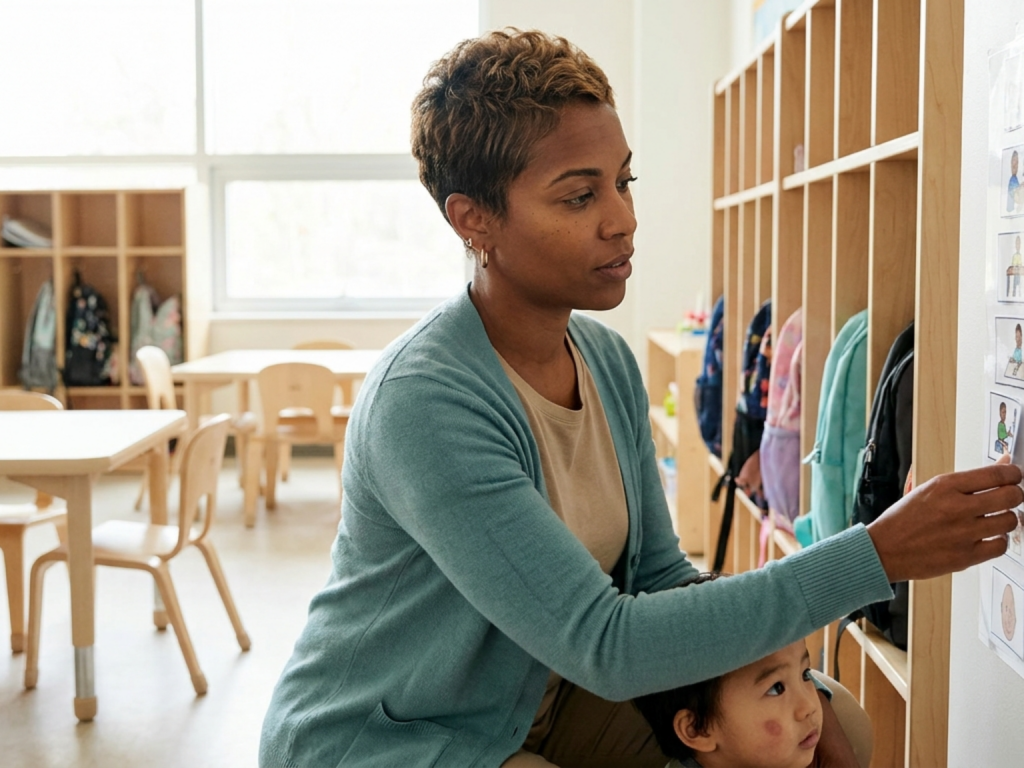
Morning routines work best when they are simple and visible. A school-age morning routine might include waking, toileting, dressing, breakfast, brushing teeth, putting on shoes, checking the bag, and leaving. For a preschool child, a preschool visual schedule with pictures may be more effective than verbal reminders. For an older child, a checklist or phone-free launch area may be enough.
Nutrition and hydration also matter. A child who arrives hungry, rushed, or dehydrated may have lower frustration tolerance and reduced attentional stamina. This does not require an idealized breakfast; even a practical, acceptable meal is better than a conflict-filled attempt at perfection. Similarly, the after-school period should not be overlooked. Many children use enormous self-control at school and then collapse emotionally at home. An after-school routine for children may include a snack, decompression time, movement, and then homework or chores. This pattern respects the child’s neurophysiology: recovery first, demands second.
Caregivers can also reduce morning stress by shifting tasks earlier: choosing clothes, signing forms, packing lunch, and placing shoes or school materials in a consistent location. The goal is not to create a flawless household, but to reduce predictable friction points.
Warmth matters: routines are not the same as harsh control
Routines are most protective when they are delivered with warmth, clarity, and reasonable flexibility. Evidence suggests that predictable routines can support adjustment to school, but harsh parenting may undermine those benefits. This distinction is clinically important. A rigid schedule enforced through yelling, humiliation, threats, or physical punishment may increase stress physiology and avoidance, even if the routine itself appears organized.
Children adapt best when expectations are clear and the emotional climate is safe. A caregiver might say, “First shoes, then we read one page in the car,” rather than “You always ruin mornings.” The first statement gives structure and a path forward; the second adds shame and may intensify dysregulation. Supportive limit-setting is not permissiveness. It means the adult holds the boundary while helping the child return to regulation.
Useful strategies include:
- Previewing: Tell the child what will happen before a transition, especially before school, pickup changes, assemblies, or substitute teachers.
- Offering limited choices: “Blue cup or green cup?” can reduce resistance without giving the child responsibility for the whole routine.
- Naming feelings: “You wish we could stay home. It is hard to stop playing.” This validates emotion without changing the school expectation.
- Using repair: If a morning goes badly, a caregiver can later say, “That was stressful. Tomorrow we will try the shoe basket again.” Repair teaches resilience.
A warm routine also allows exceptions. Illness, grief, neurodevelopmental differences, family stress, and cultural practices may all require adaptation. The best routine is consistent enough to be predictable and flexible enough to remain humane.
Age and developmental adaptations
Adaptation differs by age and developmental profile. Toddlers and preschoolers rely on concrete cues, repetition, and caregiver affect. They may not understand time concepts such as “in ten minutes,” so songs, pictures, objects, and consistent sequences are more useful. Separation distress can be expected, especially during the first weeks. A brief, predictable goodbye is usually easier than a prolonged or uncertain one.
Early school-age children can begin to internalize routines but still need adult co-regulation. They may manage a backpack checklist or classroom job but struggle when tired, hungry, or socially overwhelmed. At this age, visual schedules for school transitions can be very helpful, especially for children who become anxious when activities change quickly.
Older children and preteens face more complex demands: multiple teachers, homework planning, peer belonging, extracurricular schedules, and increasing autonomy. School transitions in children at these ages may involve social identity as much as logistics. They may resist routines if they feel infantilized, so collaboration becomes important. A caregiver can ask, “What would make mornings less chaotic?” and then help the child test a realistic plan.
Children with attention-deficit/hyperactivity traits, autism spectrum characteristics, language disorders, anxiety, sensory processing differences, chronic illness, or trauma histories may need more explicit and individualized supports. This does not mean the child is incapable of adaptation. It means the routine may need more repetition, sensory consideration, occupational therapy input, behavioral consultation, school accommodations, or medical evaluation. Caregivers should avoid self-diagnosing based on routine struggles alone, because sleep problems, stress, learning differences, mood symptoms, and family disruption can overlap in presentation.
Common difficulties during school routine adaptation
Some friction is normal. A child may be clingy at drop-off, irritable after school, tired by midweek, or more emotionally reactive during the first month. These responses often reflect adaptation demands rather than deliberate misbehavior. However, patterns matter. The frequency, intensity, duration, and functional impact of distress help determine whether additional support is needed.
Common challenges include morning refusal, repeated lateness, somatic complaints such as stomachache or headache, difficulty sleeping before school, tearfulness at separation, aggressive outbursts, homework avoidance, or after-school meltdowns. Somatic symptoms are real experiences for the child and should not be dismissed. Stress can affect gastrointestinal motility, appetite, muscle tension, and sleep. At the same time, persistent or severe physical symptoms should be assessed by a healthcare professional to rule out medical causes.
It is also important to examine the environment. A child who resists school may be responding to bullying, academic mismatch, sensory overload, toileting anxiety, separation anxiety, teacher-child conflict, or unsafe transportation experiences. The solution is not always “more discipline.” Sometimes adaptation improves when adults identify and modify the stressor.
Keep a brief pattern log for one to two weeks: sleep time, wake time, breakfast, drop-off behavior, teacher notes, after-school mood, homework response, and physical complaints. This can help caregivers and clinicians distinguish predictable fatigue from escalating distress. If the child has sudden regression, panic-like episodes, self-harm statements, marked appetite change, persistent insomnia, or school refusal that disrupts daily life, seek professional guidance promptly.
Partnering with school and healthcare professionals
Successful adaptation is rarely the child’s responsibility alone. Caregivers, teachers, school counselors, pediatricians, and when needed child psychologists, occupational therapists, speech-language therapists, or developmental specialists can work together. The most useful communication is specific: “He cries for five minutes at drop-off but settles after the first activity,” or “She is calm at school but has a 45-minute meltdown at pickup.” Specific observations guide practical support.
Families can ask the school about the daily timetable, transition cues, lunch procedures, toileting access, rest opportunities, and how distress is handled. A relationship map for school support can identify which adult the child can approach when overwhelmed. For some children, a small transition object, morning classroom job, visual schedule, sensory break, or gradual re-entry after hospitalization may be appropriate. These supports should be coordinated with school policy and professional advice.
If concerns persist, a pediatric visit can assess sleep, vision, hearing, nutrition, chronic pain, medication effects, developmental history, and mental health symptoms. Clinicians may recommend further evaluation rather than immediate labels. This is especially important when symptoms resemble ADHD, anxiety, depression, autism spectrum differences, or learning disorders, because accurate assessment depends on history across settings.
Caregivers can advocate firmly while staying collaborative. A helpful frame is: “We are trying to understand what makes the routine hard and what support helps recovery.” This reduces blame and keeps attention on function. Over time, the child learns that routines are not traps; they are reliable pathways through the day, held by adults who are paying attention.
When to seek extra help
- School refusal, panic-like distress, or daily prolonged meltdowns should be discussed with a pediatric or mental health professional.
- Persistent headaches, abdominal pain, vomiting, appetite change, or sleep disruption need medical evaluation.
- Any talk of self-harm, wanting to disappear, or feeling unsafe requires urgent professional support.
- Sudden regression, loss of skills, or major personality change should not be attributed to routine stress without assessment.
- Concerns about bullying, abuse, neglect, or unsafe school transport should be addressed immediately with appropriate authorities and professionals.
Tools & Assistance
- Create a simple visual morning or bedtime schedule with the child.
- Keep a one- to two-week sleep, mood, and school routine log.
- Ask the teacher for the classroom timetable and transition cues.
- Schedule a pediatric visit if physical symptoms or severe distress persist.
- Use school counseling, educational psychology, or occupational therapy services when indicated.
FAQ
How long does it usually take a child to adapt to school routines?
Many children settle within a few weeks, but timing varies by age, temperament, previous school experience, sleep, family stress, and classroom fit. Persistent or worsening distress deserves support.
Should I let my child stay home if mornings are very emotional?
Occasional illness or crisis is different from avoidance patterns. If distress is frequent, consult the school and a healthcare professional before making repeated stay-home arrangements, because avoidance can sometimes reinforce anxiety.
Are strict routines better for children with attention difficulties?
Predictable routines may help attention and behavior, but they should be warm, visual, brief, and flexible. Harsh or punitive control can worsen dysregulation and should be avoided.
What if my child behaves well at school but falls apart at home?
This is common. Some children use significant self-control at school and release fatigue at home. A snack, quiet decompression, movement, and reduced immediate demands may help.
When should neurodevelopmental evaluation be considered?
Consider discussing evaluation if routine struggles are persistent, occur across settings, impair learning or relationships, or are accompanied by language, sensory, attention, social communication, or motor concerns.
Sources
- Wiley Online Library, Journal of Family Theory & Review — Routines and child development: A systematic review
- Penn State University — Routine helps children adjust to school, but harsh parenting may undo benefits
- Northwest Iowa Community College, nwcommons — Examining the Impact of Structured Routines on Behavior and Attention in Preschool Students
Disclaimer
This article is for informational purposes only and does not diagnose or treat any condition. Consult a pediatrician, qualified mental health professional, or school specialist for concerns about a child’s health, behavior, or school functioning.

















Please log in to leave a comment.