
Intro
Homework can be a useful bridge between classroom learning and independent practice, but it can also become a daily pressure point for children and families. The healthiest approach is not simply “more work” or “no work”; it is developmentally appropriate, purposeful homework balanced with sleep, play, relationships, movement, and recovery time.
Children’s brains and bodies are still developing. Executive functions such as planning, working memory, inhibitory control, and cognitive flexibility mature gradually through childhood and adolescence. A supportive homework routine can strengthen these skills, while excessive or poorly designed homework may contribute to stress, sleep restriction, somatic complaints, and family conflict.
Highlights
Homework is most helpful when it reinforces meaningful learning, promotes independence, and fits the child’s developmental stage.
Research suggests that very high homework loads can be counterproductive, especially when they displace sleep, exercise, family connection, and hobbies.
Younger children usually need shorter, more structured homework periods, while adolescents may benefit from gradually increasing autonomy and planning skills.
Persistent distress, headaches, abdominal pain, insomnia, or school avoidance deserve compassionate attention and, when needed, professional support.
The real role of homework in childhood learning
Homework is not valuable simply because it occupies time. Its role is strongest when it helps a child retrieve information, practice a skill at the right level of difficulty, prepare for discussion, or extend classroom thinking into a meaningful task. In educational terms, effective homework supports spaced practice, metacognition, and transfer of learning. In everyday language, it helps a child remember, reflect, and apply what they have learned.
For younger children, the academic effect of homework is generally smaller than it is for older students. Early elementary children are still developing attention regulation, fine motor stamina, frustration tolerance, and the ability to understand multi-step instructions. A worksheet that takes an adult ten minutes may feel neurologically demanding to a tired child after a full school day. At this age, reading together, brief practice, curiosity-based projects, and predictable routines often matter more than long assignments.
For adolescents, homework can carry a different role. It may support exam preparation, deeper analysis, independent study habits, and self-monitoring. Research summarized by education sources suggests that homework’s academic association becomes stronger through secondary school. Still, the quality of the task matters. Homework that extends thinking, gives timely feedback, and has a clear purpose is more likely to help than repetitive tasks that create workload without cognitive benefit.
Homework can also teach non-academic skills: planning, persistence, help-seeking, and time estimation. These are part of executive function during homework, a set of brain-based skills that mature over time and are especially relevant for children with attention, learning, anxiety, sleep, or neurodevelopmental challenges. The goal is not perfection. The goal is gradual independence with appropriate scaffolding.
When homework becomes too much
A balanced approach recognizes that children need recovery time. Stanford-reported research found that benefits may plateau at around two hours per night for high school students, with about 90 to 150 minutes described as an optimal range in that context. The same research reported that many students identified homework as a primary stressor, with effects on sleep, health, and time for friends, family, and hobbies. These findings do not mean every child should do two hours. Rather, they remind families and schools that “more” is not automatically better.
Excessive homework can affect a child through several pathways. Psychologically, it may increase perceived uncontrollability, a key ingredient in stress. Physiologically, prolonged evening work may delay melatonin-related sleep readiness, keep the sympathetic nervous system activated, and reduce opportunities for physical activity, outdoor light exposure, and social buffering. Behaviorally, it can create avoidance cycles: the child feels overwhelmed, delays starting, works later, sleeps less, and feels even less capable the next day.
Caregivers may notice irritability, tearfulness, shutdown, perfectionistic rewriting, arguing, or repeated reassurance-seeking. Some children show homework-related physical symptoms such as headaches, stomachaches, muscle tension, nausea, or fatigue. These symptoms are real, even when stress contributes to them. They should not be dismissed as “just avoidance.” If symptoms are persistent, severe, worsening, or accompanied by weight loss, fever, fainting, self-harm thoughts, panic symptoms, or marked school refusal, families should seek medical or mental health advice.
A helpful question is: “What is this homework costing?” If it regularly costs sleep, meals, movement, friendships, family calm, or a child’s sense of competence, the plan needs adjustment. That adjustment may involve the teacher, school counselor, pediatrician, or an educational specialist, depending on the pattern.
Balancing schoolwork with sleep, play, and relationships
Free time is not the opposite of learning. It is part of healthy development. Play, hobbies, sports, music, imaginative activity, and relaxed conversation support emotional regulation, motor development, identity formation, and social cognition. For adolescents, time with peers and extracurricular activities can support belonging and positive youth development, especially when activities are structured and supervised.
Sleep deserves particular protection. Sleep is when memory consolidation, emotional processing, growth hormone secretion, and synaptic recalibration occur. A child who studies late into the night may appear disciplined, but chronic sleep restriction can impair attention, working memory, mood regulation, immune function, and academic performance. Protecting sleep during homework is therefore not indulgent; it is biologically rational.
Families can think of a school day as an energy budget rather than a moral test. Many children come home cognitively saturated. They may need food, hydration, movement, and after-school decompression time before they can engage productively. For some, 20 minutes of outdoor play before homework improves focus. For others, starting immediately prevents anticipatory anxiety. The “best” routine is the one that supports regulation and consistency for that particular child.
A balanced schedule usually includes: a predictable start time, a realistic stop time, short breaks, a screen plan, and protected time for sleep and connection. For younger children, a visual schedule can reduce negotiation. For older students, weekly planning times for students can help them map assignments, tests, activities, and rest periods before the week becomes overwhelming.
Unstructured evening time with peers can sometimes be associated with less favorable outcomes, depending on supervision and context, but this should not be interpreted as a reason to remove all free time. The healthier goal is a mix of purposeful schoolwork, structured activities, restorative leisure, family involvement, and autonomy that increases with maturity.
Building a routine that respects the child’s nervous system
A sustainable after-school homework routine begins with observation. Notice when the child is most regulated, what triggers conflict, and how long focused work actually lasts. Many children benefit from work intervals of 10 to 25 minutes, followed by brief breaks. Adolescents may manage longer blocks, but even they benefit from task switching, movement, and hydration.
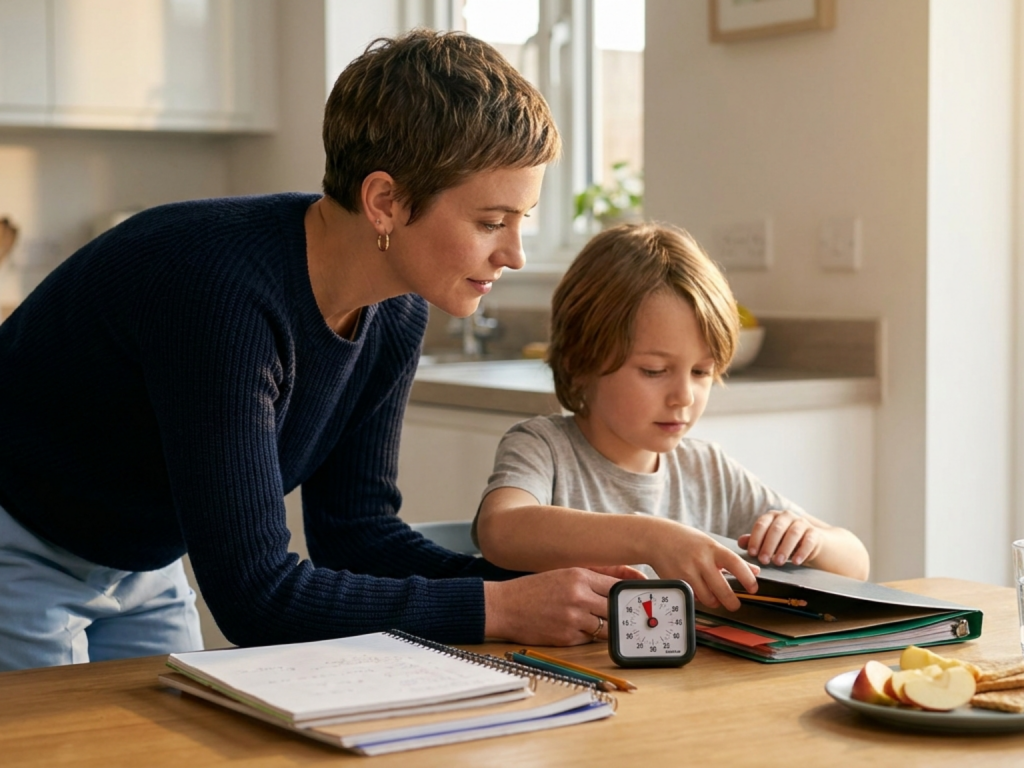
Environment matters. A distraction-reduced homework area does not have to be silent or perfect; it simply needs to reduce avoidable friction. Supplies should be accessible, instructions visible, and unnecessary notifications minimized. For children with attention vulnerabilities, externalizing the task can help: write the steps, use a timer, place completed work in a specific folder, and define what “done” means.
Caregiver support works best when it is warm, structured, and autonomy-supportive. Instead of hovering or correcting every answer, try asking: “What is the first step?” “How will you know when this is finished?” “Do you want me nearby or should I check back in ten minutes?” This approach supports independence while signaling that the child is not alone.
Some families use a simple homework audit:
- How long does each subject take on a typical night?
- Which assignments create the most distress or confusion?
- Is the child practicing skills already taught, or trying to learn new material without support?
- Is homework replacing sleep, meals, movement, or family time?
- What can be communicated to the teacher with specific examples?
For children who struggle with writing, reading fluency, math facts, attention, anxiety, or processing speed, “reasonable” homework may take far longer than expected. This does not prove laziness. It may indicate a mismatch between task demands and current skills. Families can document time spent, level of support needed, and emotional or physical symptoms, then share this information with the school to discuss accommodations or instructional changes.
Supporting motivation without adding pressure
Children are more likely to engage when homework feels understandable, achievable, and connected to a purpose. Pressure may produce short-term compliance, but it can also increase cortisol-mediated stress responses, avoidance, and negative self-beliefs. A child who repeatedly hears “You should know this” may begin to interpret struggle as personal failure rather than part of learning.
Process-based positive reinforcement is more helpful than global praise or criticism. Notice effort, strategy, persistence, and self-advocacy: “You broke that into smaller parts,” “You asked a clear question,” or “You came back after a break.” This kind of feedback builds self-efficacy, the belief that actions can influence outcomes.
Motivation also improves when children have limited, real choices. They might choose whether to do reading or math first, whether to sit at the desk or kitchen table, or whether to take a movement break before or after a writing task. Choice supports autonomy while the caregiver still maintains boundaries around completion, bedtime, and respectful behavior.
It is also acceptable to set a compassionate stop rule. If a young child has worked earnestly for an agreed period and is deteriorating emotionally, a caregiver can write a brief note to the teacher: “We worked for 25 focused minutes; this is where we stopped.” For older students, the stop rule can involve emailing the teacher, planning office hours, or identifying what is incomplete and why. The message is not that responsibilities disappear; it is that health and learning both matter.
If homework conflict dominates family life, consider whether the pattern reflects anxiety, perfectionism, attention difficulties, learning disorders, bullying, unrealistic workload, sleep problems, or family stress. A pediatric clinician, school psychologist, counselor, or educational evaluator can help clarify concerns without blaming the child or caregiver.
Working with schools and knowing when to seek help
Schools and families are most effective when they exchange specific information rather than general frustration. Instead of saying “homework is impossible,” try: “Reading responses are taking 70 minutes, my child cries after 30 minutes, and bedtime is delayed four nights per week.” Concrete data helps teachers distinguish between procrastination, misunderstanding, workload, and possible skill gaps.
Useful questions for teachers include: What is the expected time for this assignment? Should parents correct errors or let the teacher see them? Which parts are essential if the child is overwhelmed? Is there a pattern of incomplete classwork being sent home? Could instructions be written more clearly? Would reduced repetition, assistive technology, extended time, or a different format preserve the learning goal?
For children with documented disabilities or health conditions, formal supports may be appropriate through school-based processes. These might address workload, testing conditions, reading support, occupational therapy needs, or executive function support during homework. Families should consult the relevant school team and healthcare professionals; accommodations should be individualized rather than copied from another child’s plan.
Medical or mental health consultation is especially important when homework stress is associated with persistent insomnia, panic attacks, depressive symptoms, self-harm statements, significant appetite change, frequent pain complaints, school refusal, or loss of previously enjoyed activities. Clinicians can assess contributing factors such as anxiety disorders, attention-deficit/hyperactivity disorder, migraine, gastrointestinal conditions, vision problems, sleep disorders, or medication effects. This article cannot diagnose those issues, but it can encourage timely evaluation.
Ultimately, homework should serve the child’s development, not consume it. A healthy plan leaves room for competence and rest, responsibility and play, academic growth and emotional safety. When adults treat balance as a legitimate educational goal, children learn not only the subject matter but also how to care for their minds and bodies while meeting responsibilities.
When homework stress needs extra attention
- Seek professional help promptly if a child mentions self-harm, hopelessness, or not wanting to live.
- Consult a clinician for persistent headaches, abdominal pain, fainting, severe fatigue, or sleep disruption.
- Talk with the school if homework routinely takes far longer than expected despite focused effort.
- Do not use punishment or humiliation to force homework completion; it can worsen avoidance and distress.
- Protect sleep whenever possible, especially when late homework becomes a repeated pattern.
Tools & Assistance
- Keep a one-week homework time log including start time, end time, breaks, and distress level.
- Ask the teacher for the expected time range and the learning purpose of recurring assignments.
- Create a distraction-reduced homework area with supplies, timer, water, and a visible task list.
- Schedule weekly planning times for students to map homework, activities, rest, and sleep.
- Contact a pediatrician, school counselor, or mental health professional when stress symptoms persist.
FAQ
How much homework is too much?
It depends on age, workload, and the child’s needs. A warning sign is homework that regularly displaces sleep, meals, movement, family connection, or causes marked distress.
Should parents correct every homework mistake?
Usually no. Teachers often need to see what the child can do independently. Parents can support instructions, organization, and calm problem-solving without taking over.
Is free time really necessary during the school week?
Yes. Restorative free time supports emotional regulation, social development, physical activity, creativity, and sleep readiness, all of which contribute to learning.
What if my child spends hours but completes very little?
Track time, distractions, emotional reactions, and task types. Then discuss patterns with the teacher and consider evaluation for learning, attention, anxiety, sleep, or vision concerns if difficulties persist.
Sources
- Stanford Graduate School of Education — More than two hours of homework may be counterproductive, research suggests
- Edutopia — The Pros and Cons of Homework (in 6 Charts)
- National Center for Biotechnology Information / PubMed Central — The Long-Term Effects of Time Use during High School on Positive Youth Development
Disclaimer
This article is for informational purposes only and does not diagnose, treat, or replace professional medical, mental health, or educational advice. Consult qualified healthcare and school professionals for concerns about a child’s symptoms, learning, or wellbeing.















Please log in to leave a comment.