
Intro
Pets can offer companionship, comfort, and opportunities for children to learn empathy. Most interactions are positive, but bites can occur even with familiar, well-loved animals. Young children may not recognize warning signals, may move unpredictably, or may approach an animal during a vulnerable moment.
Bite prevention is therefore a shared responsibility between adults, children, and pet caregivers. The safest approach combines close supervision, respectful handling, developmentally appropriate teaching, and attention to the animal’s behavior. No strategy eliminates risk completely, and any bite that breaks the skin deserves prompt medical advice.
Highlights
Never leave a young child and a pet together without active adult supervision, even if the animal is familiar.
Children should not disturb animals that are eating, sleeping, ill, injured, frightened, or caring for young.
Teach children to ask permission before touching an unfamiliar pet and to let the animal approach and sniff first.
Rough play, chasing, pulling, hugging, riding, and taking toys or food can increase bite risk.
If a dog approaches aggressively or knocks a child down, staying still and protecting the face and neck may reduce injury.
Why children are particularly vulnerable to pet bites
Children are disproportionately affected by dog bites because they may be less able to interpret canine communication, regulate impulses, or move away quickly. A child’s face, head, neck, and hands may also be close to an animal’s mouth during ordinary play. A small child may approach from behind, stare directly at a dog, grab fur, or place a face near the animal without understanding that these actions can feel threatening.
Animal behavior is influenced by context. Pain, fear, illness, territoriality, guarding of food or objects, and overstimulation can all lower an animal’s tolerance. A dog that is gentle in one situation may react differently when woken abruptly, cornered, restrained, or touched while eating. The scientific literature emphasizes that any dog can bite under particular circumstances, including a familiar family pet; breed-based assumptions should not replace supervision and behavior-aware precautions.
Children may also miss subtle warning signs such as turning the head away, lip licking, yawning, freezing, crouching, hiding, growling, or attempting to escape. Growling should be treated as communication that the animal is uncomfortable, not as misbehavior to punish. Adults should end the interaction and create distance.
Build supervision into every child–pet interaction
Active supervision means an attentive adult remains close enough to intervene immediately and watches both the child and the animal. It is not the same as being somewhere in the home, listening from another room, or relying on an older child to supervise. This is especially important for infants, toddlers, and preschool-aged children, whose actions can be sudden and difficult for an animal to predict.
Use physical separation whenever direct supervision is not possible. Gates, closed doors, crates used appropriately, or a quiet pet-only area can give an animal space and prevent an unsupervised approach. During busy household periods, visitors, meals, or children’s parties, consider separating pets before excitement escalates. A family injury prevention plan can specify who supervises, where the pet rests, and what adults will do if either child or animal appears distressed.
Supervision should be renewed when circumstances change. A pet may respond differently around a crying baby, a sleeping child, a new toy, food, a crowded room, or another animal. Adults should avoid distractions such as phone use during close interactions and should intervene at the first sign of chasing, grabbing, climbing, wrestling, or escalating excitement.
Teach respectful ways to approach and touch pets
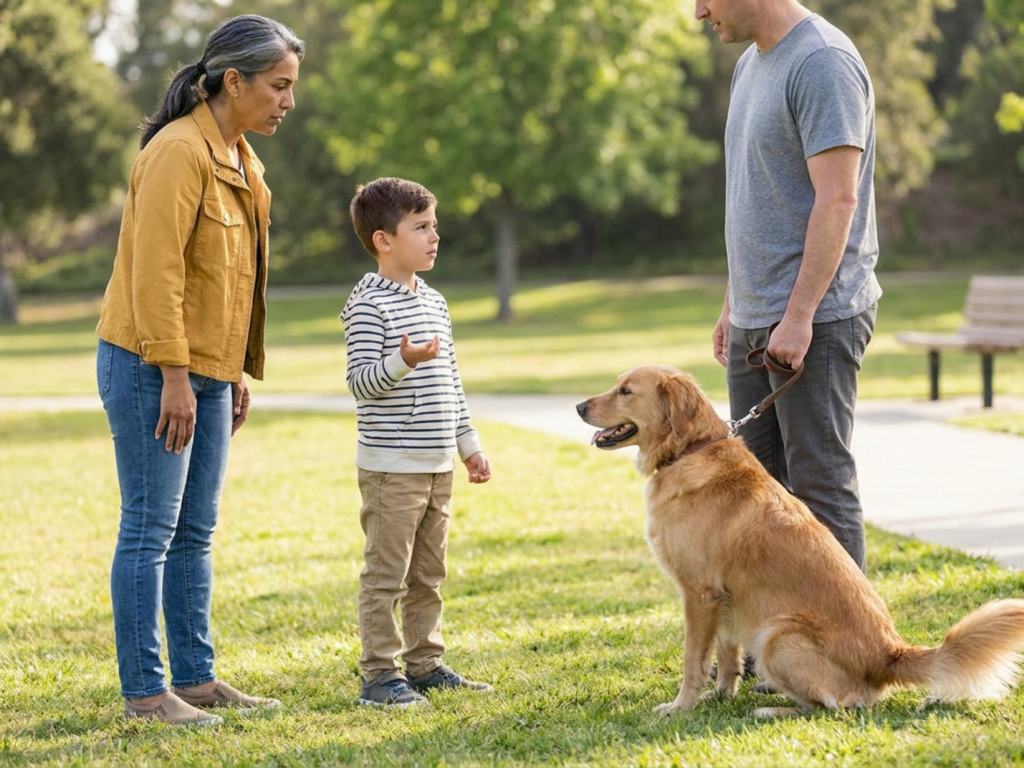
Give children a small number of consistent rules and practice them when everyone is calm. A child should ask the owner before petting an unfamiliar animal. If permission is given, the child can stand to the side, remain quiet, keep hands low and relaxed, and allow the animal to approach and sniff. Gentle stroking along the shoulder or back is generally less intrusive than reaching over the head, touching the face, or wrapping arms around the neck.
Children should never hug, kiss, sit on, ride, pull, pinch, hit, or climb on a pet. They should not put fingers near the mouth, take food or toys, or disturb an animal in a crate or other retreat. Teach children not to stare into a dog’s eyes, run toward an animal, scream near it, or chase it when it moves away. These are practical elements of developmentally appropriate safety planning.
Use role-play rather than fear-based lessons. An adult can model stopping, lowering the hands, and stepping away when a pet moves off. Praise the child for respecting the animal’s boundary. If a child cannot reliably follow the rules, interactions should remain physically separated and closely managed rather than treated as a test of obedience.
Protect animals during vulnerable moments
Many bites happen when an animal is startled, defending a resource, or trying to escape. Establish protected times and places for eating, sleeping, toileting, grooming, and recovery from illness or injury. Children should wait until the pet has finished eating before approaching, and adults should prevent them from reaching into food bowls or removing treats, bones, toys, or bedding.
Sleeping animals should be awakened by an adult or left undisturbed. Rather than allowing a child to touch a resting pet, call the animal away from a distance or wait for it to wake naturally. A pet that is limping, hiding, unusually irritable, or recovering from a procedure needs additional space and may require veterinary assessment.
Resource guarding and fear should be managed by adults, not children. Do not ask a child to retrieve an object from an animal’s mouth or to physically restrain a pet. A veterinarian or qualified animal-behavior professional can advise on behavior concerns. Avoid punishment, especially physical punishment, because it may increase fear and make warning signals less predictable.
Reduce excitement, rough play, and chasing
Running, squealing, wrestling, and chasing can activate a pet’s predatory or play responses and can make a child fall. Children should use calm, structured activities instead, such as helping an adult offer treats with an open palm when appropriate, practicing simple commands under supervision, or observing the animal quietly. Toys should be selected and used by adults when there is a risk of guarding or tugging.
Do not allow children to play-bite, tease, corner, or repeatedly provoke a pet, even if the animal appears to tolerate it. Stop play before the child or pet becomes overstimulated. Warning signs may include rapid or stiff movements, repeated jumping, mouthing, barking, pinned-back ears, a tense body, raised hackles, avoidance, or freezing. The safest response is to calmly separate them, reduce noise, and give the animal a quiet retreat.
Dogs should not be encouraged to chase children, bicycles, or clothing. Secure fencing, appropriate leashes, and responsible adult handling help prevent unpredictable encounters. Pet training and veterinary care may support safer behavior, but they do not remove the need for adult supervision.
Help children respond to unfamiliar or loose dogs
Children should not approach a dog they do not know, even if the dog appears friendly, is behind a fence, or is accompanied by an adult. Teach them to ask the handler first and to respect a refusal. They should never reach through a fence, enter a yard without permission, or try to pet a dog that is tied up, confined, sleeping, eating, injured, or caring for puppies.
If an unfamiliar dog approaches, teach the child to stand still, keep hands at the sides or folded near the chest, avoid direct eye contact, and remain quiet. The child should not run, scream, wave arms, or turn and sprint away. An adult should calmly place a barrier between the child and dog when possible, without making sudden movements. Children can slowly back away once the dog loses interest.
If a dog knocks a child down, the child should curl into a ball, protect the face and neck with the arms, and remain as still and quiet as possible. These instructions should be practiced gently so they are easier to remember under stress. A broader child safety basics by age approach can help adults match expectations to a child’s language, motor skills, and ability to follow multistep directions.
What to do after a bite or scratch
Move the child away from the animal and ensure the animal is safely contained without creating another exposure. If there is significant bleeding, apply firm direct pressure with clean material while arranging urgent medical care. Once bleeding is controlled, wash a bite or scratch that breaks the skin with soap and running water. Avoid assuming that a small puncture is harmless: puncture wounds can involve deeper tissue and may become infected.
Contact a healthcare professional promptly for any bite that breaks the skin, particularly bites to the face, hand, foot, genitals, or near a joint; deep or crushed wounds; wounds with uncontrolled bleeding; or injuries in very young children. Professional assessment may be needed for wound care, infection risk, tetanus immunization status, and rabies exposure risk. Do not delay care while trying to identify the animal’s breed or searching for home remedies.
Seek emergency help for severe bleeding, breathing difficulty, loss of consciousness, marked weakness, extensive tissue injury, or a bite involving the eye, mouth, or neck. Record the time and circumstances, the animal’s owner and vaccination information if available, and whether the animal was acting abnormally. Follow local public-health guidance for reporting and observation. A child may also feel frightened or guilty afterward; calm reassurance and follow-up support are part of recovery.
Situations requiring extra caution
- Never leave infants or young children alone with a pet, regardless of the animal’s history.
- Separate children from pets that are eating, sleeping, injured, ill, frightened, or guarding food or objects.
- Treat a bite that breaks the skin as a reason to contact a healthcare professional promptly.
- Seek emergency care for uncontrolled bleeding, severe wounds, breathing problems, altered consciousness, or bites near the eye, mouth, or neck.
- Do not punish an animal for growling or force a child to continue an interaction after either appears uncomfortable.
Tools & Assistance
- A child–pet interaction rules poster reviewed regularly with caregivers
- Safety gates, closed doors, and a designated quiet retreat for the pet
- A written family injury prevention plan with supervision responsibilities
- Contact details for the child’s healthcare professional, veterinarian, and local public-health service
- A role-play routine for responding to an unfamiliar or loose dog
FAQ
Can a familiar family dog bite a child?
Yes. Familiarity does not eliminate risk. Fear, pain, illness, startling, resource guarding, or excessive excitement can alter an animal’s response, so close supervision remains necessary.
Should children hug or kiss pets to show affection?
It is safer to avoid hugging and kissing pets, especially near the face. Children can show affection through calm, gentle interaction while respecting the animal’s choice to move away.
What should a child do if an unfamiliar dog runs toward them?
Teach the child to stand still, stay quiet, avoid direct eye contact, keep hands close to the body, and slowly back away when the dog loses interest. They should not run or scream.
Does every bite require emergency treatment?
Not every bite requires an emergency department, but any bite that breaks the skin warrants prompt medical advice. Emergency care is appropriate for severe bleeding, extensive injury, breathing problems, altered consciousness, or wounds involving the eye, mouth, or neck.
How can adults address a pet that growls at a child?
End the interaction, calmly separate the child and pet, and prevent similar exposures. Do not punish the growl. Consult a veterinarian or qualified animal-behavior professional about safe management.
Sources
- HealthyChildren.org, American Academy of Pediatrics — Prevent Bite Wounds
- PubMed Central — Pet dog bites in children: management and prevention
- Nemours KidsHealth — Preventing Dog Bites
Disclaimer
This article provides general educational information and does not replace individualized medical, veterinary, or public-health advice. Contact a healthcare professional promptly after a bite that breaks the skin, and seek emergency care for severe or potentially life-threatening injuries.

















Please log in to leave a comment.