
Intro
Family routines are not meant to be rigid scripts. They are predictable patterns that help children know what comes next, lower stress, and practice self-regulation. As a child grows from a toddler into a teenager, the routine must change because sleep biology, cognition, emotional regulation, school demands, peer relationships, and the need for autonomy all change too.
For parents and caregivers, this shift can feel bittersweet and sometimes frustrating. A toddler may need a visual schedule and hands-on help, while a teen may need negotiated boundaries and privacy. The goal is not perfect compliance; it is a developmentally appropriate structure that protects health while gradually transferring responsibility to the young person.
Highlights
Toddlers need short, concrete, highly predictable routines because their language, impulse control, and time awareness are still developing.
Preschool and school-age routines gradually add responsibility, such as cleaning up, preparing school items, and following a bedtime routine with fewer prompts.
Tweens and teens still benefit from structure, especially during hormonal, social, and academic changes, but they need more voice in how routines are designed.
Healthy routines should be flexible enough for illness, transitions, neurodevelopmental differences, family stress, and changing sleep needs.
Why routines matter across childhood
Routines act like external scaffolding for the developing nervous system. Young children do not yet have mature executive function, the set of cognitive skills that includes working memory, inhibition, planning, and cognitive flexibility. A predictable sequence such as wake, toilet, dress, breakfast, shoes, and leave helps the child borrow structure from the environment until internal regulation becomes stronger.
Consistent routines can reduce stress because they decrease uncertainty. When a child knows what usually happens after dinner or before school, fewer decisions are required, and fewer transitions feel surprising. This matters from toddlerhood through adolescence. Older children and teens may appear resistant to structure, but they are also navigating puberty, social comparison, academic load, and a stronger drive for independence. Predictability can still provide emotional safety.
A useful routine is not the same as strict control. It is a repeated pattern with enough flexibility to adapt to illness, travel, school holidays, family separation, caregiving schedules, or developmental differences. The healthiest routines usually include anchor points: wake time, meals, school or childcare, movement, homework or learning time, hygiene, connection, and sleep.
Toddler routines: concrete, sensory, and caregiver-led
Toddlers live mainly in the present. Their understanding of time is limited, and transitions can feel abrupt even when adults think they have given enough warning. A toddler routine works best when it is short, visual, and repetitive. Instead of explaining the whole morning in abstract terms, caregivers can use a simple sequence: diaper or toilet, clothes, breakfast, teeth, shoes, goodbye.
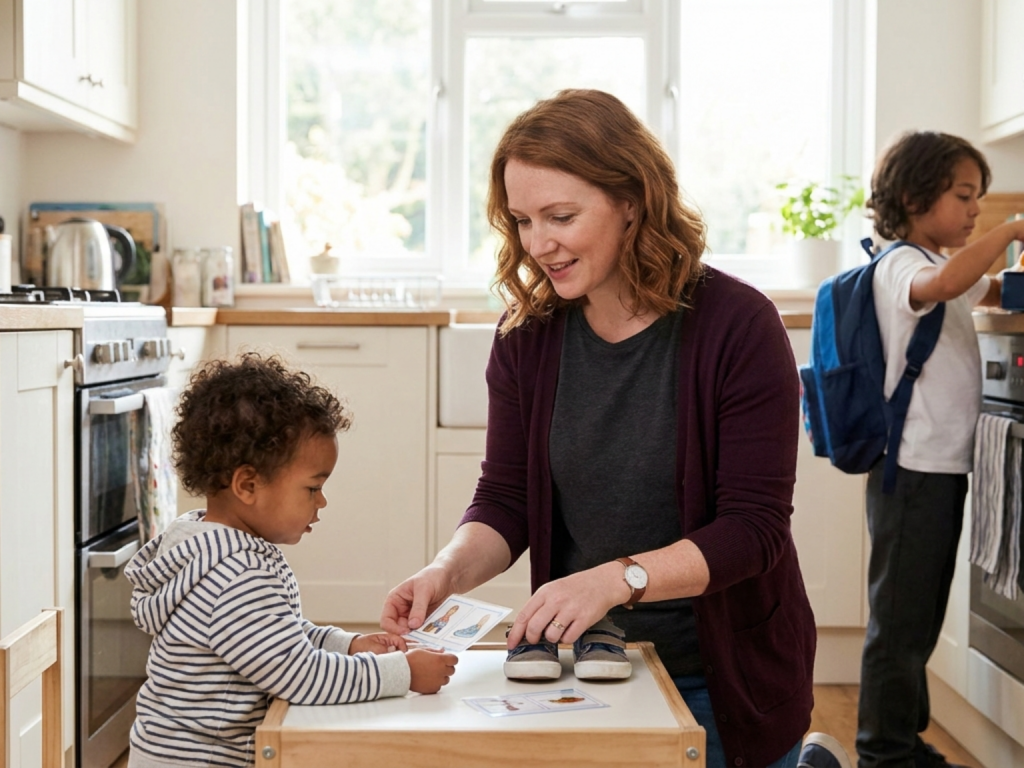
At this stage, routines are heavily caregiver-led. The adult regulates the pace, environment, and emotional tone. Offering limited choices can support autonomy without overwhelming the child: “blue cup or green cup,” “walk to the bathroom or be carried,” “pajamas first or teeth first.” A bedtime visual schedule for toddlers may be especially helpful because pictures can communicate before full language comprehension is available.
Common toddler routines include:
- Morning care: waking, diapering or toileting, dressing, eating, brushing teeth, and leaving for childcare or activities.
- Clean-up: putting blocks in a basket, returning books to a shelf, or helping wipe a small spill.
- Mealtimes: washing hands, sitting in a safe eating space, and learning that meals have a beginning and end.
- Sleep preparation: bath or wash-up, pajamas, toothbrushing, a short book, comfort object, and lights out.
A toddler bedtime routine is often less about “making” a child sleep and more about cueing the brain and body that stimulation is ending. Separation distress, tantrums, or bedtime resistance can be common at this age. However, persistent snoring, labored breathing during sleep, poor growth, severe feeding difficulty, developmental regression, or extreme sleep disruption should be discussed with a pediatric clinician.
Preschool routines: independence through repetition
Preschoolers are beginning to connect actions with outcomes. They can often follow two- or three-step directions, imitate household tasks, and participate in routines with pride. The routine still needs adult support, but the child can take on more visible responsibility: choosing clothing from weather-appropriate options, putting toys away by category, placing a cup in the sink, or helping pack a small bag.
Transitions remain a major focus. Preschool children may become deeply absorbed in play and struggle to stop. Predictable transition cues help: a song for clean-up, a timer, a five-minute warning, or a consistent phrase such as “first clean-up, then snack.” The phrase is not magic; its power comes from repetition and calm follow-through.
Preschool routines also support early cognitive development. Sorting toys, setting a nap mat, washing hands before meals, and sitting for a story all build sequencing, attention, and early self-care skills. Structured learning should still be developmentally appropriate: play, movement, language, and imagination are central. Preschool symbolic play is not a distraction from learning; it is one of the ways young children rehearse social roles, problem-solving, and emotional themes.
Caregivers can start to shift from doing every step to prompting the child to recall the next step. For example: “You brushed your teeth. What comes next on the chart?” This gently strengthens working memory and agency. If the child is tired, hungry, ill, or overstimulated, temporarily increasing adult help is not failure; it is responsive caregiving.
School-age routines: skills, responsibility, and predictable limits
In middle childhood, routines expand beyond basic care into school readiness, homework, extracurricular activities, friendships, chores, and digital boundaries. Children may be able to understand calendars, clocks, and consequences more clearly, but they still need adult support to manage competing demands. Many school-age children can help prepare clothing, organize a backpack, feed a pet with supervision, clear dishes, and follow a bedtime routine with fewer reminders.
This is a valuable time to teach systems rather than simply correct mistakes. A child who forgets homework may need a visible launch pad by the door. A child who melts down after school may need a decompression routine before questions about assignments. Bedtime routines school age kids can include hygiene, reading, laying out clothes, and a brief check-in about worries. For some children, worry-writing before lights-out can reduce repetitive reassurance seeking, though persistent anxiety symptoms warrant professional guidance.
School-age routines should protect sleep, nutrition, movement, and connection. Over-scheduling can create chronic stress, while under-structure may leave children dysregulated. A balanced after-school sequence might be snack, movement or outdoor time, homework block, free play, dinner, hygiene, reading, and sleep. The exact order can vary by family, but the predictability matters.
Parents should also watch for medical or developmental factors that make routines unusually hard. Attention-deficit/hyperactivity disorder, anxiety, learning differences in school-age children, sleep-disordered breathing in children, constipation, chronic pain, and medication effects can all affect daily functioning. This does not mean a caregiver should diagnose at home. It means persistent, impairing difficulty deserves discussion with a pediatrician, school team, or qualified mental health professional.
Tween routines: collaboration and the beginning of self-management
The tween years often bring a noticeable shift. Children may still need reminders, but they also want privacy, fairness, and a say in household expectations. Pubertal changes may begin, peer relationships become more emotionally important, and academic tasks often require planning across several days. Routines that once worked by adult direction alone may now provoke resistance.
This is the time to move from “because I said so” toward collaborative structure. Parents can identify non-negotiables such as sleep opportunity, school attendance, hygiene, safety, medication routines if prescribed, and respectful communication. Then the tween can help design the details. For example, the family expectation may be that homework is completed before recreational screens on school nights, but the tween may choose whether to start after a snack or after 20 minutes of movement.
Preteen learning motivation often improves when routines include autonomy, competence, and connection. A weekly planning meeting can be brief: review school assignments, activities, chores, sleep times, and upcoming stressors. Visual calendars remain useful, but the format may change from picture charts to whiteboards, apps, or shared family schedules.
Emotional regulation can be uneven during this period. A tween may seem mature one day and overwhelmed the next. This variability is not necessarily defiance; it reflects ongoing brain maturation and increasing social pressure. Calm, consistent routines can reduce the number of daily negotiations and preserve energy for genuine problem-solving.
Teen routines: structure with autonomy
Adolescents need routines that respect their growing capacity while acknowledging that the brain is still developing. The prefrontal cortex, which supports planning, impulse control, and future-oriented decision-making, continues maturing into young adulthood. At the same time, puberty can shift circadian biology later, contributing to adolescent circadian delay and difficulty falling asleep early. This does not mean teens should have no limits; it means sleep routines may need realistic planning and careful screen boundaries before bed.
A teen routine often centers on self-management: waking independently, managing school platforms, planning study time, participating in chores, maintaining hygiene, eating regularly, getting physical activity, and balancing social life. The parent’s role becomes more like a coach than a director. Instead of micromanaging every step, caregivers can help teens evaluate what is working: “You said mornings feel rushed. What part of the routine needs to change?”
Useful teen routines may include:
- A consistent wake time on school days, with weekend variation kept reasonable when possible.
- A technology plan that protects sleep, privacy, schoolwork, and safety.
- A homework or study rhythm that includes breaks, movement, and realistic deadlines.
- Shared household responsibilities that contribute to family life rather than feeling like punishment.
- Regular check-ins about stress, mood, friendships, substances, sexual health, and online experiences.
Teen sleep and emotional regulation are closely connected. Insufficient sleep can worsen irritability, attention, risk-taking, and mood vulnerability. If a teen has persistent insomnia, loud snoring, witnessed pauses in breathing, severe daytime sleepiness, self-harm thoughts, disordered eating concerns, substance use, or major functional decline, caregivers should seek professional support promptly.
How to update routines without constant conflict
Routines need periodic revision. A schedule that worked for a 3-year-old will not fit a 9-year-old, and a middle-school plan may collapse under high-school demands. The best time to revise a routine is often during a calm moment, not during a morning meltdown or late-night argument.
Start small. Choose one anchor point, such as bedtime, the morning exit, after-school decompression, or screen shut-off. Ask what the routine is meant to protect: sleep, safety, learning, connection, hygiene, or family cooperation. Then reduce unnecessary steps. Children and teens are more likely to follow routines that are visible, realistic, and not overloaded.
Positive reinforcement can help, especially when it is specific. “You put your shoes by the door before breakfast; that made leaving easier” teaches more than a vague “good job.” For older children, reinforcement may look like trust, privileges, or increased independence rather than stickers or charts.
Flexibility is also a health skill. Illness, exams, grief, travel, or a new baby can disrupt even strong routines. During transitions, maintain a few core anchors such as meals, sleep cues, medication schedules if applicable, and brief emotional check-ins. Predictability does not require perfection. It requires returning to the pattern with compassion.
When to seek extra support
- Routine struggles that cause major impairment at home, school, or with peers deserve professional assessment.
- Seek urgent help for self-harm thoughts, suicidal statements, severe withdrawal, or sudden dangerous behavior.
- Discuss loud snoring, pauses in breathing, chronic insomnia, or severe daytime sleepiness with a pediatric clinician.
- Do not start, stop, or change medication or supplements for sleep, attention, anxiety, or mood without medical guidance.
- Developmental regression, major appetite changes, disordered eating behaviors, or rapid functional decline should be evaluated.
Tools & Assistance
- Create one-page visual routines for toddlers and preschoolers
- Use a shared family calendar or whiteboard for school-age children and teens
- Hold a brief weekly planning meeting for activities, homework, chores, and sleep
- Ask a pediatrician, school counselor, occupational therapist, or child mental health clinician when routines remain unusually difficult
- Track sleep, screens, mood, and morning functioning for one to two weeks before a healthcare visit
FAQ
Should teenagers still have routines?
Yes. Teens need more autonomy, but predictable sleep, study, technology, meals, and safety routines support emotional regulation and independence.
What if my child resists every routine change?
Resistance is common during transitions. Start with one small anchor point, involve the child in choices when appropriate, and seek guidance if conflict is severe or persistent.
Are visual charts only for toddlers?
No. Younger children may need picture charts, while older children and teens may prefer calendars, checklists, apps, or written plans.
How strict should bedtime be as children grow?
Bedtime routines should evolve with age, but adequate sleep opportunity remains important. If sleep problems are persistent or medically concerning, consult a pediatric clinician.
Sources
- Seattle Childrens — Kids Thrive on Structure and Routines
- iCare Software — Routines and Transitions
- Childrens Health — How to create a daily routine for kids
Disclaimer
This article is for general educational purposes only and does not replace medical, developmental, or mental health care. Consult a qualified healthcare professional for concerns about your child’s sleep, behavior, mood, development, or safety.


















Please log in to leave a comment.