
Intro
Stranger safety is not about teaching children that the world is terrifying. It is about giving them clear, rehearsed rules for uncertain situations while preserving their confidence, curiosity, and ability to seek help from safe adults.
Children vary widely in temperament, language skills, executive function, and risk perception. A supportive approach combines simple rules, repeated practice, caregiver supervision, and attention to anxiety so safety education becomes empowering rather than frightening.
Highlights
Stranger safety works best when children learn specific behaviors, not vague fear of unfamiliar people.
The practical core is to check first, say no, move away, and tell a trusted adult when something feels unsafe.
Children need to know safe adults, safe places, and safe routes before they are expected to act independently.
Online stranger safety is part of modern child protection because digital contact can lead to coercion, secrecy, or in-person meetings.
Role-play helps convert instructions into automatic responses, especially for younger children and children with attention or communication differences.
A balanced way to define stranger safety
Many adults grew up hearing the phrase “stranger danger,” but this wording can be too broad for children. Most unfamiliar adults are not dangerous, and in an emergency a child may need to ask an unfamiliar adult for help. At the same time, children must understand that they should never leave with, accept rides from, or keep secrets with someone unless a parent or caregiver has clearly approved it.
A more useful concept is “safe and unsafe behavior.” Safe adults respect a child’s body, boundaries, and family rules. Unsafe behavior includes asking a child to go somewhere without checking first, requesting secrecy, offering gifts in exchange for compliance, asking for personal information, or making the child feel trapped, pressured, or confused. This distinction reduces unnecessary fear while keeping the focus on observable actions.
Children’s neurodevelopment matters. Preschoolers often think concretely and may be reassured by simple scripts. School-age children can understand categories of safe places and emergency plans. Adolescents may need frank discussion about grooming, online coercion, and peer-mediated risk. For children with developmental delay, autism, attention-deficit/hyperactivity traits, language disorders, trauma exposure, or high anxiety, safety plans may need visual supports, repeated rehearsal, and coordination with school or healthcare professionals.
Teach the check-first rule
The check-first rule is a cornerstone of stranger safety. It means a child should check with a parent, caregiver, teacher, or another approved adult before talking with an unfamiliar adult in a way that goes beyond ordinary politeness, accepting anything, changing location, or sharing information. The rule is simple enough for young children but remains useful for older children as situations become more complex.
For example, a child can learn: “If someone asks me to help find a pet, offers candy, asks me to get in a car, or says my parent sent them, I check first.” The same rule applies if the person looks friendly, knows the child’s name, wears a uniform-like outfit, or says there is an emergency. Children should understand that real safe adults will not be angry if a child checks first.
Caregivers can create a short list of adults who are always allowed to pick the child up or help them. This list should be specific, not abstract. A family password or pickup code can be useful, but it should not replace direct caregiver confirmation when possible. Children should also be told that they are allowed to refuse, shout, run, or interrupt an adult if they feel unsafe. This is especially important because many children are socialized to be polite and compliant with adults.
Use the no-go-tell response
The no-go-tell response gives children a clear behavioral sequence. First, say no in a strong voice. Second, go away from the person or situation. Third, tell a trusted adult as soon as possible. This sequence is memorable and can be practiced repeatedly in low-stress settings.
Examples help children generalize the rule. If someone says, “Your parent asked me to take you home,” the child can say, “No, I need to check first,” move toward a teacher, shop employee, or crowded area, and tell a trusted adult. If someone asks the child to keep a “special secret,” the child can say no and report it. If someone tries to pull the child, the child can yell specific words such as “This is not my grown-up” or “I need help,” because bystanders may respond more quickly to clear statements.
Practice should be calm, brief, and repeated. A caregiver might role-play at the front door, in a park, near school pickup, or while walking a usual route. Afterward, ask open questions: “What would you do first?” “Where could you go?” “Who would you tell?” This checks comprehension without shaming mistakes. If the child freezes during practice, that is useful information; the plan may need simpler language, more rehearsal, or adult coaching.
Identify safe adults, safe places, and safe routes
Children should know where to go if they are separated from a caregiver or feel unsafe. Safe adults may include uniformed police officers, firefighters, school staff, store employees at a checkout counter, or a parent with children nearby. Safe places may include schools, libraries, staffed stores, community centers, or a neighbor’s home that caregivers have approved. The safest option depends on the child’s environment, so families should personalize the plan.
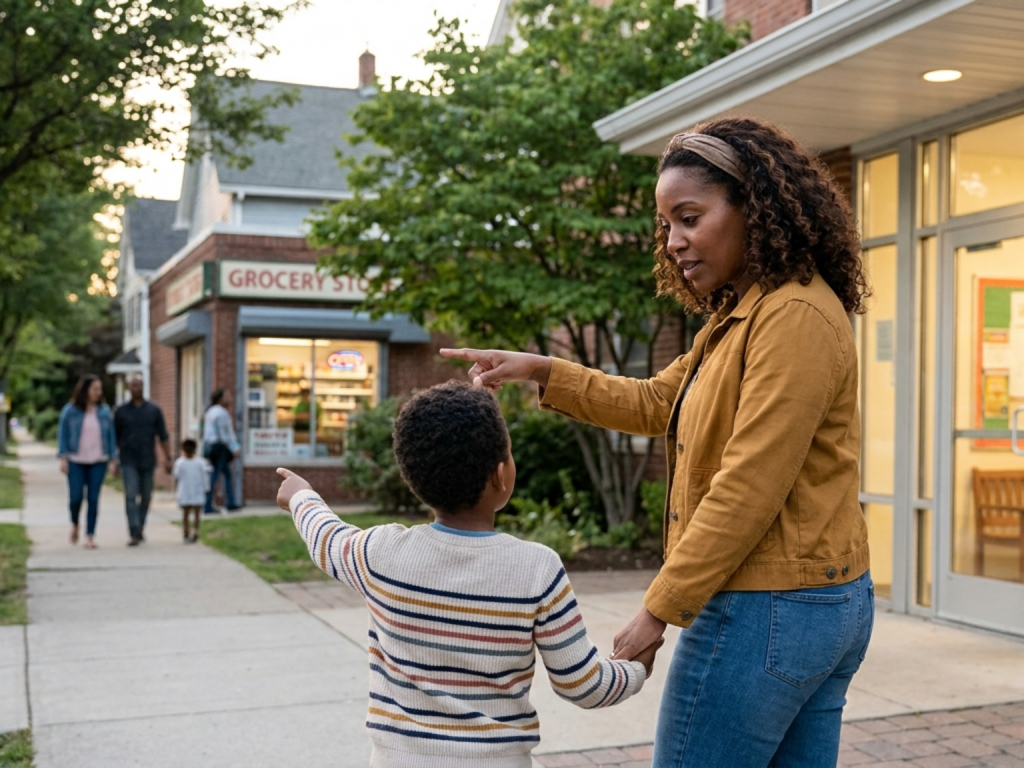
Route planning is particularly important for children who walk to school, use public transit, or play outside with gradually increasing independence. Caregivers can walk routes together and point out where the child could seek help. They can also identify places to avoid, such as deserted lots, isolated stairwells, empty playgrounds at dusk, or shortcuts that reduce visibility. A route that is slightly longer but better supervised may be safer.
Home rules should be equally clear. Children should not open the door to unknown people, reveal that they are home alone, or share family schedules. If someone comes to the door, the child can remain quiet, call a caregiver, or speak through a locked door only if the family has practiced that rule. Phone and messaging rules matter too: children should not confirm their address, school, caregiver location, or whether an adult is home.
For children with medical conditions, disability, or communication differences, consider adding a written emergency card, wearable identification, or school-based plan. Families may also benefit from an emergency action plan for school if a child needs coordinated support during unexpected events.
Make lessons age-appropriate and emotionally safe
For preschool children, use short rules and concrete examples. “Check with me first,” “Stay where I can see you,” and “Tell me if someone asks you to keep a secret” are more effective than long explanations about crime. Puppets, drawings, and pretend scenarios can help, but avoid graphic details that the child cannot process developmentally.
For early school-age children, add more detailed problem-solving. Ask them to name three safe adults, two safe places, and the exact words they could use if someone pressures them. Teach them that adults should ask other adults for help, not children. This principle is useful when someone asks a child to help carry something, find an animal, or give directions from inside a car.
For preteens and adolescents, the conversation should include manipulation, secrecy, and digital contact. Older children may be less vulnerable to simple lures but more vulnerable to social pressure, embarrassment, romantic attention, gaming chats, or threats involving images and personal information. Discuss consent, coercion, and the fact that they can ask for help without losing your support, even if they broke a rule first.
Monitor the child’s emotional response. Some children become vigilant or develop persistent emotional distress after safety talks, especially if they are already anxious or have experienced trauma. If safety education leads to sleep disruption, avoidance of normal activities, panic-like episodes, school refusal, or repeated reassurance seeking, consult a pediatrician, child psychologist, or other qualified clinician. The goal is realistic preparedness, not hypervigilance.
Include online stranger safety
Online contact can feel less threatening to children because it happens through games, social media, messaging apps, or video platforms. However, the same safety principles apply. Children should check first before accepting new contacts, joining private chats, sharing photos, turning on location features, or agreeing to meet anyone in person. They should understand that people online may misrepresent their age, identity, or intentions.
Personal information includes more than a home address. It can include school name, team name, daily routine, caregiver workplace, photos in identifiable uniforms, geotagged images, usernames used across platforms, or details that reveal when a child is alone. Children should be taught not to share these details publicly or with people they do not know offline and whose connection has not been approved by caregivers.
Parental controls and monitoring can reduce risk, but they are not substitutes for relationship-based safety. Children are more likely to disclose concerning contact when they believe they will be helped rather than immediately punished. A useful family message is: “If someone online makes you uncomfortable, asks for secrecy, sends sexual content, asks for pictures, threatens you, or wants to meet, tell me right away. You will not be in trouble for asking for help.”
Families can create device rules that include approved apps, privacy settings, no private messaging with unknown people, no face-to-face meetings arranged online, and regular check-ins. If there is suspected exploitation, threats, sexual solicitation, or image-based abuse, preserve evidence when safe to do so and contact appropriate authorities or child protection resources.
Practice, review, and coordinate with other caregivers
Stranger safety improves when all caregivers use the same language. Parents, babysitters, grandparents, school staff, and coaches should know who may pick up the child, how changes are communicated, and what the child has been taught to do. Inconsistent pickup arrangements can confuse children and weaken the check-first rule.
Review plans before predictable transitions: starting school, moving neighborhoods, attending camp, walking to a friend’s house, getting a phone, or using a new online platform. Keep rehearsals short and matter-of-fact. Overly intense drills can increase fear, while no rehearsal at all may leave children unable to act under stress.
Caregivers should also model boundary-respecting behavior. Ask before hugging, respect a child’s “no” when safe and appropriate, and avoid forcing affection toward relatives or friends. This helps children recognize that bodily autonomy and consent are normal. When children report discomfort, listen carefully. You do not need to prove danger before taking a child’s concern seriously.
If an incident occurs, focus first on safety and emotional containment. Use calm language, write down what the child says in their own words, and avoid repeated interrogations, which can be distressing and may complicate formal assessment. Seek urgent help if there is immediate danger, suspected assault, abduction risk, self-harm risk, or pediatric emergency warning signs such as severe injury, altered consciousness, or acute medical distress.
Seek urgent help when safety is uncertain
- Call emergency services if a child is missing, being followed, threatened, forcibly taken, or in immediate danger.
- Report suspected sexual exploitation, coercion, or grooming to appropriate child protection or law enforcement services.
- Consult a healthcare professional if a child shows persistent fear, sleep disturbance, regression, or trauma symptoms after an incident.
- Do not rely on a child to manage unsafe situations alone; adult supervision and coordinated safety planning remain essential.
- If a child has been injured or assaulted, seek medical care promptly and avoid bathing or changing clothes if forensic evaluation may be needed.
Tools & Assistance
- Create a written list of approved pickup adults and emergency contacts.
- Walk common routes with your child and identify safe places to seek help.
- Practice check-first and no-go-tell scripts in brief role-play sessions.
- Review privacy settings, parental controls, and direct-message rules on devices.
- Coordinate safety rules with school, childcare, coaches, and regular caregivers.
FAQ
Should I tell my child that all strangers are dangerous?
No. A more accurate message is that some behaviors are unsafe, even if the person seems friendly. Children also need to know which unfamiliar adults may help in an emergency.
What is the simplest rule for a young child?
Teach “check first” before going anywhere, accepting anything, helping an adult, sharing information, or changing plans. Pair it with “no, go, tell” for unsafe pressure.
How often should we practice stranger safety?
Brief practice every few months and before new independence, such as walking to school or getting a phone, is usually more helpful than one long conversation.
What if safety talks make my child anxious?
Use calmer language, emphasize helpers and plans, and reduce graphic details. If anxiety persists or interferes with sleep, school, or normal activities, consult a pediatrician or child mental health professional.
Does online stranger safety matter for younger children?
Yes. Games, videos, and apps may allow chat or contact requests. Young children need clear rules about approved contacts, privacy, and telling an adult about uncomfortable messages.
Sources
- Johns Hopkins Medicine — Stranger Danger and Stranger Safety
- First 5 California — Stranger Safety: Preparing Kids for Safe Interactions
- Scholastic — Talking About Stranger Safety
Disclaimer
This article is for general educational purposes and does not replace medical, mental health, legal, or emergency advice. If a child may be in danger or shows concerning physical or psychological symptoms, seek help from emergency services or qualified professionals.
















Please log in to leave a comment.