
Intro
A home fire is one of the emergencies that can move from manageable to life-threatening within minutes, especially for children. Children have smaller airways, breathe faster than adults, and may sleep deeply through early cues such as odor, heat, or noise. A working smoke detector or fire alarm system gives families the time they need to wake up, gather children, and leave before smoke inhalation, thermal injury, or toxic gas exposure becomes catastrophic.
This article is written for caregivers who want practical, medically informed guidance without fear-based messaging. The goal is to help you make your home safer, prepare children in a calm way, and understand when smoke exposure or burns require urgent medical attention.
Highlights
Working smoke alarms reduce the risk of dying in a home fire by about 60 percent, making them one of the most effective household safety measures.
Children need repeated, calm practice because alarms can be frightening, confusing, or hard to interpret during sleep.
Both ionization and photoelectric alarms have strengths; correct placement and maintenance are more important than owning a device that is never tested.
After any significant smoke exposure, breathing symptoms in a child deserve prompt medical attention, even if burns are not visible.
Why smoke alarms matter for children
Children are uniquely vulnerable during residential fires. Their respiratory rate is higher, their airways are narrower, and their oxygen reserve is smaller. Smoke inhalation can cause airway irritation, bronchospasm, carbon monoxide poisoning, cyanide toxicity in some fire environments, and impaired consciousness before a child is able to call for help. Many fatal fires occur at night, when children may not smell smoke or may not understand that an alarm means immediate action.
Smoke detectors do not prevent fires, but they change the timeline. A working alarm can alert a household before smoke density, heat, and toxic gases make escape difficult. Research on house-fire deaths has shown that smoke alarms have saved thousands of lives since widespread adoption. The National Fire Protection Association reports that working smoke alarms reduce the risk of dying in a home fire by 60 percent. For families, this is not an abstract statistic; it may mean enough time to lift a toddler from a crib, guide a frightened school-age child to an exit, or reach an agreed outdoor meeting place.
Fire risk is not distributed equally. Homes facing socioeconomic stress, overcrowding, older wiring, limited heating options, or fewer landlord resources may be less likely to have functioning alarms. Supportive community approaches, including alarm distribution, education, legislation, and home safety checks, are therefore part of child health promotion. Pediatric clinicians and primary care teams can also help by asking about smoke alarms during preventive visits, much as they ask about car seats, safe sleep, and medication storage.
Choosing smoke detectors and understanding alarm types
Most homes use either ionization alarms, photoelectric alarms, or combination units. Ionization alarms generally respond faster to flaming fires, such as a rapidly burning paper or grease fire. Photoelectric alarms generally respond faster to smoldering fires, such as a cigarette igniting upholstery or overheated wiring producing smoke before flames. Because real home fires vary, many safety organizations support using both technologies or dual-sensor alarms, while still emphasizing that any properly installed, working alarm is far safer than no alarm.
Families may also consider interconnected alarms. When one alarm sounds, all linked alarms sound, which is particularly helpful in larger homes, multilevel homes, and bedrooms with closed doors. For children who sleep deeply, the alarm nearest the fire may not be loud enough to wake them reliably. Interconnection increases the chance that caregivers hear the alarm quickly and reach children.
For children who are deaf or hard of hearing, alarms with strobe lights, bed shakers, or low-frequency sound may be needed. For children with sensory processing differences, autism, developmental delay, or trauma histories, the sound of an alarm can trigger freezing, hiding, or panic. These children still need effective alarms, but they also need gradual practice, visual supports, and a predictable escape script.
When selecting alarms, look for devices listed by a recognized testing laboratory and follow the manufacturer’s instructions. Avoid disabling alarms because of nuisance activation from cooking or steam. Instead, improve placement, use a hush feature if available, increase ventilation while cooking, or choose an alarm type better suited to the area. A disabled alarm cannot protect a sleeping child.
Where to install alarms in a child-safe home
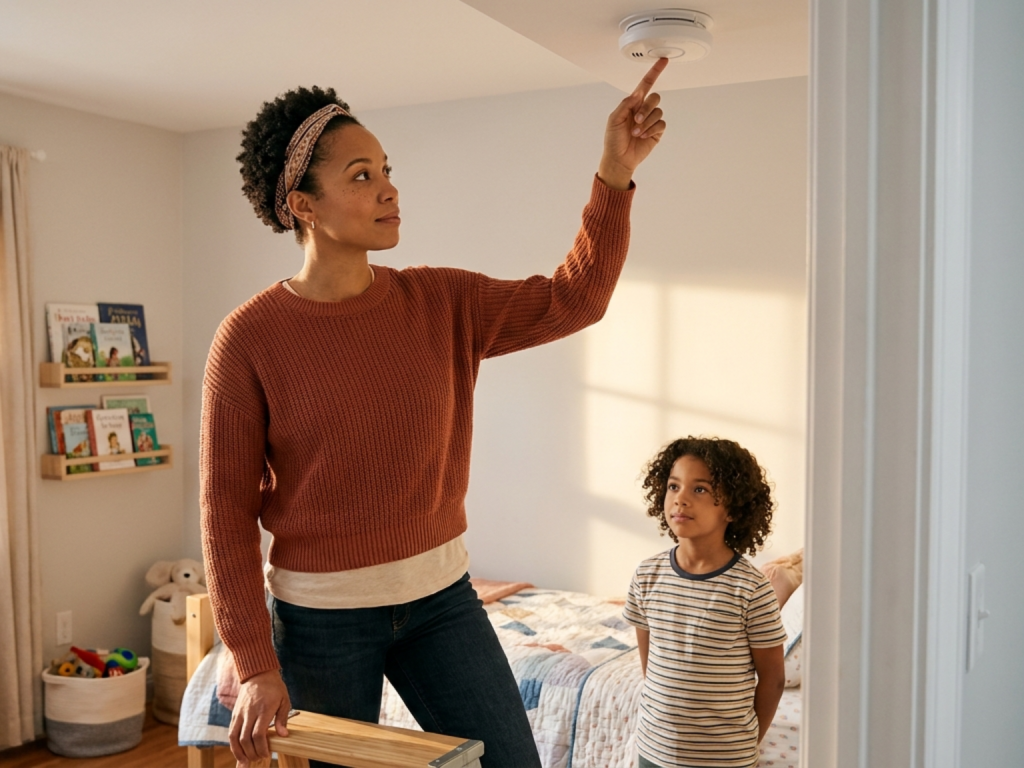
Placement determines whether smoke is detected early enough. The NFPA recommends smoke alarms inside every sleeping room, outside each sleeping area, and on every level of the home, including the basement. For a child’s bedroom, this means an alarm inside the room, not just down the hallway. Closed doors slow the spread of smoke and heat, which can be protective, but they may also delay hallway alarm activation if smoke begins inside the room or if the sound is muffled.
Install alarms high on walls or ceilings according to the manufacturer’s directions because smoke rises. Keep them away from windows, vents, and fans that may interfere with smoke entry. Avoid placing standard smoke alarms too close to kitchens or bathrooms, where steam and cooking aerosols can cause nuisance alarms; instead, follow spacing guidance and consider heat alarms in garages or areas where smoke alarms are not recommended.
Families in apartments or rental housing should know both the in-unit alarm plan and the building alarm plan. A hallway fire, stairwell smoke, or alarm sounding elsewhere in the building can require different action than a small contained incident inside the apartment. Caregivers should identify at least two ways out when possible, learn stair locations, and teach children never to use elevators during a fire alarm unless emergency personnel specifically direct otherwise.
Infants, toddlers, and children who cannot self-evacuate need assigned adults. If more than one caregiver is present, decide ahead of time who gets each child, who brings needed mobility equipment if it is immediately accessible, and where everyone meets outside. Do not spend time collecting valuables, routine medicines, toys, or pets if smoke or fire is present. People leave first; belongings can be replaced.
Maintenance: the most common point of failure
A smoke alarm is only protective if it has power, is within its service life, and is tested. NIST research identifies missing or dead batteries and intentional power source interruption as two major reasons smoke alarms fail. This is a practical, solvable problem. Many families do not mean to leave children unprotected; they remove a battery after a nuisance alarm, plan to replace it later, and forget. Others assume a hardwired alarm is always working, although backup batteries and device age still matter.
Create a routine that is simple enough to sustain:
- Test each smoke alarm monthly using the test button.
- Replace batteries at least yearly, or sooner if the alarm chirps or the manufacturer instructs a different schedule.
- Replace the entire smoke alarm every 10 years, or earlier if it fails testing or the manufacturer recommends replacement.
- Write the installation or replacement date on the device or keep it in a home safety checklist.
- Keep alarms clean by gently vacuuming or dusting according to the instructions, since dust and insects can interfere with function.
Testing can be hard for children who are anxious or sound-sensitive. Warn them before the test, offer ear protection if needed, and explain: “This loud sound helps us know the alarm can wake us up.” If a child has a history of panic, seizures triggered by sudden stimuli, or significant developmental differences, ask their healthcare or therapy team for individualized preparation strategies. The aim is not to force distress but to build familiarity and safety.
Teaching children what to do when an alarm sounds
Children often learn best through repetition, role play, and concrete instructions. A fire escape plan should be practiced during calm moments, not introduced for the first time during an emergency. Use simple language: “When the alarm beeps, we get low, go outside, and meet at the mailbox.” Pick a meeting place that is a safe distance from the home and easy for children to remember, such as a specific tree, neighbor’s porch, or lamp post.
Practice these steps:
- Wake up or respond immediately when the alarm sounds.
- Stay low if there is smoke, because air may be clearer near the floor.
- Check a door for heat with the back of the hand before opening if the child is old enough to understand.
- Use the planned exit and do not hide under a bed or in a closet.
- Go to the meeting place and stay there.
- Never go back inside for toys, pets, phones, or family members.
Some children hide from firefighters because of masks, helmets, and loud breathing equipment. If possible, attend community fire department events where children can see firefighters in gear in a non-emergency setting. For younger children, practice crawling under pretend smoke and calling out loudly from a room. For older children, discuss how to call emergency services from outside the home and how to give the address.
Keep practice supportive. A child who cries, laughs nervously, or refuses is not “being difficult”; they may be overwhelmed. Break the plan into shorter steps. Children with anxiety may benefit from predictable bedtime routines school age kids already use, with fire safety reminders placed into a calm household rhythm rather than presented as frightening warnings.
Smoke exposure, burns, and pediatric medical caution
After a fire or smoke event, a child may need medical assessment even if they look well. Smoke inhalation can irritate the upper and lower airways, worsen asthma, trigger bronchospasm, or cause delayed airway swelling. Carbon monoxide binds hemoglobin with high affinity, reducing oxygen delivery to tissues; children may develop headache, dizziness, nausea, confusion, weakness, syncope, or altered mental status. Cyanide toxicity is less common but can occur in enclosed-space fires involving synthetic materials and may cause severe lactic acidosis and cardiovascular instability.
Seek emergency care promptly for pediatric emergency warning signs such as severe breathing difficulty in children, persistent coughing after smoke exposure, hoarseness, soot around the mouth or nose, burns to the face or neck, confusion, fainting, seizure, bluish lips, or unusual sleepiness. If a child has known asthma, chronic lung disease, congenital heart disease, sickle cell disease, neuromuscular disease, or a history of prematurity, have a lower threshold for urgent evaluation after smoke exposure.
For burns, cool the area with cool running water if it is safe and the burn is minor, but do not apply ice, butter, toothpaste, or home remedies. Cover with a clean, dry cloth and seek medical advice for burns involving the face, hands, feet, genitals, major joints, circumferential areas, electrical injury, chemical exposure, inhalation concern, or any burn in an infant. Avoid diagnosing burn depth at home; superficial, partial-thickness, and full-thickness burns can be difficult to distinguish early.
If a fire occurs, leave the home first and call emergency services from outside. Do not re-enter a smoky building, even briefly. Caregivers naturally want to retrieve medications or comfort objects, but the risk of sudden incapacitation from smoke and toxic gases is real.
Building a safer household system
Smoke detectors work best as part of a broader fire prevention system. Keep matches, lighters, candles, and vaping or smoking materials out of children’s reach. Use child-resistant storage when appropriate, while remembering that child-resistant caps are not childproof. Keep space heaters at least three feet from bedding, curtains, and furniture, and turn them off when adults leave the room or go to sleep. Do not overload outlets or run cords under rugs. In the kitchen, turn pot handles inward, keep children away from hot surfaces, and supervise cooking closely.
Families should also think about night conditions. Close bedroom doors during sleep if this fits the household’s safety plan, because a closed door can slow smoke and heat spread. Keep pathways clear of toys, laundry, and furniture so a caregiver can reach a child quickly in the dark. Store mobility aids, glasses, hearing devices, or communication tools where they can be reached immediately.
For multigenerational households, babysitters, and shared custody arrangements, make sure every adult knows the same plan. A written pediatric medication plan may matter after evacuation if a child relies on rescue medications, insulin, antiseizure medication, or other time-sensitive treatment, but it should never delay escape. Once outside and safe, caregivers can inform emergency responders about the child’s medical conditions and medications.
If your family cannot afford alarms or is unsure about installation, contact the local fire department, housing authority, community health program, or pediatric clinic. Many communities offer free or low-cost smoke alarm installation and education. Asking for help is a protective parenting decision, not a failure.
Get urgent help immediately
- Call emergency services if a smoke alarm sounds and you see smoke, flames, or cannot confirm the source safely.
- Seek urgent medical care for any child with breathing difficulty, confusion, fainting, seizure, facial burns, or soot around the mouth or nose.
- Do not re-enter a burning or smoky building for belongings, pets, or medications.
- Do not disable a smoke alarm because of nuisance alarms; fix placement or ventilation instead.
- Ask a healthcare professional for individualized advice after smoke exposure in children with asthma, heart disease, prematurity history, or complex medical needs.
Tools & Assistance
- Monthly smoke alarm testing checklist for every bedroom and home level
- Home fire escape map with two exits and one outdoor meeting place
- Local fire department home safety visit or smoke alarm installation program
- Emergency contact list and child medical summary stored outside the home or in a phone
- Calendar reminder to replace batteries yearly and alarms every 10 years
FAQ
How many smoke alarms does a family home need?
At minimum, install alarms inside every sleeping room, outside each sleeping area, and on every level of the home, including the basement. Larger homes may need more.
Which is better: ionization or photoelectric?
Ionization alarms tend to respond faster to flaming fires, while photoelectric alarms tend to respond faster to smoldering fires. Many families use both technologies or dual-sensor alarms.
What if my child sleeps through the alarm?
Use interconnected alarms, practice the escape plan, and assign an adult to wake or carry the child. Children who are deaf, hard of hearing, or deep sleepers may need specialized alerting devices.
Can I remove the battery if cooking keeps setting off the alarm?
No. A disabled alarm cannot protect your child. Improve ventilation, adjust placement according to instructions, use the hush feature, or ask a fire safety professional for help.
When should a child be checked after smoke exposure?
Seek urgent care for breathing symptoms, persistent cough, hoarseness, confusion, fainting, soot near the airway, facial burns, or any concern after an enclosed-space fire.
Sources
- PubMed Central — Smoke alarms and prevention of house-fire—related deaths
- National Institute of Standards and Technology — Smoke Alarm Research
- National Fire Protection Association — Learn More About Smoke Alarms
Disclaimer
This article is for general educational purposes and does not replace medical care. For smoke exposure, burns, breathing symptoms, or emergency concerns in a child, contact emergency services or a qualified healthcare professional.

















Please log in to leave a comment.