
Intro
Games are more than entertainment for children. When chosen thoughtfully and supported by caring adults, they can become structured opportunities to practice communication, turn-taking, emotional regulation, perspective-taking, cooperation, and conflict repair. These abilities are not simply “nice manners”; they are core developmental skills shaped by neurodevelopment, language growth, executive function, temperament, family context, and peer experience.
Some children learn interaction skills easily through play, while others need more repetition, adult scaffolding, or professional support. A child who struggles during games is not “bad at socializing”; they may be overwhelmed by sensory input, language demands, impulsivity, anxiety, frustration intolerance, or unclear rules. The goal is to use games with warmth and clinical caution: observe patterns, support practice, and consult healthcare or developmental professionals when concerns persist.
Highlights
Games can help children rehearse social communication in a low-stakes, motivating format.
Cooperative, pretend, movement, board, and digital games each build different interaction skills.
Adult coaching matters: brief prompts, emotion labeling, and repair after conflict often teach more than the game itself.
Persistent distress, aggression, isolation, or regression during play deserves discussion with a pediatrician, psychologist, speech-language pathologist, or other qualified clinician.
Why games are powerful social laboratories
Games create a small social world with rules, roles, goals, feedback, and shared attention. In that world, children practice the same interaction skills they need in classrooms, playgrounds, family routines, and friendships. A simple game of rolling a ball may involve joint attention, waiting, eye gaze, motor planning, anticipation, and reciprocal play in early childhood. A board game may add impulse control, frustration tolerance, flexible thinking, and verbal negotiation. A team video game may require planning, role assignment, rapid communication, and cooperation under pressure.
From a developmental perspective, games combine cognitive, emotional, and social learning. Children must hold rules in working memory, inhibit the urge to act out of turn, interpret another player’s intention, and adjust behavior when the situation changes. These processes rely partly on executive functions, including inhibitory control, cognitive flexibility, and working memory. They also require social cognition: noticing cues, predicting what another person may do, and understanding that others can have different goals or feelings.
Playful learning is especially effective because it is usually joyful, meaningful, iterative, and socially interactive. Children can test strategies, make mistakes, receive immediate feedback, and try again. This repetition is not mechanical; it is emotionally encoded. When a child laughs, feels competent, or experiences belonging during a game, the learning often becomes more durable. For children who find direct social instruction uncomfortable, games may feel safer than being told to “make friends” or “be polite.”
Interaction skills children can practice through games
Different games emphasize different skills. Turn-based games teach waiting, sequencing, and respect for another person’s opportunity to act. Cooperative games teach shared goals, helping behavior, and noticing when a partner needs support. Pretend play builds symbolic thinking, narrative language, emotional perspective-taking, and flexible role shifting. Movement games support body awareness, spatial boundaries, and coordinated attention. Digital multiplayer games can involve complex communication patterns, including planning, signaling, alliance-building, and problem-solving.
Important interaction skills that may be practiced through games include:
- Initiation: asking to join, inviting another child, or suggesting an activity.
- Reciprocity: responding to another person’s move, comment, or emotion rather than playing in parallel only.
- Pragmatic communication: using language appropriately for the social context, such as clarifying, requesting, joking, negotiating, and repairing misunderstandings.
- Emotion regulation: managing disappointment, excitement, uncertainty, and competition without becoming unsafe or overwhelmed.
- Conflict repair: apologizing, compromising, restarting, or changing a rule after a disagreement.
- Perspective-taking: recognizing that another player may have different knowledge, intentions, preferences, or feelings.
These skills do not emerge evenly. A child may be verbally advanced but unable to tolerate losing. Another may be generous and empathic but too anxious to initiate play. A medically literate caregiver may recognize that this unevenness is common in neurodevelopment: language, sensory processing, motor coordination, affect regulation, and social motivation can develop at different rates.
Choosing games by developmental stage
For infants and toddlers, interaction games are usually body-based and repetitive: peekaboo, rolling a ball, imitation sounds, simple chase games, songs with gestures, and hiding objects. These experiences support early social development in infancy and toddlerhood by strengthening shared attention, anticipation, imitation, and co-regulation before self-regulation. The adult’s facial expression, voice, pacing, and responsiveness are part of the game.
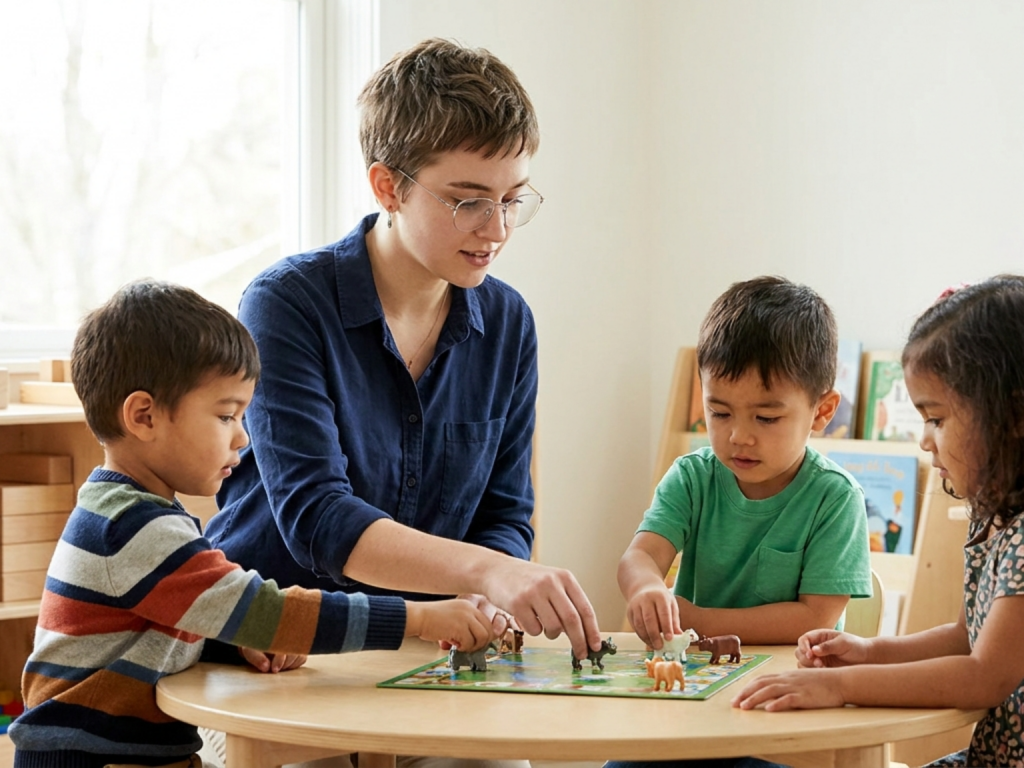
For preschoolers, games should be short, concrete, and emotionally manageable. Matching games, simple board games, pretend shops, animal role-play, obstacle courses, and small-group preschool activities can help children practice waiting, sharing materials, using words for needs, and recovering from frustration. At this age, adult modeling is often more effective than long explanations. A caregiver might say, “You wanted the red piece. Maya has it now. Let’s ask, ‘Can I have it when you’re done?’”
School-age children can usually handle more complex rules, strategy, team roles, and negotiation. Cooperative board games, construction challenges, treasure hunts, sports with modified rules, classroom simulations, and age-appropriate multiplayer games can support social problem-solving in school-age children. These children may benefit from reflection after play: “What helped your team?” “What made the argument worse?” “What could you try next time?”
Adolescents often use games as social spaces. Digital games, role-playing games, sports, debate-style games, and collaborative creative platforms can support identity, belonging, leadership, and digital communication in adolescents. Adults do not need to control every interaction, but they should remain attentive to sleep, mood, bullying, exposure to inappropriate content, and whether gaming is replacing rather than supporting real-life functioning.
The adult’s role: scaffold, do not dominate
Children often learn the most when adults provide just enough support to keep the game socially and emotionally workable. This is sometimes called scaffolding: the adult adjusts the challenge so the child can succeed with effort. Too much adult control can remove the child’s chance to negotiate; too little support can allow repeated failure, exclusion, or escalation.
Helpful coaching is brief, specific, and calm. Instead of lecturing during a conflict, an adult might pause the game and name the problem: “Two people want to be first.” Then offer a limited strategy: “We can flip a coin, take turns, or start with the youngest player today.” This teaches a repair pathway without shaming the child. Emotion vocabulary in children grows when adults label internal states gently: “You look disappointed that the tower fell,” or “You were excited and grabbed quickly.”
Adults can also model prosocial behavior. During a cooperative game, a caregiver can think aloud: “I see you need one more piece. I can help you.” During a competitive game, the adult can model losing with dignity: “I wanted to win, but I can say, ‘Good game,’ and try again.” These small scripts become internal templates.
It is useful to praise the process rather than only the outcome. Comments such as “You waited even though it was hard,” “You asked before taking the card,” and “You changed your plan when your friend had a different idea” reinforce the behaviors that build durable interaction skills. This approach is especially helpful for children with impulsivity, anxiety, or low frustration tolerance, because it makes invisible effort visible.
Cooperative games versus competitive games
Cooperative games are often excellent for children who become dysregulated by competition. In a cooperative game, players work against a shared challenge rather than against each other. This structure can reduce threat perception, support helping behavior, and encourage group planning. Children practice statements such as “What should we do next?” “Can I help?” and “Let’s try your idea.” For some children, cooperative play in preschool children is an ideal bridge from solitary or parallel play to more complex peer interaction.
Competitive games are not harmful by nature. They can teach resilience, rule-following, effort, fairness, and coping with disappointment. However, competition needs careful dosing. A child who repeatedly melts down, becomes aggressive, or feels humiliated may need shorter rounds, lower stakes, predictable rules, or a temporary shift toward cooperative play. The clinical principle is to keep the child within a tolerable arousal window where learning remains possible.
Many families benefit from mixing both types. For example, begin with a cooperative puzzle to build connection, then play a short turn-taking game with a clear ending, then close with a calming routine. If competition triggers intense reactions, adults can preview coping language before starting: “Someone will win and someone will not win this round. If you feel upset, you can squeeze the cushion, ask for a break, or say, ‘I want to try again.’”
Children also need to learn that rules can be both stable and negotiable depending on context. In formal games, rules protect fairness. In pretend play, rules may be co-created. This distinction supports flexible thinking and reduces conflict when children move between structured and imaginative play.
Digital and multiplayer games: risks and opportunities
Digital games can support interaction skills when they involve cooperation, communication, strategy, and shared problem-solving. Research on multiplayer environments describes rich forms of communicative action: players signal intentions, coordinate timing, create alliances, respond to social norms, and use verbal or nonverbal cues within the game system. The American Psychological Association has also summarized evidence that video games may offer cognitive, motivational, emotional, and social benefits, including cooperation and helpfulness in some contexts.
At the same time, digital play requires boundaries. Online environments can expose children to toxic communication, exclusion, grooming risks, excessive time use, microtransactions, and sleep disruption. Younger children generally need more direct supervision, privacy protection, and limited access to open chat. Adolescents need collaborative rule-setting, not only surveillance: discussions about respectful communication, blocking/reporting tools, time limits, and how gaming affects mood, schoolwork, sleep, and offline relationships.
Parents can make digital games more socially constructive by choosing cooperative modes, playing together occasionally, asking the child to explain strategies, and observing communication style. A useful question is not simply “How many minutes?” but “What is this game doing for my child?” If a child is calmer, connected, and able to transition away, the game may be functioning differently than if the child becomes irritable, secretive, sleep-deprived, or socially withdrawn.
For children with social anxiety or neurodevelopmental differences, online games may provide a less visually demanding route into interaction. Still, digital communication should not be the only social practice unless a clinician recommends a specific therapeutic plan. Many children need both online and face-to-face opportunities, with adaptations for sensory, language, or emotional needs.
Adapting games for children with different needs
Not every child benefits from the same game in the same way. A child with language delay may need visual supports, simplified rules, gestures, or extra response time. A child with attention-deficit/hyperactivity traits may need movement breaks, shorter turns, and clear external cues. A child with autism-related social communication differences may benefit from predictable structure, explicit role descriptions, and reduced sensory load. A child with anxiety may need gradual exposure for shy children, beginning with one trusted partner before moving into a group.
Adaptations should preserve dignity. The aim is not to force “normal” play but to make participation accessible. Useful modifications include:
- Reducing the number of players or rules.
- Using visual turn markers, timers, or picture cards.
- Offering a choice between speaking, pointing, drawing, or acting.
- Practicing one target skill at a time, such as asking to join or waiting for a turn.
- Building in a predictable break before the child is overwhelmed.
- Ending while the experience is still successful, rather than pushing until collapse.
If a child has motor coordination difficulties, choose games that do not make clumsiness the center of attention. If sensory sensitivities are present, avoid loud, chaotic, or highly tactile games unless the child actively enjoys them. If trauma, grief, chronic illness, or family stress is affecting behavior, emotional safety may be more important than performance in the game.
When to seek professional guidance
Games can reveal patterns, but they should not be used by caregivers to diagnose a child. Occasional difficulty sharing, losing, waiting, or joining play is developmentally common. Concern increases when problems are persistent, impairing, escalating, or present across settings. Examples include repeated aggression during play, extreme distress with minor rule changes, inability to engage in any reciprocal play, persistent social withdrawal in children, loss of previously acquired social or language skills, or peer rejection that significantly affects mood or school participation.
A pediatrician can help determine whether further evaluation is appropriate. Depending on the pattern, referral may involve a developmental-behavioral pediatrician, child psychologist, speech-language pathologist, occupational therapist, child psychiatrist, school psychologist, or early intervention program. Teacher observations of peer interactions can be especially informative because some children behave differently at home than in groups.
Professional support may include parent coaching, social communication intervention, speech-language therapy for pragmatic language, occupational therapy for sensory-motor regulation, psychotherapy for anxiety or mood concerns, or school-based accommodations. These supports are not a sign that play has failed. Rather, they can make play more accessible and therapeutic.
Caregivers can bring concrete observations to appointments: which games are difficult, what triggers escalation, how long recovery takes, whether the child understands rules, whether language breaks down under stress, and whether difficulties occur with siblings, peers, adults, or all partners. Specific examples help clinicians distinguish developmental variation from concerns that need targeted assessment.
Use caution and seek help when needed
- Do not use game behavior alone to diagnose autism, ADHD, anxiety, language disorder, or any other condition.
- Seek urgent help if play involves serious aggression, self-harm statements, or unsafe behavior.
- Discuss persistent regression in language, play, or social interest with a pediatric professional promptly.
- Consider professional advice if gaming disrupts sleep, school functioning, mood, or family relationships.
- Children who are repeatedly excluded, bullied, or intensely distressed during play may need adult advocacy and clinical support.
Tools & Assistance
- Keep a brief play observation log: game, partners, triggers, strengths, and recovery time.
- Ask teachers or childcare staff for specific observations about peer play and group participation.
- Use visual turn markers, timers, emotion cards, or simple rule cards for children who need structure.
- Schedule a pediatric visit if social play concerns are persistent across settings.
- Consider speech-language, occupational therapy, or child psychology evaluation when advised by a healthcare professional.
FAQ
Can games really improve a child’s interaction skills?
Yes, games can provide repeated practice in turn-taking, communication, cooperation, and emotion regulation. The benefit is strongest when adults choose developmentally appropriate games and coach gently.
Are video games bad for social development?
Not necessarily. Some digital games support cooperation and problem-solving, but supervision, age-appropriate content, privacy protection, sleep routines, and balance with offline activities are important.
What if my child always gets upset when losing?
This can be common, especially in younger children. Try shorter games, cooperative formats, coping scripts, and praise for recovery. If reactions are extreme or impairing, discuss it with a pediatrician or child mental health professional.
Should I force my shy child to play group games?
Forced exposure can increase anxiety. Gradual, supported participation with a trusted child or adult is usually more helpful. Seek guidance if avoidance is persistent or interferes with school or friendships.
Which games are best for preschool social skills?
Simple cooperative games, pretend play, matching games, movement games with clear rules, and short turn-taking board games are often useful. The best choice depends on the child’s language, attention, sensory needs, and frustration tolerance.
Sources
- Game Studies Journal — Interaction Forms and Communicative Actions in Multiplayer Games
- Learning Through Play Foundation — The scientific case for learning through play
- American Psychological Association — Video games play may provide learning, health, social benefits
Disclaimer
This article is for informational purposes only and does not provide diagnosis or treatment. Consult a qualified healthcare professional for concerns about a child’s development, behavior, mood, or safety.

















Please log in to leave a comment.