
Intro
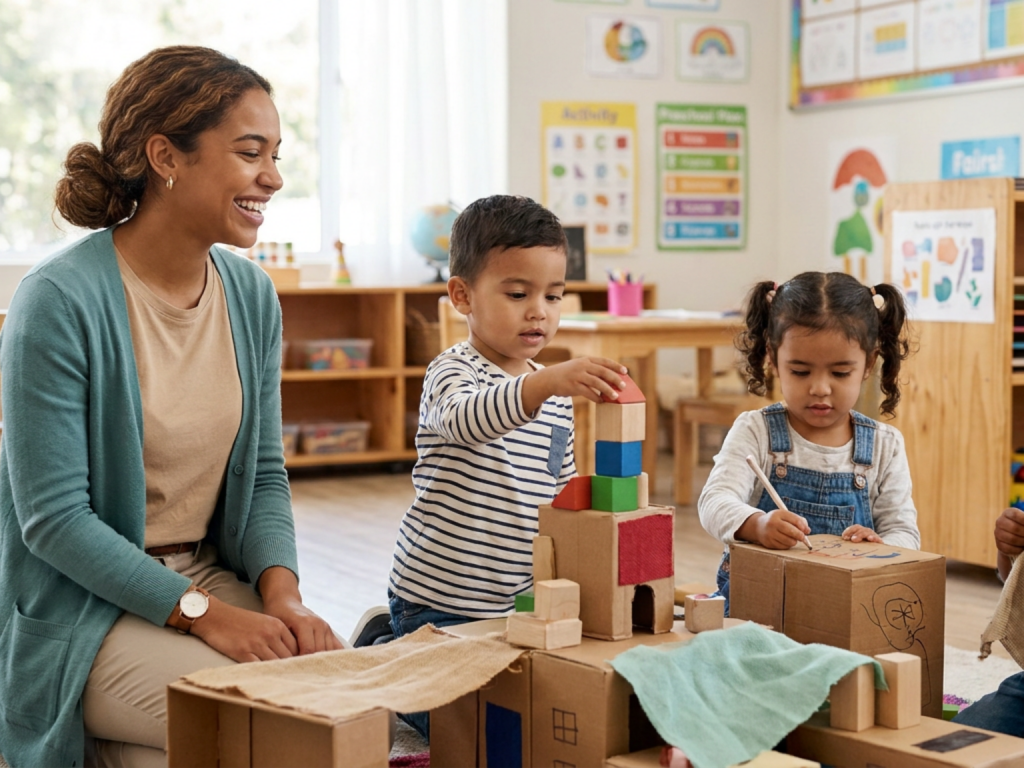
Creative development through play is not a luxury or a way to keep children busy; it is a biologically meaningful part of childhood learning. When a child invents a story with blocks, turns a cardboard box into a clinic, experiments with paint, or negotiates roles in a pretend shop, the brain is integrating language, sensory processing, motor planning, memory, emotion, and social understanding.
Highlights
Child-led play supports creativity by giving children room to explore, combine ideas, test possibilities, and recover from small mistakes.
Dramatic and pretend play appear especially powerful in early childhood, when neural plasticity and symbolic thinking are rapidly developing.
Creative play is also social and emotional: children practice perspective-taking, impulse control, flexibility, and repair after conflict.
Adults can support creativity without over-directing it by offering time, psychological safety, open-ended materials, and responsive guidance.
Why play is a developmental engine, not a break from learning
In childhood, play is one of the most efficient ways the nervous system learns. It allows a child to repeat actions, vary them, notice consequences, and attach emotional meaning to experience. From a developmental neuroscience perspective, play recruits distributed networks: sensory cortices process touch, movement, sound, and vision; prefrontal circuits support planning and inhibition; limbic structures attach motivation and emotion; language networks help children label, narrate, and negotiate.
Creative play is especially important because it asks the child to generate something that is not fully given by the environment. A spoon becomes a microphone, a blanket becomes a cave, and a pile of blocks becomes a city with rules. This symbolic transformation is more than imagination. It reflects representational thinking, cognitive flexibility, working memory, and the ability to hold multiple possibilities in mind.
Free play also provides a context for neural plasticity, the brain’s capacity to strengthen, weaken, and reorganize connections in response to experience. When children direct their own play, they link ideas across domains: a story may include movement, drawing, counting, emotional expression, and social negotiation. These cross-domain connections are part of why play can support later innovation and problem-solving.
What research suggests about creative play and creativity
Research on play is complex because play varies by age, culture, setting, adult involvement, and measurement method. Still, the overall pattern is encouraging. A recent meta-analytic review reported a meaningful association between creative play and creativity, with a stronger effect in early childhood, particularly between ages 3 and 7 years. Dramatic play activities were especially influential, likely because they require children to invent roles, maintain a narrative, adapt to peers, and use objects symbolically.
This does not mean every child must perform elaborate pretend scenes on demand. Creativity can appear quietly: arranging shells by imagined categories, making unusual sounds with household objects, mixing colors, designing a route for toy animals, or asking “what if” questions. The central feature is generativity: the child is producing, transforming, or recombining ideas rather than only following a fixed script.
Culture also matters. In some collectivist contexts, the relationship between play and creativity appears particularly strong. This may reflect the way shared storytelling, role flexibility, interdependence, and group problem-solving are embedded in children’s play. For medically literate readers, this is a useful reminder that development is biopsychosocial: maturation of the brain interacts continuously with relational expectations, community routines, and opportunities for practice.
The building blocks of creative play
Creative development through play is not one single skill. It is a cluster of capacities that mature at different rates and are shaped by temperament, sensory preferences, language development, motor ability, sleep, stress, and health. Many children move among several play forms in one afternoon, and each form offers different developmental benefits.
- Pretend play: The child uses symbolic representation, narrative memory, perspective-taking, and emotional rehearsal. Pretending to be a doctor, parent, animal, builder, or shopkeeper can help children explore fears, wishes, and social rules safely.
- Sensory and messy play: Sand, water, clay, finger paint, fabric, and natural materials support tactile processing, curiosity, and experimentation. For some children, sensory play is calming; for others, it can be overwhelming and should be adapted gently.
- Construction play: Blocks, cardboard, loose parts, and recycled materials build spatial reasoning, motor planning, persistence, and early engineering thinking.
- Movement play: Dancing, climbing, balancing, chasing games, and obstacle courses integrate vestibular and proprioceptive input, body awareness, sequencing, and confidence.
- Social play: Group stories, cooperative building, and shared make-believe foster turn-taking, negotiation, empathy, and conflict repair.
These categories often overlap. A preschooler building a “space hospital” from cushions is using construction play, dramatic play, language, motor planning, and early social cognition all at once.
Executive function, emotion regulation, and resilience
Creative play supports executive function because children must plan, remember rules, inhibit impulses, shift strategies, and monitor outcomes. In pretend play, a child may need to stay in role, wait for a turn, revise a plot when another child changes it, and tolerate frustration when the tower collapses. These are early forms of cognitive control, not simply cute behavior.
Play also gives children a low-stakes laboratory for emotion regulation. A child who makes a scary puppet, pretends a stuffed animal is sick, or builds a “safe house” after a loud storm may be metabolizing stress through symbolic action. Imaginative play can reduce the physiological and psychological burden of stress when the child feels safe, supported, and not pressured to perform.
Parents and educators sometimes worry when play includes conflict, monsters, injury themes, or intense emotions. Often, these themes are normal attempts to understand power, fear, care, and repair. However, play that is persistently distressing, repetitive in a rigid way, associated with loss of skills, or accompanied by sleep disruption, severe anxiety, self-injury, aggression, or trauma reminders should be discussed with a qualified clinician. The goal is not to pathologize imagination, but to notice when a child may need additional support.
The adult role: support without taking over
Adults are most helpful when they create the conditions for play and then follow the child’s lead. This can be difficult in achievement-focused environments, where adults may feel pressure to turn every activity into a lesson. Yet creativity often needs spaciousness. A child may learn more from twenty minutes of open-ended block exploration than from a perfectly sequenced worksheet about shapes.
Responsive adults can strengthen play by observing, narrating, and gently extending. Instead of saying, “Build it this way,” an adult might say, “Your bridge keeps falling. What could make it stronger?” Instead of correcting a story, the adult can join the child’s logic: “The dragon is sad today. What does it need?” These prompts invite problem-solving while preserving agency.
Useful adult strategies include offering open-ended toys for toddlers and preschoolers, rotating materials rather than overwhelming the space, allowing safe boredom, and protecting uninterrupted time. Simple materials often work best: boxes, scarves, blocks, crayons, cushions, spoons, leaves, tape, and containers. Toys that do only one thing tend to reduce invention; materials that can become many things invite it.
Adults can also model curiosity. Saying “I wonder what would happen if…” or “Let’s try another way” normalizes experimentation. When a child fails, the adult’s calm response teaches that mistakes are part of creative thinking, not evidence of inadequacy.
Play across ages: from toddler exploration to preschool imagination
Creative play changes with maturation. Infants explore through sensorimotor actions: mouthing, banging, dropping, reaching, and imitating. Toddlers begin combining objects and actions, such as feeding a doll or making a toy car sleep. This stage is closely related to How toddlers learn through play, because toddlers use repetition and variation to understand cause and effect.
Between ages 3 and 7, many children show rapid growth in symbolic play, storytelling, drawing, role play, and collaborative imagination. Preschool learning skills development often emerges inside play: children practice vocabulary, sequencing, classification, early numeracy, self-regulation, and persistence without experiencing the activity as formal instruction.
Not all children follow the same pattern. Some are highly verbal storytellers; others are builders, movers, musicians, collectors, or quiet observers. Neurodivergent children may show creativity through intense interests, pattern detection, visual design, humor, or unconventional object use. Children with motor, sensory, speech-language, hearing, or visual differences may need adapted materials or support from occupational therapy, speech-language pathology, audiology, vision services, or developmental specialists.
If caregivers are concerned about limited play variety, absence of pretend play after the expected age range, poor joint attention, loss of previously acquired skills, persistent difficulty engaging with peers, or major sensory distress, it is reasonable to ask the child’s pediatrician about developmental surveillance and screening. Screening is not a diagnosis; it is a way to decide whether further evaluation may be helpful.
Social creativity: cooperation, culture, and belonging
Creativity is often imagined as an individual trait, but much childhood creativity is relational. Children borrow ideas from siblings, grandparents, classmates, stories, songs, rituals, and community life. They learn that one idea can become richer when another person adds to it. This is why cooperative play in preschool children can be so developmentally powerful: a shared imaginary world requires listening, compromise, and flexible authorship.
Group play also teaches children that creativity has boundaries. A child may invent a game, but peers may not agree to unfair rules. Another child may want to join but not know how. These moments are opportunities for social development, empathy, and communication. Adults can support by coaching language such as “Can I have a turn when you are done?” or “Let’s make a rule everyone can follow,” rather than immediately solving every disagreement.
Cultural humility is essential. Some families value quiet concentration, others value expressive drama, outdoor exploration, spiritual storytelling, music, handcrafts, or intergenerational play. None is inherently superior. The developmental question is whether the child has safe opportunities to explore, imagine, connect, and try new roles within the values of the family and community.
Practical ways to nurture creative development through play
Families do not need expensive materials or a perfectly designed playroom. The most protective ingredients are safety, time, emotional availability, and permission to explore. A few practical principles can help.
- Protect child-led time: Aim for regular periods when the child decides the theme, pace, and materials, within safe limits.
- Choose open-ended materials: Blocks, art supplies, fabric, cardboard, clay, water, natural objects, and household items can become many different things.
- Use fewer questions and more observations: Too many adult questions can feel like testing. Try “You made a tall tower” or “That character looks surprised.”
- Make room for repetition: Repeating the same scenario may help children consolidate memory, master emotion, or refine a skill.
- Balance freedom with safety: Supervise choking hazards, water, climbing, sharp tools, and allergens. Creative freedom does not mean ignoring injury prevention.
- Watch the child’s nervous system: If play becomes dysregulating, reduce noise, simplify materials, offer movement breaks, or provide a predictable ending routine.
For many children, the best adult contribution is delight. When a caregiver takes a child’s idea seriously, the child learns that inner life matters. That sense of being seen is a foundation for confidence, flexible thinking, and lifelong creative engagement.
When to seek professional guidance
- Consult a pediatrician if a child loses previously acquired language, social, motor, or play skills.
- Ask for developmental guidance if play is persistently rigid, highly distressing, or very limited for the child’s age.
- Seek urgent help if play themes are accompanied by self-harm, dangerous aggression, or signs of abuse or trauma.
- Discuss sensory distress, feeding concerns, sleep disruption, or severe anxiety with a qualified healthcare professional.
- Use developmental screening as a support tool, not as a label or diagnosis.
Tools & Assistance
- A weekly child-led play block with open-ended materials and minimal adult direction
- A simple rotation of blocks, fabric, art supplies, containers, and safe household objects
- Developmental surveillance visits with a pediatrician or family physician
- Occupational therapy or speech-language pathology consultation when sensory, motor, or communication concerns affect play
- Teacher-caregiver conversations about play patterns, peer interaction, and emotional regulation
FAQ
Does creative play need special toys?
No. Many highly creative play experiences use simple materials such as boxes, blocks, fabric, water, clay, leaves, crayons, and household containers.
Is pretend play necessary for every child?
Pretend play is a common pathway to creativity, especially in early childhood, but children express creativity in different ways. Concerns are best discussed in the context of the child’s overall communication, social engagement, and development.
How much should adults guide play?
A helpful balance is to provide safety, materials, and gentle language while letting the child lead the theme and direction. Guided prompts can extend thinking without taking over.
When should I worry about repetitive play?
Repetition is often normal and useful. Consider professional advice if the play is extremely rigid, causes distress when interrupted, prevents social engagement, or occurs with developmental regression or major functional concerns.
Sources
- F1000Research — Creative play and creativity development: A three level meta data analysis
- Harvard Medicine Science — Free Play Shapes a Child's Brain — and Bestows a Lifetime of Benefits
- Waldorf Education Association — The Essential Benefits of Play: A Research-Based Perspective
Disclaimer
This article is for general educational purposes and does not diagnose, treat, or replace medical care. If you have concerns about a child’s development, behavior, or mental health, consult a qualified healthcare professional.















Please log in to leave a comment.