
Intro
Creative play is not just a pleasant way for children to pass time. It is a biologically meaningful, developmentally rich activity through which children test ideas, regulate emotion, practice social roles, and build flexible thinking.
For parents, caregivers, educators, and health professionals, understanding creative play can make everyday moments feel less chaotic and more purposeful. A cardboard box, a pretend café, a pile of fabric scraps, or water poured between cups may look simple, but these experiences can support cognitive, motor, language, sensory, and emotional growth.
Highlights
Creative play is open-ended, child-led activity that allows imagination, experimentation, and emotional expression.
Research links high-quality pretend play and loose parts play with executive function, self-regulation, reasoning, and problem-solving.
Adults support creative play best by providing safety, time, responsive attention, and flexible materials rather than constant instruction.
A lack of interest in play, loss of previously gained play skills, or extreme distress during play may warrant discussion with a healthcare professional.
What creative play means
Creative play is unstructured, open-ended activity in which a child uses imagination, materials, movement, language, or social roles to make something personally meaningful. It includes pretend play, drawing, building, music-making, dress-up, storytelling, small-world play, sensory exploration, and experimenting with ordinary objects. The defining feature is not the toy or activity itself, but the child’s opportunity to generate ideas, change the rules, and explore possibilities.
In developmental terms, creative play is a form of active learning. It draws on attention, working memory, symbolic thinking, motor planning, language, emotional regulation, and social cognition. A child pretending that a block is a phone is using symbolic representation: one object stands for another. A preschooler negotiating roles in a pretend veterinary clinic is practicing perspective-taking and flexible communication. A school-age child designing a cardboard bridge is testing cause and effect, spatial reasoning, and persistence.
Creative play differs from highly directed instruction. Adult-led craft projects, worksheets, or apps may have value in some contexts, but they are not the same as child-led exploration. In creative play, there is usually no single correct outcome. A tower may become a rocket, then a hospital, then a cave. This flexibility is one reason play-based learning in preschoolers is considered so powerful: children are not merely repeating information; they are organizing experience into meaning.
Why the developing brain needs open-ended play
Creative play supports executive function, the group of cognitive processes that helps a child hold information in mind, inhibit impulses, shift attention, plan, and monitor behavior. These skills are essential for later academic learning, peer relationships, and day-to-day self-management. During pretend play, children often hold a scenario in working memory, remember roles, delay immediate impulses, and adapt when another child changes the storyline.
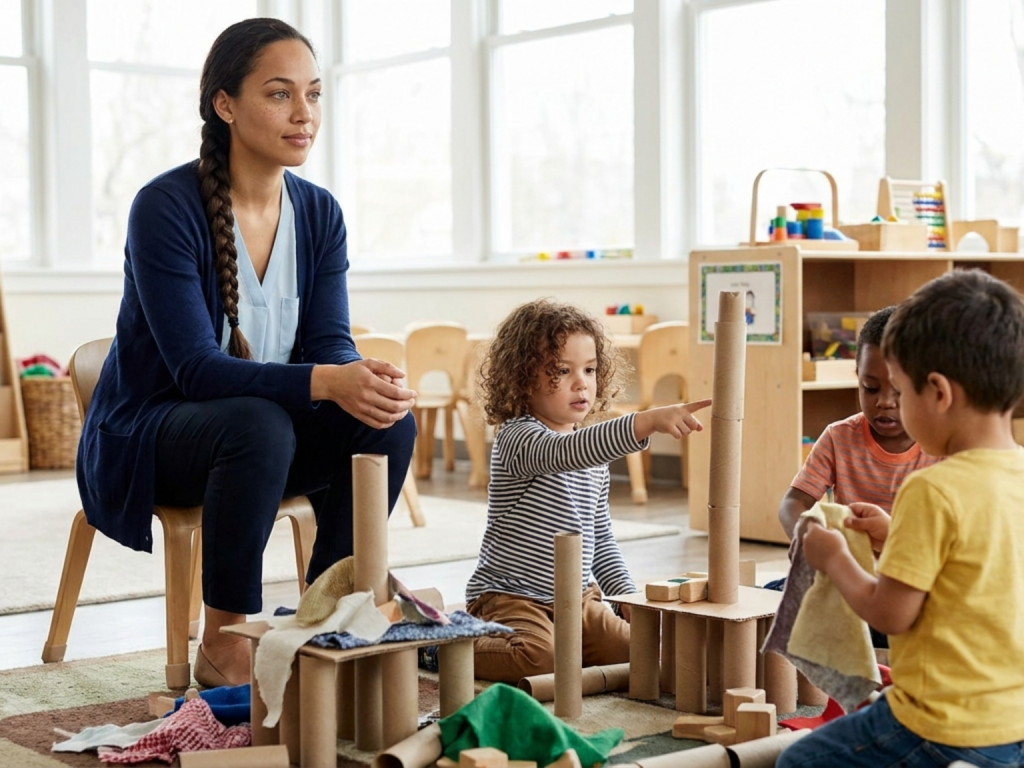
Loose parts play is especially useful for cognitive flexibility. Loose parts are open-ended materials such as blocks, shells, cardboard tubes, fabric pieces, stones, sticks, lids, containers, or magnetic tiles. Because these items do not dictate one fixed use, children must generate hypotheses: Will this balance? Can this roll? What happens if I add water? Such experimentation supports reasoning, innovation, and understanding of cause-and-effect relationships.
Creative play also helps regulate physiological stress. Playful states can provide a safe context for trying difficult emotions, moderate challenge, and recovery after frustration. A child who repeatedly acts out separation, rescue, injury, or conflict in pretend play may be processing themes they are trying to understand. This does not mean every play theme has a hidden clinical meaning. Often, play is simply the child’s natural language for organizing experience.
Reducing playtime in favor of narrow academic practice can be counterproductive, especially in early childhood. Children need the foundations that make formal learning possible: attention, curiosity, language, body control, emotional security, and persistence. Creative play builds these capacities in an integrated way.
Emotional and social learning through imagination
Creative play gives children a low-risk space to express feelings that may be too complex for direct conversation. A child may not say, “I feel powerless,” but may create a story in which a tiny animal becomes brave. Another child may use drawing, clay, or construction to communicate frustration, mastery, fear, joy, or grief. This is one reason adults should be cautious about dismissing imaginative play as “just pretending.” For the child, the play may be a meaningful emotional rehearsal.
Pretend play and emotional regulation are closely connected. When children act out roles, they practice modulating voice, body movement, and intensity. They learn that feelings can be represented, changed, paused, and revisited. A child pretending to be a doctor may move between concern, competence, and reassurance. A child pretending to be a dragon may explore power and inhibition: roaring loudly, then learning when to stop.
Social creative play also builds theory of mind, the ability to understand that other people have thoughts, feelings, and perspectives different from one’s own. In cooperative play, children negotiate scripts, assign roles, repair misunderstandings, and manage disappointment. These are complex neurodevelopmental tasks. Conflict is not necessarily a sign that play is failing. With supportive adult co-regulation, disagreements can become practice in empathy, flexibility, and problem-solving.
Some children prefer solitary creative play, and that can be entirely healthy. Temperament, neurodevelopmental profile, sensory preferences, language level, and fatigue all influence how a child plays. The goal is not to force constant group interaction, but to provide a range of safe opportunities for self-expression and connection.
Examples of creative play by age and stage
Creative play changes as the nervous system matures. Infants explore through sensorimotor play: mouthing safe objects, banging, dropping, reaching, and imitating facial expressions. These actions build sensory integration, motor coordination, and early cause-and-effect learning. Babies do not need elaborate toys; they need safe objects, responsive adults, and room to move.
Toddlers often enjoy sensory play for toddlers, simple pretend scenarios, stacking, filling, dumping, scribbling, music, and movement games. A toddler feeding a doll, stirring an empty bowl, or putting a blanket over a toy is developing symbolic thought. Because toddlers have immature impulse control, adults should expect mess, repetition, and sudden shifts of attention.
Preschoolers typically expand into richer pretend play, construction, role-play, art experiments, obstacle courses, and early storytelling. Their play may include elaborate rules that change quickly. This is developmentally expected. Preschool executive function skills are still emerging, so children may need help taking turns, tolerating frustration, and returning to calm after excitement.
School-age children may use creative play through drama, coding, craft design, comics, music, sports invention, science experiments, collaborative world-building, or complex construction. At this age, creative play may look more goal-directed, but it remains most beneficial when children have some authorship. Even older children need unpressured time to explore without every activity becoming a performance or achievement task.
Children with disabilities, developmental differences, chronic illness, sensory processing differences, or communication challenges also benefit from creative play. Adaptations may include larger materials, visual supports, quiet spaces, switch-access toys, alternative communication, shorter play periods, or occupational therapy guidance. The principle remains the same: the child should have agency, safety, and meaningful ways to express ideas.
How adults can support creative play
Adults do not need to entertain children constantly. In fact, over-directing can reduce the very flexibility creative play is meant to nurture. The adult role is to provide a safe environment, appropriate materials, emotional availability, and gentle scaffolding when needed.
Helpful strategies include:
- Offer open-ended materials. Blocks, cardboard, fabric, containers, paper, crayons, clay, natural objects, and recycled materials invite more flexible thinking than toys with one programmed function.
- Protect unhurried time. Creative play often deepens after a child has moved beyond the first few minutes of uncertainty or boredom.
- Observe before joining. Watch what the child is trying to do. Then follow their lead rather than taking over the storyline or design.
- Use descriptive language. Comments such as “You made a ramp and the car went faster” support learning without turning play into a quiz.
- Normalize mistakes. A collapsed tower or mixed paint color is a chance to test, revise, and persist.
Safety still matters. Loose parts should be developmentally appropriate, especially for children under 3 years or any child who mouths objects. Supervise water play, small objects, climbing, scissors, heat, and household items. Avoid materials that pose choking, strangulation, poisoning, burn, or allergy risks. If a child has asthma, eczema, food allergies, pica, seizures, mobility limitations, or sensory defensiveness, ask a clinician or therapist about safe modifications.
For many families, creative play also requires reducing pressure. Parents may worry that a child is “falling behind” if they are not doing academic drills. A more balanced view is that playful exploration strengthens the neural and behavioral foundations that formal learning depends on.
When to seek professional guidance
Children vary widely in play style. Some are cautious, some intensely imaginative, some sensory-seeking, some repetitive, and some socially reserved. A single unusual play behavior rarely means something is wrong. However, play can provide useful information about development, emotional well-being, sensory processing, motor skills, language, and social communication.
Consider discussing concerns with a pediatrician, child psychologist, speech-language pathologist, occupational therapist, or early intervention service if you notice persistent loss of previously acquired play or language skills, very limited interest in people or objects, absence of pretend play beyond the expected age range, extreme distress with ordinary play materials, unsafe impulsivity that does not improve with supervision, or play that is dominated by themes of harm accompanied by significant anxiety, aggression, sleep disruption, or functional impairment.
It is also reasonable to ask for help if a child cannot participate in play because of pain, fatigue, breathing symptoms, motor difficulties, feeding problems, seizures, hearing or vision concerns, or marked developmental differences. The purpose of consultation is not to label a child based on play alone. It is to understand the child’s strengths and needs, rule out medical contributors, and identify supportive strategies.
Families should trust their observations while also avoiding self-diagnosis. If something about a child’s play feels concerning, document what you see: the setting, frequency, triggers, what helps, and whether the pattern affects sleep, learning, relationships, or daily routines. This information can make developmental evaluation for play concerns more accurate and compassionate.
When play concerns need attention
- Seek medical advice if a child loses previously gained language, social, motor, or play skills.
- Discuss persistent lack of pretend play, very limited interaction, or intense distress during ordinary play with a pediatric professional.
- Supervise small objects, water, climbing, scissors, heat, and sensory materials to reduce choking, drowning, injury, burn, and poisoning risks.
- If play themes involve repeated harm plus anxiety, aggression, sleep problems, or impaired functioning, consider mental health guidance.
- Do not use play behavior alone to diagnose a developmental, neurological, or psychiatric condition.
Tools & Assistance
- A small basket of open-ended materials such as blocks, fabric, cardboard tubes, paper, crayons, and containers
- A daily 20–30 minute protected play window without screens or adult-directed outcomes
- Observation notes for patterns in play, language, sensory responses, and emotional regulation
- Pediatrician, early intervention program, occupational therapist, speech-language pathologist, or child psychologist if concerns persist
- Safe outdoor spaces, libraries, playgroups, museums, or preschool classrooms that allow hands-on exploration
FAQ
Is creative play the same as art?
Art can be creative play, but creative play is broader. It also includes pretend play, building, movement, music, storytelling, sensory exploration, and experimenting with loose parts.
How much should adults join in?
Join enough to keep the child safe, connected, and supported, but try to follow the child’s lead. Observation, gentle narration, and occasional scaffolding are often more helpful than directing every step.
What if my child repeats the same play theme over and over?
Repetition is often normal and helps children master ideas, emotions, and skills. Seek guidance if the play is highly distressing, unsafe, associated with regression, or interferes with daily functioning.
Are screens a form of creative play?
Some digital tools can support creativity, especially for older children, but passive screen use is not equivalent to hands-on, embodied, open-ended play. Balance digital activities with physical, social, and sensory play.
Do children need expensive toys for creative play?
No. Simple, safe, open-ended materials often support richer creativity than expensive single-purpose toys. Boxes, fabric, blocks, paper, and household containers can be excellent play materials.
Sources
- Waldorf Education — The Essential Benefits of Play: A Research-Based Perspective
- PubMed Central — Preschool Children's Loose Parts Play and the Relationship to Cognitive Development
- Play Matters Australia — The Role of Creative Play in Childhood Development
Disclaimer
This article is for informational purposes only and does not replace medical, developmental, or mental health advice. Consult a qualified healthcare professional for concerns about a child’s development, behavior, safety, or well-being.














Please log in to leave a comment.