
Intro
Preschool group play can look simple from the outside: children stacking blocks, pretending to run a store, or deciding who gets the next turn with a ball. Underneath, however, they are practicing complex neurodevelopmental skills, including language, executive function, emotional regulation, motor planning, perspective-taking, and flexible problem solving.
Every child develops at a different pace. Some preschoolers enter group play easily, while others need more adult scaffolding, sensory support, or time to observe before joining. The goal is not to force perfect sharing or instant cooperation, but to create safe, predictable opportunities for children to solve small social and practical problems together.
Highlights
Group play helps preschoolers practice social cognition, turn-taking, language, and early executive function in a natural setting.
Problem solving activities work best when adults provide structure without taking over the child’s thinking.
Small-group preschool activities can be adapted for children with different communication, sensory, motor, or attention needs.
Persistent distress, regression, or major difficulty participating may warrant discussion with a pediatrician, early childhood educator, occupational therapist, or speech-language pathologist.
Why group play builds problem solving in preschoolers
Between ages 3 and 5, children are rapidly developing the neural networks that support executive functions in preschool children: working memory, inhibitory control, cognitive flexibility, and goal-directed behavior. These skills are not learned only through worksheets or adult instruction. They are built in real time when a child remembers the rules of a game, waits for a turn, changes a plan when a tower falls, or uses words to negotiate with a peer.
Group play adds a social layer to problem solving. A child does not simply ask, “How do I build this?” but also, “How do we build this together?” That requires joint attention, receptive and expressive language, emotional regulation, and early theory of mind, meaning the ability to consider that another person may have a different idea or feeling.
For many preschoolers, frustration is part of the learning process. A block structure may collapse, a puzzle piece may not fit, or two children may both want to be the firefighter in dramatic play. With supportive adult co-regulation, these moments can become practice in persistence rather than episodes of failure. Co-regulation means the adult helps the child’s nervous system settle through calm voice, predictable language, and manageable choices before expecting independent self-control.
Principles for choosing developmentally appropriate activities
The most useful activities are simple enough for children to understand but open-ended enough to require collaboration. Preschoolers usually benefit from short instructions, visible materials, and a clear beginning and ending. A 10-minute activity with engaged participation is often more valuable than a long activity that overwhelms attention, motor planning, or sensory tolerance.
Consider the child’s developmental profile rather than age alone. Some children need more visual cues, fewer peers, or a quiet corner before joining. Others need heavy-work movement, such as carrying blocks or pushing a cart, before they can sit for a puzzle. Children with language delays may participate successfully when adults provide picture cards, gesture models, or sentence starters such as “My turn,” “Can I have,” and “Let’s try this.”
- Keep groups small: Two to four children is often ideal for emerging cooperative play.
- Use shared goals: Build one bridge, create one mural, solve one puzzle, or act out one story together.
- Rotate roles: Give children concrete jobs such as builder, helper, material manager, storyteller, or tester.
- Plan for repair: Expect disagreements and teach phrases for pausing, asking, trading, and trying again.
- Protect safety: Avoid small choking hazards, unsafe climbing, latex balloons for children who mouth objects, and overstimulating setups for sensory-sensitive children.
Block building and construction challenges
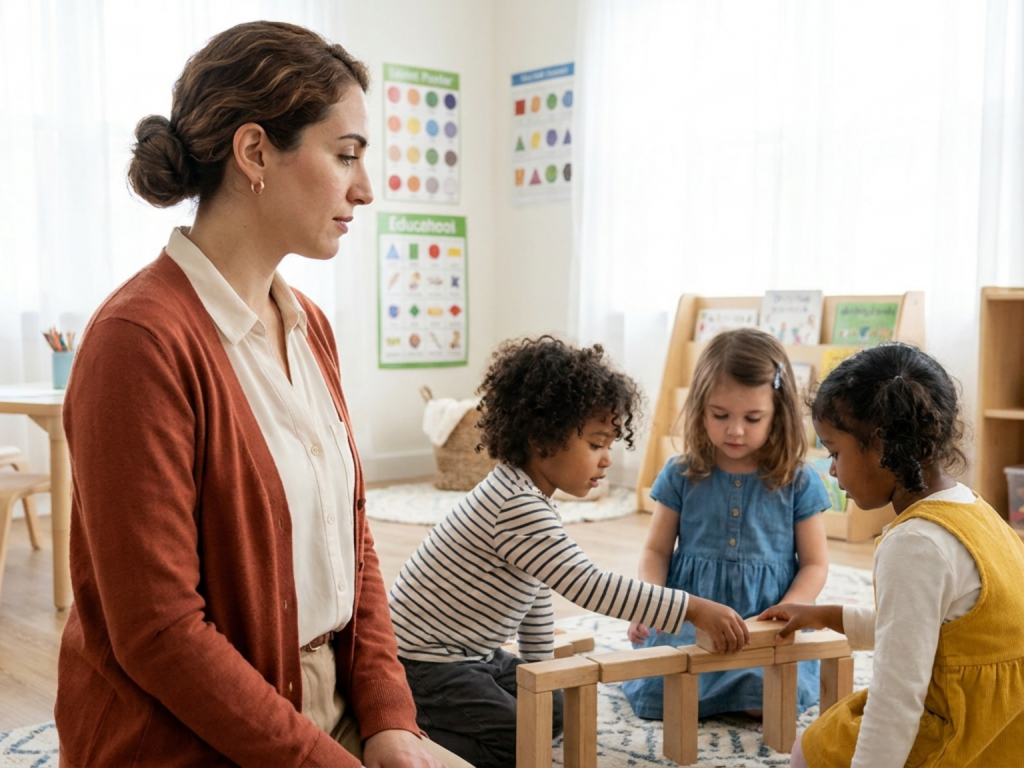
Block play is one of the most effective group problem solving activities because it combines spatial reasoning, fine and gross motor skills, symbolic thinking, and negotiation. Children must decide what to build, how to distribute materials, and what to do when the structure becomes unstable. A simple prompt such as “Can your team build a bridge for three toy animals?” gives the group a shared problem without dictating every step.
Adults can scaffold by asking concise, open-ended questions: “What do you notice?” “What could make it stronger?” “Who needs a block?” “How can we make space for both ideas?” These questions support metacognition, or thinking about thinking, without turning the activity into a test.
A preschool version of a cooperative construction game may involve giving each child a limited number of blocks and asking them to build one shared tower. This naturally creates opportunities to share resources, take turns, and tolerate differences in style. If one child dominates, the adult can assign rotating roles: one child chooses the base, another adds the next layer, another checks whether it wobbles. If the tower falls, adults can normalize the event: “The tower gave us information. Now we can try a wider bottom.”
For children who struggle with impulse control, use a visual turn marker or a sand timer. For children with motor difficulties, offer larger blocks or allow them to be the planner, counter, or stability checker. The goal is meaningful participation, not identical performance.
Group art, drawing, and sensory-safe collaboration
Group art projects allow preschoolers to contribute to a shared product while still expressing individual ideas. A large paper mural, cooperative drawing, collage, or classroom “city map” invites children to plan, divide space, and solve practical problems such as where the road should go or how to make room for everyone’s house.
Art activities can be especially helpful for children who are quieter in verbal group settings because they can participate through action before language. Adults can narrate cooperation: “Maya is adding trees, and Leo is making the road connect to them.” This supports language development and helps children notice peers’ contributions.
Some children have sensory processing differences and may avoid finger paint, glue, strong smells, or messy textures. Respecting this is not “giving in”; it is supporting nervous system regulation. Offer tools such as brushes, glue sticks, stamps, tongs, or pre-cut shapes. A child can still engage in cooperative problem solving while avoiding a sensory input that feels intolerable.
Useful prompts include “Can we make one big garden together?” or “How can everyone add something to the same ocean picture?” If conflict occurs over materials, the adult can model problem solving steps: identify the issue, validate feelings, state the limit, and offer choices. For example: “You both want the blue marker. It is hard to wait. The marker is for everyone. You can use the timer, trade for green, or work on another part while you wait.”
Storytelling, dramatic play, and role negotiation
Cooperative storytelling and dramatic play are powerful because they require children to coordinate language, imagination, social rules, and sequencing. When preschoolers pretend to run a clinic, restaurant, space station, or grocery store, they solve problems about roles, props, order of events, and social scripts. One child may want to be the doctor, another the patient, and another the ambulance driver. Negotiating these roles is the activity, not an interruption of it.
Adults can support dramatic play by offering role cards or simple props without controlling the storyline. A shared scenario such as “The animals are lost and need help finding their homes” encourages children to plan together. The adult might ask, “Who will look at the map?” or “What should happen first?” These prompts support sequencing and flexible thinking.
A puppet-and-puppeteer activity can help children practice role reversal and communication. One child gently moves a puppet while another gives directions, then they switch. This requires listening, motor inhibition, and awareness of another person’s plan. It can also reduce emotional intensity because the puppet becomes a safe intermediary for practicing words like “stop,” “help,” and “my turn.”
For children with pragmatic language difficulties, provide scripts and visual supports. For example: “Can I play?” “What is my job?” “Let’s pretend.” If a child repeatedly disrupts the story, consider whether the demand is too abstract, the group is too large, or the child needs a more concrete role.
Movement games that teach coordination and flexible thinking
Not all problem solving happens at a table. Structured movement games for preschoolers can strengthen body awareness, impulse control, social timing, and group coordination. Games such as keeping a balloon in the air, passing a ball around a circle, moving like different animals, or completing a simple obstacle course as a team all require children to monitor themselves in relation to others.
In a balloon or soft-ball game, the shared goal might be “Keep it up for five taps without anyone grabbing it.” Children must adjust force, wait, and communicate. If the group becomes overexcited, pause and reset the rule: “Hands are gentle. Bodies stay in our space. Let’s try three taps.” Avoid punitive language when possible; preschoolers often need repeated nervous system practice before they can inhibit impulses reliably.
Partner movement games can also build social problem solving. In a mirror game, one child leads slow movements while the other copies, then they switch. In a “carry the treasure” challenge, two children hold opposite sides of a towel and transport a soft toy without dropping it. These activities teach coordination, pacing, and repair after mistakes.
Children with vestibular or proprioceptive sensory needs may seek more intense movement, while others may become dysregulated by noise and fast motion. Adapt by lowering volume, reducing group size, creating clear boundaries on the floor, and offering a quiet recovery space. Safety and regulation should always come before completing the game.
Puzzles, matching games, and shared cognitive challenges
Group puzzles, alphabet matching, sorting games, and simple scavenger hunts give preschoolers a shared cognitive target. These activities strengthen visual discrimination, early literacy, categorization, working memory, and collaborative reasoning. The social benefit comes from children explaining what they see, asking for pieces, and accepting that someone else may find the answer first.
For a group puzzle, place pieces in the middle and assign roles: edge finder, color matcher, picture checker, and piece placer. Rotate roles so that the same child is not always in control. If the group is stuck, resist the urge to solve it immediately. Instead, offer a strategy: “Let’s look for all the pieces with red,” or “Which piece has a straight side?”
Alphabet or picture matching games can be made cooperative rather than competitive. For example, children work together to match all animal cards to their habitats before the timer runs out. This shifts the emphasis from winning against peers to solving a problem as a team. Cooperative formats are often better for preschoolers who become distressed by losing or who are still building frustration tolerance.
Observe how children approach errors. Some may laugh and try again; others may become tearful, rigid, or avoidant. Adults can model a healthy error response: “That one did not fit. Good information. Let’s turn it and check.” This kind of language supports resilience and reduces shame around mistakes.
Adult coaching, conflict repair, and when to seek support
Adults play a crucial role in making group play emotionally safe. Preschoolers are not miniature adults; their prefrontal regulatory systems are immature, and they often need external structure to manage conflict. Effective coaching is calm, brief, and specific. Instead of saying “Be nice,” try “Use a gentle hand,” “Ask before taking,” or “Tell Sam, ‘I’m using it now.’”
A simple conflict repair sequence can help: pause the action, name the problem, acknowledge feelings, restate the limit, invite solutions, and help children rejoin. For example: “You both wanted the truck. You felt angry. Trucks are not for grabbing. What can we try: timer, trade, or build a road together?” Repetition matters. Children may need dozens of supported experiences before they can use these steps independently.
It is also important to notice patterns that may require professional input. Consider speaking with a pediatrician, early childhood educator, speech-language pathologist, occupational therapist, child psychologist, or early intervention program if a child rarely engages with peers, has frequent aggressive behavior that does not improve with support, loses previously acquired social or language skills, shows extreme sensory distress, or cannot participate in everyday preschool routines. These signs do not automatically mean a diagnosis, but they deserve thoughtful assessment.
Families and educators can work together by sharing what helps the child regulate, communicate, and recover after conflict. The most supportive environments do not eliminate all frustration. They make frustration survivable, understandable, and connected to problem solving.
Use caution and seek guidance when needed
- Do not force a distressed preschooler to remain in group play if they are escalating or unsafe.
- Avoid small objects for children who mouth toys or have choking risk.
- Frequent aggression, regression, or inability to participate in routines should be discussed with a qualified professional.
- Sensory avoidance or sensory seeking may require individualized support from an occupational therapist.
- Activities should be adapted for each child’s communication, motor, developmental, and medical needs.
Tools & Assistance
- Use visual turn cards, timers, and simple role labels during group activities.
- Create a calm-down space near the play area for brief regulation breaks.
- Ask the preschool teacher to share observations about peer interaction and problem solving.
- Consult a pediatrician, speech-language pathologist, occupational therapist, or early intervention service if concerns persist.
- Keep a short log of triggers, successful supports, and recovery strategies.
FAQ
What is a good group size for preschool problem solving activities?
Two to four children is often best for early cooperative play. Larger groups can work when the task is simple and adult support is available.
Should adults step in every time preschoolers disagree?
Adults should step in for safety, aggression, or escalating distress. For mild disagreements, brief coaching and choices can help children practice conflict resolution.
What if my child prefers parallel play?
Parallel play can still be developmentally typical in preschool, especially for younger or more cautious children. Gradual, low-pressure small-group activities may help, but persistent concerns should be discussed with a professional.
Are competitive games helpful for preschoolers?
Some children enjoy simple competition, but cooperative formats are often better for building shared problem solving, frustration tolerance, and peer connection.
How long should these activities last?
Many preschoolers do well with 10 to 20 minutes, depending on attention, regulation, and interest. It is better to end successfully than to push past a child’s capacity.
Sources
- Children's Land — Group Activities in Preschool: Learning to Collaborate
- Procare Software — 10 Small Group Activities for Preschoolers with Examples
- Highlights for Children — 8 Get-Along-Great Games for Preschoolers
Disclaimer
This article is for informational and educational purposes only and does not diagnose, treat, or replace medical care. Consult a qualified healthcare or developmental professional for concerns about a child’s behavior, communication, sensory processing, or development.
















Please log in to leave a comment.