
Intro
Choosing a crib mattress can feel more consequential than an ordinary household purchase because the mattress becomes part of your baby's sleep environment. Safety, fit, firmness, materials, cleaning, and compatibility all matter, while marketing claims can make a simple decision seem unnecessarily complicated.
The central principle is straightforward: select a firm, flat mattress designed for the exact crib or sleep space, and use it in a bare crib with no loose bedding or accessories. The guidance below is intended to help you evaluate products systematically. Consult your baby's healthcare professional or the relevant product-safety authority if your infant has specific medical needs or if you are uncertain about a sleep setup.
Highlights
A crib mattress should be firm, flat, level, and designed to fit the crib without hazardous gaps.
Measure the crib and follow the crib and mattress manufacturer's instructions rather than relying only on general dimensions.
A waterproof, washable cover can simplify hygiene, but it should remain tight, intact, and compatible with the mattress.
Avoid positioning devices, toppers, pillows, quilts, and other products that change the flat sleep surface or add loose material.
Inspect the mattress regularly and replace it if it is damaged, misshapen, excessively soft, or no longer fits securely.
Start with the sleep space, not the marketing
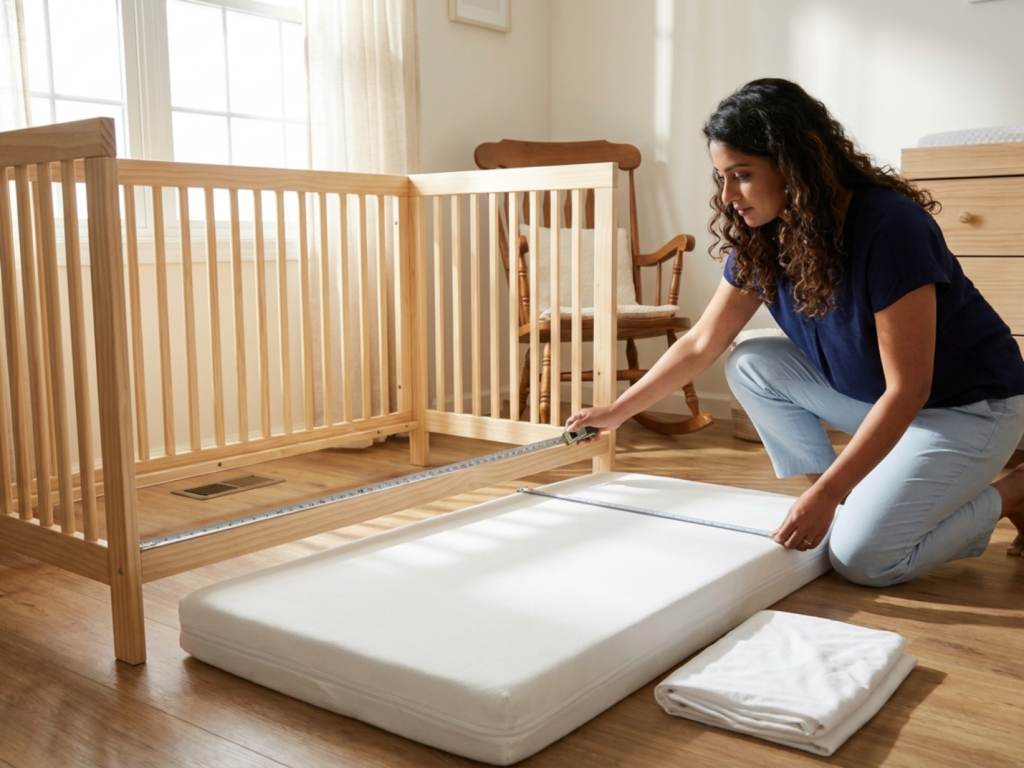
Begin by identifying the exact product the mattress will be used with: a standard full-size crib, mini crib, portable crib, or another manufacturer-defined sleep space. These categories are not interchangeable. A mattress that appears similar in a store or online listing may be too large, too small, too thick, or otherwise incompatible with the frame.
Read the crib’s instruction manual and mattress specifications before shopping. Record the internal dimensions supplied by the manufacturer, the permitted mattress thickness, and any restrictions on mattress type. If the manual is unavailable, look for the model number on the crib and obtain instructions from the manufacturer or a recognized product-safety service. Do not assume that a mattress advertised as universal will fit every crib.
For a standard full-size crib, dimensions are commonly close to 28 by 52 inches, but small variations and tolerances matter. The mattress must fit snugly on every side. Health Canada advises that the gap between the mattress and the sleep space should not exceed 3 cm, while U.S. safety guidance also emphasizes that a tight fit prevents an infant from becoming trapped between the mattress and crib sides. Check the actual fit in the assembled crib rather than relying on package language alone.
Prioritize a firm, flat, level surface
Firmness is the most important physical characteristic. An infant mattress should resist indentation when you press on it and should return to its original shape without a deep depression. The surface should be flat and level, without contours, bolsters, built-in pillows, wedges, or an incline. These features can alter an infant’s position and may increase the risk of airway obstruction or entrapment.
Do not confuse firmness with hardness or assume that a heavier mattress is safer. A suitable mattress may be made from foam or contain springs; what matters is the finished sleep surface, its structural integrity, and its compliance with applicable safety requirements. Avoid adding a plush topper, quilted pad, memory-foam layer, or extra cushion to make the mattress feel more comfortable. A separate waterproof cover is acceptable only when it is specifically designed for the mattress, fits tightly, and does not create folds or looseness.
Mattresses marketed for reflux, colic, longer sleep, or positional support deserve particular caution. A baby who has a medical condition may need an individualized plan from a pediatric clinician, but home modifications such as elevating one end of the crib should not be introduced without professional guidance. A flat surface remains the general safety baseline for healthy infant sleep.
Compare mattress construction and materials thoughtfully
Foam and innerspring mattresses can both be reasonable options when they are firm, intact, correctly sized, and made for the intended crib. Foam is often lighter and easier to lift during cleaning. Innerspring models may feel more substantial and can have a firm perimeter, although weight and construction vary considerably. Neither category is automatically superior based solely on its material.
Some mattresses have different surfaces for different developmental stages. A dual-sided design may provide a firmer infant side and a separate toddler side, but the manufacturer’s instructions must specify when and how to use each surface. Never use a softer side for an infant simply because it feels more comfortable, and do not place two mattresses together.
Material labels may mention organic fibers, low-emission foams, plant-based components, or chemical treatments. These claims can be relevant to a family’s preferences, but they do not replace the primary safety checks: firmness, flatness, fit, structural condition, and compliance with the applicable jurisdiction’s requirements. Review the product label, safety documentation, warranty, cleaning directions, and recall information. Avoid products with a strong persistent odor, exposed foam, torn seams, loose fibers, or unclear manufacturer information.
Check fit, thickness, and construction before using it
After assembling the crib according to its instructions, place the mattress inside and inspect the entire perimeter. There should be no meaningful space where an infant’s head, torso, or limbs could become wedged. Push the mattress gently toward each side and corner. If it shifts substantially, leaves a visible gap, or does not lie completely flat, do not use it until the manufacturer confirms that the combination is compatible.
Thickness also matters. A mattress that is too thick can reduce the effective height of the crib sides, while one that is too thin may create gaps or fail to provide a stable surface. Use only the thickness specified for that crib. Do not compensate for a poor fit with rolled towels, blankets, pads, or homemade fillers. These materials can move, create unevenness, and introduce additional hazards.
Examine the edges, seams, handles, vents, and cover. The mattress should maintain its shape and should not fold, buckle, or collapse under normal handling. Confirm that the cover cannot be removed by the infant and that any zipper pull or fastening component is not exposed in a way that could cause injury. Keep the purchase receipt, model information, and instructions so that you can respond promptly to a recall or manufacturer notice.
Decide whether a used mattress is appropriate
A used crib mattress may appear economical, but its safety depends on facts that are often difficult to verify. It may have absorbed moisture, developed internal softening, been stored in unsuitable conditions, or been used with an incompatible cover. It may also lack a clear model number, safety documentation, or recall history.
Before accepting a second-hand mattress, identify the manufacturer and model, confirm that it is intended for the exact crib, and check whether it has been recalled. Inspect it in bright light for stains, mold, water damage, tears, deformation, broken seams, exposed filling, or compression that does not recover. Press across the entire surface, including the edges, to identify areas that feel softer than the rest. If its history is unknown or any structural problem is present, replacement is the more cautious choice.
Do not rely on disinfecting or covering a damaged mattress to restore safety. Cleaning may address surface contamination but cannot reliably correct internal degradation or an unsafe fit. A replacement should be new or demonstrably well maintained, accompanied by clear instructions, and evaluated in the assembled crib before an infant uses it.
Build a complete safe-sleep setup
A good mattress cannot make an unsafe crib safe. Place the baby on their back for every sleep unless a healthcare professional has provided specific individualized instructions. Use a fitted sheet designed for that mattress and keep the sleep space free of pillows, quilts, comforters, bumper pads, positioners, wedges, stuffed toys, and other loose or soft objects. The U.S. Consumer Product Safety Commission specifically advises keeping these items out of a crib because they can contribute to suffocation or entrapment hazards.
Keep the crib away from window cords, heaters, lamps, and furniture that could allow climbing or pulling. Use the manufacturer’s approved mattress positions and adjust the mattress height as the child develops, particularly when the baby can sit, pull up, or stand. Check that the hardware remains tight and that the crib has not been modified with aftermarket parts.
Inspect the setup regularly, especially after laundering the sheet, moving the crib, changing mattress covers, or noticing a new developmental ability. Confirm that the sheet remains tight, the mattress is still level, and no gap has appeared. Room-sharing without bed-sharing can support observation while preserving a separate infant sleep surface. If your baby’s clinician recommends a special device or positioning strategy for a documented medical reason, ask for precise instructions and verify that the device is approved for the intended sleep environment.
Maintain and replace the mattress responsibly
Use the cleaning method specified by the manufacturer. Many crib mattresses have a waterproof surface that can be wiped with a mild cleaner, while some covers can be machine washed. Allow components to dry fully before reassembly, and never use a loose secondary cover that changes the fit. Avoid harsh chemicals or improvised treatments that could damage the cover, weaken seams, or leave residues.
Replace the mattress if it becomes soft, sagging, warped, torn, moldy, water-damaged, or difficult to clean. Replacement is also appropriate when the mattress no longer fits the crib correctly or when its cover has lost its integrity. A mattress does not become unsafe simply because a baby has used it, but age can matter when materials have degraded or the product’s history is uncertain.
At each inspection, verify the model against current recall notices and retain documentation for future reference. If a product is recalled, follow the official remedy rather than continuing to use it while waiting for a replacement. When disposing of a damaged mattress, mark it as unsafe or follow local disposal guidance so that another family does not unknowingly reuse it.
Safety warnings
- Do not use a soft, sagging, inclined, contoured, or damaged mattress for infant sleep.
- Do not use a mattress that leaves a gap larger than the manufacturer's permitted tolerance or 3 cm where that public-health standard applies.
- Do not add pillows, toppers, wedges, bumper pads, quilts, or positioners to the crib.
- Do not use rolled towels, blankets, or other materials to fill a gap or stabilize an incompatible mattress.
- Seek professional guidance before changing a flat sleep surface for an infant with a medical condition.
Tools & Assistance
- Crib and mattress instruction manuals
- Manufacturer model and recall lookup service
- Tape measure for confirming crib dimensions
- Bright-light inspection of seams, edges, and cover
- Pediatric healthcare professional or public-health advice line
FAQ
How firm should a crib mattress be?
It should feel firm and resist indentation across the entire surface. It should remain flat and level rather than contouring around the baby's body.
Can I use a standard crib mattress in a mini crib?
Usually not. Mini cribs commonly require different dimensions, so use only a mattress listed as compatible with that specific crib model.
Is a waterproof mattress cover necessary?
It is not always necessary, but a compatible waterproof cover can simplify cleaning. It must fit tightly, remain intact, and preserve the mattress's flat, firm surface.
When should a crib mattress be replaced?
Replace it when it is soft, sagging, warped, torn, moldy, water-damaged, recalled, or no longer fits securely. An unknown history is also a reason to choose a different mattress.
Can a baby sleep on an inclined crib mattress for reflux?
Do not introduce an incline or positioning product without individualized advice from the baby's healthcare professional. For routine infant sleep, use a firm, flat, level surface.
Sources
- Health Canada — Cribs, cradles and bassinets
- U.S. Consumer Product Safety Commission — Crib Safety Tips
- WebMD — How to choose a crib mattress
Disclaimer
This article provides general educational information and is not medical advice, diagnosis, or a substitute for guidance from your baby's healthcare professional or local product-safety authority.















Please log in to leave a comment.