
Intro
Between ages 3 and 5, children learn at a remarkable pace. They are building language, memory, attention, early reasoning, motor coordination, social understanding, and the confidence to try hard things. Preschool learning is not simply preparation for kindergarten; it is a broad developmental period in which relationships, play, routines, and intentional teaching all shape the brain’s growing networks.
Parents and caregivers often wonder whether a child is “on track,” whether academic activities are needed, and how much structure is helpful. The most supportive answer is usually balanced: children need warm, responsive adults, rich conversation, imaginative play, predictable routines, and carefully guided opportunities to practice early literacy, numeracy, science thinking, self-regulation, and peer interaction.
Highlights
Preschoolers learn best when caring adults combine play, conversation, routines, and explicit teaching that is developmentally appropriate.
High-quality preschool can improve early language, literacy, and mathematics skills, but programs vary in curriculum quality, teacher training, and emotional climate.
Social-emotional learning is not separate from academics; attention, impulse control, turn-taking, and emotional regulation support school readiness.
Children develop unevenly, so a strength in one area and a lag in another can both be normal. Concerns should be discussed with pediatric, developmental, or educational professionals.
What preschool learning means from ages 3 to 5
Preschool learning is a developmental process, not a race through worksheets. From ages 3 to 5, children move from primarily sensorimotor exploration toward more symbolic, verbal, and planned thinking. They begin to use language to represent ideas, retell events, negotiate with peers, ask causal questions, and follow multi-step routines. Their executive functions, including inhibitory control, working memory, and cognitive flexibility, are still immature but rapidly improving.
A 3-year-old may learn through imitation, sorting objects, naming feelings, singing, and short pretend-play sequences. A 4-year-old often expands into cooperative play, longer conversations, counting objects, recognizing some letters, and explaining simple cause and effect. By 5, many children can follow group routines, sustain attention longer, identify rhymes or sounds in words, compare quantities, and use drawings or early writing to communicate. These are broad patterns, not rigid milestones.
Learning is shaped by biology, temperament, sleep, nutrition, sensory abilities, language exposure, stress, culture, and opportunity. A child with strong verbal skills may still struggle with transitions. Another child may build elaborate structures but avoid drawing or speaking in groups. Supportive adults look for growth across domains rather than demanding uniform performance.
The core domains of preschool learning
Preschool learning is often described in domains, but in real life these areas overlap. When a child builds a tower with a friend, they may practice spatial reasoning, fine motor control, planning, frustration tolerance, vocabulary, and peer negotiation at the same time.
- Language and communication: Children expand vocabulary, sentence complexity, narrative skills, listening comprehension, and pragmatic language, such as taking turns in conversation.
- Early literacy: Important foundations include print awareness, book handling, rhyming, sound play, letter recognition, storytelling, and understanding that spoken words can be represented by written symbols.
- Early mathematics: Preschoolers learn counting, one-to-one correspondence, comparing more and less, recognizing patterns, sorting by attributes, and using spatial words such as under, beside, and between.
- Science and reasoning: Children observe, predict, test, and revise ideas. They learn that objects can sink or float, plants grow, shadows change, and living things have needs.
- Motor development: Gross motor skills support running, jumping, climbing, balance, and coordination. Fine motor skills support drawing, using utensils, manipulating blocks, and later handwriting readiness.
- Social-emotional learning: Children practice naming feelings, waiting, sharing, repairing conflicts, persisting after mistakes, and asking adults for help.
Because these domains are interconnected, a child’s learning environment should not focus only on early academics. Preschool social-emotional learning and responsive caregiving in early childhood provide the emotional safety that helps children explore, remember, and persist.
Play, explicit instruction, and why both matter
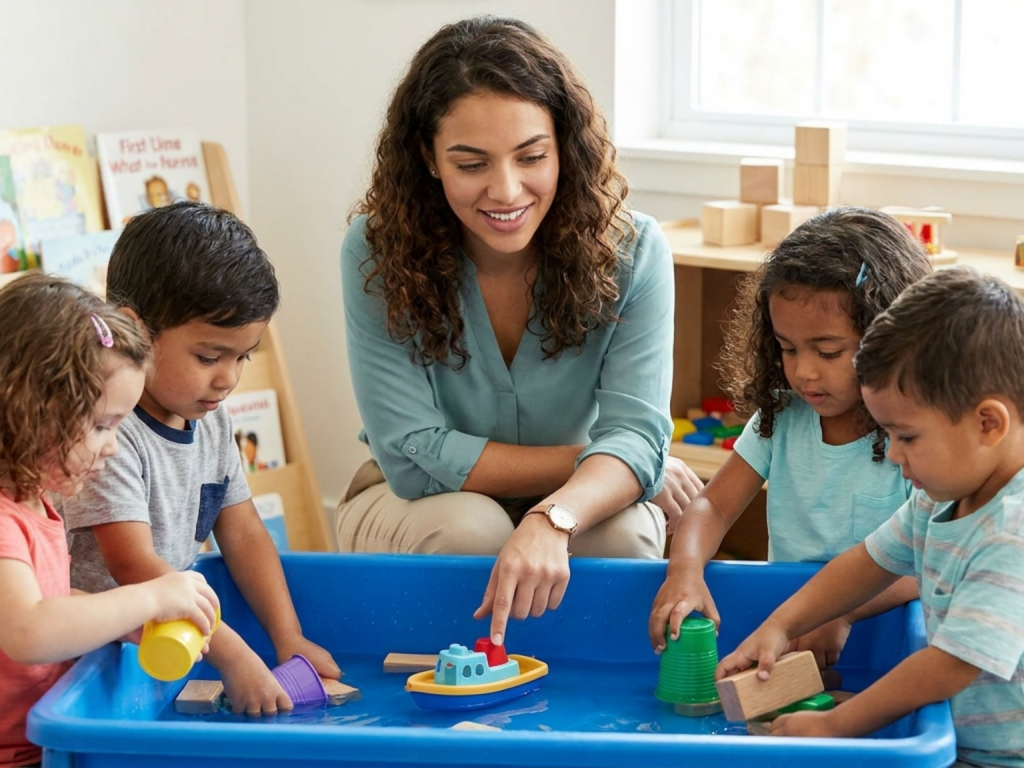
Play is a central mechanism of learning in the preschool years. Through pretend play, children practice symbolic thought, perspective-taking, narrative structure, and emotional problem-solving. Through block play, water play, puzzles, art, and movement, they explore physics, geometry, sensory properties, and motor planning. Play also gives adults a window into what a child understands and what they are ready to learn next.
At the same time, research does not support the idea that children should only discover everything independently. Evidence from preschool science learning shows that explicit instruction can produce stronger gains in specific concepts than discovery learning alone, particularly when children are learning ideas that are not obvious from casual exploration. For example, an adult might guide children to compare objects that sink and float, introduce vocabulary such as heavy, light, hollow, and dense, and help them test predictions.
The most effective approach is often intentional and responsive. Adults can observe children’s interests, offer materials, ask open questions, model vocabulary, and then provide clear explanations when needed. For example: “You noticed the big wooden block floats. Size is not the only thing that matters. Let’s compare what the objects are made of.” This kind of teaching respects curiosity while preventing children from being left alone with misconceptions.
Good instruction is not harsh, rushed, or developmentally inappropriate. It uses short, meaningful episodes, concrete materials, repetition, and warmth. A child who is overwhelmed, hungry, sleep-deprived, anxious, or dysregulated is less available for learning, which is why emotional regulation and routine matter as much as lesson design.
What high-quality preschool programs tend to provide
Research on center-based early childhood education suggests that one to two years of preschool for 3- and 4-year-olds can improve early language, literacy, and mathematics skills. Some large public programs have shown substantial gains in reading and math readiness. However, not all programs are equally effective. Quality depends on what children experience every day, not only on the label “preschool.”
High-quality programs usually include trained teachers, developmentally sequenced curricula, emotionally safe classrooms, rich language interaction, predictable routines, and active family communication. They blend child-initiated play with small-group and whole-group teaching. They also intentionally teach skills such as counting, letter-sound awareness, story comprehension, problem-solving, self-help routines, and cooperation.
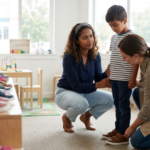
A strong preschool classroom is typically busy but not chaotic. Children have access to books, art materials, blocks, dramatic-play props, music, movement, outdoor play, and hands-on science or sensory exploration. Teachers narrate, ask questions, extend vocabulary, and help children solve conflicts. They notice when a child is withdrawn, impulsive, unusually fatigued, or struggling to hear, see, communicate, or participate.
Families can ask practical questions when evaluating a program: How are teachers trained? What curriculum is used? How are social conflicts handled? How much outdoor and active play is included? How are children supported during transitions? How does the program communicate concerns without shaming the child? A caring classroom should support preschool school readiness skills while preserving curiosity, dignity, and joy.
How caregivers can support learning at home
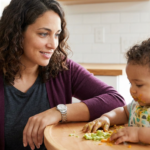
Home learning does not need to look like formal school. In fact, ordinary routines are powerful teaching opportunities when adults talk, listen, and invite children to participate. Reading together, cooking, sorting laundry, walking outside, setting the table, singing, drawing, and telling stories all build foundational skills.
Useful home strategies include naming what the child is doing, expanding their sentences, asking “how” and “why” questions, and giving time to answer. If a child says, “Dog run,” an adult might respond, “Yes, the dog is running quickly across the grass.” This supports grammar and vocabulary without turning conversation into a test. During book reading, caregivers can ask what might happen next, connect the story to the child’s life, and explain unfamiliar words.
Early math can be woven into daily life: count apples, compare cup sizes, find shapes on a walk, make patterns with socks, or divide crackers fairly. Science can be explored by planting seeds, observing melting ice, mixing colors, or testing which bath toys float. Fine motor skills can be practiced through play dough, crayons, child-safe scissors with supervision, blocks, beads designed for young children, and dressing routines.
Caregivers also support learning by protecting sleep, nutrition, movement, and emotional connection. A predictable bedtime, active outdoor play, and regular meals can make attention and behavior easier. If eating, sleep, or behavior is a persistent concern, families may benefit from discussing preschool nutrition pattern, sleep routines, or emotional development with qualified professionals.
Individual differences, concerns, and when to seek guidance
Preschoolers develop unevenly. A child may speak in complex sentences but avoid puzzles, count confidently but have frequent tantrums, or enjoy books but resist group activities. Variation is expected, especially across languages, cultures, temperaments, and preschool experiences. Bilingual or multilingual children may distribute vocabulary across languages, which should be interpreted carefully by clinicians and educators familiar with multilingual development.
Still, some patterns deserve professional attention. Families should consider discussing concerns with a pediatrician, developmental-behavioral pediatrician, speech-language pathologist, audiologist, optometrist or ophthalmologist, occupational therapist, psychologist, or early childhood education specialist when worries persist. Examples include loss of previously acquired skills, very limited speech for age, difficulty understanding simple directions, persistent lack of response to sound, frequent tripping or motor asymmetry, extreme sensory distress, inability to participate in routines, severe aggression, or intense anxiety that limits daily life.
Hearing and vision issues can look like inattention, noncompliance, language delay, or learning difficulty, so screening is important when concerns arise. Sleep-disordered breathing, chronic pain, constipation, iron deficiency, medication effects, psychosocial stress, and neurodevelopmental differences may also affect attention and behavior. This does not mean caregivers should diagnose the child at home; rather, persistent concerns deserve careful assessment.
The goal of evaluation is support, not blame. Early identification can help families access speech therapy, occupational therapy, behavioral consultation, classroom accommodations, or early childhood mental health consultation when appropriate. A child’s learning profile is not a verdict on their future. With responsive adults, appropriate expectations, and timely professional guidance, many children make meaningful progress.
When to get extra help
- Seek urgent medical advice if a child loses previously acquired language, motor, or social skills.
- Discuss persistent hearing, vision, speech, motor, sleep, feeding, or behavior concerns with a healthcare professional.
- Do not assume inattention or “not listening” is behavioral until hearing, vision, sleep, stress, and developmental factors are considered.
- If aggression, self-injury, extreme anxiety, or severe tantrums are frequent or unsafe, ask for professional support.
- Avoid using academic pressure, punishment, or comparison with peers as a learning strategy.
Tools & Assistance
- Shared book reading with open-ended questions and repeated favorite stories
- Daily counting, sorting, measuring, and pattern games using household objects
- Outdoor observation walks for science language and motor practice
- Parent-teacher communication notes about strengths, routines, and concerns
- Developmental, hearing, and vision screening through pediatric or early childhood services when indicated
FAQ
Should a 3- to 5-year-old be doing worksheets?
Worksheets are usually not necessary for strong preschool learning. Hands-on play, conversation, books, movement, music, and short guided activities are typically more developmentally appropriate.
Is play enough for preschool learning?
Play is essential, but children also benefit from intentional adult guidance and clear explanations, especially for specific concepts such as counting, letter-sound awareness, or science ideas.
What if my child is not interested in letters or numbers?
Interest varies. Try low-pressure activities such as reading aloud, finding letters in a child’s name, counting snacks, or playing matching games. If broader language or learning concerns persist, consult a professional.
How much should preschool learning focus on social skills?
A great deal. Turn-taking, emotional regulation, listening, asking for help, and coping with frustration are core school readiness skills and support later academic learning.
Can high-quality preschool make a measurable difference?
Yes. Research indicates that well-designed preschool programs can improve early language, literacy, and math readiness, although outcomes depend on program quality, curriculum, teacher training, and child context.
Sources
- National Institutes of Health (NIH) / PubMed Central — Preschool Children's Science Learning: Instructional Approaches ...
- Foundation for Child Development — Investing in Our Future: The Evidence Base on Preschool Education
- KQED / MindShift — What the Science Says About How Preschool Benefits Children
Disclaimer
This article is for informational purposes only and does not replace medical, developmental, psychological, or educational evaluation. Consult a qualified professional for concerns about a child’s health, behavior, or learning.












Please log in to leave a comment.