
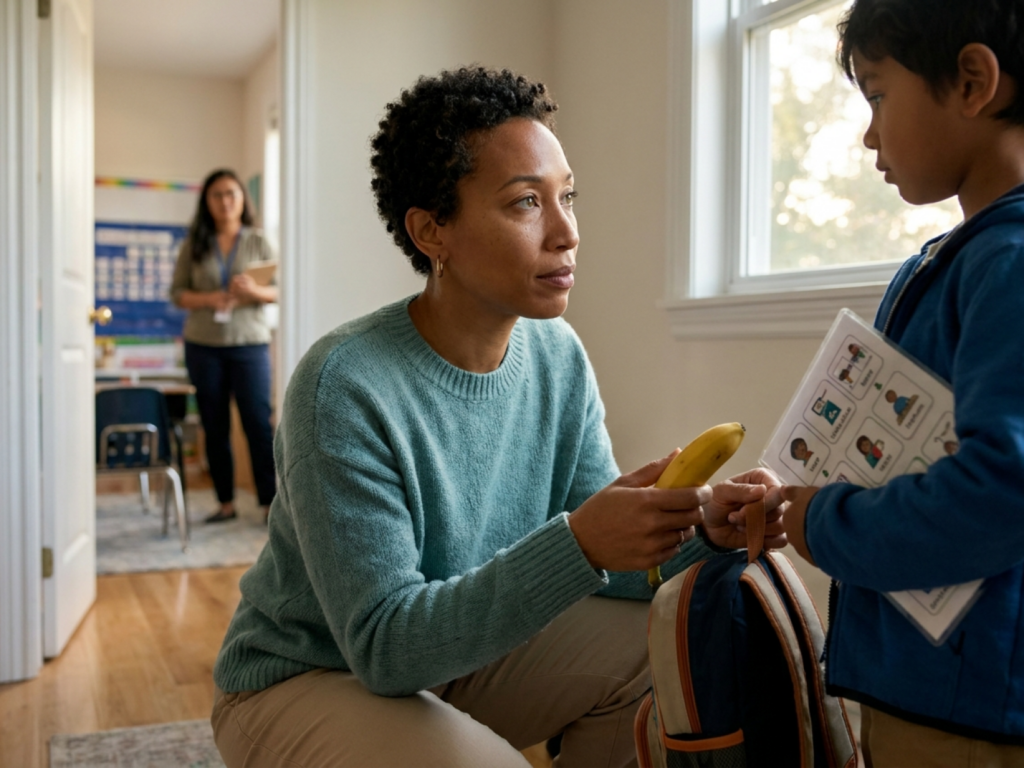
Intro
Many parents feel confused when a child is cooperative, focused, and composed at school but argumentative, emotional, or impulsive at home. This contrast can be tiring and may lead caregivers to wonder whether the child is choosing difficult behavior or whether parenting is somehow responsible.
In many cases, the difference reflects context, developmental demands, and the child’s capacity for self-regulation rather than deliberate defiance. School provides structure, social cues, predictable routines, and external support. Home may be the place where a child feels secure enough to release the tension accumulated during the day.
Highlights
School routines provide structure, predictability, and frequent external prompts for behavior.
Children may use substantial cognitive and emotional energy to regulate themselves during the school day.
A child who becomes distressed at home may be experiencing a delayed release of stress rather than manipulating caregivers.
Behavior that occurs mainly in one setting provides useful information about environmental demands and supports.
Persistent, severe, or impairing behavior warrants discussion with a pediatrician or qualified child mental health professional.
Behavior is shaped by context
Children do not behave in a vacuum. Their behavior reflects the interaction between temperament, neurodevelopment, emotional state, relationships, physical needs, and the demands of a particular environment. A child may have more difficulty following directions when tired, hungry, overstimulated, rushed, or asked to transition away from a preferred activity. The same child may function effectively in a setting that provides clear routines and immediate guidance.
Research on conduct problems across home and school contexts shows that difficulties are not distributed uniformly across all settings. Some children display concerns at home and school, while others show problems mainly in one context. This pattern is clinically meaningful because it suggests that behavior may be influenced by environmental expectations, relationships, task demands, and available supports.
Therefore, “better at school” does not necessarily mean that a child is capable of good behavior but unwilling to provide it at home. It may mean that the school environment is currently better matched to the child’s regulatory capacity. Conversely, home behavior may reveal needs that are not visible in the classroom.
School provides external regulation
Most children rely partly on adults and environments to support executive function. Executive function includes working memory, inhibition, cognitive flexibility, planning, and the ability to shift attention. School systems often provide these supports automatically: a visible timetable, repeated instructions, designated places for materials, signals for transitions, scheduled meals and breaks, and consistent consequences.
Teachers also divide complex expectations into manageable steps. A child may be reminded to put away one item, open a particular book, listen for a short period, and then begin a clearly defined task. In a less structured home environment, the same child may receive several broad instructions at once, such as getting ready, cleaning up, and preparing for bed. The cognitive load can be substantially higher, especially late in the day.
Peer behavior can also act as a cue. Children observe what classmates are doing and may find it easier to follow a shared group rhythm. At home, expectations are often more flexible and activities are less synchronized. This flexibility is valuable, but it can make transitions and limit-setting more difficult for a child whose self-management skills are still developing.
Predictable routines and emotional regulation are closely connected. A routine does not eliminate frustration, but it reduces the number of decisions a child must make and makes upcoming demands easier to anticipate.
The effort of holding it together all day
Some children spend considerable energy suppressing impulses, monitoring their behavior, interpreting social cues, tolerating noise, completing academic tasks, and managing worry during school hours. This may be described informally as “holding it together.” It is not a formal diagnosis, and it should not be assumed in every case, but it is a useful way to understand why a child can appear controlled at school and become dysregulated soon after coming home.
Self-regulation is effortful, particularly for children with immature executive function, attention difficulties, anxiety, learning differences, sensory sensitivities, or other developmental vulnerabilities. Even children without a diagnosed condition may reach the limits of their regulatory capacity by the afternoon. Hunger, dehydration, sleep debt, physical discomfort, or a demanding school day can further reduce tolerance for frustration.
A delayed meltdown may involve crying, irritability, shouting, refusal, aggression, clinginess, or apparently minor complaints that escalate quickly. The trigger may be small because the child is responding to accumulated stress rather than only to the immediate event. Home is often where the child feels safest to express this distress. A secure attachment relationship can make emotional release more likely because the child expects the caregiver to remain present.
This interpretation does not mean that all behavior should be accepted without limits. Safety and respectful conduct still require boundaries. It does mean that the adult response can combine firm limits with curiosity about what the child’s nervous system may be communicating.
Why home can be the harder setting
Home often contains the transitions that are most difficult for children: leaving school, entering the car, stopping screen use, eating, bathing, completing homework, preparing for sleep, or separating from a preferred caregiver. These transitions may occur when the child is already physiologically depleted. A classroom may offer several short breaks, while the period between school and bedtime can feel like one continuous sequence of demands.
Family relationships also carry emotional intensity. Children may test limits more with caregivers because those relationships are stable and enduring. They may be more willing to argue, cry, or disclose worries at home than with a teacher. In addition, siblings, household noise, competing caregiver demands, and inconsistent schedules can increase stimulation and reduce one-to-one support.
Differences in expectations can contribute as well. Schools usually have a limited number of clearly stated rules applied across a group. Families must negotiate meals, chores, personal preferences, cultural expectations, sibling conflict, and changing adult availability. A child may understand the school rules but struggle when home requires flexible problem-solving.
Caregivers should also consider whether the child is encountering a mismatch between ability and demand. For example, a child may manage short classroom tasks but become distressed by lengthy homework, or follow group transitions but resist a rapid evening schedule. Observing the specific circumstances is more informative than labeling the child as generally well behaved or badly behaved.
What the pattern can tell adults
The contrast between settings can be treated as information rather than evidence of blame. Caregivers can record when behavior occurs, what happened immediately beforehand, how long it lasted, and what helped. Patterns involving hunger, fatigue, sensory stimulation, transitions, difficult tasks, sibling interactions, or separation may become visible within a week or two.
Communication between caregivers and teachers is particularly useful. A teacher may describe the prompts, seating arrangement, task length, movement opportunities, and transition warnings that help the child succeed. Caregivers can then consider whether similar supports are feasible at home. A classroom behavior support plan may include environmental adjustments, clear directions, visual cues, planned breaks, and reinforcement of specific behaviors. Home adaptations do not need to duplicate school, but they can use the same principles.
Useful questions include: Does the child understand the expectation? Is the request appropriate for the child’s developmental level? Has the child had food, water, movement, and rest? Is the task too long or ambiguous? Is there a predictable warning before the transition? Is the adult giving one instruction at a time? Is the child seeking connection before cooperation?
Specific praise is often more effective than global labels. Statements such as “You put your shoes by the door after one reminder” identify the behavior that can be repeated. Calm, consistent consequences should be proportionate and related to the behavior. During an intense episode, reducing language and prioritizing safety may work better than lengthy explanations.
Building a coordinated response
A supportive plan usually begins with a small number of predictable changes. A brief after-school decompression period may help before homework or chores. This might include a snack, water, quiet play, outdoor movement, or low-demand connection with a caregiver. The aim is not to reward difficult behavior but to recognize that transition and recovery require time.
Families can create visual or verbal routines for the most challenging parts of the day. Advance warnings, timers, first-then language, and limited choices may reduce conflict. For example, a child might choose whether to shower before or after pajamas, while the overall bedtime expectation remains unchanged. Caregivers should avoid introducing many new rules at once; consistency is more important than complexity.
Adults should look for opportunities to strengthen the child’s sense of competence. Breaking tasks into smaller steps, offering brief movement breaks, and practicing emotional vocabulary can support regulation. Repair after conflict matters too. Once everyone is calm, the caregiver can acknowledge the child’s feelings, restate the limit, and discuss one alternative response for next time.
School collaboration should focus on observable behavior and practical supports rather than blame. If the child is successful at school, ask which conditions make that possible. If the child is struggling in both settings, or if school performance is deteriorating, a broader assessment may be appropriate. A pediatrician can consider sleep, hearing, vision, medication effects if relevant, medical conditions, and developmental or mental health concerns, while qualified professionals can evaluate learning, attention, anxiety, or emotional regulation when indicated.
When to seek professional guidance
Differences between home and school are common, but they should not be dismissed when they are severe, persistent, or disruptive. Seek professional advice when behavior creates safety risks, substantially impairs family functioning, interferes with learning, causes frequent school refusal, or is accompanied by marked changes in sleep, appetite, mood, energy, or social engagement.
It is also appropriate to consult a healthcare professional when a child’s behavior seems developmentally unusual, escalates despite consistent support, or leaves caregivers feeling unable to cope. A clinician may gather information from multiple settings because context-specific behavior is part of the assessment. The goal is not to assign blame or force the child to behave identically everywhere. The goal is to understand the child’s needs and identify reasonable supports.
Professional assessment should be individualized. A difference between settings can reflect ordinary fatigue and transition stress, but it can also coexist with anxiety, attention-deficit/hyperactivity disorder, autism spectrum characteristics, learning difficulties, trauma-related stress, sleep problems, or physical discomfort. These possibilities cannot be determined from behavior alone, and caregivers should avoid self-diagnosis.
Most importantly, a child who behaves differently at home and school is communicating through a pattern. Responding with empathy, clear boundaries, and coordinated observation can help adults see the behavior more accurately and reduce the pressure on both the child and the family.
When behavior needs prompt attention
- Seek urgent help if the child presents an immediate risk of serious harm to self or others.
- Contact a healthcare professional about persistent aggression, severe emotional outbursts, or major functional impairment.
- Discuss sudden behavioral change alongside sleep, appetite, mood, pain, neurological, or developmental concerns.
- Do not rely on punishment alone when behavior may reflect anxiety, learning difficulty, sensory overload, or exhaustion.
- Avoid diagnosing a child from home-school differences without a comprehensive professional assessment.
Tools & Assistance
- A simple home-school behavior and trigger log
- A predictable after-school decompression routine
- Visual schedules, transition warnings, and first-then instructions
- A structured meeting with the child’s teacher or school support team
- A consultation with a pediatrician or qualified child mental health professional
FAQ
Does better behavior at school mean my child is choosing to misbehave at home?
Not necessarily. School may provide more structure and external regulation, while home may be where the child releases accumulated stress. The behavior still needs boundaries, but intentional defiance should not be assumed.
Why does my child melt down immediately after school?
Fatigue, hunger, sensory load, social effort, and repeated self-control demands can reduce regulation by the end of the day. A calm transition, snack, hydration, movement, and connection may help.
Should home rules be exactly the same as school rules?
They do not need to be identical. Consistent principles, clear expectations, predictable routines, and shared information about successful supports are usually more practical than duplicating the classroom.
When should I ask for an evaluation?
Consider professional guidance when behavior is persistent, severe, unsafe, impairing, present across settings, associated with developmental concerns, or not improving with consistent environmental support.
Sources
- Child Mind Institute — Why Are Kids Different at Home and at School?
- PubMed Central — Child Conduct Problems across Home and School Contexts
- Indiana University School of Medicine — School and home behavior in children: Why are they so different?
Disclaimer
This article is for general educational purposes and does not diagnose or treat any child. Consult a pediatrician or qualified healthcare professional for individualized advice, especially when behavior is severe, persistent, or creates safety concerns.

















Please log in to leave a comment.