
Intro
Finding your baby on the stomach during sleep can be unsettling, especially when you have been told to place infants on their backs. In most cases, the right response depends on whether the baby can roll both ways independently, whether the crib setup is truly safe, and whether the baby is still in the early months of rapid motor development.
The core rule remains simple: place baby on the back at the start of every sleep, then respond to rolling based on the baby’s actual ability and sleep environment. The goal is not to hover all night, but to keep the sleep space aligned with current safe-sleep guidance while recognizing normal developmental change.
Highlights
Always place baby on the back at the start of every sleep, including naps. That recommendation still applies even if a baby later turns onto the stomach.
If a baby can roll both ways independently, many pediatric and safe-sleep guidelines say you usually do not need to keep turning them back all night.
If a baby can only roll one way, gently repositioning onto the back is still appropriate.
A firm, flat, separate sleep surface matters more than almost any improvised fix. Positioners, pillows, and inclined sleepers add risk and do not solve the problem.
The first signs of rolling are the cue to stop swaddling and switch to a wearable blanket or sleep sack.
Start With the Back-to-Sleep Rule
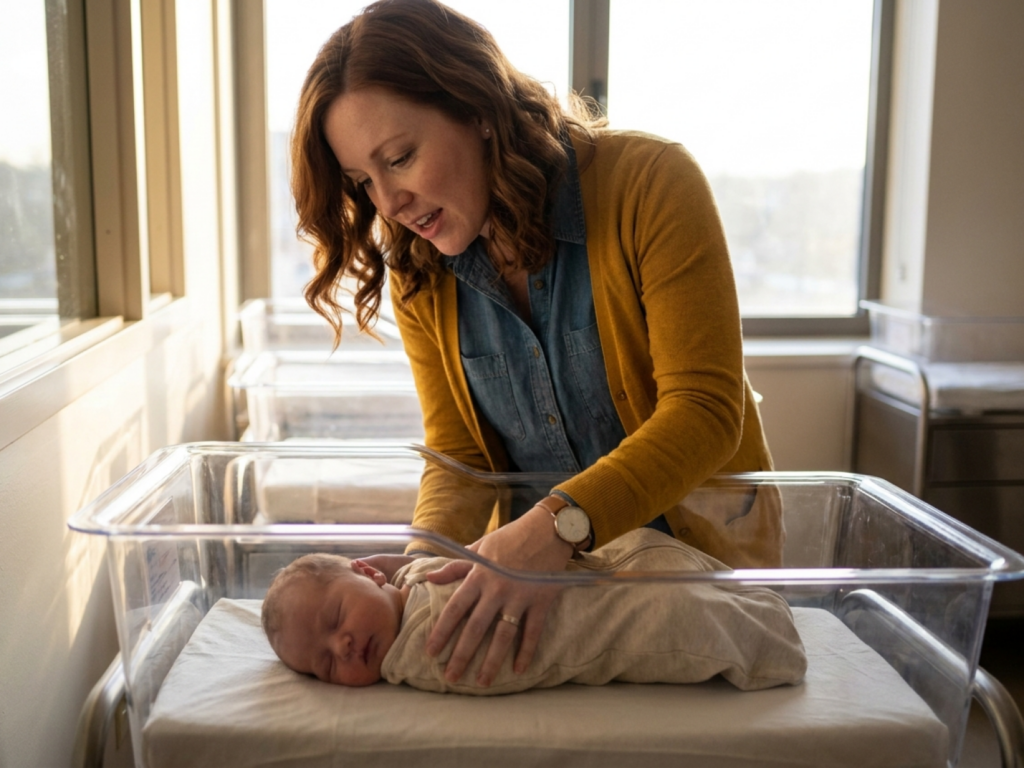
The safest default is still back sleeping at the start of every sleep. That means bedtime and naps both begin with baby placed on the back on a firm, flat, separate sleep surface. If baby later rolls onto the stomach on their own, that does not automatically mean you did something wrong. It means motor skills are changing and the response should be based on the baby’s current stage.
For many families, the first sight of a stomach-sleeping baby triggers a decision tree that feels more alarming than it needs to be. The practical question is not simply where the baby ended up, but whether the baby can reliably move between back and tummy without help. That distinction is central to current guidance from major safe-sleep organizations.
Keep the start of sleep consistent: back position, empty crib, no loose bedding, and no add-on devices meant to hold the body in place. This is the part of sleep you can control every time.
Decide Based on Rolling Ability
If baby can only roll in one direction, gently turning them back onto the back is still reasonable. That is especially true in the younger months, when rolling may be partial, inconsistent, or triggered by a brief burst of movement rather than full independent control. In that stage, the baby still depends on the caregiver to maintain the safest starting position.
If baby can roll from back to tummy and tummy to back independently, most expert guidance says you do not need to keep repositioning through the night. The reason is developmental: a baby who can roll both ways has demonstrated a degree of neuromuscular control that changes how the sleep position is interpreted. Even then, the safe setup still matters, because independent rolling does not make a soft or cluttered sleep space safe.
A useful rule of thumb is this: if the baby is still early in rolling and cannot reliably recover from the tummy position, keep intervening. If the baby is consistently rolling both ways on their own, focus on the sleep environment rather than repeated repositioning.
Make the Sleep Space Truly Safe
The sleep surface should be flat, firm, and free of soft objects. That means no pillows, bumpers, loose blankets, stuffed toys, wedges, or sleep positioners. Products marketed as helpers can create the false impression that a stomach-rolling baby needs restraint rather than a safer environment.
Room-sharing without bed-sharing is still preferred in infancy, because it keeps the baby nearby for feeding and monitoring while preserving a separate infant sleep space. A bassinet or crib should be approved for infant sleep and should not be tilted, propped, or made softer to reduce rolling. Soft surfaces can increase the chance that the face stays buried or that the airway is partially obstructed.
Also avoid routine sleep in sitting devices such as car seats, strollers, swings, or loungers. Those are transport or awake-use tools, not stable overnight sleep surfaces. If a baby falls asleep there, move them to the crib or bassinet when you can do so safely.
The strongest prevention is not a special pillow. It is a bare, predictable sleep space that supports safe movement and breathing.
Stop Swaddling When Rolling Begins
The first signs of rolling are the point at which swaddling should stop. Once a baby begins to show rotational movement, a swaddle can become a hazard because it limits the arms and can make it harder for the baby to recover if they roll onto the stomach. At that stage, switch to a non-weighted wearable blanket or sleep sack that leaves the arms free.
This transition is often harder for caregivers than for babies. A swaddle may have been part of the settling routine, and it can feel like losing a tool that worked. But the goal is not to preserve the old routine at the expense of mobility. A baby who is ready to roll needs room to use those motor skills safely.
If you are unsure whether a movement counts as early rolling, ask your pediatric clinician to review it. Video can help. What matters is not the label, but whether the baby is beginning to rotate from side to side or push up with enough force that the swaddle no longer makes sense.
When to Seek Individualized Advice
Some babies deserve a more tailored plan. That includes infants born preterm, babies with low muscle tone or neuromotor concerns, babies with respiratory disease, and babies whose caregivers have been given specific medical instructions that differ from standard safe-sleep advice. In those situations, a pediatrician or pediatric sleep specialist should help translate the general guidance into a plan that fits the child.
It is also appropriate to call for advice if the baby seems unable to lift or turn the head in the tummy position, if rolling is extremely asymmetrical, or if the movement seems to come with unusual stiffness, floppiness, or distress. Those observations do not prove a problem, but they are the kind of details a clinician should hear directly.
Parents sometimes worry that their baby will keep rolling and wake repeatedly. That can happen, but repeated wakeups are not a reason to add unsafe sleep props. The safer response is to review the setup, confirm the baby’s rolling stage, and ask for medical guidance if the pattern seems out of proportion.
What Not to Do
Do not use wedges, rolled towels, sleep positioners, or nests to keep a baby off the stomach. Do not add blankets or pillows to make the baby more comfortable. Do not assume that a product is safe just because it is sold for infant sleep. And do not stop the back-to-sleep routine because the baby rolled once or twice and seemed fine.
The same caution applies to checking and rechecking all night. If baby is still learning to roll and cannot roll both ways, you may need to reposition. But if the baby can already roll both directions independently, constant checking usually does more to exhaust caregivers than to improve safety. The better use of attention is to keep the crib consistent and the routine calm.
Safety is mostly about removing hazards, not managing every movement. When the sleep space is right, the baby’s own development can do the rest.
Seek Prompt Help If You Notice
- Baby cannot breathe normally, is dusky or blue, or seems hard to wake.
- Baby is very young, premature, or has a medical condition that changes sleep guidance.
- Rolling looks one-sided, weak, stiff, or clearly abnormal.
- You are unsure whether swaddling should stop or whether the sleep setup is still safe.
Tools & Assistance
- Call your pediatrician or nurse line for guidance on rolling, swaddling, and sleep setup.
- Review the crib or bassinet against current Safe to Sleep and AAP recommendations.
- Use a sleep sack or wearable blanket once the first signs of rolling appear.
- Ask for a safe-sleep review at the next well-baby visit if the pattern is unclear.
FAQ
Should I turn my baby back every time they roll onto the stomach?
If baby can only roll one way, gently repositioning onto the back is reasonable. If baby can roll both ways independently, you usually do not need to keep turning them back all night.
Is it okay if my baby sleeps on the stomach after rolling there alone?
If the baby can roll both ways independently and the sleep space is safe, current guidance generally allows the baby to remain in the position they choose after falling asleep.
When should I stop swaddling?
Stop swaddling at the first signs of rolling and use a wearable blanket or sleep sack instead.
Can I use a pillow or positioner to keep my baby on the back?
No. Pillows, wedges, positioners, and similar products are not recommended for infant sleep.
Sources
- Safe to Sleep® / National Institute of Child Health and Human Development — About Back Sleeping | Safe to Sleep®
- The Lullaby Trust — Sleeping position
- American Academy of Pediatrics — Back to Sleep: For Every Sleep
Disclaimer
This article is for general education only and is not a substitute for advice from your pediatrician or another qualified clinician. Seek urgent medical care if your baby has breathing difficulty, turns blue, is difficult to wake, or you are worried about immediate safety.














Please log in to leave a comment.