
Intro
Teaching responsibility to children is not a single lesson, a punishment strategy, or a demand for adult-like self-control. It is a gradual developmental process in which children learn that their choices affect themselves, other people, shared spaces, and future outcomes. For many families, the challenge is finding the middle ground between doing everything for a child and expecting more maturity than the child’s brain, temperament, and life circumstances can realistically support.
Highlights
Responsibility develops over time through repeated, supported practice rather than one-time lectures.
Children learn best when expectations are clear, age-appropriate, and connected to real family life.
Accountability works best when it is firm, calm, and repair-focused rather than shaming or fear-based.
Executive function, sleep, stress, neurodevelopmental differences, and family routines can all affect a child’s ability to follow through.
Parents can teach responsibility while still offering warmth, empathy, and practical support.
What responsibility really means for children
Responsibility in childhood includes more than completing chores or remembering homework. It involves self-regulation, empathy, planning, impulse control, accountability, and the ability to repair mistakes. These skills depend partly on executive functions, which are cognitive processes that help a person organize tasks, inhibit impulses, shift attention, and remember goals. Because executive function matures gradually through childhood and adolescence, children often need scaffolding before they can manage responsibilities independently.
A responsible child is not a perfect child. A responsible child is learning to notice what needs to be done, understand expectations, make choices, experience outcomes, and try again after errors. Bright Horizons emphasizes that accountability includes helping children understand how their actions affect others, while Positive Discipline highlights that children learn responsibility by doing tasks with adults first, then gradually doing them more independently.
This distinction matters because many conflicts arise when adults interpret immaturity as defiance. A child who forgets a backpack, resists cleaning up, or melts down over a transition may be avoiding responsibility, but they may also be overwhelmed, tired, anxious, hungry, overstimulated, or lacking a reliable routine. A supportive approach asks, “What skill is missing?” before asking, “What consequence should I impose?”
Start early, but keep expectations developmentally realistic
Children can begin learning responsibility very young, but early responsibility should look like participation, not independent performance. A toddler can put napkins on a table, place toys in a basket with help, or choose between two shirts. A preschooler may feed a pet with supervision, help wipe a spill, or put dirty clothes in a hamper. A school-age child can manage more predictable chores, pack part of a school bag, or help prepare simple food. Adolescents can increasingly manage schedules, money decisions, digital boundaries, household tasks, and school accountability without taking over by the parent.
Positive Discipline notes that young children benefit from doing tasks with adults before being expected to complete them alone. This “with, then beside, then nearby, then independent” progression protects children from repeated failure while still moving them toward autonomy.
- Ages 2–4: focus on simple routines, imitation, cleanup with help, and limited choices.
- Ages 5–7: use visual routines, short chore sequences, and immediate feedback.
- Ages 8–12: build planning skills, homework systems, shared household duties, and repair after mistakes.
- Teen years: emphasize autonomy, problem-solving, time management, financial basics, and respectful negotiation.
Developmentally realistic expectations reduce power struggles. They also prevent a child from internalizing the belief that they are “lazy” or “bad” when the real issue is that the task requires more sequencing, memory, emotional regulation, or motor planning than they can yet manage.
Model responsibility before requiring it
Children are sensitive observers. They notice whether adults keep promises, apologize after snapping, manage belongings, repair harm, and follow through on family agreements. Boys & Girls Clubs of America recommends modeling responsible behavior because children often learn from what adults repeatedly do more than from what adults say.
Modeling does not mean pretending to be flawless. In fact, visible repair can be especially powerful. A parent might say, “I forgot to sign the form last night. I’m going to set a reminder so I handle it before breakfast tomorrow.” Or, “I spoke too sharply. I’m sorry. I was frustrated, but I still need to use a calmer voice.” This teaches accountability without shame and shows that responsibility includes corrective action.
Families can also narrate responsible decision-making in simple language: “We are putting gas in the car tonight because we have an early appointment,” or “I’m paying this bill before buying something extra because housing comes first.” Such explanations help children connect behavior with planning, priorities, and consequences.
Use routines and visual supports to reduce conflict
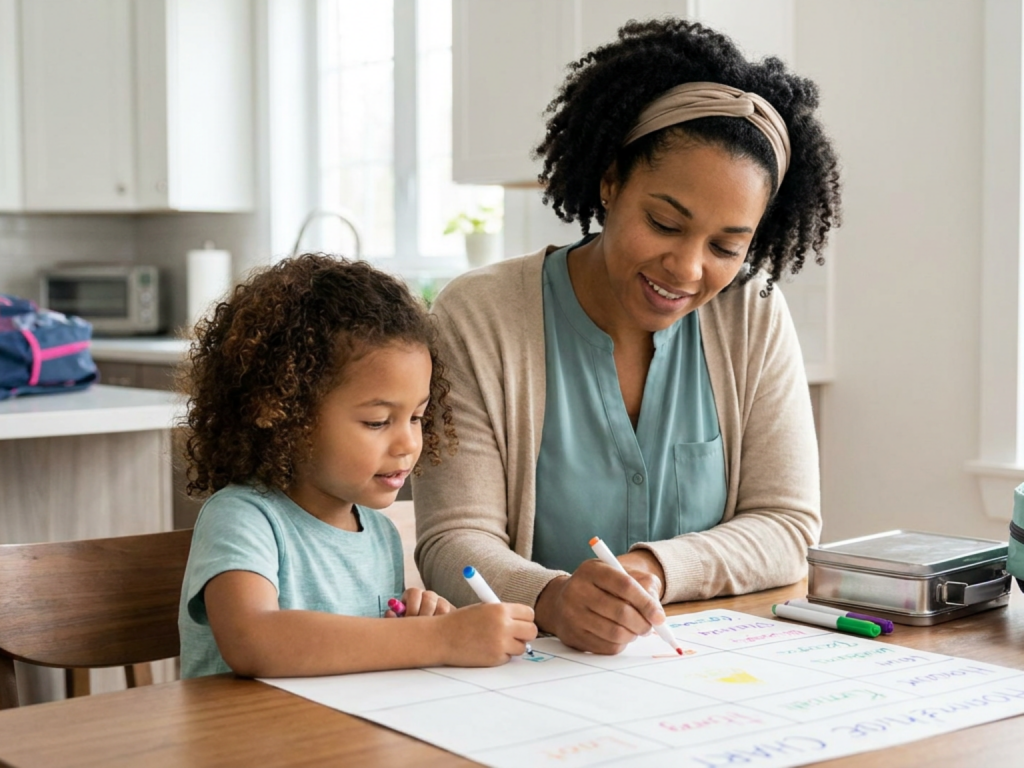
A child who hears “Be responsible” may not know exactly what to do. Responsibility becomes easier when the environment provides cues. Routine charts, checklists, calendars, labeled bins, timers, and predictable transitions are executive-function supports for routines. They reduce the burden on working memory and make expectations visible.
Positive Discipline recommends routine charts as a way to involve children in daily expectations. A chart is most effective when it is simple, co-created, and used calmly. For example, a morning chart might include: get dressed, eat breakfast, brush teeth, pack lunch, put backpack by the door. For younger children, pictures may work better than written words. For older children, a planner, phone reminder, or whiteboard may be more appropriate.
The goal is not to micromanage forever. The goal is to externalize the structure until the child internalizes it. If the child fails, avoid immediately labeling the chart as useless. Instead, ask whether the routine is too long, too abstract, poorly timed, or missing an adult check-in. Many children need repeated practice before a system becomes automatic.
Offer choices within firm boundaries
Responsibility grows when children experience agency. Choices help children practice decision-making while adults maintain safety and structure. The key is to offer choices that are acceptable to the caregiver either way. For example: “Would you like to do your reading before dinner or after dinner?” “Do you want to put away blocks first or books first?” “Would you rather pack your sports bag tonight or after breakfast?”
Positive Discipline describes the value of offering choices along with kind but firm follow-through. This approach supports autonomy without turning every expectation into a negotiation. The adult remains calm and clear: “You can choose the order, but the toys need to be put away before screen time.”
Choices should match the child’s developmental capacity. Too many options can overwhelm younger children or children under stress. A limited, concrete choice often works better than an open-ended question. “Do you want the red cup or blue cup?” is easier than “What do you want to drink from?” Similarly, “Start with math or spelling?” is easier than “How are you going to get all your homework done?”
Connect responsibility to natural and logical consequences
Consequences teach best when they are related, respectful, and reasonable. Natural consequences happen without adult intervention, such as feeling cold after refusing a jacket in safe weather. Logical consequences are arranged by adults and directly connected to the behavior, such as cleaning up a spill or replacing a broken item when appropriate. Bright Horizons recommends clear expectations, age-appropriate consequences, and positive reinforcement as part of teaching accountability.
Teaching responsibility through consequences should not mean humiliation, threats, or harsh punishment. Shame activates defensive responses and can interfere with learning, especially in children who are anxious, highly sensitive, neurodivergent, or already struggling with self-esteem. A repair-focused approach might sound like: “The marker got on the table. Markers are for paper. Let’s clean it together, and tomorrow markers will stay at the kitchen table.”
Not every natural consequence is safe or appropriate. A child should not experience dangerous consequences involving traffic, medication, severe weather, violence, food insecurity, or medical care. In those situations, adults must intervene. The teaching moment can come later, when the child is regulated enough to reflect.
Praise effort, follow-through, and repair
Positive reinforcement helps children notice which behaviors are worth repeating. Effective praise is specific and grounded in observable action: “You remembered to put your lunchbox by the sink,” or “You came back to fix the problem even though you were upset.” This is more useful than global praise such as “You’re perfect” or “You’re the responsible one,” which can create pressure and identity-based expectations.
It is also important to praise repair. Children need to learn that mistakes are not the end of responsibility; they are often where responsibility begins. If a child lies, breaks something, hurts a sibling’s feelings, or neglects a task, the repair may involve telling the truth, apologizing, cleaning, replacing, or making a plan for next time. Age-appropriate repair after mistakes teaches accountability while preserving dignity.
For children who are easily discouraged, adults may need to name progress that the child cannot yet see: “Last month you needed five reminders to start your routine. Today you needed two. That is growth.” This kind of feedback supports motivation and reduces all-or-nothing thinking.
Consider temperament, stress, and health-related factors
Some children struggle with responsibility because the demand exceeds their current regulatory capacity. Sleep deprivation, chronic stress, anxiety, depression, trauma exposure, attention differences, learning disorders, sensory processing challenges, chronic illness, pain, family conflict, and medication side effects can all affect follow-through. This does not mean parents should diagnose the child at home. It means persistent difficulty deserves curiosity and, when appropriate, professional input.
Warning signs that may justify consultation include a sudden decline in functioning, intense emotional outbursts around ordinary demands, ongoing school impairment, frequent somatic complaints, severe sleep disruption, regression, self-harm statements, or responsibility struggles that remain extreme despite consistent routines and support. A pediatrician, child psychologist, school counselor, occupational therapist, or other qualified clinician can help assess whether additional support is needed.
Medically literate caregivers may find it useful to think in terms of load versus capacity. A child’s visible behavior is the output of neurodevelopment, environment, physiology, relationships, and current stress. Increasing responsibility works best when adults reduce unnecessary load, strengthen skills, and increase autonomy gradually.
Avoid giving children too much responsibility
Responsibility is healthy when it is age-appropriate and supported. It becomes harmful when children are expected to manage adult emotions, parent siblings beyond reasonable helping, mediate family conflict, carry financial worries, or perform at a level that protects adults from discomfort. Too much responsibility parenting can create anxiety, perfectionism, resentment, or role confusion.
A useful question is: “Does this responsibility build the child’s competence, or does it meet an adult need at the child’s expense?” Asking a ten-year-old to pack a school bag is competence-building. Expecting that child to manage a parent’s emotional stability is not. Asking a teenager to contribute to household chores is appropriate. Making the teenager the primary caregiver without support may be excessive, depending on the circumstances.
Healthy responsibility includes room for childhood: play, rest, learning, mistakes, social connection, and emotional dependence when needed. The long-term goal is not early adulthood; it is gradual, secure growth toward adulthood.
A practical family plan for building responsibility
Families can begin with a small, structured plan rather than trying to overhaul everything at once.
- Choose one responsibility: Select a task that matters but is not emotionally explosive, such as putting shoes away or packing a lunchbox.
- Define success clearly: Say exactly what “done” means. “Backpack is zipped and by the door” is clearer than “Get ready.”
- Teach the steps: Demonstrate, do it together, then observe while the child tries.
- Add a cue: Use a chart, alarm, basket, checklist, or routine anchor such as “after dinner.”
- Follow through calmly: If the child forgets, guide them back without a lecture.
- Review and adjust: Ask what helped, what got in the way, and what needs changing.
Family meetings for accountability can also help. These meetings should be brief, predictable, and solution-focused. Instead of using them to criticize, ask: “What is working?” “What feels hard?” “What should we try this week?” Involving children in solutions increases cooperation and gives them practice with problem-solving.
When to seek extra support
- Consult a healthcare professional if responsibility struggles appear suddenly or are accompanied by major mood, sleep, appetite, or school changes.
- Seek urgent help if a child talks about self-harm, feels unsafe, or shows dangerous behavior.
- Do not use natural consequences when safety, medical care, nutrition, or supervision is at risk.
- Avoid shaming, humiliation, or excessive punishment; these can worsen anxiety and reduce learning.
- Consider school or clinical evaluation if attention, learning, sensory, or emotional regulation difficulties persist despite consistent support.
Tools & Assistance
- Create a simple visual routine chart for one daily task.
- Use a weekly family meeting to review responsibilities and adjust expectations.
- Ask the child’s teacher or school counselor whether similar patterns appear at school.
- Consult a pediatrician or child mental health professional if concerns are persistent or impairing.
- Use repair-focused language: name the problem, guide the repair, and plan for next time.
FAQ
At what age should children start learning responsibility?
Children can start very early with simple, supported participation, such as helping clean up toys or choosing clothes. Independence should increase gradually with development.
Should I reward my child for being responsible?
Specific praise and encouragement are usually helpful. Material rewards can be used carefully, but the long-term goal is for children to connect responsibility with contribution, competence, and trust.
What if my child refuses every responsibility?
Start smaller, make expectations clearer, reduce power struggles, and look for barriers such as fatigue, anxiety, attention difficulties, or unclear routines. If refusal is persistent or impairing, consider professional guidance.
Are consequences necessary?
Consequences can help when they are safe, related to the behavior, respectful, and age-appropriate. They should teach cause and effect, not shame the child.
How do I know if I am expecting too much?
If the task repeatedly causes distress, requires constant adult rescue, or asks the child to manage adult-level emotional or practical burdens, it may need to be simplified or reconsidered.
Sources
- Positive Discipline — Teaching Responsibility: When Does it Happen?
- Boys & Girls Clubs of America — How To Teach a Child Responsibility
- Bright Horizons — Helping Children Learn Responsibility for Their Actions
Disclaimer
This article is for informational purposes only and does not replace medical, psychological, or educational advice. Consult a qualified healthcare professional for concerns about a child’s development, behavior, mood, safety, or functioning.

















Please log in to leave a comment.