
Intro
Teaching independence values children is not about expecting children to behave like small adults. It is about helping them gradually internalize values such as responsibility, self-trust, persistence, cooperation, safety awareness, and respect for others while they practice real-life skills. A child’s nervous system, executive function, and emotional regulation are still developing, so independence grows best through repeated, supported practice rather than pressure or sudden withdrawal of help.
Highlights
Independence is a value as well as a skill: children learn that they are capable, that their contributions matter, and that effort leads to growth.
Developmentally appropriate expectations protect children from shame while still giving them meaningful responsibility.
Parents can promote autonomy through daily routines such as dressing, meal preparation, clean-up, problem-solving, and asking trusted adults for help.
Mistakes are not failures; they are essential feedback for the developing brain and opportunities for coaching.
Children with medical, neurodevelopmental, mental health, or learning differences may need individualized supports, and families should consult qualified professionals when concerns arise.
Independence is learned through connection, not disconnection
Many parents worry that encouraging independence means being less nurturing. In reality, healthy autonomy is usually built inside a secure caregiver-child relationship. Children are more willing to try hard things when they know an adult is nearby, emotionally available, and not measuring their worth by immediate success.
From a developmental perspective, independence relies on executive functions: working memory, inhibitory control, planning, cognitive flexibility, and emotional regulation. These capacities mature gradually through childhood and adolescence. A preschooler who forgets the second step of a clean-up routine is not being defiant in the same way an adult would be; their prefrontal systems are still under construction. This is why independence grows through modeling, reminders, repetition, and calm coaching.
The University of Michigan C.S. Mott Children’s Hospital National Poll on Children’s Health notes that parents often value independence because it supports self-confidence, resilience, problem-solving, and mental health. Yet parents may also step in quickly because it is faster, cleaner, or less emotionally uncomfortable. That tension is normal. The goal is not perfection; it is noticing small moments when a child can do a little more for themselves with safe support.
Start with developmentally appropriate expectations
Teaching independence values children begins with realistic expectations. Chronological age matters, but readiness also depends on temperament, sleep, stress, motor coordination, language ability, neurodevelopment, health conditions, family culture, and previous opportunities to practice.
Useful responsibilities often include:
- For toddlers and preschoolers: putting toys in a bin, choosing between two outfits, washing hands with reminders, carrying a small plate to the sink, and helping match socks.
- For early elementary children: packing part of a school bag using a checklist, feeding a pet with supervision, making a simple snack, tidying a bedroom zone, and asking a teacher or trusted adult for help.
- For older children: preparing simple meals, managing a homework plan with check-ins, helping with laundry, comparing choices before spending money, and practicing safe communication about plans and location.
- For adolescents: managing appointments with adult backup, planning transportation, budgeting for needs and wants, taking appropriate responsibility for school communication, and reflecting on digital decision-making.
These are examples, not prescriptions. A child recovering from illness, coping with anxiety, experiencing family disruption, or living with a disability may need more scaffolding. The value is not in doing tasks at a certain age; the value is in practicing capability at a safe and humane pace.
Use scaffolding: help enough, but not too much
Scaffolding means giving a child enough structure to succeed while gradually reducing adult assistance. It is similar to rehabilitation principles used in medicine and therapy: function improves when the task is achievable, repeated, and adjusted to the person’s current capacity.
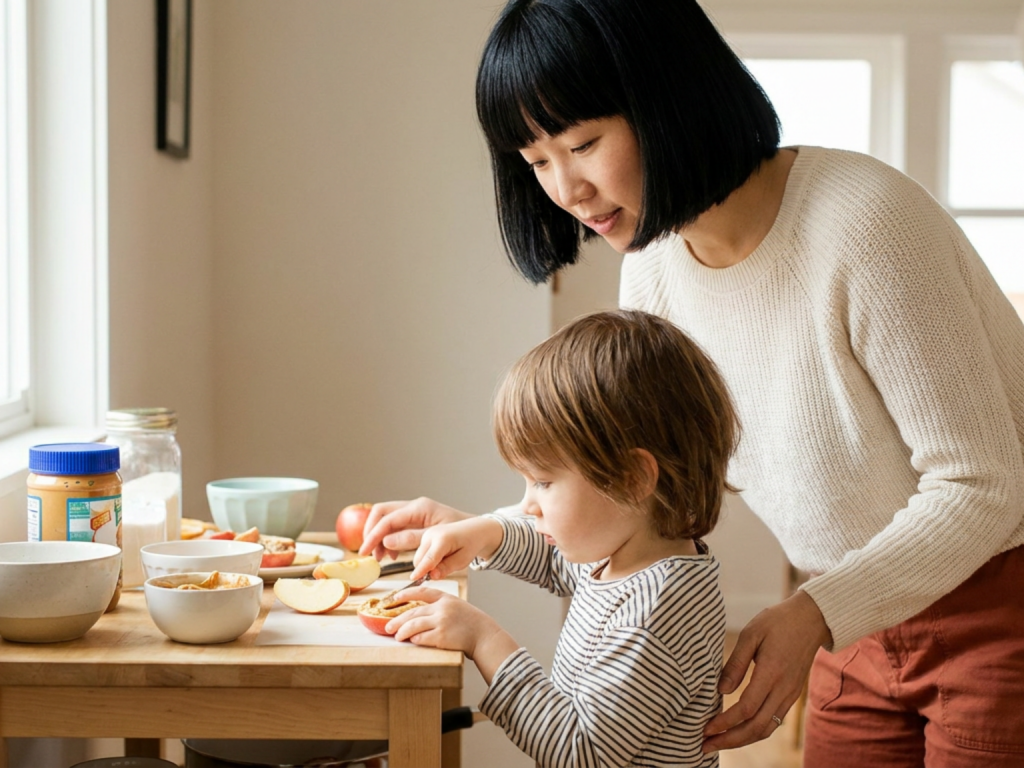
A simple approach is: model, do together, watch nearby, then step back. For example, if a child is learning to make breakfast, a parent might first demonstrate safe food handling, then make it together, then supervise from the kitchen table, and eventually allow independent preparation of a simple meal. This teaches competence without creating unnecessary risk.
Parents can also use a pause-and-coach parenting method. Instead of immediately tying the shoe, solving the sibling conflict, or finding the missing worksheet, pause and ask: “What have you tried?” “What is the next small step?” or “Who could help you safely?” These questions communicate trust while still offering support.
Children often experience frustration before mastery. That frustration is not automatically harmful. In manageable doses, with a calm adult nearby, it can help build distress tolerance and problem-solving. However, persistent panic, shutdown, aggression, or somatic symptoms such as recurrent headaches or abdominal pain deserve careful attention and may warrant professional guidance.
Make daily routines the classroom for independence
Independence does not require elaborate lessons. The most powerful teaching usually happens during ordinary routines: getting dressed, preparing food, cleaning up, leaving for school, managing homework, and bedtime. Repetition allows children to encode habits in procedural memory, reducing the cognitive load over time.
Confident Parents, Confident Kids emphasizes life skills, chores, routines, and age-appropriate responsibilities as practical pathways to autonomy and confidence. The Children’s House similarly highlights the importance of resisting the impulse to do everything for children, creating opportunities for responsibility, allowing mistakes, and giving children space to solve problems.
Helpful routine strategies include:
- Create visual checklists for multi-step tasks such as morning preparation or backpack packing.
- Use environmental supports for self-discipline, such as low hooks for coats, labeled bins, or reachable cups and plates.
- Offer limited choices: “Do you want to put on shoes first or pack your snack first?”
- Build in extra time so the child can practice without everyone feeling rushed.
- End with repair rather than blame: “The milk spilled. Let’s get a towel and clean it together.”
When children contribute to family life, they learn that independence is not isolation. It is participation. A child who clears the table or helps fold laundry is learning responsibility, coordination, sequencing, patience, and respect for shared spaces.
Teach safety as part of autonomy
Independence must be paired with safety literacy. Children need to know not only how to do things alone, but also when not to do things alone. This is especially important for street safety, water safety, kitchen tools, medication storage, online communication, and interactions with unfamiliar adults.
One underappreciated independence skill is learning how to seek help from trusted adults. A child who can identify a teacher, coach, school nurse, neighbor, relative, or emergency worker as a safe helper is not less independent; they are more competent. Knowing when to ask for help is a mature form of autonomy.
Parents can practice safety scripts in calm moments. For example: “If you get separated from me in a store, stay inside the building and ask a worker at the counter for help.” Or: “If a friend shows you something online that feels scary or private, close the device and come to me. You will not be in trouble for asking for help.” Rehearsal reduces fear and makes action more accessible under stress.
Safety teaching should be clear but not terrifying. Excessive fear can restrict independence and increase avoidance. The tone should be: “The world has risks, and we can learn skills to handle many of them.”
Let mistakes teach, while protecting dignity
Mistakes are biologically useful. The brain updates predictions through feedback: what worked, what did not, and what might work next time. If adults prevent every mistake, children may lose opportunities to develop self-monitoring and adaptive problem-solving. If adults shame every mistake, children may become avoidant or perfectionistic.
Natural consequences can be effective when they are safe, proportionate, and not humiliating. If a child forgets a water bottle once, feeling thirsty may help them remember tomorrow. If a child forgets essential medication, allergy supplies, weather-appropriate clothing in dangerous conditions, or a safety plan, adults must intervene. Natural consequences and child safety should never be treated as opposing values; safety comes first.
Language matters. Compare “You never remember anything” with “Your library book did not make it into the bag today. What reminder could help tomorrow?” The second response preserves dignity and directs attention to strategy. Over time, this builds metacognition: the child’s ability to think about their own thinking and behavior.
Support emotional independence without emotional abandonment
Emotional independence does not mean a child stops needing comfort. It means the child gradually learns to recognize feelings, use coping strategies, communicate needs, and recover from distress with less adult regulation over time. This pathway moves from co-regulation to self-regulation.
When a child is upset, a parent can validate the feeling while still holding the boundary: “You are disappointed that I will not pack your bag for you. I understand. I can sit with you while you use your checklist.” This teaches that feelings are acceptable, responsibilities remain real, and support does not always mean rescue.
Some children require more explicit emotional coaching. They may benefit from naming body cues such as a tight chest, stomach discomfort, clenched fists, or racing thoughts. They may need practice with breathing, movement breaks, sensory tools, or problem-solving cards. If emotional distress is frequent, intense, impairing, or associated with sleep disruption, appetite changes, school refusal, self-harm statements, or regression, consult a pediatrician, child psychologist, psychiatrist, occupational therapist, or other qualified clinician as appropriate.
Balance culture, family needs, and the child’s individuality
Independence does not look identical in every family. Some cultures emphasize interdependence, respect for elders, and collective responsibility; others emphasize individual choice and early self-management. These values do not have to conflict. A child can learn to make a snack independently and also learn to serve others at the table. A teenager can learn to manage a schedule and also consider family obligations.
Families also differ in time, resources, work schedules, housing, safety conditions, and support networks. A strategy that works in one home may not fit another. The key question is: “What is the next safe, meaningful responsibility this child can practice in this family’s real life?”
Parents should be gentle with themselves. If you have been doing many tasks for your child, you can change gradually. Choose one routine, teach it explicitly, expect imperfection, and celebrate effort. Independence is not created by one dramatic shift; it is built through hundreds of small transfers of responsibility.
When to use extra caution
- Do not use independence training to withhold needed care, comfort, nutrition, medication, supervision, or disability support.
- Seek professional advice if a child’s difficulties with independence are sudden, severe, or accompanied by major anxiety, depression signs, regression, school refusal, or self-harm statements.
- Do not rely on natural consequences when medication, allergies, traffic, water, fire, online exploitation, or physical safety is involved.
- Avoid shaming, ridicule, or comparisons with siblings; these can undermine self-efficacy and emotional security.
- Consult healthcare or developmental professionals if motor delays, language difficulties, attention problems, sensory processing issues, chronic illness, or neurodevelopmental differences affect daily functioning.
Tools & Assistance
- A visual morning or bedtime checklist created with the child
- A weekly family responsibility chart with age-appropriate household responsibilities
- A calm problem-solving script: pause, name the problem, list options, choose one next step
- Consultation with a pediatrician, school counselor, occupational therapist, or child mental health professional when concerns persist
- Regular family meetings for accountability, planning, and respectful feedback
FAQ
What if my child refuses to do things independently?
Start smaller. Refusal may reflect fatigue, anxiety, low confidence, unclear instructions, or a task that is too complex. Break the task into one achievable step, model it, and praise effort rather than speed or perfection.
Should I let my child fail so they learn?
Allow safe, proportionate mistakes, but do not allow preventable harm. Forgetting a nonessential item may teach planning; missing necessary medication or safety equipment requires adult intervention.
How do I know if I am helping too much?
Ask whether your help is doing the task for the child or helping the child learn the task. If the child could safely do part of it with time and coaching, consider stepping back one small level.
Can independence be taught to anxious or neurodivergent children?
Yes, but pacing and supports may need to be individualized. Visual aids, predictable routines, sensory accommodations, explicit teaching, and professional guidance can make autonomy safer and more successful.
How can I encourage independence without sounding critical?
Use language that communicates confidence: “I know this is hard, and I think you can try the first step.” Avoid labels such as lazy, babyish, or irresponsible, which can increase shame and resistance.
Sources
- University of Michigan C.S. Mott Children's Hospital National Poll on Children's Health — Promoting children's independence: What parents say vs do
- Confident Parents, Confident Kids — How to Teach Kids Life Skills to Promote Independence and Confidence
- The Children's House — Giving Your Child the Gift of Independence
Disclaimer
This article is for general educational purposes and is not a medical, developmental, or mental health diagnosis or treatment plan. Consult a qualified healthcare professional for concerns about your child’s health, behavior, development, or safety.


















Please log in to leave a comment.