
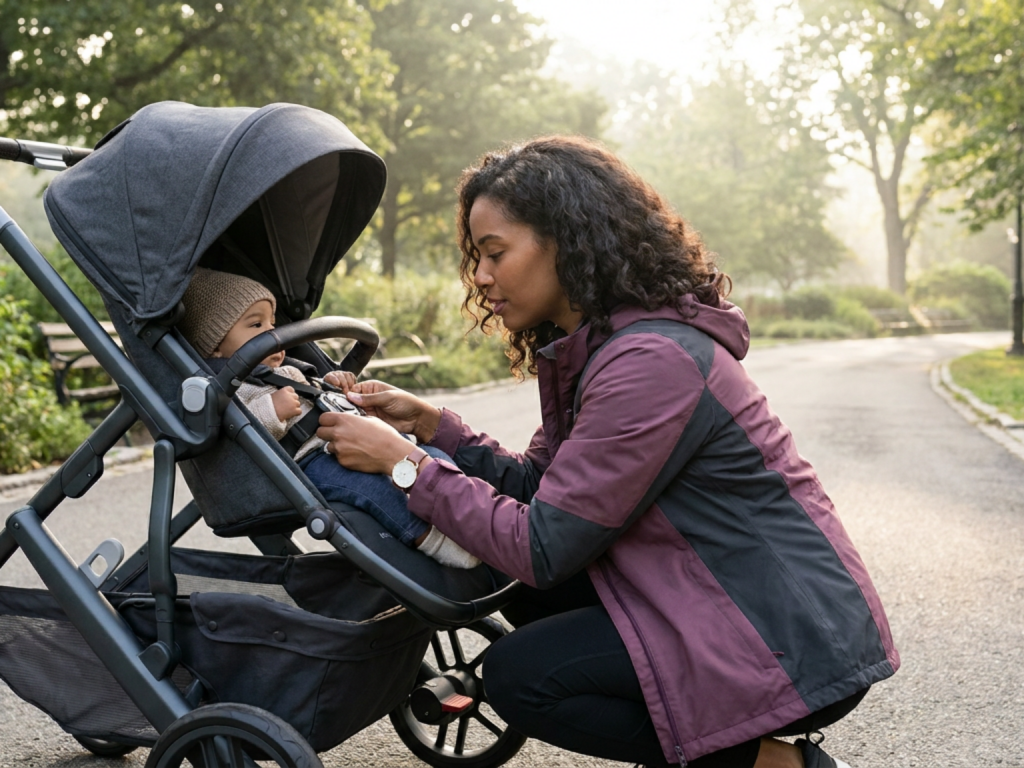
Intro
A stroller is one of the most useful pieces of baby gear, but it also introduces predictable safety risks: falls, tip-overs, entrapment, and injury from incorrect restraint use. The good news is that many of these risks are preventable with a few consistent habits and a stroller that is appropriately designed and maintained.
This article gives a medically informed overview of stroller safety for babies and young children. It is written for caregivers who want clear, practical guidance without alarmism, and it emphasizes when it is worth seeking advice from a pediatric clinician or child-safety professional.
Highlights
Most stroller injuries involve falls or tip-overs, and head or face injuries are common. A stable frame, correct braking, and a properly used harness reduce risk.
A five-point harness is one of the most important safety features, but it only works if it is used every time and adjusted correctly.
Never overload the handlebars or hang heavy bags where they can shift the center of gravity and cause a tip-over.
Newborns need special attention because their airway control, posture, and head support are still developing.
Regular checks for recalls, worn parts, and correct assembly are part of everyday stroller safety, not optional extras.
Why stroller safety matters
Strollers may look simple, but they combine movement, weight, posture support, and restraint systems in a way that can become unsafe if the stroller is used casually or if a feature fails. Published research on stroller injuries found that incorrect use is a major contributor, which is important because it means many injuries are preventable rather than random. The most commonly reported injuries involve falls and tip-overs, and head and face injuries are especially frequent.
That injury pattern is a reminder that safety is not just about choosing a stroller with a good reputation. It is about using the harness correctly, parking on stable ground, avoiding overloading, and paying attention to the child’s developmental stage. For families already managing sleep deprivation, rushed outings, or multiple caregivers, a simple safety routine can make a real difference.
Choose a stroller with core safety features
When you are comparing strollers, it helps to focus on the features that reduce real-world injury risk rather than only on convenience. A sturdy frame and a wide wheel base improve stability. A reliable braking system matters because a parked stroller can still move if it is on a slope, bumped by another person, or pulled by an older sibling. A wrist tether strap adds another layer of control, especially on uneven ground or when the stroller is being used in busy environments.
A five-point harness is a major safety feature because it distributes restraint across the shoulders, hips, and crotch area, making it harder for a child to slide out or lean into a dangerous position. If a stroller folds or reclines, the locking mechanism should feel secure and easy to check. For newborn use, the stroller should allow an appropriate lie-flat position or a configuration specifically designed for young infants, because early infants need more postural support than older babies.
Compliance with relevant safety standards is also worth checking when you buy a new stroller or accept a second-hand one. Safety standards do not replace supervision, but they do improve the baseline design and testing of the product.
Use the harness correctly every time
The harness is only protective when it is used consistently and adjusted properly. A child should be buckled in every ride, even for short trips, because injuries often happen during routine use when caregivers are distracted. The shoulder straps should sit correctly, the waist section should be snug, and the buckle should close securely without obvious looseness or twisting.
If the harness is too loose, a child may slump, slide forward, or twist in a way that compromises both safety and comfort. If it is too tight or poorly positioned, it may irritate the skin or make caregivers tempted to use it less often. That is one reason stroller fit should be checked as children grow. Different models also vary in strap placement and adjustment mechanisms, so it is sensible to reread the manual whenever you change use patterns or pass the stroller to another caregiver.
Remember that straps are not a substitute for attention. Even a well-fitted harness cannot compensate for a stroller that is unstable, parked on a poor surface, or loaded in a way that makes it tip.
Prevent tip-overs and falls
Tip-overs are among the most important stroller hazards because they can happen quickly and with little warning. A common mistake is hanging a heavy diaper bag, shopping bag, or purse from the handlebars. That extra weight shifts the stroller’s center of gravity backward and can make it easier to overturn, especially if the child leans, the stroller hits a curb, or one wheel catches.
Another useful habit is to lock the wheels whenever the stroller is stopped. Brakes should be engaged on flat ground, on ramps, and whenever you step away, even briefly. On hills or uneven surfaces, choose routes that are as stable as possible and avoid leaving the stroller unattended. A wide wheel base generally improves stability, but no design eliminates the need for careful use.
Falls can also occur if a child climbs in or out unexpectedly, stands up in the seat, or wriggles against the restraint. Close supervision is especially important when toddlers are transitioning from passive riding to more independent behavior. If a child is old enough to undo parts of the harness or push against the seat, it is time to reassess how and when the stroller is used.
Pay special attention to newborns and young infants
Newborns are not just smaller versions of older babies. Their neck muscles are weak, their head control is limited, and their airway positioning can be affected by slumping or chin-to-chest posture. For that reason, newborn stroller use needs more than a standard seat and harness. The stroller should support an appropriate recline or lie-flat setup for the infant’s age and developmental stage.
Airway safety matters here. If a baby is curled forward too much, breathing may become less efficient, particularly during sleep. Caregivers should check that the infant’s face remains visible and that the head is positioned in a way that does not obstruct the airway. If you are uncertain whether a stroller is appropriate for a newborn, ask your pediatric clinician or a child passenger or child-safety specialist for guidance before using it regularly.
It is also wise to be cautious about added covers, blankets, or accessories. Anything that blocks airflow or alters how the baby fits into the stroller can create hidden risk. The goal is a secure, well-supported position with good airflow and easy observation.
Safe habits for everyday use
Daily stroller safety is largely about habits. Use the brakes whenever the stroller is parked. Keep bags in the storage basket rather than on the handlebar, and be mindful not to exceed the stroller’s intended load. Check that folding joints, locks, and wheels are functioning smoothly before heading out, especially if the stroller has been stored for a while or transported in a car.
Weather and terrain matter too. In hot weather, avoid draping heavy coverings over the stroller in a way that reduces ventilation, as that can trap heat and restrict airflow. In crowded places, keep your hands on the stroller and consider the wrist tether if the model provides one. On sidewalks, watch for curbs, cracks, gravel, and other surfaces that can destabilize the stroller or jolt the child.
If multiple caregivers use the same stroller, make sure everyone knows how to buckle, brake, fold, and inspect it. A stroller that is safe in theory can become risky if one adult routinely uses it correctly and another does not.
Inspect, maintain, and replace when needed
Stroller safety is not a one-time decision. It depends on ongoing inspection and maintenance. Look for loose screws, cracked plastic, frayed straps, failing brakes, bent frames, and wheels that wobble or do not lock well. Small mechanical problems can become meaningful safety issues because strollers experience repeated stress from curbs, storage, folding, and travel.
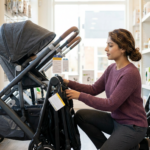
Recalls are another important part of maintenance. Before first use, and again if you buy a second-hand stroller, check whether the model has any safety notices or recall history. A second-hand stroller can be a good option if it is structurally sound and complete, but only if the restraint system, brake, and frame are intact and all parts are present. Missing parts or improvised repairs are red flags.
If a stroller has been in a crash, dropped from a height, or exposed to obvious structural damage, treat it cautiously even if it still appears functional. When in doubt, contact the manufacturer or a qualified baby-gear retailer, and ask your pediatric clinician if you are unsure how to adapt stroller use for your child’s needs.
When to get extra help
Sometimes the safest next step is to ask for expert input. This is especially true if your baby was born prematurely, has low muscle tone, has breathing concerns, or seems unable to maintain a stable posture in the stroller. In those situations, the issue may not be the stroller alone; the fit between the stroller and the child’s developmental needs may need review.
Ask a pediatric clinician, occupational therapist, or other child-health professional if you are unsure about positioning, harness fit, or the safety of a stroller attachment. If you are choosing a stroller for a baby with special medical needs, individual guidance is particularly valuable. It is better to pause and confirm than to assume a setting is safe simply because it looks comfortable.
Supportive safety habits are not about perfection. They are about reducing preventable risk while making everyday life more manageable for both caregiver and child.
Safety warnings
- Do not hang heavy bags from the handlebar; this can cause tip-overs.
- Do not use a stroller with broken brakes, a damaged frame, or missing harness parts.
- Do not leave a child unbuckled, even for a short stop.
- Do not use coverings that reduce airflow around a newborn.
- Do not assume a second-hand stroller is safe without a full inspection and recall check.
Tools & Assistance
- Pediatrician or family doctor
- Occupational therapist or child-safety specialist
- Manufacturer instruction manual for your stroller model
- Product recall database or manufacturer recall page
- Local baby-gear retailer for fit and safety checks
FAQ
What is the most important stroller safety feature?
A correctly used five-point harness is one of the most important features, along with stable brakes and a sturdy frame.
Can I hang my diaper bag on the handlebar?
It is safer to keep bags in the storage basket. Heavy items on the handlebar can make the stroller tip backward.
Is it safe for a newborn to sleep in a stroller?
Only if the stroller provides an age-appropriate, well-supported position and the baby can maintain a clear airway. Ask a clinician if you are unsure.
How often should I check the stroller?
Check it before use, and do a more careful inspection after storage, travel, rough use, or if anything feels loose or unusual.
Should I buy a second-hand stroller?
You can, but only after checking the frame, brakes, harness, locks, accessories, and recall history very carefully.
Sources
- PubMed — Stroller safety
- Nationwide Children's Hospital — Strollers
- Raising Children Network — Prams and strollers: safety guide
Disclaimer
This article is for general informational purposes only and does not replace individualized medical advice. If you are concerned about your baby's breathing, posture, or stroller safety, please consult a qualified healthcare professional.












Please log in to leave a comment.