
Intro
Deciding whether to rent or buy baby gear can feel more consequential than it first appears. A bassinet, stroller, travel crib, high chair, or car seat may be used during a short developmental window, yet each item also carries practical, hygiene, and safety considerations.
There is no universally correct choice. The best approach depends on how long the item will be used, how often you travel, the available storage space, the baby's age and medical needs, and whether you can verify that a product is complete, clean, undamaged, and appropriate for its intended use.
Highlights
Renting can lower upfront costs and reduce luggage or storage burdens when gear is needed briefly, especially during travel.
Buying can offer greater control over product history, fit, cleaning, recalls, and repeated daily use.
Sleep and vehicle-transport products deserve a higher safety threshold than many convenience items because correct assembly and condition are essential.
A short checklist for model information, instructions, missing parts, cleaning, and return terms can prevent avoidable problems.
Start with the real use case
Begin by defining the job the item must do, rather than by asking whether renting or buying is generally cheaper. Estimate the length of use, number of uses, where the gear will live, how it will be transported, and whether another caregiver will need to use it. A travel crib needed for four nights at a hotel presents a different decision from one needed every day at home for several months.
For a short trip, renting can reduce airport logistics, vehicle crowding, and the temptation to improvise with equipment that is not designed for infant sleep or transport. Consumer guidance on baby-gear rentals emphasizes confirming availability and details before arrival, since rental inventory and delivery arrangements can vary. Reserve early enough to clarify the exact product category, model if available, delivery window, fees, and what happens if the requested item is unavailable.
Buying often becomes more attractive when use will be frequent or prolonged. The purchase price is only one component of cost: include rental delivery charges, cleaning fees, insurance or damage charges, replacement fees, and the time required to collect and return the item. Also consider resale, lending to a trusted family member, or future siblings. A well-maintained item that remains within its manufacturer-stated service life may retain some practical value after your family no longer needs it.
Storage is a valid part of the calculation. Bulky items can create ongoing household friction in small homes, shared spaces, or temporary accommodation. Renting may be particularly useful when a product is large, used intermittently, or difficult to bring on a trip. However, convenience should never override the product’s intended use, age range, weight limit, assembly instructions, or safety requirements.
Gear that may suit renting
Rental arrangements are often most straightforward for large, temporary, or destination-specific equipment. Examples may include a travel crib, high chair, stroller, wagon, beach equipment, or a short-term indoor play yard. These products can be cumbersome to pack and may only be needed for a limited period. Renting can also allow caregivers to try a style of equipment before committing to a purchase, although a rental experience is not a substitute for reading the manufacturer’s manual and checking whether the specific model fits your routine.
A stroller can be a sensible rental for walking-heavy travel, provided it is suitable for the baby’s age and the hire company can supply the correct accessories and instructions. Infants who cannot sit independently may require a product with a flat or near-flat recline or a compatible bassinet attachment, according to the particular stroller’s instructions. Do not assume that every stroller is suitable from birth simply because it appears padded or reclines somewhat.
High chairs may also be practical to rent for short stays, but confirm that the restraint system functions and that all necessary parts are present. The chair should be stable on the actual floor surface, with no cracks, sharp edges, loose hardware, or compromised locking mechanisms. Babies should be supervised continuously while seated; even an appropriately functioning chair does not eliminate fall or choking risk.
Rental may be less useful for small items that are inexpensive, needed daily, or difficult to clean to your preferred standard. Some families also find that the time spent coordinating delivery, inspecting the product, documenting existing wear, and arranging return outweighs the savings. The right answer can reasonably differ between one vacation and another.
When buying gives meaningful advantages
Buying provides a known product history from the first use in your household. You can register the product, retain the full manual, follow the cleaning instructions, and monitor ordinary wear over time. This can be particularly reassuring for gear that contacts feeding surfaces or is used frequently during infancy, when caregivers are already managing disrupted sleep and shifting routines.
Owned items may be easier to adapt to the baby’s changing developmental needs. For example, you can repeatedly assess harness fit, recline settings, weight limits, and the condition of fasteners without depending on a rental provider’s inventory. Regular use also lets caregivers learn the mechanisms calmly, rather than figuring out folding, braking, or adjustment during a transfer, an outing, or a late arrival.
Buying may be financially sensible for equipment used every day over many months. Before purchasing, check expected duration of use and compare it with realistic rental pricing. Avoid purchasing solely because a product is marketed as multipurpose. Products should be used only in the settings and configurations approved by their manufacturer; a device that converts between modes may have different age, positioning, and supervision requirements in each mode.
New ownership does not automatically equal safety. New products can still be assembled incorrectly, used beyond stated limits, or subject to recalls. Keep proof of purchase, product identifiers, manuals, and registration details. Inspect the product periodically, especially after travel, a fall, a spill, or a difficult-to-operate adjustment. Replace damaged components only with manufacturer-approved parts.
Higher caution for sleep and vehicle transport
Some categories warrant more scrutiny because a mistake can have serious consequences. For sleep, use an infant sleep product only as its manufacturer intended and follow current guidance from the baby’s healthcare team and relevant local public-health authorities. A rental sleep space should include the correct firm mattress or pad, fitted components, instructions, and all required structural parts. Do not accept improvised bedding, loose blankets, pillows, soft inserts, or an aftermarket mattress that is not specifically approved for that exact product.
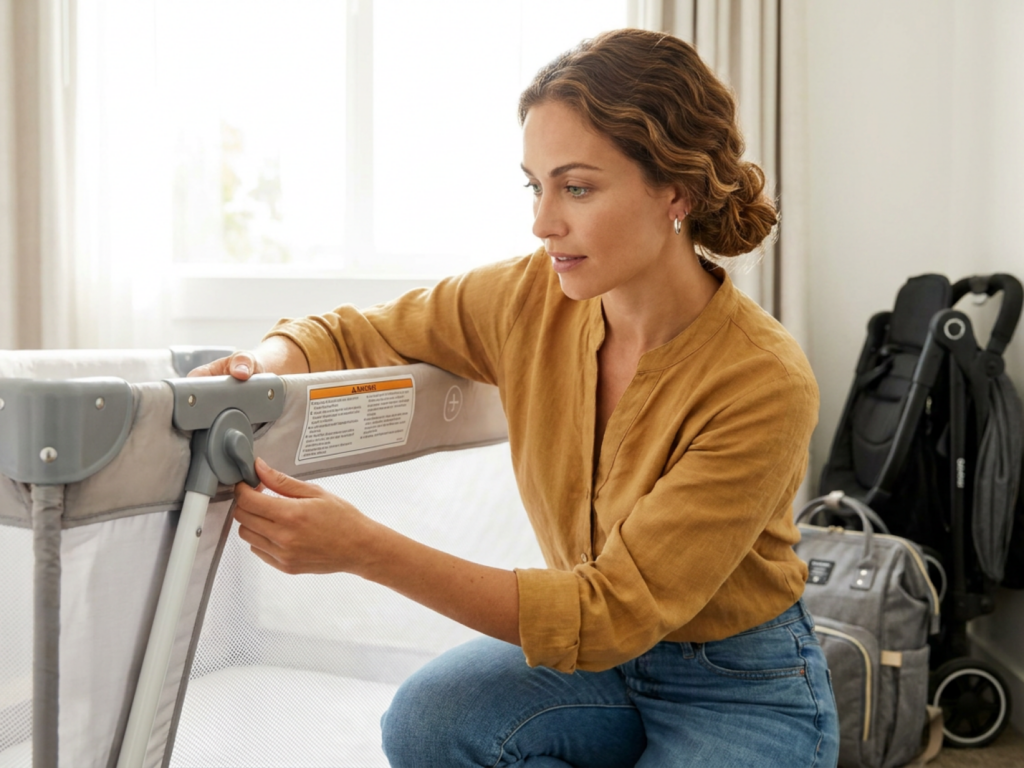
Before using a rented crib, bassinet, or play yard, inspect the frame, mesh, mattress support, locking points, and labels. Set it up fully and test every locking mechanism according to the manual. If the product will not lock as described, has missing parts, shows damage, or lacks legible safety information, do not use it for sleep. Ask the provider for a replacement. A rental company saying an item has been cleaned does not replace your own inspection for integrity and correct setup.
Car seats require particular caution. A car seat’s crash history, expiration date, completeness, and compatibility with the vehicle all matter. Many child passenger safety professionals advise against using a seat when its history is unknown. A rented seat may be appropriate only when you can verify its model, labels, instructions, condition, and post-crash status, and install it correctly in the actual vehicle. Do not rely on a driver or rental counter to install the seat for you.
For newborns, premature infants, or babies with airway, neuromuscular, cardiopulmonary, or orthopedic concerns, positioning needs may be individualized. Discuss travel equipment and safe transport with the child’s pediatric clinician. A certified child passenger safety technician can help assess installation and harness use, but does not replace clinical advice for medically complex infants.
Inspect hygiene, condition, and documentation
Cleanliness matters, but it is not the only safety question. Rental companies may use commercial cleaning procedures, yet caregivers should still inspect all surfaces that contact the baby, food, hands, or mouth. Look for visible soil, residue in seams, mold-like staining, strong odors, peeling material, frayed straps, broken buckles, corrosion, and cracks. Ask how fabric components are cleaned and whether parts are replaced when they cannot be adequately sanitized.
Request the product’s manufacturer, model name or number, and manual before accepting delivery whenever possible. This information allows you to confirm age and weight limits, identify the correct assembly, and check recall information through the relevant national product-safety authority. Do not use an item with missing warning labels or a provider who cannot explain how it is cleaned, maintained, inspected, and withdrawn from service.
On delivery or pickup, take time-stamped photographs of the item, its accessories, and any visible wear. This supports a clear conversation if a component is missing or an existing defect is later questioned. Count essential pieces before the delivery person leaves: harness pads, tray, mattress support, wheels, brakes, adapters, straps, and manuals are not interchangeable across models.
- Confirm the model and read the relevant setup instructions.
- Check every latch, brake, buckle, and adjustment before placing the baby in the item.
- Verify that the product is complete and within its stated limits.
- Document damage and contact the provider promptly for replacement equipment.
- Keep food, medication, and cleaning products out of the baby’s reach during setup and use.
Build a practical decision plan
A simple decision plan can reduce stress. First, separate essential safety equipment from convenience gear. Then list what is already available at your destination, what can be safely borrowed from a trusted source with a known history, what should travel with you, and what could be rented. For each rental candidate, compare the all-in price with purchase cost and estimate how many days or uses would make ownership more practical.
Next, identify the non-negotiables. These commonly include a known product model, intact labels, a current manual, no missing parts, a cleaning and maintenance policy, an appropriate age and weight range, and a reliable replacement pathway. For travel, ask whether delivery is guaranteed for a late flight, whether collection requires your presence, and whether a different model may be substituted. A contingency plan is useful when traveling with an infant: know where you could obtain a safe replacement if the rental is late, incomplete, or unsuitable.
Do not overlook caregiver ergonomics. A product that is safe in theory but too heavy to lift, difficult to fold, or awkward in your lodging may be used inconsistently or incorrectly. Test routine actions: carrying the baby to the vehicle, applying a stroller brake, adjusting the harness, lifting a travel crib mattress, and cleaning a feeding surface. If multiple adults will provide care, ensure each person can use the equipment correctly.
Finally, allow your decision to change as your circumstances change. Renting a travel stroller for a one-time trip and buying a durable daily stroller can both be rational choices. The goal is not to own the most gear or rent the least; it is to choose equipment that supports safe, realistic care for your baby and household.
Safety checks before use
- Do not use sleep gear with missing parts, damaged locks, soft aftermarket inserts, or unclear instructions.
- Avoid a car seat with an unknown crash history, expired label, missing components, or uncertain installation.
- Stop using any rented item that has cracks, frayed straps, faulty brakes, broken buckles, or unstable joints.
- Confirm weight, age, and developmental-use limits before placing a baby in rented or purchased gear.
- Seek individualized advice from a pediatric clinician for premature or medically complex infants.
Tools & Assistance
- Compare the all-in rental price against purchase price and expected number of uses.
- Request the manufacturer, model number, manual, and cleaning policy before delivery.
- Check product recalls through the applicable national consumer product-safety authority.
- Schedule a car seat installation review with a certified child passenger safety technician.
- Create a destination backup plan for essential infant sleep and transport equipment.
FAQ
Is it safe to rent a travel crib?
It may be appropriate when the product is complete, undamaged, correctly assembled, cleaned, and used exactly according to its manual. Decline it if locks, labels, mattress components, or instructions are missing or unclear.
Should I rent a car seat for travel?
Use caution. Verify the seat's model, expiration date, completeness, condition, crash history, instructions, and compatibility with the vehicle. If these cannot be confirmed, arrange another safe option.
What baby gear is usually easiest to rent?
Bulky, short-term items such as travel cribs, high chairs, and strollers may be practical candidates, provided their condition, fit, and intended use can be verified.
Can renting save money?
It can for brief or occasional use, especially when storage and transport costs matter. Compare delivery, cleaning, damage, and return charges with the likely purchase and resale cost.
Sources
- Consumer Reports — Baby Gear Rental: What to Know
- Bounty Parents — Baby Equipment: What To Rent, Hire & Buy
- Lifehacker — Which Baby Gear Should You Rent Instead of Buy?
Disclaimer
This article is for general information and does not provide medical, safety, or product-specific advice. Consult your baby's healthcare professional and follow the manufacturer's instructions and local safety guidance.













Please log in to leave a comment.