
Intro
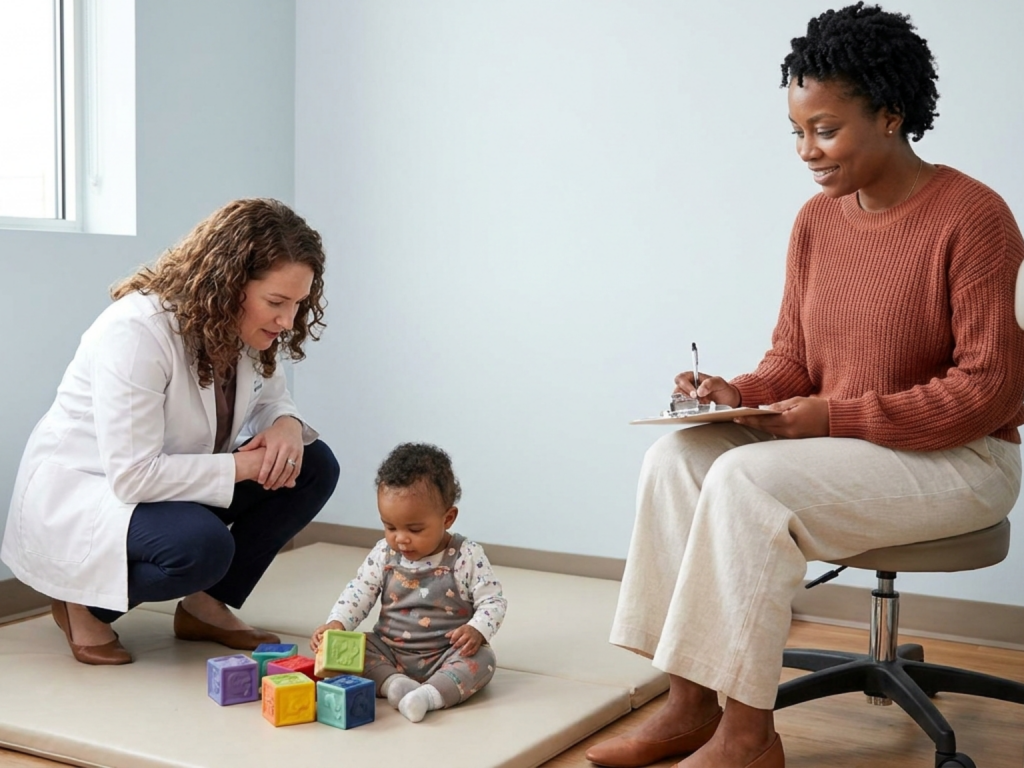
A month-by-month baby milestone chart can help you recognize the many ways infants develop during the first year: socially, emotionally, linguistically, cognitively, and physically. It is a guide to commonly observed skills, not a rigid timetable. Babies may reach the same milestone at different ages, and development often occurs in bursts rather than in a smooth, predictable sequence.
Use this chart to observe patterns, share useful information during well-child visits, and identify questions for your pediatrician or other healthcare professional. For babies born preterm, clinicians may interpret progress using corrected age, particularly during the first two years.
Highlights
Milestones describe what many babies can do by a given age, but normal variation is substantial.
Social interaction, communication, movement, and problem-solving develop together and influence one another.
Tummy time, responsive interaction, safe exploration, and consistent caregiving support healthy development.
A lost skill, marked asymmetry, or persistent concern deserves timely discussion with a healthcare professional.
How to use a baby milestone chart
Milestones are observable behaviors or abilities that emerge as the nervous system, sensory systems, muscles, communication pathways, and relationships mature. They are commonly grouped into social-emotional, language and communication, cognitive, and gross- and fine-motor domains. A baby may be advanced in one domain and slower in another while developing typically overall.
Age-based charts are best used for surveillance: watching a child over time, considering the quality and consistency of skills, and discussing observations with a clinician. They should not be used to diagnose a developmental disorder. A single missed skill is usually less informative than a broader pattern, especially when the child is tired, ill, hungry, or adapting to a new environment.
Milestone lists from the CDC and pediatric guidance often describe skills expected by a particular age rather than the exact day a child will acquire them. The most useful comparison is often the baby’s own trajectory. For a broader overview, families may also review Normal baby milestones by age while keeping the child’s individual medical history in mind.
Birth to 1 month: regulation and connection
Newborn development is centered on physiologic regulation, feeding, sleep-wake organization, sensory orientation, and early attachment. In the first weeks, babies commonly respond to familiar voices, startle or blink in response to sudden sounds, and briefly focus on faces or high-contrast objects at close range. Their visual attention may be fleeting because sustained control of the eyes is still developing.
Motor behavior is dominated by flexed posture and reflexes, including rooting, sucking, grasping, and the Moro response. A newborn may briefly lift or turn the head while prone, although head control is not yet established. Movements can appear jerky or asymmetric from moment to moment, but persistent or pronounced asymmetry should be discussed with a clinician.
Social development begins through reciprocal caregiving. Crying communicates needs; caregivers gradually learn to interpret different patterns of hunger, discomfort, fatigue, and overstimulation. Calm voice, skin-to-skin contact when appropriate, face-to-face interaction, and predictable responses support bonding and regulation. Safe sleep remains essential: place the infant supine on a firm, flat sleep surface without loose bedding or soft objects.
2 to 3 months: social smiling and stronger head control
By about 2 months, many infants show a social smile in response to a person’s face or voice, look at caregivers, and appear calmer when spoken to or picked up. They may make sounds other than crying, such as cooing, and react to loud sounds. By 3 months, a baby may engage in longer face-to-face exchanges, watch a caregiver move, and show pleasure or excitement through vocalizations and body movement.
Gross-motor control begins to improve. During supervised prone play, many babies lift the head and upper chest and hold the head more steadily when held upright. They may open their hands more often, bring hands toward the mouth, and briefly retain a toy placed in the hand. Visual tracking usually becomes smoother, although coordination is still immature.
Short, frequent periods of awake tummy time on a firm floor can build neck, shoulder, and trunk strength. Always stay within reach and stop if the baby becomes distressed or fatigued. Avoid using developmental devices as substitutes for active interaction; containers that restrict movement should be used only as recommended and for limited periods.
4 to 5 months: reaching, laughing, and purposeful exploration
At around 4 months, many babies smile spontaneously to gain attention, chuckle, and respond with sounds when spoken to. They may turn toward a caregiver’s voice, show interest in their hands, and look at themselves in a mirror. By 5 months, vocal play often becomes more varied, and babies may recognize familiar people, anticipate feeding or routines, and express excitement through movement.
Motor milestones become more purposeful. A baby may hold the head steady without support, push up on the forearms when prone, bring hands together, reach for a toy, and hold an object for several seconds. Rolling may begin during this period, but the sequence varies: some babies roll from tummy to back first, while others develop back-to-tummy rolling later. As reaching and rolling emerge, never leave the baby unattended on a bed, sofa, or changing surface.
Offer simple, safe objects with different shapes and textures that are too large to swallow. Talk, sing, imitate the baby’s sounds, and pause to allow a response. These exchanges support early turn-taking, auditory attention, and the foundations of language.
6 to 7 months: sitting, babbling, and object permanence
At 6 months, many infants recognize familiar people, laugh, take turns making sounds, and show curiosity about nearby objects. They may respond to their name or familiar sounds, although name recognition becomes more reliable over time. Babbling may include consonant-like sounds, and vocal tone can communicate pleasure, frustration, or interest.
Trunk and hand control advance rapidly. Many babies roll in both directions, push up with straight arms, sit with hand support, and reach for objects with increasing accuracy. They may transfer a toy from one hand to the other and explore it by mouthing, shaking, or banging. By 7 months, some infants sit briefly without support and begin using their hands to stabilize themselves.
Object permanence, the understanding that an object continues to exist when temporarily hidden, starts to develop through games such as peekaboo. Introduce complementary foods only in accordance with individualized pediatric guidance and readiness signs, while breast milk or iron-fortified formula remains central to infant nutrition. Choking hazards, including whole grapes, nuts, popcorn, and hard pieces of food, require careful prevention and age-appropriate preparation.
8 to 9 months: mobility and intentional communication
During 8 and 9 months, many babies become more mobile and socially intentional. They may look when their name is called, show several facial expressions, react when a caregiver leaves, and enjoy interactive games. Babbling often includes repeated syllables such as consonant-vowel combinations. Babies may raise their arms to be picked up, use gestures, or vocalize to direct attention.
Fine-motor development progresses from a whole-hand grasp toward a more refined pincer-like grasp. Infants may pick up small objects between the thumb and finger, bang two objects together, search for a partially hidden toy, and intentionally drop or release objects. Gross-motor skills may include sitting independently, moving from sitting to another position, pivoting, crawling, creeping, or pulling toward a supported stand. Not every baby crawls in the classic pattern.
Create a safe floor area for exploration by securing furniture, covering electrical outlets, blocking stairs, and removing small objects. Separation distress is common and reflects developing attachment and memory rather than a parenting failure. Brief, predictable departures and warm reunions can help the baby practice transitions.
10 to 11 months: problem-solving and supported standing
By 10 to 11 months, many babies use communication more deliberately. They may imitate gestures, respond to simple words or routines, understand the meaning of familiar prohibitions in context, and use sounds or gestures to request help. Babbling may sound increasingly speech-like, but the amount of verbal output varies widely. Some infants use one or more meaningful words near the end of the first year, while others communicate primarily through gestures and vocal patterns.
Many babies pull to stand, cruise while holding furniture, lower themselves with support, and move between sitting and lying positions. They may point, poke, place objects into containers, turn pages in a board book, and look for a toy that has been hidden. These behaviors reflect growing balance, bilateral coordination, visual-spatial reasoning, and intentional problem-solving.
Provide sturdy furniture or a stable caregiver hand for supported standing, but do not use wheeled baby walkers, which can increase injury risk. Continue reading, naming objects, and responding to gestures. Shared attention, in which baby and caregiver focus on the same object or event, is especially important for language learning.
12 months: emerging independence and first-year integration
At approximately 12 months, many children interact socially through gestures, pointing, showing objects, imitation, and simple back-and-forth games. They may understand familiar instructions accompanied by context, use a parent-specific name or another meaningful word, and express preferences clearly. Some children take independent steps, while others cruise confidently or walk with support; walking age has a broad normal range.
Hand skills may include a mature pincer grasp, placing objects into a container, releasing items intentionally, and self-feeding soft pieces with supervision. Cognitive development is visible in experimentation: a child may repeat an action to produce an effect, search systematically for hidden objects, and imitate household activities. Emotional regulation remains dependent on caregivers, even as independence and frustration increase.
First-year development is integrated rather than divided into separate boxes. Secure relationships support exploration; movement expands opportunities for learning; and communication grows through repeated, responsive interaction. A pediatric visit around this stage commonly includes developmental surveillance, physical examination, growth assessment, and age-appropriate screening. A chart such as a Baby weight chart by month addresses physical growth, but weight percentiles and developmental observations answer different clinical questions.
Supporting development and responding to concerns
The strongest everyday support is responsive caregiving: notice the baby’s signals, respond consistently, talk during routine care, share books, sing, imitate sounds, and allow safe movement on the floor. Follow the baby’s attention rather than forcing an activity. Tummy time should be supervised while the baby is awake; sleep positioning remains on the back. Limit background screens and prioritize direct human interaction.
Discuss concerns promptly if a baby loses a previously acquired skill, does not respond to sound, rarely makes eye contact or social expressions, has persistent difficulty feeding, shows marked movement asymmetry, or seems unusually stiff or floppy. Concerns about hearing, vision, tone, coordination, or communication may require targeted evaluation. A clinician may review the history, perform an examination, use a standardized screening questionnaire, and refer to audiology, ophthalmology, physical or occupational therapy, speech-language services, or early intervention when appropriate.
Developmental surveillance is ongoing, and a referral is not a diagnosis. Early assessment can clarify whether a variation reflects temperament, opportunity, hearing or vision, prematurity, medical factors, or a developmental difference. Families should bring specific examples, videos when appropriate, and information about what the baby can do consistently across settings. For more practical ideas, review guidance on How to support milestones month by month and seek individualized advice from the baby’s healthcare professional.
When to seek professional advice
- A baby loses a skill that was previously present or shows developmental regression.
- Movements remain markedly asymmetric, unusually stiff, unusually floppy, or difficult to control.
- The baby does not appear to respond to sound, voices, or visual interaction.
- Feeding is persistently difficult, unsafe, painful, or associated with poor intake or exhaustion.
- Caregivers have a continuing concern, even when a milestone chart appears reassuring.
Tools & Assistance
- Keep a brief monthly observation log with examples of new social, communication, motor, and problem-solving skills.
- Bring milestone questions and short, relevant videos to routine pediatric appointments.
- Use supervised floor play, books, songs, and responsive conversation as daily developmental activities.
- Contact local early intervention services when a clinician recommends assessment or referral.
- Ask about hearing, vision, corrected age, and standardized developmental screening when concerns arise.
FAQ
Do all babies follow the same month-by-month sequence?
No. Milestones have typical age ranges, and the order or timing can vary. Prematurity, temperament, medical history, opportunities for movement, and sensory factors may influence when skills appear.
Should I be worried if my baby skips crawling?
Not necessarily. Some babies use alternative ways to move or begin standing and walking without classic hands-and-knees crawling. Discuss mobility, symmetry, muscle tone, and overall progress with the pediatrician if you remain concerned.
How are milestones assessed in a medical visit?
The clinician usually combines caregiver observations, direct observation, physical examination, medical and birth history, and validated screening tools. Additional hearing, vision, or developmental assessment may be recommended.
What is corrected age for a preterm baby?
Corrected age adjusts chronological age to account for weeks born before 40 weeks of gestation. Healthcare professionals may use it when interpreting early developmental progress, especially during infancy and early toddlerhood.
Can a milestone chart diagnose a developmental delay?
No. A chart is an educational surveillance tool. Diagnosis requires a qualified professional to evaluate the child's development, health history, examination findings, and functioning across settings.
Sources
- Centers for Disease Control and Prevention (CDC) — Developmental Milestones | Learn the Signs. Act Early.
- American Academy of Pediatrics — Bright Futures Tool & Resource Kit, Second Edition
- Office of the State Superintendent of Education, District of Columbia — Infant and Toddler Developmental Chart
Disclaimer
This article is for general educational information and does not diagnose, treat, or replace advice from a pediatrician or other qualified healthcare professional. Seek prompt medical care for urgent concerns or sudden loss of skills.















Please log in to leave a comment.