
Intro
Babies explore with their hands and mouths long before they understand danger. A pill on a nightstand, a sweet-tasting liquid medicine, or a visitor’s purse can become accessible in seconds, especially during busy caregiving moments. Medication storage is therefore not just housekeeping; it is a core part of infant injury prevention.
This guide is written for medically literate caregivers who want practical, evidence-informed routines without blame or alarm. The goal is to make safe behavior easier: secure storage, clear labeling, careful disposal, and calm escalation if exposure is suspected.
Highlights
Child-resistant packaging slows access but does not make a product childproof; locked storage remains the safest default.
Bathrooms, kitchens, counters, diaper bags, and bedside tables often expose medicines to heat, moisture, or infant reach.
Every adult who enters the home, including grandparents, babysitters, and overnight guests, should follow the same medication storage rules.
Safe storage includes prescription medicines, over-the-counter products, vitamins, supplements, topical preparations, and pet medicines.
Why medication storage is different when a baby is in the home
Infants and mobile babies create a distinctive safety problem: they are developmentally driven to grasp, mouth, shake, and open objects, but they cannot recognize pharmacologic risk. A single adult tablet may represent a large mg/kg exposure for an infant. Liquid medicines may smell pleasant, chewable tablets may resemble candy, and transdermal patches can retain active drug after use. This is why medication safety has to be designed around predictable child behavior rather than perfect adult attention.
Research on medication storage appropriateness in households highlights that medicines left on counters, tables, or other accessible surfaces can be reached by children and contribute to accidental ingestion. In real life, these lapses happen when a caregiver is tired, interrupted, or trying to give a dose during a feverish night. A supportive approach is to build a system that assumes interruptions will happen and still protects the baby.
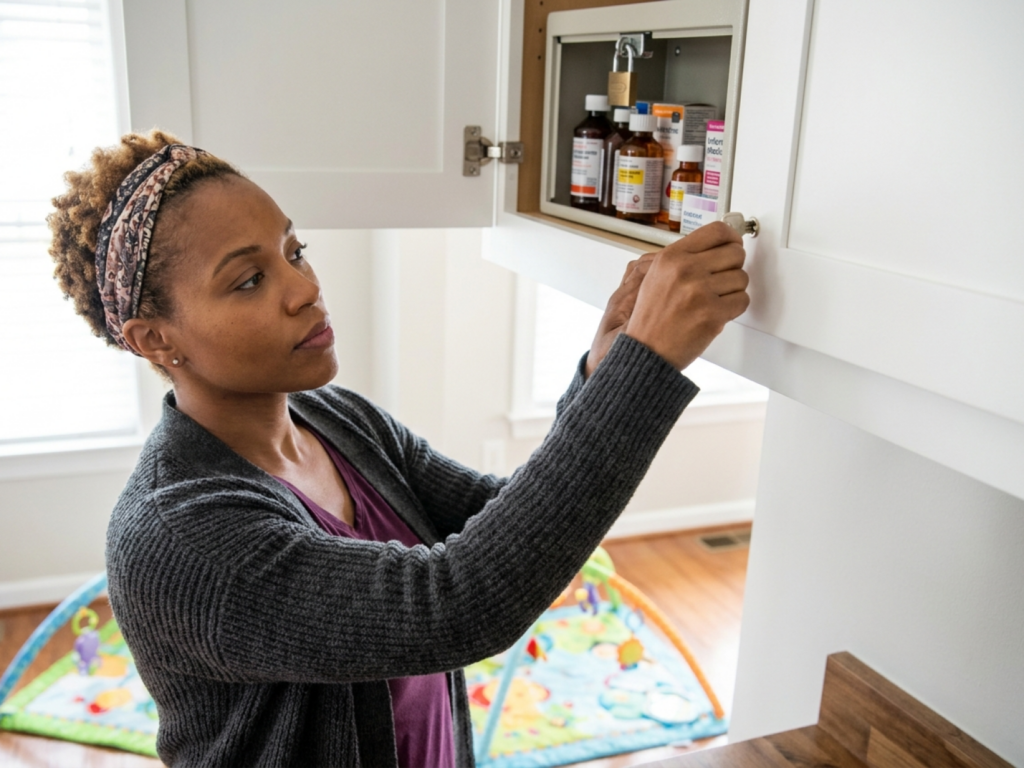
Use locked medication storage as the default
The safest home routine is locked medication storage: all medicines should be kept in a locked cabinet, lockbox, or container that is high and out of sight. A cabinet with a child latch may reduce access, but a true lock adds a more reliable barrier. Child-resistant caps are helpful, yet they are not childproof; some children open them, and adults may fail to re-secure them fully.
Store prescription drugs, over-the-counter medicines, vitamins, herbal products, iron, fluoride, nicotine replacement products, medicated creams, eye drops, and pet medicines together in a controlled location unless a product label requires different conditions. Do not keep medicines in handbags, backpacks, stroller organizers, or diaper bags unless they are in a locked pouch that remains under adult control. Visitors should be asked kindly but directly to secure purses and luggage, because grandparents’ medications can include potent cardiovascular, sedative, diabetes, or opioid agents.
Choose the right environment: cool, dry, labeled, and separate
Many medicines remain stable only within specific environmental limits. Unless the label or pharmacist says otherwise, choose a cool, dry place away from sunlight, heat, and moisture. Bathrooms are often poor storage sites because showers increase humidity. Kitchens can also be problematic if medicines are near a stove, sink, dishwasher, or sunny window. Heat and moisture may degrade active ingredients or alter liquid formulations.
Keep every medicine in its original container whenever possible. The original label preserves the drug name, concentration, dosing directions, expiration date, lot information, and warnings. This matters if poison control, a pharmacist, or a clinician needs to identify the exposure quickly. Avoid mixing tablets in one bottle, transferring liquids into food containers, or storing adult and infant medicines in look-alike organizers. If a medication requires refrigeration, place it in a locked refrigerator box or a clearly separated container that a baby cannot open.
Daily-use medicines need a safety workflow
A medicine used every day is often the one most likely to be left out. Build a repeatable sequence: remove the medicine, measure or take the dose, close the container until it clicks or locks, and return it immediately to the locked location before doing anything else. Do not leave a bottle open while soothing the baby, answering the phone, changing a diaper, or searching for a syringe.
For infant liquid medications, storage and dosing safety overlap. Use an oral syringe when directed, confirm the concentration, and keep a dosing log if more than one caregiver is involved. If you are reviewing Preventing Medication Dosing Mistakes, pay special attention to look-alike bottles and duplicate active ingredients. Store dosing devices clean and dry, but not loose where a baby can mouth them after contact with medication residue. Never call medicine candy, even as a way to gain cooperation; babies and toddlers learn language before they understand risk.
Include over-the-counter products and supplements in the same safety system
Caregivers sometimes treat prescription medicines as dangerous while leaving over-the-counter products more accessible. That distinction is unsafe. Acetaminophen or paracetamol, ibuprofen when age-appropriate, antihistamines, cough and cold products, antidiarrheals, topical anesthetics, vitamins, iron, melatonin, essential oils, and homeopathic preparations can all harm infants if taken incorrectly or ingested accidentally. Over the counter meds for babies require the same locked storage as controlled substances or chronic adult prescriptions.
Infant products can also be confused because concentrations, brand names, and combination formulas vary. A medicine’s active ingredient is more important than the marketing category on the front label. If two products contain the same active ingredient, accidental duplication can occur even when each product seems familiar. For any medication you plan to give a baby, ask a pediatric clinician or pharmacist if the product, dose, interval, and measuring device are appropriate for that child’s age, weight, medical history, and current symptoms.
Plan for visitors, childcare, travel, and divided households
Medication safety storage baby routines must travel with the baby. In homes where the baby spends time, such as a grandparent’s house, co-parent’s home, daycare, or temporary rental, do a medication sweep before floor play begins. Check bedside tables, bathroom counters, kitchen surfaces, purses, pill organizers, coat pockets, and low drawers. Use calm language: the request is not an accusation, it is standard infant safety.
During travel, keep medicines in original labeled containers inside a locked case. Do not leave the case in a hot car, checked stroller basket, or hotel nightstand. If a medicine must be available quickly, such as an emergency medication prescribed for a caregiver or child, ask a healthcare professional how to balance rapid access with child-resistant security. Childcare providers should have written instructions, emergency contacts, and clear separation between stored medicines and infant feeding supplies.
Dispose of expired, unused, and unclear medicines promptly
Expired, discontinued, unlabeled, or leftover medicines increase risk because they may be mistaken for current therapy or remain accessible after the reason for use has passed. Review the medication storage area regularly, especially after illnesses, hospital discharge, postpartum treatment, or a change in a caregiver’s prescriptions. If a medicine is no longer needed, follow local take-back programs or pharmacist guidance for disposal. Some drugs have specific disposal instructions because accidental exposure can be especially dangerous.
Do not flush medicines or place them in household trash unless authoritative disposal instructions recommend that method for that specific product. Remove or obscure personal information on empty prescription containers before recycling or discarding them, while preserving safety information until disposal is complete. If you find a mystery pill, leaking bottle, or unlabeled syringe, do not guess. Keep it away from the baby and consult a pharmacist, poison control center, or healthcare professional.
If exposure is suspected, respond quickly and calmly
If you see pills in a baby’s mouth, find an open bottle, notice missing tablets, or suspect contact with a patch, cream, or liquid medicine, treat it as a potential exposure even if the baby appears well. Remove any remaining substance from reach. Do not induce vomiting, give food or drink, or attempt home antidotes unless poison control or emergency clinicians instruct you to do so.
Call poison control or emergency services according to local guidance, especially if the baby has respiratory depression, unusual sleepiness, agitation, seizures, vomiting, cyanosis, abnormal tone, or altered consciousness. Have the container, product name, strength, estimated amount, time of possible exposure, baby’s age and weight, and symptoms ready. For ongoing prevention, consider pediatric medication reconciliation after any exposure scare or medication change: a clinician or pharmacist can help identify duplicates, high-risk products, and safer storage steps.
Seek urgent help if
- A baby may have swallowed any unknown pill, adult medicine, supplement, nicotine product, or cannabis-containing product.
- A baby is unusually sleepy, difficult to wake, breathing abnormally, seizing, cyanotic, or persistently vomiting.
- A transdermal patch is missing, found on the baby, or found in the baby’s mouth.
- A medication bottle is open and the amount missing is uncertain.
- You are unsure whether two products contain the same active ingredient or whether a dose was duplicated.
Tools & Assistance
- Locked medication box or lockable cabinet mounted high and out of sight
- Poison control center number saved in every caregiver’s phone
- Medication list with drug names, concentrations, prescribers, and dosing instructions
- Pharmacist review of expired, duplicate, or confusing medicines
- Weekly home sweep of bags, bedside tables, counters, and guest areas
FAQ
Are child-resistant caps enough for a home with a baby?
No. They reduce risk but are not childproof. Use locked storage and return medicines immediately after each use.
Where should I store medicine that must be taken every day?
Keep it in a locked container that is still convenient for adults. Convenience should come from a good workflow, not from leaving medicine on a counter.
Should vitamins and supplements be locked too?
Yes. Iron, vitamin D, melatonin, herbal products, and other supplements can be harmful if a baby ingests too much.
What should I do if a visitor has medicines in a purse or suitcase?
Ask them to place bags in a locked room, high closet, or lockbox. Explain that this is your standard baby safety rule for everyone.
Can I store baby medicine in the refrigerator door?
Only if the label requires refrigeration and the medicine is secured from child access, ideally in a locked refrigerator container or separated bin.
Sources
- MedlinePlus — Storing your medicines: MedlinePlus Medical Encyclopedia
- HealthyChildren.org, American Academy of Pediatrics — Medication Safety Tips for Families
- PubMed Central — Medication Storage Appropriateness in US Households
Disclaimer
This article is for general educational purposes and does not diagnose, prescribe, or replace individualized medical advice. For questions about a baby’s medication, dose, exposure, or symptoms, contact a pediatric healthcare professional, pharmacist, poison control center, or emergency services.












Please log in to leave a comment.