

Intro
Lower abdominal pain during ovulation is common enough to be familiar, but it can still feel unsettling when it happens in the middle of an otherwise ordinary cycle. In medical terms, this pattern is often called mittelschmerz, a German word meaning “middle pain.” It usually refers to one-sided pelvic or lower abdominal discomfort that appears around the time an egg is released.
For many people, the pain is brief and mild. For others, it can be sharp, crampy, or annoying enough to interfere with daily activities. Most ovulation-related pain is benign, but not every mid-cycle ache comes from ovulation, so it is reasonable to pay attention to timing, severity, and any accompanying symptoms.
Highlights
Ovulation pain is usually one-sided and tends to appear midway through the menstrual cycle, often around 14 days before a period.
The discomfort is often brief, but some people notice it as a sharper twinge, cramp, or dull ache that may last hours rather than days.
A common explanation is follicle rupture, with fluid or a small amount of blood irritating the pelvic lining.
Pain that is new, worsening, longer than usual, or linked with unusual bleeding deserves medical review.
Because several pelvic and abdominal conditions can mimic ovulation pain, pattern recognition matters more than a single symptom.
What ovulation pain is
Ovulation pain is a form of mid-cycle pelvic discomfort that occurs when an ovary releases an egg. The pain is typically felt on one side of the lower abdomen, although the side can change from month to month depending on which ovary ovulates. Many people describe it as a sudden twinge, a localized cramp, or a dull ache rather than a generalized abdominal upset.
Clinically, this pattern is called mittelschmerz. It is not rare: MedlinePlus notes that about one in five women experience pain around ovulation. The symptom is common enough to be considered a normal possibility in a regular cycle, but it is not identical for everyone. Some notice it clearly every month, some only occasionally, and some never feel it at all.
The timing can be helpful. Ovulation pain often occurs about midway through the cycle, usually around 14 days before the next period in a typical cycle, though the exact day can shift if cycles are shorter, longer, or irregular. That timing can make it especially confusing for people who are tracking fertility, watching for a missed period, or trying to separate menstrual cramps from other causes of lower abdominal pain.
Why it happens
The exact cause of ovulation pain is not fully proven, but the most widely accepted explanation is mechanical and inflammatory. As the follicle grows on the ovary and then ruptures to release the egg, the surrounding surface can stretch and irritate nearby structures. A small amount of fluid or blood may also escape into the pelvis, which can irritate the lining of the abdominal cavity and trigger discomfort.
This helps explain why the pain can feel so localized. The ovary itself does not hurt in the same way as skin or muscle, but the process around it can irritate sensitive pelvic tissues. The result may be a brief sharp sensation at the moment of ovulation or a lingering ache afterward. Some people feel it only during certain cycles, which suggests that the intensity of the rupture or the degree of irritation may vary from month to month.
Mayo Clinic notes that mittelschmerz is generally not preventable, which is important reassurance for people who think they are doing something “wrong” when it appears. In other words, the pain is often a normal physiologic event rather than a sign of poor health or an error in cycle tracking. Still, because lower abdominal pain has many possible causes, the fact that it happens near ovulation does not automatically confirm that ovulation is the only explanation.
What it usually feels like
The experience can vary, but certain features are especially typical. Ovulation pain is often one-sided, centered low in the pelvis, and noticeable for a short period. Some people feel it as a stab or pinch, while others describe cramping, pressure, or a heavy ache. The pain may remain in the same spot or shift slightly as the pelvis moves and the abdominal muscles respond.
Duration is one of the most useful clues. NHS guidance explains that ovulation pain is usually short-lived, while MedlinePlus and Mayo Clinic both emphasize that it occurs at or around ovulation and is generally temporary. A brief episode that resolves without other symptoms is more consistent with mittelschmerz than with a persistent abdominal problem. Even so, brief pain can still be intense enough to be memorable.
Associated sensations can add to the picture. Some people notice mild bloating, a sense of pelvic fullness, or a small amount of spotting around ovulation. Others do not have any extra symptoms at all. The absence of other symptoms does not rule in or rule out ovulation pain; it simply means the pain may be the main feature. What matters most is the whole pattern: side, timing, intensity, duration, and whether the symptom recurs in a familiar way from cycle to cycle.
When it may not be normal ovulation pain
Although ovulation pain is common, not every episode of lower abdominal pain during the middle of the cycle should be assumed to be benign. Changes in the usual pattern are especially important. MedlinePlus advises attention to pain that becomes different from past episodes, lasts longer than expected, or comes with bleeding that is not typical for you. Those changes can suggest that something else is happening.
It is also worth being cautious if the pain is severe, keeps getting worse, or does not fit the timing of ovulation very well. Pain that feels bilateral, spreads widely across the abdomen, or recurs outside the middle of the cycle may have a different cause. Likewise, if you are unsure whether the pain is truly linked to ovulation, the uncertainty itself is a reason to ask for medical input rather than self-diagnosing.
People sometimes assume any mid-cycle discomfort is simply “normal period stuff,” but pelvic pain can arise from ovarian cysts, gastrointestinal issues, urinary problems, or gynecologic conditions unrelated to ovulation. The point is not to worry unnecessarily; it is to avoid missing a condition that deserves treatment. If the symptom is new for you, unusually intense, or paired with abnormal vaginal bleeding, it should be discussed with a clinician.
How clinicians evaluate it
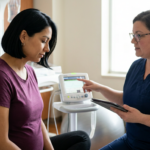
A healthcare professional will usually start by asking about timing, side, duration, cycle regularity, and whether the pain has a predictable pattern. That history is often the most valuable diagnostic clue. If the episodes line up closely with ovulation and are short, one-sided, and recurrent in a similar pattern, ovulation pain becomes more likely. If the picture is less clear, further evaluation may be needed.
Evaluation may also include questions about bleeding, discharge, bowel or urinary symptoms, pregnancy possibility, and any past pelvic conditions. This broader approach matters because lower abdominal pain is a shared symptom across many systems. For someone who is pregnant or could be pregnant, the timeline and associated symptoms become especially important, because not all pelvic pain in that context should be attributed to ovulation.
Depending on the history and exam, a clinician may recommend observation, testing, or imaging. The goal is not to label every mid-cycle pain episode as dangerous, but to distinguish a predictable physiologic event from a condition that needs treatment. If you seek care, being able to describe exactly where the pain is, how long it lasts, what it feels like, and whether it changes with each cycle can make the evaluation more efficient and more reassuring.
What helps you cope while waiting it out
When ovulation pain is mild and familiar, the hardest part is often uncertainty rather than the pain itself. It can help to track the day in your cycle, the side of the pain, how long it lasts, and whether it recurs in a similar pattern. That record can clarify whether the discomfort truly follows ovulation and can also give a clinician more context if you need one.
Many people find it useful to rest briefly, change position, or use gentle self-care measures that feel calming to them. The purpose is comfort and observation, not forcing the pain away. If the pain is interfering with work, sleep, exercise, or intimacy, that level of impact is worth discussing with a healthcare professional even if the timing seems ovulatory.
If you are trying to conceive, ovulation pain can be emotionally loaded because it may coincide with fertility tracking. If you are trying to avoid pregnancy, it can also create uncertainty about where you are in the cycle. In either case, remember that the symptom is only one part of the picture. Tracking does not replace medical assessment when pain changes character, becomes persistent, or shows up with other concerning symptoms.
Seek medical advice promptly if
- The pain is new, severe, or clearly different from your usual mid-cycle discomfort.
- The pain lasts longer than expected or keeps returning outside the ovulation window.
- You have unusual vaginal bleeding or spotting that does not fit your normal pattern.
- The pain is accompanied by symptoms that make you feel unwell or worried, even if the timing seems ovulatory.
- You are unsure whether the pain could be related to pregnancy or another pelvic condition.
Tools & Assistance
- A menstrual or ovulation tracking app to record timing, side, and duration of pain
- A simple symptom diary with dates, bleeding, and any associated pelvic symptoms
- A primary care clinician, gynecologist, or sexual health clinic for assessment when patterns change
- NHS, MedlinePlus, or Mayo Clinic patient information for medically reviewed background reading
FAQ
Is lower abdominal pain during ovulation normal?
It can be. One-sided mid-cycle pain is a recognized pattern called mittelschmerz, but not every pelvic pain episode is due to ovulation.
How long does ovulation pain usually last?
It is usually short-lived, often lasting a brief period rather than several days. Pain that persists longer or changes in character should be reviewed.
Can ovulation pain switch sides?
Yes. Because ovulation can occur from either ovary in different cycles, the pain may appear on the left one month and the right the next.
When should I talk to a doctor about it?
You should seek advice if the pain is severe, new, longer than usual, associated with abnormal bleeding, or simply not matching your normal pattern.
Sources
- Mayo Clinic — Mittelschmerz - Symptoms and causes
- MedlinePlus — Mittelschmerz: MedlinePlus Medical Encyclopedia
- NHS — Ovulation pain
Disclaimer
This article is for general information only and is not a substitute for medical advice, diagnosis, or treatment. If pain is severe, persistent, unusual, or associated with bleeding or possible pregnancy, contact a healthcare professional.















Please log in to leave a comment.