
Intro
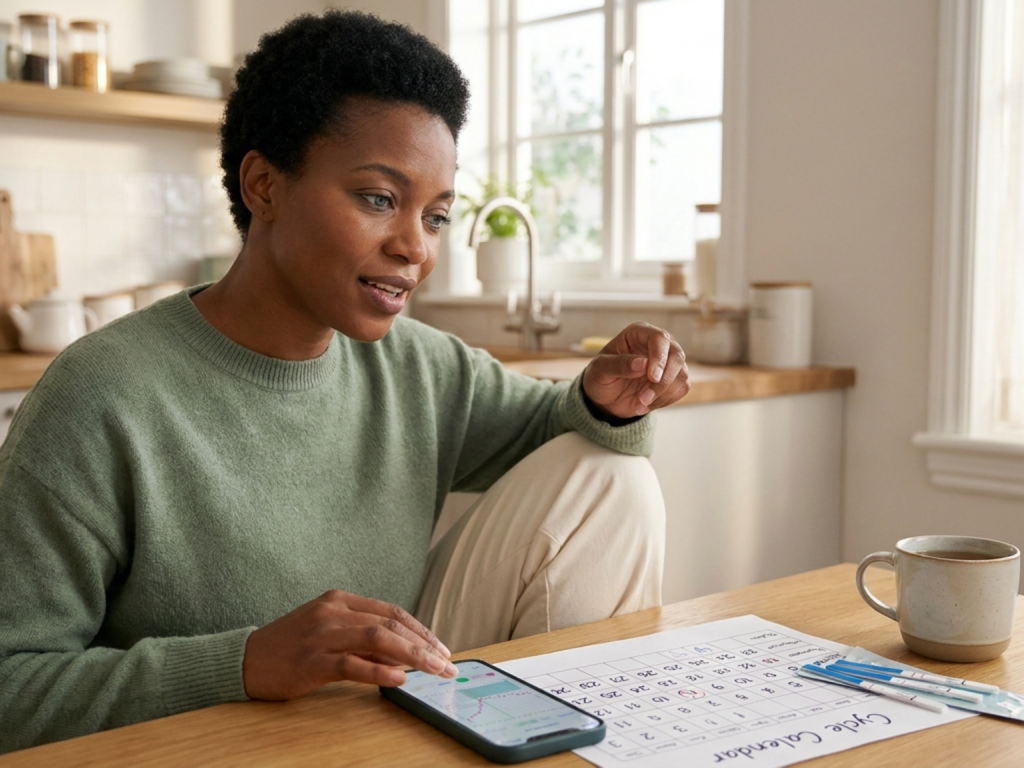
Estimating ovulation accurately can feel deceptively simple: count days, check an app, and wait for the fertile window. In reality, ovulation is influenced by biologic variation from cycle to cycle, so the exact day is often harder to pinpoint than people expect.
If you are trying to conceive or want a better understanding of your cycle, the most useful approach is usually to combine several signals rather than rely on a single calendar estimate. That gives you a clearer picture of when ovulation is likely, when it has probably already happened, and how much uncertainty remains.
Highlights
Calendar methods can estimate a likely fertile window, but they do not precisely identify the ovulation day for everyone.
The most evidence-supported tracking methods are urinary hormone testing, cervical mucus monitoring, and basal body temperature.
A single sign is easy to misread; combining data points usually gives the most reliable estimate.
Irregular cycles, recent hormonal changes, and postpartum or breastfeeding cycles can make prediction much less precise.
Why ovulation day is hard to pin down
Ovulation is the release of a mature egg from the ovary, and it is the main timing event for estimating the most fertile days of the menstrual cycle. The challenge is that ovulation does not happen on a perfectly fixed schedule. Even cycles with the same length can have different ovulation timing, which is why calendar-based ovulation prediction is only an approximation.
This is an important distinction. A calendar can tell you when ovulation is likely to occur, but it cannot directly observe the event. The fertile window is broader than one day, because sperm can survive for several days and the egg remains viable only for a short time after ovulation. That means accuracy is really about narrowing a range, not finding a single magic date. For many people, the most realistic goal is a well-supported estimate that is good enough to guide conception timing or to understand cycle pattern changes.
Start with cycle length, but treat it as a first estimate
The simplest place to begin is your cycle length, meaning the number of days from the first day of one period to the first day of the next. If you have tracked at least six to 12 cycles, you can look for your shortest and longest cycles and use a standard rhythm method to estimate fertile days. Mayo Clinic describes the common approach as subtracting 18 from the shortest cycle and subtracting 11 from the longest cycle to estimate the fertile range.
That method can be helpful, especially when you are just starting to learn your pattern. But it is still a calendar approximation, not a direct measure of ovulation. It works best when cycles are reasonably consistent and less well when they vary widely. If your cycle length changes from month to month, the estimated fertile window becomes wider, which is a clue that you should lean more heavily on physiologic signs rather than the calendar alone. Think of this step as the map, not the destination.
Use body-based fertility signs to narrow the window
Among currently established home methods, urinary hormone testing, cervical mucus monitoring, and basal body temperature are the best supported for detecting ovulation timing and luteal phase length. They each tell you something slightly different. Cervical mucus often becomes wetter, more slippery, and more stretchable as estrogen rises before ovulation, which signals that the fertile window is opening. Ovulation predictor kits detect the luteinizing hormone surge, which usually appears shortly before ovulation. Basal body temperature, by contrast, rises after ovulation because progesterone has a thermogenic effect.
Used together, these signs can be very informative. A fertile-mucus pattern plus a positive ovulation predictor kit suggests that ovulation is approaching. A sustained temperature rise afterward supports that ovulation has probably already occurred. The key is understanding what each method can and cannot tell you. Mucus and LH testing are better for prediction; temperature is better for confirmation after the fact. If you expect one sign to do everything, the timing will often seem confusing.
How to interpret app predictions without overtrusting them
Fertility apps can be excellent for organization. They make it easier to log bleeding days, cycle length, test results, and temperature charts in one place. The limitation is that many apps predict ovulation from cycle length alone, which is not accurate enough to pinpoint the ovulation day reliably. Research has shown that ovulation varies substantially, even in cycles that look similar by calendar length.
That does not mean apps are useless. It means they are best used as a dashboard, not as the final authority. If your app says ovulation should happen on day 14 but your cervical mucus, ovulation predictor kit, and temperature pattern point elsewhere, the biologic signals deserve more weight. This is especially true if your cycle is irregular, you have recently stopped hormonal contraception, you are postpartum, or your pattern has changed because of stress, illness, or a medical condition. In those settings, the app may be describing a pattern that no longer matches your current physiology.
A practical way to estimate ovulation more accurately
The most reliable home strategy is to combine methods in a deliberate sequence. First, record cycle length for several months so you know whether your pattern is fairly stable or highly variable. Next, watch for the first clear change in cervical mucus, because that often marks the start of the fertile window. Then use an ovulation predictor kit in the middle of the cycle or earlier if your cycle is short or irregular. Finally, take basal body temperature every morning before getting out of bed and look for a sustained post-ovulation rise.
When the signals line up, your estimate becomes stronger. When they do not line up, the safest interpretation is usually that ovulation has not been confirmed yet or that it occurred later than expected. If your goal is conception, focus on the fertile window rather than a single day, because the range matters more than perfection. If your goal is avoiding pregnancy, calendar-based ovulation prediction alone is not dependable enough to use as a stand-alone method. In both cases, the most useful habit is consistency: the more carefully and regularly you track, the more meaningful your pattern becomes.
When to get individualized medical advice
Some cycle patterns are inherently difficult to interpret at home. Very irregular cycles, unusually long cycles, frequent missed periods, or a sudden change in bleeding pattern deserve a more personalized conversation with a healthcare professional. The same is true if you are getting repeated mixed signals from testing and charting, because that may reflect timing issues, technique problems, or a cycle pattern that needs a different approach.
It is also worth reaching out if you are trying to conceive and need help making sense of several months of data. A clinician can help you decide whether the issue is timing, method selection, or whether additional evaluation is appropriate. That support can be especially reassuring when fertility tracking starts to feel more stressful than helpful. You do not need to master every detail alone; a careful review of your pattern is often enough to clarify the next step.
Important cautions
- A calendar estimate is not a confirmed ovulation date.
- An app prediction can be wrong even when previous cycles looked regular.
- Basal body temperature confirms ovulation only after the temperature shift appears.
- A positive ovulation predictor kit suggests timing, but it does not guarantee ovulation occurred.
- If your cycles are very irregular, home estimation may be too unreliable on its own.
Tools & Assistance
- A menstrual cycle tracker or paper calendar
- An ovulation predictor kit that detects urinary luteinizing hormone
- A basal body thermometer
- A cervical mucus chart or note-taking app
- A gynecologist, midwife, or fertility specialist for individualized review
FAQ
Can an app tell me the exact day I ovulate?
Usually not. Apps that rely mainly on cycle length can estimate a range, but they cannot precisely detect ovulation for every cycle.
Which home method is most accurate?
The best-supported methods are urinary hormone testing, cervical mucus monitoring, and basal body temperature, especially when used together.
Why does my temperature rise after ovulation instead of before it?
Basal body temperature rises after ovulation because progesterone increases body temperature, so it is mainly a confirmation tool rather than a predictor.
How many cycles should I track before trusting my estimate?
At least six to 12 cycles give a better view of your range, and the rhythm method traditionally uses that history to estimate fertile days.
Sources
- PubMed — Can apps and calendar methods predict ovulation with accuracy?
- PubMed Central — Current ovulation and luteal phase tracking methods: a systematic review
- Mayo Clinic — Rhythm method for natural family planning
Disclaimer
This article is for educational purposes only and is not a substitute for personalized medical advice, diagnosis, or treatment. If you have irregular cycles, fertility concerns, or questions about pregnancy timing, consult a qualified healthcare professional.














Please log in to leave a comment.