
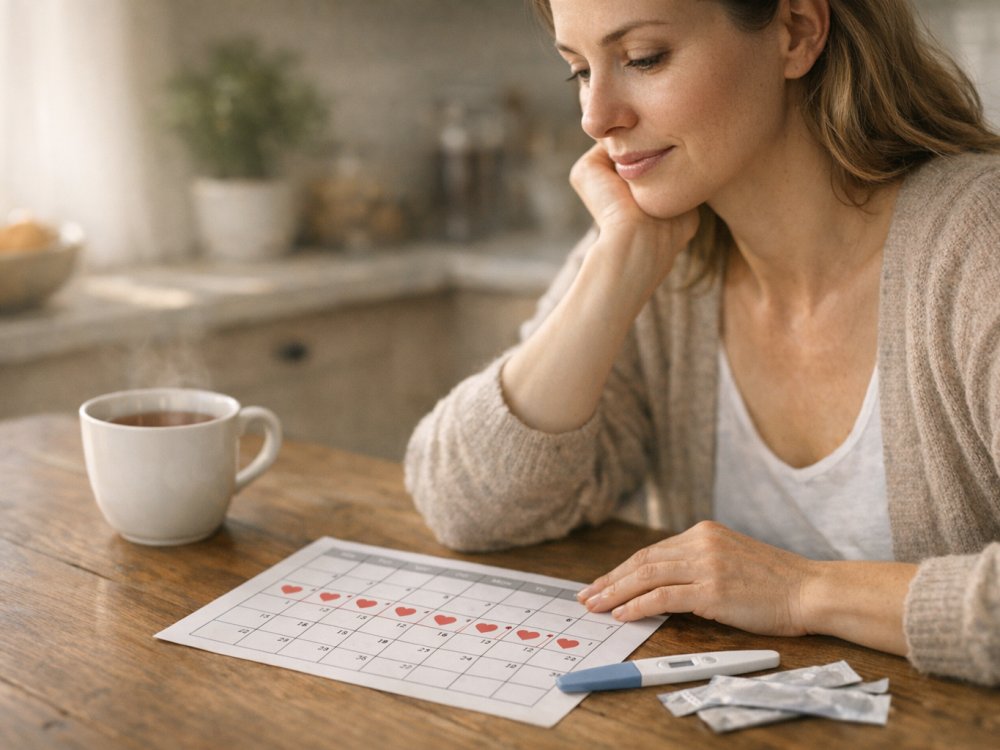
Intro
Ovulation is the release of a mature egg from the ovary, and it is the central timing event in a menstrual cycle for anyone trying to understand fertility or plan conception. Because the egg survives for only a short time after release, while sperm can remain viable in the reproductive tract for several days, estimating ovulation helps identify the days when pregnancy is biologically most likely.
Many people are taught that ovulation happens on “day 14,” but that is only an approximation for a 28-day cycle. In real life, cycle length varies between people and sometimes from month to month in the same person. A more useful rule is that ovulation typically occurs about 14 days before the next period starts, with the fertile window spanning the five days before ovulation and the day of ovulation.
Highlights
Ovulation usually occurs about 14 days before the next menstrual period, not necessarily on day 14 of the cycle.
The fertile window is commonly described as the five days before ovulation plus the day of ovulation, because sperm can survive for several days and the egg is viable for a limited time.
Cycle-length calculations work best for people with relatively regular periods; variable cycles make prediction less precise.
Cervical mucus changes, basal body temperature tracking, and ovulation prediction kits can help refine estimates when calendar math is not enough.
Ovulation timing: the physiology behind the estimate
The is counted from the first day of menstrual bleeding to the day before the next period begins. usually occurs once per cycle, after follicular development in the ovary and a surge in luteinizing hormone, often called the LH surge. After , the ruptured follicle becomes the corpus luteum, which produces progesterone to support the endometrium.
The post-ovulation portion of the cycle is called the . In many people, it is relatively consistent and lasts around 14 days, although individual variation exists. This is why clinical and educational resources often estimate ovulation as occurring about 14 days before the next period rather than exactly 14 days after bleeding starts.
The follicular phase, which comes before ovulation, is usually more variable. Stress, illness, travel, changes in weight, intense exercise, polycystic ovary syndrome, thyroid , perimenopause, lactation, and some medications can all influence whether and when ovulation occurs. This variability is the reason a cycle-length method is an estimate, not a diagnostic tool or a guarantee.
Why “day 14” is not universal
For a person with a predictable 28-day cycle, estimating around day 14 is reasonable. But if the cycle is 24 days, may occur closer to day 10. If the cycle is 35 days, ovulation may occur closer to day 21. The key calculation is to subtract approximately 14 days from the expected start date of the next period.
Examples:
- 24-day cycle: estimated ovulation around cycle day 10.
- 28-day cycle: estimated ovulation around cycle day 14.
- 30-day cycle: estimated ovulation around cycle day 16.
- 35-day cycle: estimated ovulation around cycle day 21.
This approach assumes ovulation occurs and that the luteal phase is close to 14 days. If cycles are highly variable, very short, very long, or sometimes absent, calendar estimates become less reliable and should be interpreted cautiously.
How to calculate your average cycle length
To estimate from , first track several cycles. Mark day 1 as the first day of true menstrual bleeding, not light spotting. Count each cycle until the day before the next period starts. After at least three cycles, calculate the average length by adding the cycle lengths together and dividing by the number of cycles tracked.
For example, if three cycles were 29, 31, and 30 days, the average is 30 days. Subtracting 14 gives an estimated day of cycle day 16. If cycles were 26, 34, and 29 days, the average is about 30 days, but the wide range tells you that may shift meaningfully from cycle to cycle.
A practical method is:
- Track the first day of each period for at least three cycles.
- Calculate the length of each cycle.
- Find your average cycle length.
- Subtract about 14 days to estimate ovulation.
- Plan for a that begins several days before that estimate.
Understanding the fertile window
The ]] is broader than the day of . Sperm may survive in fertile-quality cervical mucus for up to several days, while the egg is typically fertilizable for a much shorter period after release. For this reason, many medical resources describe the ]] as the five plus the day of .
If is estimated for cycle day 16, the ]] would be approximately cycle days 11 through 16. Intercourse during this interval, especially in the one to two days before and on ovulation day, is generally considered well timed for conception.
Because ovulation estimates can be imprecise, many couples choose a simpler strategy: every two to three days across the cycle, or more frequently during the estimated ]] if desired. This reduces the pressure of identifying a single “perfect” day and can be emotionally easier for many people.
How cycle variability changes the estimate
Cycle variability means that ]]]] may not occur on the same cycle day each month. A person with cycles ranging from 28 to 30 days can often use calendar estimation fairly comfortably. A person with cycles ranging from 24 to 40 days may find that the shifts by more than two weeks.
When cycles vary, it helps to think in ranges rather than single dates. Identify your shortest and longest recent cycles, then estimate possible ]] days by subtracting 14 from each. For example, if your cycles range from 26 to 34 days, ]] may occur roughly between cycle days 12 and 20. The could begin several days before the earlier estimate and extend through the later estimate.
This wider fertile interval can be useful, but it may also feel burdensome. If timing over a long window becomes stressful, predictor kits, cervical mucus observation, and a regular schedule may be more practical than trying to cover every possible date.
Additional ways to refine ovulation timing
Calendar methods are helpful, but physiologic signs can improve confidence. Cervical mucus often becomes clearer, stretchier, and more slippery as estrogen rises before . This “egg-white” quality mucus is associated with higher fertility because it supports sperm survival and transport.
prediction kits detect the LH surge in urine. A positive result usually indicates that is likely to occur within about 24 to 36 hours. These kits can be especially useful for people whose cycles are somewhat variable, although they may be harder to interpret in conditions associated with persistently elevated or multiple LH surges.
Basal body tracking can confirm that likely occurred after the fact. Progesterone raises resting body temperature slightly after ovulation. However, temperature does not reliably predict ovulation in advance, and readings can be affected by sleep disruption, illness, alcohol, and measurement technique.
When irregular cycles deserve medical attention
Occasional variation is common, but persistent ity can make harder to predict and may reflect an underlying hormonal or health issue. Cycles that are consistently very short, very long, absent, or unpredictable may warrant , especially if you are trying to conceive.
Consider speaking with a clinician if periods are absent for several months, cycles are commonly longer than 35 days, bleeding is very heavy or painful, or there are symptoms such as new acne, increased facial hair growth, galactorrhea, hot flashes, or unexplained weight changes. These signs do not prove a specific diagnosis, but they are reasons to seek individualized assessment.
If you are under 35 and have been trying to conceive for 12 months without pregnancy, or 35 or older and trying for 6 months, many professional guidelines support fertility . Seek care sooner if cycles are very , you have known reproductive conditions, or there are concerns about male-factor fertility.
When to seek medical advice
- Periods are absent for 90 days or more when you are not pregnant, postpartum, or using a method expected to suppress bleeding.
- Cycles are repeatedly shorter than 21 days or longer than 35 days.
- Bleeding is very heavy, prolonged, or associated with severe pelvic pain.
- Ovulation tests are consistently positive, consistently negative, or confusing in the setting of irregular cycles.
- You have been trying to conceive for 12 months if under 35, or 6 months if 35 or older.
Tools & Assistance
- Track period start dates and cycle lengths for at least three months.
- Use ovulation predictor kits around the estimated fertile window.
- Observe cervical mucus changes during the days leading up to expected ovulation.
- Discuss persistent irregular cycles with an obstetrician-gynecologist, reproductive endocrinologist, or qualified healthcare professional.
FAQ
Does ovulation always happen 14 days after my period starts?
No. Ovulation is better estimated as occurring about 14 days before the next period. Day 14 is mainly an approximation for a 28-day cycle.
Can I ovulate if my cycles are irregular?
Yes, some people with irregular cycles still ovulate, but the timing may be less predictable. Tracking cervical mucus, using ovulation tests, and discussing patterns with a clinician can help.
What are the best days to have sex when trying to conceive?
The fertile window is generally the five days before ovulation plus ovulation day. Intercourse in the one to two days before ovulation and on ovulation day is often well timed.
Are ovulation apps accurate?
Apps can be useful for tracking dates, but predictions are estimates based on past cycles. Accuracy decreases when cycles are irregular or ovulation shifts from month to month.
Can basal body temperature tell me when I am about to ovulate?
Basal body temperature usually confirms ovulation after it has happened because temperature rises in response to progesterone. It is less useful for predicting ovulation in advance.
Sources
- Stanford Medicine Children's Health — Ovulation Date Calculator
- Cleveland Clinic — Ovulation Calendar
- Your Fertility — Right Time For Sex, When Do You Ovulate?
Disclaimer
This article is for general educational purposes only and is not a substitute for personalized medical advice, diagnosis, or treatment. Consult a qualified healthcare professional about irregular cycles, fertility concerns, or symptoms.















Please log in to leave a comment.