
Intro
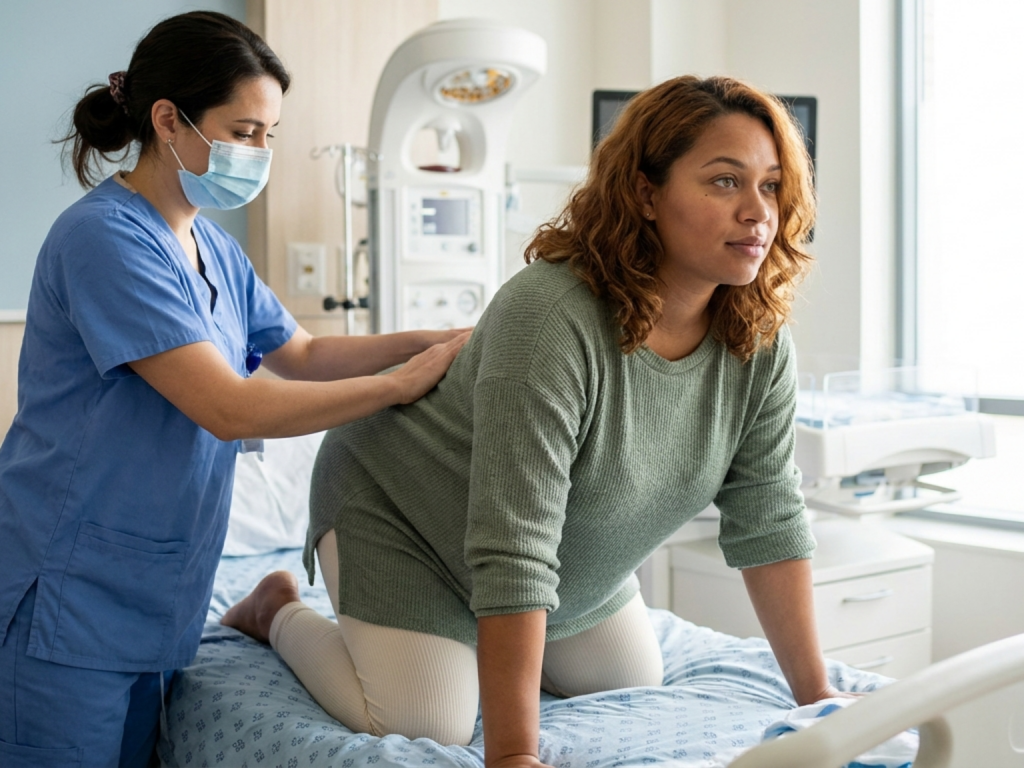
The hands-and-knees position is a labor posture in which a pregnant person supports weight on the hands and knees, usually with the shoulders over the wrists and the hips over the knees. It may be done on a bed, floor mat, birth ball, or padded surface, with or without support from pillows, a partner, or a clinician.
In obstetric care, it is one of several birth positions during labor used to improve comfort, change the angle of the pelvis, and give the person more control over movement. It is not a cure-all and it does not work the same way for everyone, but it is often a practical option when labor feels intense or when a different posture is needed for rest, assessment, or pain relief.
Highlights
The hands-and-knees position changes load away from the sacrum and lower back, which may reduce pressure during contractions.
It can be used in early labor, active labor, and sometimes during pushing, including in monitored settings.
Current evidence supports improved comfort for some people, but it does not prove that the position reliably rotates the fetus or shortens labor.
The position can still be feasible with epidural analgesia, although staff assistance may be needed for safe repositioning.
It should be treated as one option within individualized labor care, not as a universal solution.
What the position is
In practical terms, hands-and-knees positioning in labor means a forward-leaning posture supported by the hands and knees, often with a neutral spine or a slight curve through the back. Some people rest the chest on a pillow, lean over the back of a bed, or place the upper body on a birth ball while keeping the knees grounded. The goal is not a perfect pose; it is a position that is stable, sustainable, and useful in the moment.
From a biomechanical perspective, this posture can unload the sacrum, shift the center of gravity forward, and change how the fetus rests against the maternal pelvis. It may also reduce direct pressure on the perineum compared with a flat supine posture. Those changes are one reason it is discussed as a labor position rather than just a comfort technique.
Why it is used
Many people try the hands-and-knees position for back labor, especially when contractions are strongly felt in the sacrum, pelvis, or lower spine. The posture may lessen the sense of constant pressure, make contractions feel more tolerable, or provide a brief window of relief between waves. Some people also find that rocking the pelvis gently while in this posture helps them cope with pain and tension.
Clinicians may suggest the position when a laboring person wants more freedom of movement, when fetal heart rate tracing allows a position change, or when the team is trying to improve comfort without reducing the ability to observe labor progress. It can also be used as part of a broader plan that includes breathing, support, counterpressure, hydration, and other nonpharmacologic measures. In that sense, it belongs alongside other forward-leaning labor positions rather than standing apart as a special intervention.
What the evidence shows
The research base is mixed but useful. Reviews of repeated hands-and-knees positioning during labour suggest that some people report less pain and better comfort, and many find the posture acceptable and easy to try. That said, better comfort does not automatically translate into better birth outcomes. The best-supported conclusion is that the position may improve maternal experience for some laboring patients, while its effect on delivery outcomes remains uncertain.
A more recent trial on fetal head position found no clear evidence that hands-and-knees posturing reliably converts a fetus to an occiput anterior position at delivery. That is an important correction to older assumptions. The position may still be worthwhile for symptom relief or support, but it should not be presented as a dependable way to fix persistent fetal malposition in labor.
That distinction matters in counseling. A labor posture can be genuinely helpful without being transformative. The right standard is not whether it guarantees rotation or a faster birth; it is whether it helps the individual laboring person cope, maintain mobility, and stay engaged in care.
Using it with epidural analgesia and monitoring
Hands-and-knees positioning can still be possible after epidural analgesia, but it usually requires more planning. Sensory block, motor weakness, IV tubing, urinary catheters, and continuous fetal monitoring can all make the posture less independent than it would be without an epidural. Even so, published experience shows that many patients tolerate it well when staff assist with turning, support the hips or shoulders, and check that the epidural block is not creating unsafe asymmetry.
For some people, the position is easier if it is introduced early, before complete numbness or exhaustion develops. Others prefer to use it briefly during a contraction pattern that feels especially intense, then return to side-lying or upright rest. The key is flexibility. A labor plan should not assume that one posture must be held for long stretches. Rather, it should allow position changes after epidural analgesia as the labor pattern, monitoring needs, and maternal comfort evolve.
When monitoring is needed, the team may use mobility-compatible fetal monitoring to preserve movement as much as possible. If the tracing is intermittent or if the room layout is restrictive, the care team may still be able to support a modified version of the posture over the bed, on a wedge, or with pillows under the chest and forearms.
How to make it sustainable
The most useful version is the one the body can tolerate. A person may start on hands and knees and then lean onto a birthing ball, lower onto forearms, or place the head and chest on a pillow to reduce shoulder strain. Small changes in wrist angle, knee spacing, and hip height can materially change comfort. If the hands become painful, forearms can substitute. If the knees ache, thicker padding may help.
It is also reasonable to use the posture intermittently rather than continuously. Labor is dynamic, and staying in one place is not required. Short intervals in the hands-and-knees birth position may be enough to change the pattern of pressure or provide emotional relief. After that, the person can move to side-lying, kneeling, sitting, or another posture that feels better at that moment.
Support matters. A partner, doula, nurse, or midwife can steady the pelvis, help with balance, or assist during contractions so the person can focus on breathing and relaxation rather than on holding themselves up. This is especially relevant if fatigue, contractions, or epidural-related weakness makes balance less reliable.
When to ask for a different option
The hands-and-knees posture is not appropriate for every situation. A care team may recommend another position if there is concern about maternal instability, severe fatigue, dizziness, bleeding, a need for urgent procedures, or a monitor pattern that requires closer intervention. Musculoskeletal limitations in the wrists, knees, hips, or shoulders can also make the position impractical. None of that means the posture is ineffective; it means labor care has to stay individualized.
It is also worth revisiting expectations. The position may help pain, pressure, or coping without changing the course of labor in a measurable way. If the goal is fetal rotation, cervical change, or simply rest, different postures may be more useful at different points. The value of the position lies in its adaptability. It can be one tool among many, not the only answer.
For that reason, a good labor conversation is specific. Ask what is being targeted: comfort, rotation, monitoring access, or rest. Then choose the posture that best matches that goal, with the option to change again if the plan stops working.
When to get help promptly
- Seek immediate clinical guidance for heavy bleeding, severe abdominal pain, or sudden worsening pain.
- Do not continue the position if you feel faint, unstable, or unable to support your weight safely.
- Ask for assistance if an epidural, IV line, or monitor makes turning difficult.
- Report reduced fetal movement or any concern about the fetal heart rate pattern right away.
- Follow the labor team's instructions if another position is needed for examination, monitoring, or urgent care.
Tools & Assistance
- Discuss position options with your obstetrician, midwife, or labor nurse before active labor if possible.
- Ask whether your unit can support mobility-compatible fetal monitoring.
- Use pillows, a birth ball, or folded blankets to reduce strain on wrists, knees, and shoulders.
- Request assistance with repositioning if you have an epidural or any line or catheter in place.
- Review your hospital or birth center's labor positioning policies during prenatal visits.
FAQ
Does the hands-and-knees position speed up labor?
It may improve comfort and help some people cope better, but evidence does not show a reliable effect on labor duration.
Can it help with back labor?
Yes, many people try it for back labor because it may reduce sacral pressure and make contractions feel more manageable.
Is it safe with an epidural?
It can be, but usually with staff help and closer attention to balance, lines, and monitoring.
Will it turn a baby from occiput posterior to occiput anterior?
It may be tried for that reason, but current research does not show reliable rotation at delivery.
Sources
- PubMed Central — Repeated hands-and-knees positioning during labour
- PubMed — Hands-and-knees positioning during labor with epidural analgesia
- PubMed — Hands-and-knees posturing and fetal occiput anterior position
Disclaimer
This article is for general information only and does not replace advice from your obstetric team. Seek urgent medical care for severe pain, bleeding, reduced fetal movement, or any concern during labor.
















Please log in to leave a comment.