
Intro
Preschool screen time can feel emotionally loaded for families. Many caregivers are trying to balance child development, work, meals, fatigue, sibling needs, and the reality that digital media is everywhere. A thoughtful plan is not about perfection or guilt; it is about protecting sleep, play, language, attention, and relationships while using media in the most developmentally supportive way possible.
For children ages 2 to 5, major pediatric guidance commonly recommends limiting screen use to about one hour per day of high-quality programming, ideally watched with a caregiver. The most beneficial screen experiences are brief, intentional, age-appropriate, and connected back to real-world conversation and play.
Highlights
For most preschoolers, the goal is not zero screens but a predictable, limited routine built around high-quality content.
Co-viewing matters because young children learn more when an adult helps them interpret, label, question, and apply what they see.
Screens should not routinely replace sleep, physical activity, imaginative play, shared reading, meals, or face-to-face interaction.
Household rules such as screen-free meals, no background television, and a clear stopping routine can reduce conflict.
Families should seek individualized guidance if screen use is linked with sleep disruption, major behavior changes, developmental concerns, or caregiver distress.
Why preschool screen limits are developmentally different
Preschool children are in a period of rapid neurodevelopment involving language networks, executive function, emotional regulation, sensory processing, motor planning, and social cognition. Their brains learn best through contingent interaction: a caregiver responds to the child’s words, gestures, emotions, and curiosity in real time. A screen can present information, but it cannot fully replace the reciprocal feedback loop of conversation, shared play, movement, and touch.
This is why screen limits for preschoolers are not simply about preventing “bad habits.” They are about preserving enough time and nervous system bandwidth for sleep, outdoor play, drawing, pretend play, reading, eating, dressing, building, climbing, negotiating with peers, and calming with a trusted adult. These daily experiences are the biological and social curriculum of early childhood.
Many pediatric and early childhood organizations support limiting screen use for ages 2 to 5 to about one hour per day of high-quality programming. This is a population-level guideline, not a moral judgment about an individual family. Some days may be different because of travel, illness, medical appointments, emergencies, or caregiver exhaustion. The bigger developmental question is the overall pattern: Is screen time predictable, limited, and supportive, or is it crowding out foundational routines?
What makes content truly educational for preschoolers
Educational content for preschoolers is most helpful when it matches their developmental stage. A child in this age group benefits from slow pacing, clear language, repetition, emotionally safe storylines, music, counting, turn-taking prompts, problem-solving, and opportunities to name feelings. Content is less helpful when it is extremely fast, overstimulating, filled with abrupt scene changes, commercially manipulative, or designed mainly to keep attention rather than build understanding.
High-quality programming usually has several features:
- It is made specifically for young children, not adapted from older-child or adult entertainment.
- It uses simple narratives with cause and effect that a preschooler can retell.
- It encourages active thinking, such as predicting what comes next, counting objects, identifying sounds, or naming emotions.
- It avoids frightening images, aggressive problem-solving, sexualized material, and inappropriate advertising.
- It protects privacy and does not pressure children into in-app purchases or endless autoplay.
Educational apps and videos are not automatically beneficial because they include letters, numbers, or bright labels. A preschooler may tap rapidly without understanding, memorize a jingle without applying a concept, or repeat words without meaningful language use. True learning becomes stronger when the child can transfer what they saw to real life, such as counting blueberries, acting out a story, sorting socks by color, or discussing how a character solved a problem. This transfer is closely related to early literacy and numeracy connection.
The value of co-viewing and guided conversation
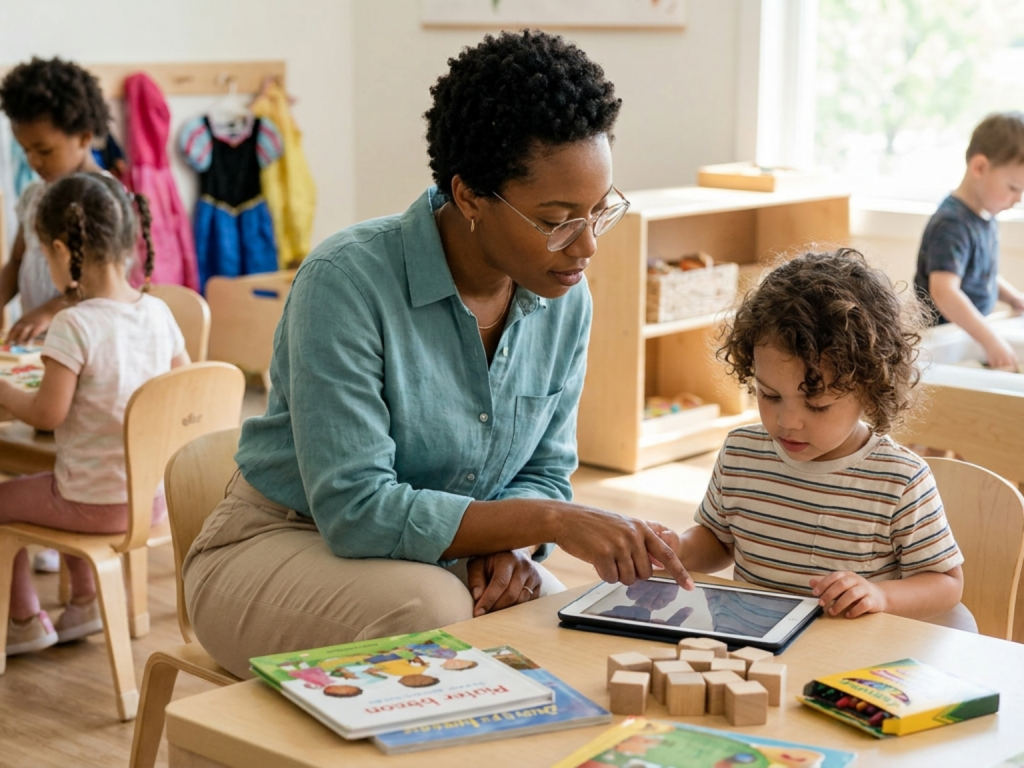
Co-viewing means an adult watches with the child and actively helps the child make sense of the material. It can be brief and natural; it does not need to feel like a lesson. Preschoolers often miss subtle messages, misunderstand fantasy versus reality, or focus on exciting movement rather than the educational point. A caregiver’s comments act like scaffolding, supporting comprehension, emotional labeling, and memory.
Helpful co-viewing phrases include: “What do you think will happen next?” “That character looks frustrated; what helped?” “Can we find three circles in our kitchen?” or “Let’s try that dance move together.” These questions convert passive viewing into shared attention. Shared attention is a critical social-communication skill in early childhood and supports vocabulary growth, narrative skills, and self-regulation.
Co-viewing is also protective. It allows adults to notice if content is too intense, if ads appear, if autoplay shifts to unrelated videos, or if the child becomes dysregulated. Some children are more sensitive to sensory input, suspense, or character conflict. If a child becomes unusually fearful, aggressive, withdrawn, or unable to stop watching without intense distress, the content or the timing may need adjustment. Families should consider discussing persistent concerns with a pediatrician or child development professional rather than assuming the child is simply being “difficult.”
Building a practical one-hour screen routine
A daily limit is easier to maintain when it is predictable. For many preschoolers, “one hour” works better as two shorter periods than as one long block, especially if the child becomes overstimulated or resistant at transitions. Some families use 20 to 30 minutes after rest time and another short period while dinner is prepared. Others reserve screens for specific situations, such as a caregiver’s meeting, a long wait, or a planned weekend family movie segment.
Children this age often struggle with time abstraction. “Five more minutes” may mean little unless paired with a concrete cue. A visual timer, a familiar ending song, or a consistent phrase can help. For example: “When this episode ends, the tablet rests and we go to the table.” It is usually better to stop at the end of an episode or activity than in the middle of an emotionally engaging scene.
Families can reduce conflict by setting rules before the screen turns on:
- Choose the program or app in advance.
- Turn off autoplay when possible.
- Keep devices in shared spaces rather than bedrooms.
- Use screen-free zones during meals and family conversation.
- Avoid background television, which can fragment attention and reduce adult-child talk.
Consistency matters, but so does compassion. A caregiver who occasionally uses a longer screen session during illness, travel, or an overwhelming day has not harmed their child. The aim is to return to the usual rhythm without shame.
Protecting sleep, movement, meals, and play
Screen limits are most effective when framed around what they protect. Preschoolers generally need abundant physical activity, enough sleep, responsive mealtimes, and hands-on exploration. Screens used close to bedtime may interfere with sleep onset in some children through stimulating content, emotional arousal, bedtime resistance, and light exposure. A calming pre-sleep routine without screens is often more supportive of circadian rhythm and behavioral settling.
Meals are another important boundary. Screen-free meals support hunger and fullness cues, social communication, oral-motor awareness, and family connection. When a child routinely eats while absorbed in a screen, they may pay less attention to satiety signals or the sensory qualities of food. This does not mean a screen can never be used in exceptional feeding or medical contexts, but persistent mealtime screen dependence is worth discussing with a pediatric clinician, feeding therapist, or dietitian if feeding is already stressful.
Preschoolers also need pretend play and open-ended materials. A video about animals can be educational, but the learning deepens when the child later builds a zoo from blocks, crawls like a bear, draws a habitat, or tells a story about a veterinarian. Imagination games for preschoolers help children practice symbolic thinking, emotional flexibility, planning, language, and social roles in ways a screen cannot fully provide.
Choosing apps, videos, and games with medical caution
Not all “educational” claims are evidence-based. Marketing language may imply cognitive benefits that are not well supported for preschool-aged children. A medically literate approach is to evaluate content by developmental fit, sensory load, privacy, and the child’s post-screen behavior rather than by labels alone.
Before offering a new app or program, preview it. Look for privacy settings, ad exposure, in-app purchase prompts, data collection, chat functions, autoplay, and links to external content. Preschoolers cannot reliably understand persuasive design or commercial intent. They also cannot safely navigate open platforms without adult controls and supervision.
Interactive content can be useful when it prompts thinking instead of compulsive tapping. A child who pauses to match sounds, solve a simple spatial problem, create music, or respond verbally is having a different experience from a child who is rapidly swiping through rewards. Still, even a high-quality app is only one small part of developmentally appropriate preschool education. It should sit alongside conversation, books, sensory play, fine motor practice, outdoor movement, and social experiences.
Special circumstances may require individualized advice. Children with neurodevelopmental differences, language delay, visual or hearing impairment, sleep disorders, anxiety symptoms, attention regulation difficulties, or a history of trauma may respond differently to media. Caregivers should consult healthcare professionals if they are unsure how screen use interacts with a child’s developmental or medical needs.
When screen time becomes an emotional battleground
Many preschoolers protest when screens stop. That reaction does not automatically mean addiction; it often reflects immature executive function. The prefrontal systems involved in inhibition, time awareness, and flexible shifting are still developing. A screen provides strong sensory rewards and clear stimulation, while stopping requires the child to tolerate disappointment and transition to a less instantly rewarding activity.
Caregivers can help by using calm, repeated routines. Offer a preview, a transition cue, and a next activity: “After the show, we put the tablet away, then you can help wash strawberries.” Avoid negotiating repeatedly after the limit has already been set, because intermittent extra time can make protests more persistent. At the same time, acknowledge feelings: “You really wanted more. It is hard to stop.” Validation does not require changing the boundary.
If screen limits trigger severe, prolonged distress every day, consider the context. Is the child overtired? Hungry? Using screens mainly when already dysregulated? Watching content that is too intense? Lacking appealing alternatives? Quiet screen-free activities for children, such as puzzles, water painting, audiobooks, reusable stickers, play dough, or sorting games, can make transitions more humane. If the family feels trapped in a cycle of escalating conflict, professional guidance can help without blame.
When to seek professional guidance
- Screen use is consistently displacing sleep, meals, physical activity, preschool participation, or social interaction.
- A child has major meltdowns, panic, aggression, or withdrawal related to starting or stopping screens.
- Caregivers notice language regression, loss of skills, persistent attention concerns, or developmental delays.
- Screens are needed for most meals, most transitions, or most emotional calming and the family cannot reduce use.
- Content exposure included frightening, violent, sexual, or unsafe material and the child remains distressed.
Tools & Assistance
- Create a written family media plan with daily timing, allowed content, and screen-free zones.
- Preview new programs and apps before the child uses them.
- Use device settings to disable autoplay, restrict purchases, and limit open-platform access.
- Ask the pediatrician about screen use if sleep, behavior, feeding, or development is a concern.
- Keep a simple one-week log of screen timing, content, sleep, meals, and post-screen behavior.
FAQ
Is one hour of screen time always safe for every preschooler?
One hour of high-quality content is a common guideline for ages 2 to 5, but individual needs vary. Some children do better with less, especially if screens affect sleep, behavior, or transitions.
Are video calls with relatives the same as watching videos?
Video chatting is more interactive because it involves real social response. It is generally treated differently from passive media, especially when it supports relationships.
What if my child learns letters and numbers from a tablet?
That can be useful, but learning is stronger when paired with real-world practice, conversation, books, counting objects, drawing, and play.
Should screens be used to calm tantrums?
Occasional use during unusual stress is understandable, but routine use as the main calming strategy may limit development of self-regulation skills. Consider discussing persistent patterns with a pediatric professional.
Is background TV a problem if my child is not watching?
Background TV can still interrupt attention and reduce caregiver-child conversation. Turning it off during play and meals is a helpful household rule.
Sources
- Mayo Clinic — Screen time and children: How to guide your child
- Zero to Three — Screen-Time Recommendations for Children Under Six
- Tessai School — How to Limit Children's Screen Time: 5 Tips for Parents
Disclaimer
This article is for educational purposes only and is not a substitute for medical, developmental, or mental health advice. Consult a qualified healthcare professional for concerns about your child’s sleep, behavior, development, or media use.

















Please log in to leave a comment.