
Intro
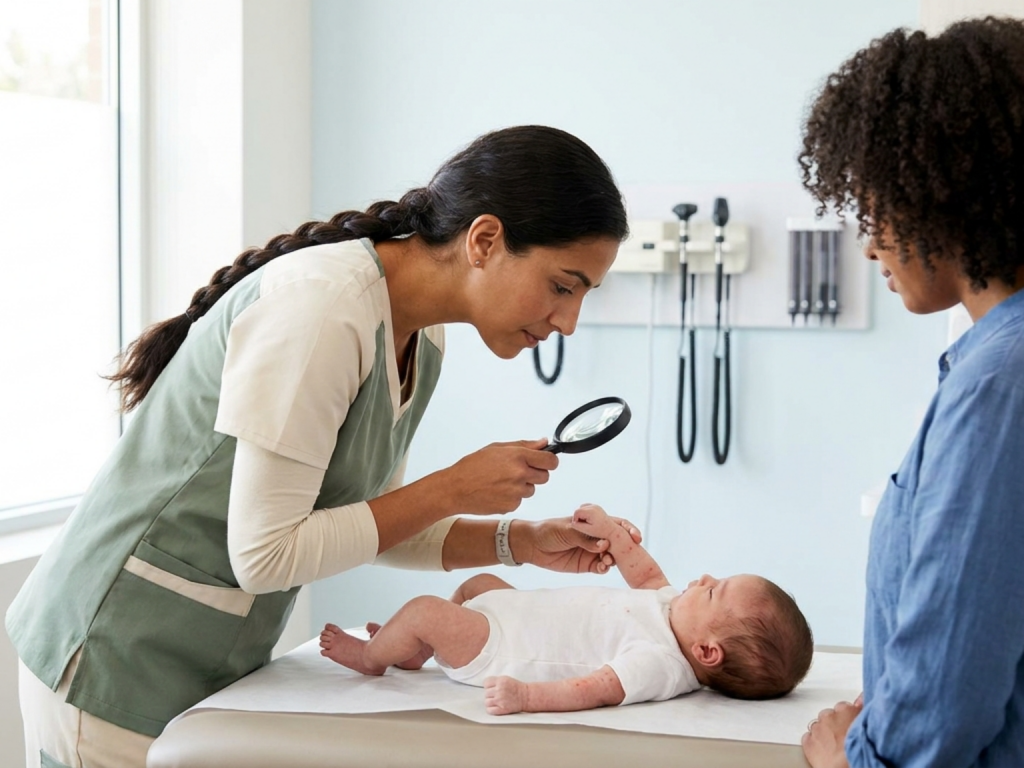
Newborn skin can look remarkably different from one baby to another, and it may change from hour to hour during the first weeks of life. Redness, peeling, small bumps, pustules, and flaky areas are often part of normal adaptation after birth. Because newborns have an immature skin barrier and can become unwell quickly, however, a new or changing rash deserves thoughtful observation.
This guide reviews common benign newborn skin conditions, practical skin-care principles, and warning signs that should prompt professional assessment. A photograph, the baby’s age, the rash’s distribution, and associated findings such as fever, poor feeding, lethargy, or breathing difficulty can all help a clinician interpret what is happening.
Highlights
Many newborn rashes are benign and resolve without specific treatment.
Gentle cleansing, limited friction, and fragrance-free products help protect the developing skin barrier.
A rash with fever, blisters, rapidly spreading redness, poor feeding, or marked sleepiness requires prompt medical advice.
The appearance and timing of a skin finding matter; do not rely on a visual comparison alone to diagnose it.
Why newborn skin looks different
Newborn skin is transitioning from a fluid-filled intrauterine environment to exposure to air, clothing, diapers, microorganisms, and temperature changes. The epidermal barrier is still maturing, so the skin may lose water more easily and react to friction, heat, saliva, urine, stool, and fragranced products. Peeling, dryness, mild redness, and transient color variation are therefore common during the first days and weeks.
Normal findings can also be influenced by gestational age and the timing of delivery. Post-term infants may have more pronounced peeling, while premature infants have a particularly immature barrier and may require individualized handling from their neonatal team. Color changes can be harder to interpret in deeply pigmented skin, so caregivers should also assess texture, warmth, swelling, blistering, tenderness, and the baby’s overall behavior.
Most uncomplicated newborn eruptions are not caused by poor hygiene and do not mean that a caregiver has done anything wrong. Conversely, a benign-looking rash cannot always be distinguished from infection or another significant disorder without examination. When uncertain, contacting the baby’s clinician is appropriate.
Common transient newborn rashes
Erythema toxicum neonatorum is one of the most frequent benign newborn eruptions. It often consists of blotchy red areas with small papules or pustules, commonly appearing on the trunk and spreading to the face or limbs while sparing the palms and soles. It may appear during the first few days, come and go, and change location. Despite its alarming name, it is generally self-limited and does not usually require treatment.
Transient neonatal pustular melanosis is another benign condition. It may be present at birth as superficial pustules that rupture, leaving small pigmented macules with a surrounding scale or collarette. Lesions can occur on the chin, neck, trunk, limbs, palms, and soles. The pustules resolve, while the residual pigmentation may persist longer. A clinician may distinguish it from infectious pustular conditions by considering the baby’s appearance, lesion characteristics, and timing.
Miliaria, commonly called heat rash, develops when sweat ducts become obstructed. Tiny red or clear bumps may occur in warm, occluded areas such as the neck folds, upper trunk, or diaper region. Keeping the baby comfortably cool, using breathable clothing, and reducing overdressing may help. Do not apply powders that can be inhaled, and seek advice before using medicated preparations on newborn skin.
Some newborns also have temporary mottling or acrocyanosis, in which the hands and feet look bluish when cool. These findings should improve with appropriate warming. Persistent blue coloration of the lips or central face, or color change accompanied by breathing difficulty, is not something to monitor at home.
Small bumps and facial findings
Milia are tiny white or yellow keratin-filled cysts, often seen on the nose, cheeks, chin, or forehead. They are not usually infected and should not be squeezed, scraped, or treated with acne products. Most disappear spontaneously as the superficial skin sheds.
Neonatal acne, also called neonatal cephalic pustulosis in some clinical contexts, can produce small red bumps or pustules on the cheeks, forehead, and scalp. It may relate to hormonal influences rather than inadequate cleansing. Gentle washing with lukewarm water and a mild, fragrance-free cleanser is generally preferable to vigorous scrubbing. Adult acne medicines, exfoliants, essential oils, and alcohol-containing products may irritate newborn skin and should not be used unless specifically recommended by a clinician.
Small red vascular marks can also be noticed in the early weeks. Some are temporary capillary changes, while others may represent an infantile hemangioma that becomes more apparent after birth. A rapidly enlarging lesion, one near the eye, nose, mouth, or airway, or one that ulcerates or interferes with feeding, vision, breathing, or movement warrants medical evaluation. A clinician can determine whether observation or specialist follow-up is needed.
When taking a photograph for a healthcare professional, use natural light and include a wider image showing the distribution as well as a close view. Avoid delaying care while trying to identify a rash from online images.
Peeling, cradle cap, and irritated skin
Peeling or flaking is common, particularly on the hands, feet, ankles, and wrists during the first days after birth. It usually reflects normal shedding rather than an allergy. Pulling at the flakes can create small breaks in the skin, so allow them to shed naturally. Short, lukewarm baths and a plain, fragrance-free moisturizer may be reasonable for dry areas, but product choice should be discussed with a healthcare professional if the skin is cracked, oozing, or extensively inflamed.
Cradle cap, or infantile seborrheic dermatitis, causes greasy or dry scales on the scalp. It may extend to the eyebrows, behind the ears, or skin folds. It is usually not painful or dangerous. Caregivers may soften scale with a small amount of an appropriate emollient and gently brush or wash it away, but should avoid picking. Do not use medicated dandruff shampoos, corticosteroids, antifungals, or keratolytic products on a newborn unless a clinician has advised their use.
Diaper dermatitis is common because urine, stool, moisture, and friction affect an occluded area. Redness limited mainly to convex surfaces may improve with frequent diaper changes, gentle water-based cleansing, air exposure, and a protective barrier product. Avoid vigorous wiping and fragranced wipes if they irritate the skin. Redness in the folds, satellite spots, erosions, pus, blisters, or failure to improve should be assessed because candidal dermatitis, bacterial infection, allergic contact dermatitis, or another condition may require different management.
Gentle newborn skin care
Newborn skin care is usually best kept simple. Clean visible dirt, milk, urine, or stool without prolonged soaking or scrubbing. Use lukewarm water, support the baby securely, and pat the skin dry, paying attention to folds. Bathing frequency varies, but repeated washing can remove protective lipids and worsen dryness. Never leave a newborn unattended in water, even briefly.
Choose products labeled for sensitive skin and without added fragrance when possible. A fragrance-free moisturizer can be applied to dry, intact skin, while an emollient-based product may help support the barrier. Introduce one product at a time so that irritation can be recognized. Avoid talcum powder, strongly scented oils, adult cosmetics, harsh antiseptics, and home remedies. Do not apply topical antibiotics, steroid preparations, antifungals, or other medicines without medical guidance.
Keep the room and clothing comfortable rather than excessively warm. Overheating can aggravate miliaria and contributes to sleep-related risk. Loose, breathable layers and regular checks of the baby’s chest or back are more useful than judging temperature from cool hands and feet alone. Protect broken skin from further friction and keep nails short or use appropriate clothing to reduce scratching.
For families managing dryness or repeated irritation, a consistent gentle bathing routine and attention to laundry products may be helpful. However, persistent eczema-like inflammation, widespread scaling, recurrent fissures, or severe itch should be reviewed rather than attributed automatically to ordinary newborn dryness.
When a rash needs medical assessment
Newborns have limited physiological reserves, and skin findings may occasionally be the first visible sign of infection or systemic illness. Seek urgent medical advice for a baby with a rash and a measured fever, unusual temperature instability, poor feeding, repeated vomiting, reduced urine output, marked irritability, unusual sleepiness, weak responsiveness, or a generally ill appearance. A newborn with breathing difficulty, pauses in breathing, grunting, or persistent blue coloration needs emergency assessment.
Skin-specific warning signs include rapidly spreading redness, warmth and swelling, tenderness, pus, bleeding, extensive peeling, bruising without a clear explanation, or a rash that does not blanch when gently pressed. Newborns with vesicles or blisters, especially clustered blisters around the eyes, mouth, or genital area, should be assessed urgently because herpes simplex and other infections require prompt medical attention. Do not rupture blisters or apply unapproved treatments.
Contact a clinician promptly if yellowing appears very early, intensifies, extends to the limbs, or occurs with poor feeding or excessive sleepiness; these may be newborn jaundice warning signs. Also seek advice about umbilical cord infection signs such as spreading redness around the stump, foul-smelling discharge, significant swelling, or fever.
When contacting a clinician, note when the rash began, whether it was present at birth, how quickly it is changing, the baby’s temperature, feeding and urine output, and any new products or medications. These details can make triage more efficient. If you are worried that the baby looks unwell, trust that concern and seek professional help rather than waiting for the rash to declare itself.
Seek prompt medical care
- Rash with fever, poor feeding, marked sleepiness, or an ill appearance.
- Blisters, widespread peeling, rapidly spreading redness, pus, or unexplained bruising.
- Breathing difficulty, pauses in breathing, or blue coloration of the lips or central face.
- A rash that does not blanch, or skin swelling and tenderness that are progressing.
- Early or worsening yellowing with feeding difficulty or unusual sleepiness.
Tools & Assistance
- A digital thermometer used according to its instructions
- A phone camera for documenting changes for the clinician
- The newborn’s pediatrician, midwife, or primary care service
- An after-hours pediatric triage line
- A written record of feeds, wet diapers, temperature, and rash progression
FAQ
Should I put cream on every newborn rash?
No. Many transient rashes need no treatment, and unnecessary products can irritate immature skin. Use only gentle, appropriate products and ask a clinician before applying medicated creams.
Can I pop newborn pustules or squeeze milia?
No. Squeezing can injure the skin and introduce infection. These findings often resolve naturally, while a clinician can assess lesions that are atypical or persistent.
When is cradle cap concerning?
Seek medical advice if the scalp is very inflamed, painful, oozing, bleeding, spreading extensively, or associated with fever or an unwell baby.
How can I tell whether a rash is dangerous?
Appearance alone is not reliable. Consider the baby’s age, overall behavior, temperature, feeding, breathing, and how rapidly the rash is changing, and contact a healthcare professional when uncertain.
Sources
- PubMed — Newborn Skin: Part I. Common Rashes and Skin Changes
- Mayo Clinic Press — Common skin conditions in babies
- PubMed Central / NIH — Newborn Skin: Common Skin Problems
Disclaimer
This article is for general educational information and does not diagnose or treat a newborn. Contact a qualified healthcare professional for personalized advice, and seek urgent care if the baby appears seriously unwell.


















Please log in to leave a comment.