
Intro
Choosing art supplies can feel surprisingly high-stakes. You may want to encourage creativity, independence, and emotional expression, while also worrying about choking hazards, toxic exposures, sharp tools, mess, and frustration. A developmentally matched choice does not limit a child; it gives them materials they can use safely and successfully right now.
Age labels are a starting point, not a full assessment. A child’s motor coordination, oral exploration, attention span, sensory needs, vision, learning profile, and ability to follow safety instructions all matter. When a child has developmental delay, neurodivergence, chronic illness, visual impairment, motor impairment, or a history of pica or mouthing nonfood items, caregivers should individualize choices and consult appropriate professionals.
Highlights
The safest art supply is one that matches both chronological age and developmental ability, including fine motor control and likelihood of mouthing materials.
For younger children, prioritize large, washable, nontoxic supplies and close supervision rather than small parts, powders, aerosols, solvents, or sharp tools.
Older children and teens can use more sophisticated media when they understand labels, ventilation, storage, cleanup, and personal protective habits.
Frustration is a safety issue too: supplies that are too advanced can lead to misuse, avoidance, or emotional distress.
Start with developmental readiness, not just age
Age recommendations on art materials are important because they reflect predictable patterns in children’s behavior: mouthing objects, immature hand control, impulsive actions, short attention span, and limited understanding of hazards. However, chronological age is only one part of the decision. A 5-year-old with strong scissor control may safely use blunt-tip scissors with supervision, while an older child with impulsivity, visual impairment, or significant motor planning difficulty may need adaptive tools and closer adult support.
Think in terms of functional skills. Can the child sit long enough to complete a short activity? Can they distinguish art supplies from food? Can they follow a two-step safety rule, such as “paint on the paper, then wash hands”? Can they stop when asked? Can they coordinate both hands to hold paper and move a crayon? These questions help you choose developmentally appropriate child products rather than relying on packaging alone.
Skill fit also protects confidence. Materials that are too easy may bore a child; materials that are too difficult may cause fatigue, tantrums, or unsafe improvisation. The ideal supply offers a small stretch: enough challenge to build competence, but not so much that the child has to fight the tool.
Infants and young toddlers: sensory play with strict boundaries
For babies and young toddlers, art is usually sensory exploration rather than representational drawing. They smear, pat, bang, grasp, and taste. Because oral exploration is expected in this stage, avoid small pieces, beads, button-like items, dried beans, tiny foam shapes, glitter, and anything that can fragment into a choking or aspiration hazard. Choose large, sturdy tools that cannot fit fully into the mouth.
Good options include large washable crayons labeled for the child’s age, thick paper taped to a table, edible-style sensory activities designed by caregivers, and supervised water painting with a large brush. Even when products are labeled nontoxic, “nontoxic” does not mean “safe to eat” or “safe in the airway.” It generally means the product is not expected to cause poisoning when used as intended.
Paints, markers, and modeling materials for this age should be washable and clearly intended for young children. Avoid powders that can be inhaled, aerosol sprays, permanent markers, solvent-based products, and containers that invite drinking. Keep sessions short, use a high chair or washable surface, and put materials away immediately after the activity. If a child persistently mouths nonfood objects, has pica, or has swallowing difficulties, ask a pediatric clinician or occupational therapist about safer sensory alternatives.
Preschoolers: build control with large, forgiving tools
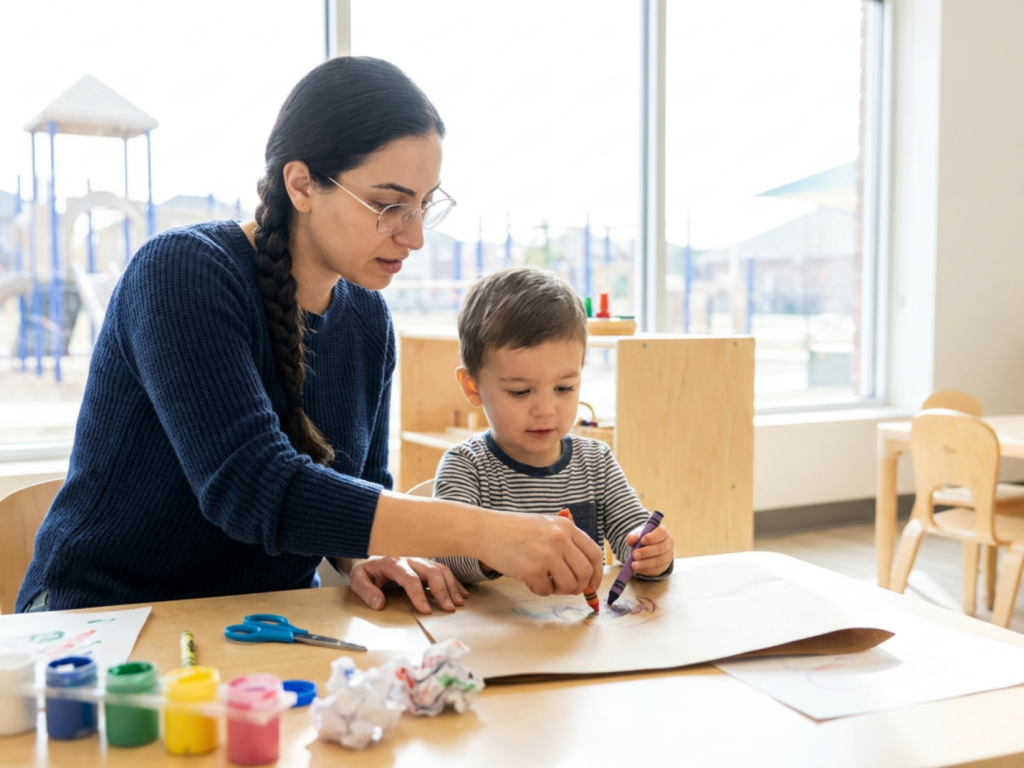
Preschoolers often want independence before they have full bilateral coordination, grip strength, or impulse control. This is the stage where preschool fine motor supplies can be especially helpful. Look for chunky crayons, triangular crayons or pencils, washable broad-tip markers, large glue sticks, blunt-tip scissors designed for children, stampers, dot markers, stickers large enough not to pose a choking risk, and soft modeling dough.
At this age, children are learning hand dominance, wrist stability, graded pressure, and visual-motor integration. Supplies should reward effort quickly. A thick marker that makes a bright line with minimal pressure may be better than a hard colored pencil that requires sustained force. Large paper gives room for broad arm movements before refined finger control develops.
Supervision still matters. Preschoolers may cut hair or clothing, spread glue near eyes or mouth, or mix materials unpredictably. Teach one safety habit at a time: caps back on markers, scissors carried point down, glue stays on paper, hands washed after paint. Avoid products with cautionary labeling meant for adults or older children, including materials requiring ventilation or protective equipment. Open-ended craft materials such as paper scraps, cardboard tubes, fabric pieces, and safe collage items can be excellent, but screen them for staples, sharp edges, strings that could wrap tightly, and small detachable parts.
School-age children: match tools to growing independence
Children around 6 to 12 years usually have better hand control, longer attention, and more interest in projects with steps. This is a good time to introduce higher-quality colored pencils, watercolor sets, child-safe printmaking foam, rulers, erasers, pencil sharpeners, weaving looms, larger beads for children past the mouthing stage, and simple sewing cards. Many families also begin to consider nontoxic art materials for kids that feel less “babyish” but still meet child-safety expectations.
Fine motor endurance becomes more important in school-age projects. A child may be able to write or draw neatly for five minutes but develop pain, poor posture, or frustration during a long craft. Watch for excessive hand pressure, frequent shaking of the hand, avoidance, or complaints of fatigue. Ergonomic grips, larger barrels, slant boards, shorter work periods, or alternating drawing with gross-motor play can help without turning art into therapy.
Children in this age group can learn label literacy. Show them how to look for age recommendations, warnings, and instructions. Explain that some materials are safe only with ventilation, some should not touch skin for long periods, and some tools are shared only when an adult is present. This approach respects their competence while making safety concrete. Store sharper tools, hot glue guns, craft knives, permanent inks, and specialty chemicals separately unless an adult has approved the project.
Tweens and teens: expand media with adult-level safety habits
Adolescents may be ready for more sophisticated materials: acrylics, advanced watercolor, linocut tools, sewing machines, jewelry pliers, polymer clay, resin alternatives, calligraphy pens, or digital art tablets. Readiness depends less on age alone and more on judgment, planning, and willingness to use protective routines. A teen who can follow written instructions, ventilate a space, protect surfaces, avoid eating while working, and clean up responsibly can safely explore more complex media than a child who rushes or ignores warnings.
Some art materials used by adults are inappropriate for unsupervised child use. Products with solvents, toxic pigments, strong fumes, corrosive ingredients, aerosol propellants, or dust-generating powders require careful review. Ventilation is not just about odor; airborne particles and volatile organic compounds may irritate the respiratory tract, trigger asthma symptoms, or cause systemic exposure depending on the substance and dose. Teens with asthma, eczema, allergies, migraine sensitivity, pregnancy, immune compromise, or neurologic conditions should be especially cautious and may need medical guidance before using certain media.
Teach adolescents to treat art like a lab: read the label, use the smallest practical quantity, avoid skin contact when instructed, keep food and drinks away, wash hands, close containers, and dispose of waste correctly. This preserves creative freedom while reducing preventable risk.
Safety labels, toxicity, choking, and supervision
Before buying, read the front and back of the package. Look for the intended age, hazard statements, and whether the product is marketed for children. Avoid giving young children materials labeled with adult cautionary statements or warnings that require special handling. “Conforms to” safety standards can be useful, but it does not replace age matching and supervision.
- Choking and aspiration: avoid small parts, caps, beads, dried pasta, sequins, and crayon fragments for children who mouth objects or are under the product’s age range.
- Chemical exposure: avoid solvents, permanent markers, spray fixatives, powdered pigments, and resin systems for younger children.
- Skin and eye irritation: wash hands after use, keep materials away from eyes, and stop use if irritation occurs.
- Ventilation: use products with fumes only in well-ventilated areas and only when the child can follow instructions.
- Storage: keep art supplies in original containers when possible, away from food, medications, and younger siblings.
If ingestion, inhalation, eye exposure, or a concerning skin reaction occurs, do not rely on online reassurance. Contact poison control, emergency services, or a clinician as appropriate, and have the product container available.
Adapting art supplies for different abilities
Children with disabilities or developmental differences deserve art materials that support participation, not materials chosen only by age. An occupational therapist, physical therapist, art therapist, vision specialist, special educator, or pediatric clinician may help identify adaptations. Examples include larger handles, built-up grips, spring-loaded scissors, tabletop easels, nonslip mats, adaptive switches for digital art, low-odor materials, high-contrast paper, or shortened activity steps.
For children with sensory sensitivities, texture, smell, and mess can be as important as toxicity. Finger paint may be joyful for one child and overwhelming for another. Offer choices: brush instead of fingers, dry collage instead of wet glue, washable markers instead of chalk dust, or gloves if tolerated. For children who seek oral input, separate safe oral sensory tools from art supplies and increase supervision.
Art should not become a test of compliance. If a child refuses a material, consider whether it is painful, fatiguing, confusing, or sensorily intense. The goal is safe creative access. A child who cannot use scissors may still design a collage with pre-cut shapes; a child who cannot tolerate paint may create visual art and cognitive enrichment through stickers, stamping, or digital drawing.
Safety warnings to take seriously
- Do not give small craft parts to children who mouth objects or are below the recommended age range.
- Avoid adult art products with solvents, aerosols, toxic pigments, strong fumes, or cautionary labels for young children.
- Seek urgent help for trouble breathing, persistent coughing after inhalation, eye injury, significant skin reaction, or suspected poisoning.
- Store art supplies separately from food and medicine, ideally in original labeled containers.
- Consult a healthcare professional for children with pica, swallowing disorders, asthma, severe allergies, developmental delay, or complex medical needs.
Tools & Assistance
- Read the age label and all caution statements before purchase.
- Create a supervised, ventilated art area with washable surfaces and handwashing nearby.
- Ask an occupational therapist about grip, posture, fatigue, or adaptive art tools.
- Keep the poison control number accessible and save product packaging after opening.
- Review school supply lists with teachers if your child has medical, sensory, or motor needs.
FAQ
Does nontoxic mean my child can safely eat the product?
No. Nontoxic generally means the product is not expected to cause poisoning when used as directed. It can still cause choking, aspiration, stomach upset, or irritation.
When can a child use scissors?
Many preschoolers can begin with blunt-tip child scissors under close supervision, but readiness depends on hand control, attention, and ability to follow safety rules.
Are adult art supplies okay for advanced children?
Sometimes, but only after reviewing labels, ventilation needs, toxicity warnings, and the child’s judgment. Some adult materials are not appropriate for unsupervised minors.
What if my child has weak hands or avoids drawing?
Consider larger tools, shorter sessions, vertical surfaces, or adaptive grips. If avoidance is persistent or associated with pain or school difficulty, consult a pediatrician or occupational therapist.
Sources
- U.S. Consumer Product Safety Commission — Art and Craft Safety Guide
- U.S. Consumer Product Safety Commission — Age Determination Guidelines: Relating Consumer Product to Characteristics, Skills, Play Behavior, Interests to Children
- U.S. Consumer Product Safety Commission — Art Materials Business Guidance
Disclaimer
This article is for general educational purposes and does not diagnose, treat, or replace professional medical advice. Consult a qualified healthcare professional or poison control center for exposure concerns or child-specific medical guidance.















Please log in to leave a comment.