
Intro
Car journeys with a baby can require more preparation than expected, especially when you are balancing feeds, naps, recovery after birth, and the understandable wish to arrive safely. A calm plan can make travel more manageable without expecting your baby, or you, to follow a perfect schedule.
These practical tips focus on safe restraint, avoiding prolonged time in a seated position, responsive care during stops, and knowing when individualized advice from your baby's healthcare professional is needed.
Highlights
Use a rear-facing infant or child car seat correctly installed in the back seat, following both the vehicle and car seat manufacturers' instructions.
Plan to stop at least every two hours on longer journeys so your baby can be removed from the car seat, checked, fed if needed, and repositioned.
A car seat is designed for transport, not routine sleep outside the vehicle. Move a sleeping baby to an appropriate flat sleep surface once travel has ended.
Babies born prematurely or with medical conditions may need individual travel guidance before longer journeys.
Start with a correctly fitted rear-facing seat
The most consequential preparation happens before the engine starts. Your baby should travel in a suitable rear-facing car seat, installed according to the seat manual and your vehicle manual. Rear-facing positioning supports the infant head, neck, and spinal column during sudden deceleration. The back seat is generally the safest location because it is away from a front passenger airbag, which can cause serious injury to a rear-facing child restraint.
Do not assume that a car seat fits every vehicle or every seating position in the same way. Check whether your seat uses the vehicle belt, ISOFIX/LATCH connectors, or a support leg, and follow the instructions specific to that model. The seat should be firmly installed without excessive side-to-side movement at the belt path. If you are unsure, seek hands-on help from a qualified child passenger safety professional, retailer fitting service, or local road-safety resource.
Check the seat’s stated weight and height limits, make sure it has not been recalled or damaged, and avoid using a second-hand seat if its history is uncertain. A properly installed rear-facing car seat is the foundation of travel safety with baby, but correct daily use matters just as much.
Position your baby safely before every departure
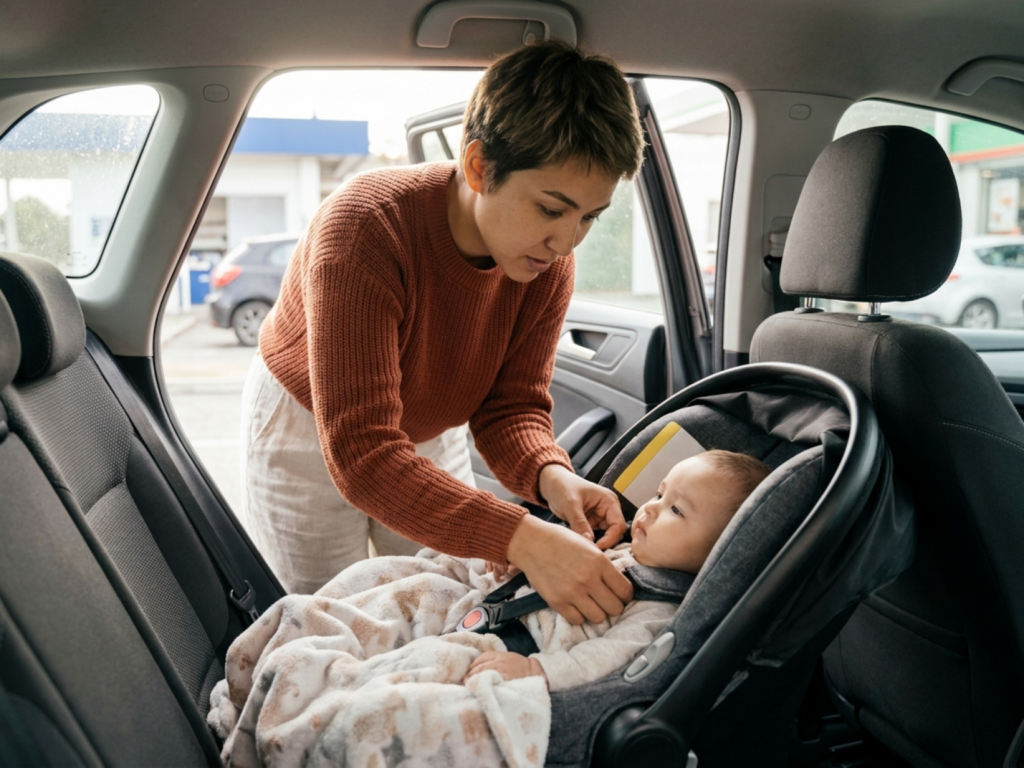
Place your baby with their back and bottom against the car seat, keeping the harness straps flat rather than twisted. The harness should be snug enough that you cannot pinch a horizontal fold of webbing at the shoulder. Position the chest clip, where supplied and required by the seat design, at armpit level. Follow the seat instructions for strap height and newborn inserts; do not add aftermarket head supports, cushions, strap covers, or liners unless the car seat manufacturer specifically approves them.
Bulky coats, snowsuits, and thick padded layers can leave hidden slack beneath the harness. Instead, use ordinary close-fitting clothing and add a blanket over the secured harness once your baby is buckled in if the temperature requires it. Ensure the face remains fully visible and unobstructed. Hats may contribute to overheating and can shift over the face, so assess whether one is actually needed inside a warmed vehicle.
Newborns have limited head control. Before leaving, look from the side to confirm that your baby’s chin is not resting tightly on their chest and that the head is supported in the position intended by the seat manufacturer. This is particularly relevant for premature infants and babies with respiratory, neuromuscular, or airway concerns. Ask the neonatal or pediatric team for individualized guidance when relevant.
Plan realistic stops and limit time in the seat
Long travel is easier when the route is built around your baby’s needs rather than an ideal arrival time. Plan breaks at least every two hours, and be prepared to stop sooner for feeding, a diaper change, distress, heat, or a position check. At each stop, remove your baby from the car seat for a brief period when it is safe to do so. This gives you an opportunity to observe breathing, skin color, alertness, temperature, and comfort while allowing a change of position.
For a young baby, feeding is safest when the vehicle is stopped and the baby is removed from the car seat. Feeding while the car is moving can compromise positioning and makes it harder to respond promptly if the baby coughs, vomits, or appears uncomfortable. Schedule departures around a feed when practical, but avoid rigid timing that pressures you to continue driving when your baby needs care.
A written plan can reduce stress: identify accessible rest areas, allow extra journey time, pack water and food for caregivers, and keep diapers, wipes, spare clothes, and a weather-appropriate blanket within reach. If your baby has recently been unwell, is feeding poorly, or has a condition affecting breathing or circulation, discuss travel readiness for infants with their healthcare professional before a lengthy trip.
Manage sleep, temperature, and comfort without compromising safety
Many babies fall asleep soon after a car starts moving. This can be convenient, but it does not remove the need for supervision and planned breaks. Use a rear-view mirror designed for observing a rear-facing baby only if it does not distract the driver or become an unrestrained projectile. When another adult is present, having them sit beside or near the baby can make observation and reassurance easier.
Keep the vehicle comfortably ventilated and avoid direct sun on the car seat. Babies can overheat quickly, particularly under layers, blankets, or car-seat covers. A sunshade fixed to the window may help reduce glare, but do not drape a blanket over the seat or carrier because it can reduce airflow and conceal the baby’s face. Check the baby’s chest or back rather than hands and feet alone, which may feel cool even when core temperature is comfortable.
Once the journey has ended, take your baby out of the car seat as soon as practical. If they are asleep, transfer them to a firm, flat, approved sleep surface and place them on their back to sleep. Do not use the car seat as a routine sleep space in the home, at a destination, or attached to a stroller for prolonged rest. This protects against positional airway compromise and allows safer sleep positioning.
Respond to crying without creating a driving hazard
Crying in the car can be emotionally intense, especially for a tired caregiver. It is reasonable to check basic needs before departure: a clean diaper, recent feed, comfortable clothing, and a secure harness. Gentle music, a familiar voice, or one lightweight, securely managed toy may help some babies, but no accessory should interfere with the harness or become a hazard during sudden braking.
While driving, prioritize the road. Do not turn around to adjust straps, offer a bottle, retrieve a dropped item, or investigate persistent crying. Pull over safely at the next appropriate location. A baby may cry because they are hungry, tired, overstimulated, too warm, uncomfortable, or simply unhappy with the restraint; these are reasons to pause and assess rather than reasons to loosen the harness or improvise positioning.
If your baby has unusual breathing, blue or gray discoloration, marked lethargy, repeated vomiting, or appears acutely unwell, stop in a safe place and seek urgent medical advice or emergency assistance as appropriate to your location. Do not attempt to determine the cause while continuing the journey. Trusting a concern and stopping is a sensible safety decision, not an inconvenience.
Prepare for medical needs and post-journey care
For most healthy full-term babies, short car trips are manageable with attentive preparation. The plan should be more individualized for premature babies, infants recently discharged from neonatal care, or babies with cardiac, respiratory, neurological, feeding, or airway conditions. Their clinician may advise on travel duration, positioning, monitoring, oxygen or equipment needs, and what symptoms require a change of plan. Do not rely on general online advice to replace that assessment.
Keep essential supplies accessible rather than buried in the trunk: any prescribed emergency equipment, medications needed during the expected travel window, feeding supplies, a changing kit, spare layers, and contact details for relevant healthcare services. Medication should be stored at the temperature specified on its label. Never leave a baby alone in a parked vehicle, even for a short errand; cabin temperature can change rapidly, and an unattended infant cannot be safely monitored.
After arrival, take a moment to reset rather than rushing into the next activity. Remove your baby from the seat, check the diaper and feeding cues, and offer a safe place to lie down or sleep. For repeated travel, note what worked: the duration tolerated, useful stop locations, and signs that a break was needed earlier. This practical record can help build a calm baby travel care plan while keeping safety decisions clear.
Safety reminders
- Never place a rear-facing infant car seat in front of an active airbag.
- Never leave a baby unattended in a vehicle, including during a brief stop.
- Do not loosen the harness, add unapproved inserts, or use bulky clothing beneath the straps.
- Stop safely if your baby needs feeding, repositioning, or urgent assessment.
- Seek individualized clinical advice before long travel for a premature baby or a baby with significant medical needs.
Tools & Assistance
- Car seat manufacturer fitting guide and vehicle handbook
- Qualified child passenger safety fitting service
- Route planner with safe rest-stop locations
- Pediatrician, neonatal team, or family doctor for individualized travel advice
- Travel checklist for feeds, diapers, spare clothing, and essential medications
FAQ
How often should we stop when driving with a baby?
Plan to stop at least every two hours and sooner if your baby needs feeding, changing, comfort, or a position check.
Can my baby sleep in the car seat after we arrive?
Transfer your baby to a firm, flat, approved sleep surface as soon as practical, placing them on their back to sleep.
Should a baby wear a winter coat in a car seat?
Avoid bulky coats and padded snowsuits under the harness because they can create unsafe slack. Use close-fitting layers and place a blanket over the secured harness if needed.
When should I ask a clinician about car travel?
Ask before extended travel if your baby was born prematurely, has recently left neonatal care, or has respiratory, cardiac, airway, neurological, or feeding concerns.
Sources
- East Lancashire Hospitals NHS Trust — Keeping your baby safe
- Mayo Clinic — Car seat safety: Avoid 9 common mistakes
- Health Service Executive (HSE) — Keeping your child safe while driving
Disclaimer
This article provides general educational information and is not a substitute for medical advice. Consult your baby's healthcare professional for advice tailored to their health and travel needs.















Please log in to leave a comment.