
Intro
A birth center is designed to offer safe, respectful maternity care for people who want a low-intervention birth in a non-hospital environment, while still having trained clinicians, routine monitoring, emergency supplies, and clear pathways for transfer if complications arise.
Choosing a place to give birth can feel deeply personal and medically complex. Understanding what birth centers do, who they are appropriate for, and how they manage both normal labor and unexpected problems can help you have a more informed conversation with your midwife, obstetrician, or maternity care team.
Highlights
A birth center is usually a freestanding health care facility where birth is planned outside a hospital and outside the home.
Birth centers primarily serve people with low-risk pregnancies and emphasize physiologic labor, mobility, individualized education, and minimal routine intervention.
Most birth centers do not provide epidural anesthesia or surgical birth, so transfer agreements and emergency protocols are essential.
The safest choice depends on maternal health, fetal wellbeing, gestational age, pregnancy history, and access to timely hospital care.
What a birth center is
A birth center is a health care facility where people plan to give birth outside a hospital and outside a private residence. Freestanding birth centers are commonly organized around a midwifery and wellness model: pregnancy and birth are viewed as normal physiologic events for most healthy people, while complications are actively screened for and escalated when needed.
Unlike a hospital labor and delivery unit, a birth center is not designed for major surgery, continuous high-acuity monitoring, or immediate cesarean delivery. Unlike home birth, it offers a dedicated clinical environment with birth rooms, sterilized equipment, medications for selected emergencies, oxygen, neonatal resuscitation equipment, and staff trained to recognize when a higher level of care is needed.
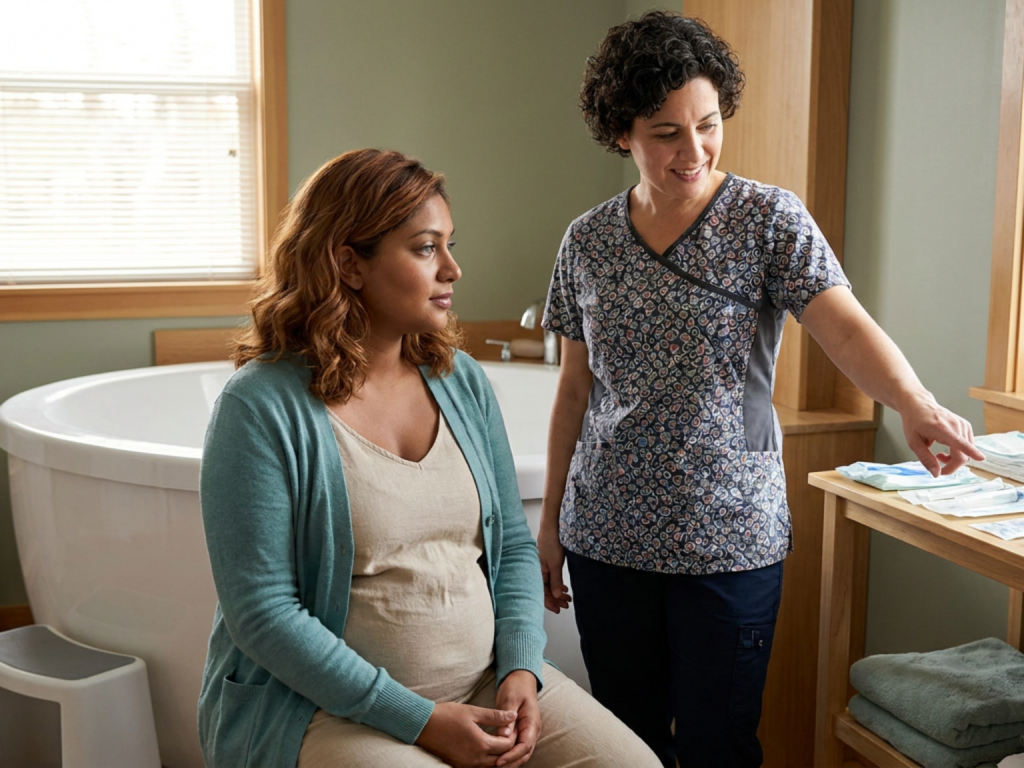
The environment is often more homelike than medicalized. Rooms may include a large bed, space to move, a shower or tub, dimmable lighting, and room for a support person or doula. The goal is not to avoid medical care, but to use medical care judiciously: supporting physiologic labor while maintaining readiness for problems such as fetal heart rate concerns, postpartum hemorrhage, maternal hypertension, shoulder dystocia, or neonatal transition difficulties.
Who a birth center is designed for
Birth centers are generally intended for people with a low-risk pregnancy birth setting profile. Eligibility varies by center, state or regional regulation, and clinician judgment, but common criteria include a singleton pregnancy, cephalic presentation, term gestation, reassuring fetal growth, no major placenta problems, and no condition requiring continuous hospital-level care.
Examples of factors that may make hospital birth safer include certain cardiac conditions, insulin-requiring diabetes, severe hypertensive disease, significant bleeding, placenta previa, multiple gestation, preterm labor, breech presentation, prior complicated uterine surgery, or fetal conditions needing immediate specialist support. A previous cesarean may or may not be accepted, depending on local protocols and the individual risk assessment.
Some educational resources describe birth centers as especially suited to people who have given birth before without complications. In practice, many centers also care for first-time parents if they meet risk criteria. The key is not parity alone, but ongoing assessment: risk status is reviewed during pregnancy, on admission in labor, and throughout labor and the immediate postpartum period.
Because eligibility is clinical and dynamic, it is wise to have a birth plan review with obstetrician or collaborating clinician if you have a medical history, prior pregnancy complication, or any uncertainty about whether out-of-hospital birth is appropriate for you.
The care model: midwifery, education, and shared decisions
Birth center care is usually led by certified nurse-midwives, certified professional midwives, licensed midwives, registered nurses, or a combination of maternity professionals, depending on local licensing. Many centers maintain consultative relationships with physicians and hospitals for laboratory review, ultrasound interpretation, higher-risk consultation, medication needs, or transfer of care.
A distinguishing feature is the amount of time often devoted to prenatal visits. Appointments may include routine clinical assessment, fetal growth and heart rate checks, blood pressure measurement, screening tests, nutrition and mental health discussion, lactation preparation, newborn care education, and planning for labor support. The tone is often collaborative, with attention to values, family context, trauma-informed care, cultural needs, and informed consent.
Birth centers often support low-intervention birth preferences, but this should not be confused with no intervention. Appropriate interventions may include screening for Group B Streptococcus, assessment of rupture of membranes, intermittent fetal heart rate monitoring, treatment of dehydration, medications for postpartum bleeding, newborn assessment, vitamin K and eye prophylaxis where accepted, and referral when clinical findings fall outside normal parameters.
Shared decision-making is central. Families are typically encouraged to ask why a test, treatment, or transfer is recommended; what alternatives exist; and what risks are associated with waiting. A good birth center should welcome these questions while being clear about situations where urgent action is medically necessary.
How labor usually works in a birth center
When labor begins, families usually call the birth center before coming in. A midwife or nurse may ask about contraction pattern, fetal movement, membrane rupture, bleeding, fluid color, maternal temperature, pain coping, and any warning symptoms. This triage helps decide whether to stay home longer, come for assessment, or go directly to a hospital.
On arrival, the team evaluates maternal vital signs, fetal position and heart rate, contraction pattern, labor progress, and overall risk status. If findings remain reassuring, the person may be admitted to a birth room. Birth center care typically emphasizes freedom of movement, upright positions, hydration, nourishment as appropriate, emotional reassurance, and continuous or frequent hands-on labor support.
Common comfort measures include hydrotherapy, showers, massage, counterpressure, breathing techniques, heat or cold packs, birth balls, positioning, quiet lighting, and support from a partner or doula. Most freestanding birth centers do not offer epidural analgesia, spinal anesthesia, or operative vaginal delivery. Some may use limited medications such as nitrous oxide or sterile water injections if permitted, but options vary widely.
Monitoring is generally intermittent rather than continuous for low-risk labor, unless concerns arise. Intermittent fetal heart rate monitoring allows mobility while still checking fetal wellbeing at defined intervals and after significant events, such as membrane rupture or a change in labor pattern. If the fetal heart rate becomes nonreassuring, maternal vital signs change, labor is not progressing appropriately, or pain relief needs exceed what the center can provide, transfer may be recommended.
Birth, newborn care, and the first hours after delivery
During the pushing phase, the midwife monitors maternal coping, fetal heart rate, descent, and signs that birth is near. Many centers allow a range of positions, including side-lying, hands-and-knees, squatting with support, standing, or water birth if the center offers it and criteria are met. The emphasis is usually on physiologic labor support rather than directing every push, although coaching may be used if fatigue or fetal concerns develop.
Immediately after birth, if parent and baby are stable, many centers encourage immediate skin-to-skin contact, delayed cord clamping, and early breastfeeding. The newborn is assessed for breathing, tone, color, heart rate, temperature stability, feeding readiness, and overall transition. If the baby needs help, trained staff can initiate neonatal resuscitation and arrange emergency transfer when needed.
The birthing parent is observed for uterine tone, bleeding, blood pressure, pulse, temperature, bladder function, perineal trauma, pain, and signs of dizziness or instability. Medications to prevent or treat postpartum hemorrhage may be available, but capabilities differ by center. Repair of minor lacerations may be performed on site if the clinician is trained and the injury is within the center’s scope; more complex tears require hospital care.
Length of stay is often shorter than in a hospital, sometimes several hours after an uncomplicated birth. Discharge should include clear instructions about bleeding, fever, severe pain, headache, visual symptoms, mood changes, infant feeding, jaundice, urination, stooling, and when to seek urgent care. Follow-up may occur by phone, home visit, or return visit within the first days.
Transfers and emergency planning
A safe birth center depends on realistic planning for the uncommon but important moments when hospital care is needed. Birth center transfer protocols should specify when to transfer, who calls emergency services, which hospital receives the patient, how records are sent, and whether the midwife continues as a support person after transfer.
Transfers can be non-urgent or urgent. Non-urgent transfers may occur for prolonged labor, maternal exhaustion, desire for epidural analgesia, need for augmentation, or slow progress that remains stable but exceeds the center’s scope. Urgent transfers may occur for heavy bleeding, persistent abnormal fetal heart rate, seizure, severe hypertension, cord prolapse, suspected placental abruption, shoulder dystocia not resolving, or a newborn who needs advanced respiratory support.
Legal and accreditation standards in many regions require birth centers to have relationships with hospitals capable of cesarean birth within a reasonable distance. However, distance alone is not the only issue. Traffic, ambulance availability, communication quality, hospital receptiveness, and the completeness of the medical record all affect transfer safety.
Families should understand that transfer is not failure. It is part of the safety design. The best centers normalize this conversation early, explain rates and reasons for transfer, and maintain respectful collaboration with hospital teams so that care remains continuous and dignified.
Potential benefits and limitations
Research on freestanding birth centers has found favorable outcomes for appropriately selected low-risk pregnancies, including lower rates of cesarean birth and higher rates of breastfeeding in some studies. Birth center care may also be associated with fewer routine interventions, more time for education, greater autonomy, and a calmer environment for people who value unmedicated or low-intervention labor.
These benefits are closely tied to selection criteria, skilled midwifery care, integrated consultation, and timely transfer. A birth center is not the safest setting for every pregnancy. The same low-intervention design that many families value also means that epidural anesthesia, blood transfusion, operative delivery, neonatal intensive care, and cesarean birth are not immediately available on site.
When comparing settings, consider your medical risk profile, emotional needs, distance to emergency care, pain relief priorities, previous birth experiences, and how you feel about transfer uncertainty. Some people feel safer in a hospital from the start; others feel safer beginning labor in a birth center with a clear backup plan. Both preferences deserve respect when they are matched with sound clinical guidance.
Before choosing a planned birth center birth, ask about accreditation or licensing, clinician credentials, transfer rate, emergency medications, neonatal equipment, collaboration with physicians, insurance coverage, newborn screening, postpartum follow-up, and how complications are communicated. The right setting is one where your values and your clinical needs can both be supported.
When to seek urgent medical advice
- Heavy vaginal bleeding, severe abdominal pain, or suspected placental problems need urgent evaluation.
- Decreased or absent fetal movement should be discussed promptly with a maternity clinician.
- Severe headache, visual changes, chest pain, shortness of breath, or very high blood pressure can signal serious complications.
- Fever, foul-smelling fluid, or prolonged rupture of membranes may increase infection risk.
- Any newborn breathing difficulty, poor tone, persistent blue color, or poor feeding requires immediate medical assessment.
Tools & Assistance
- Schedule a consultation with a licensed midwife or obstetric clinician to review eligibility.
- Tour the birth center and ask to see emergency equipment and transfer procedures.
- Create a written birth plan that includes preferences and backup priorities.
- Confirm insurance coverage, facility fees, laboratory costs, and newborn care billing.
- Identify the receiving hospital and travel route before labor begins.
FAQ
Is a birth center the same as a hospital birthing suite?
No. A freestanding birth center is outside a hospital and focuses on low-risk, physiologic birth. A hospital birthing suite is within a facility that can provide surgery, anesthesia, blood products, and intensive care.
Can I get an epidural at a birth center?
Most freestanding birth centers do not offer epidural anesthesia. If you need or choose an epidural, transfer to a hospital is usually required.
What happens if I need a cesarean birth?
A freestanding birth center cannot perform a cesarean. The team should activate its transfer plan so you can receive hospital-based obstetric and anesthesia care.
Are first-time parents eligible for birth center care?
Often, yes, if the pregnancy remains low risk and the center’s criteria are met. Eligibility should be confirmed with the birth center and your maternity care clinician.
How soon do people go home after a birth center birth?
After an uncomplicated birth, discharge may occur within several hours, but timing depends on maternal bleeding, vital signs, newborn transition, feeding, and local protocols.
Sources
- PubMed Central (PMC) — Freestanding Birth Centers: An Evidence-Based Option for Birth
- California Health Care Foundation — What Is a Birth Center?
- Cook Children's Medical Center — Hospital or Birthing Center?
Disclaimer
This article is for general educational purposes only and is not a substitute for individualized medical advice, diagnosis, or treatment. Always consult a qualified maternity care professional about your pregnancy, birth setting, and emergency plan.


















Please log in to leave a comment.