
Intro
Labor pain is real, intense, and highly individual. The position that feels relieving at 4 centimeters may feel unhelpful at 8 centimeters, and that is completely normal. Changing posture can influence pelvic dimensions, pressure on the sacrum, fetal rotation, maternal fatigue, and the way contractions are perceived.
There is no single “best” labor position for everyone. The safest and most effective approach is usually a flexible one: use movement when it is medically appropriate, adapt to fetal monitoring or epidural needs, and work with your midwife, obstetrician, nurse, or doula to find positions that support both comfort and clinical safety.
Highlights
Upright and forward-leaning positions may help use gravity, reduce back pressure, and support fetal descent when medically appropriate.
Hands-and-knees, kneeling, and side-lying can be especially useful when back labor, fatigue, or an epidural limits movement.
Frequent position changes often matter more than finding one perfect posture.
Medical factors such as fetal heart rate concerns, bleeding, epidural density, or urgent obstetric needs may limit which positions are safe.
Why position changes can reduce labor pain
Labor pain arises from coordinated uterine contractions, cervical dilation, stretching of pelvic tissues, pressure on ligaments, and fetal descent through the pelvis. Position can change how these forces are distributed. A posture that opens the pelvic outlet, decreases sacral pressure, or improves relaxation may make contractions feel more manageable even though it does not remove the physiologic work of labor.
Upright positions during labor, such as standing, walking, slow dancing, or supported squatting, may use gravity to encourage descent. Forward-leaning labor positions can shift the uterus away from the spine and reduce lower back pain in labor, particularly when the baby is occiput posterior or when the sacrum feels compressed. Side-lying can reduce exertion and allow rest while still providing pelvic asymmetry if the top leg is supported.
Movement also has neurophysiologic value. Rhythmic swaying, rocking, or changing weight from foot to foot may provide competing sensory input, which can reduce the perceived intensity of pain. It may also improve a birthing person’s sense of control, which is strongly tied to coping. The goal is not to perform positions perfectly; it is to notice what helps during each contraction and what allows recovery between contractions.
Upright positions: standing, walking, and slow swaying
Standing and walking are often helpful in early and active labor if membranes, fetal status, maternal vital signs, and the care plan allow it. Being upright may reduce the feeling of being trapped in bed and can help contractions feel more productive. Many people instinctively lean into a partner, wall, bed, or counter during a contraction, then walk or rest between waves.
A simple option is the supported standing lean. Place the forearms on a raised bed, windowsill, or partner’s shoulders, soften the knees, and let the abdomen hang forward. This may reduce lumbar pressure and allow the pelvis to move freely. Slow dancing is similar: the birthing person stands facing a partner, arms supported, while gently swaying the hips. This can be emotionally grounding and physically useful.
Walking is not always comfortable during intense contractions, and it is not mandatory. If walking feels destabilizing, try marching in place, shifting weight, or standing with one foot on a low step to create pelvic asymmetry. If continuous fetal monitoring is needed, ask whether wireless monitoring, bedside standing, or short position changes are possible. Safe movement during fetal monitoring depends on equipment, fetal heart rate assessment, and staff guidance.
Forward-leaning positions for back labor
Back labor can feel like severe pressure, aching, or pain in the sacrum and lower back, sometimes persisting between contractions. It is commonly associated with fetal position but can also occur for other reasons. Forward-leaning positions may help because they reduce direct pressure on the maternal spine and allow the sacrum more room to move.
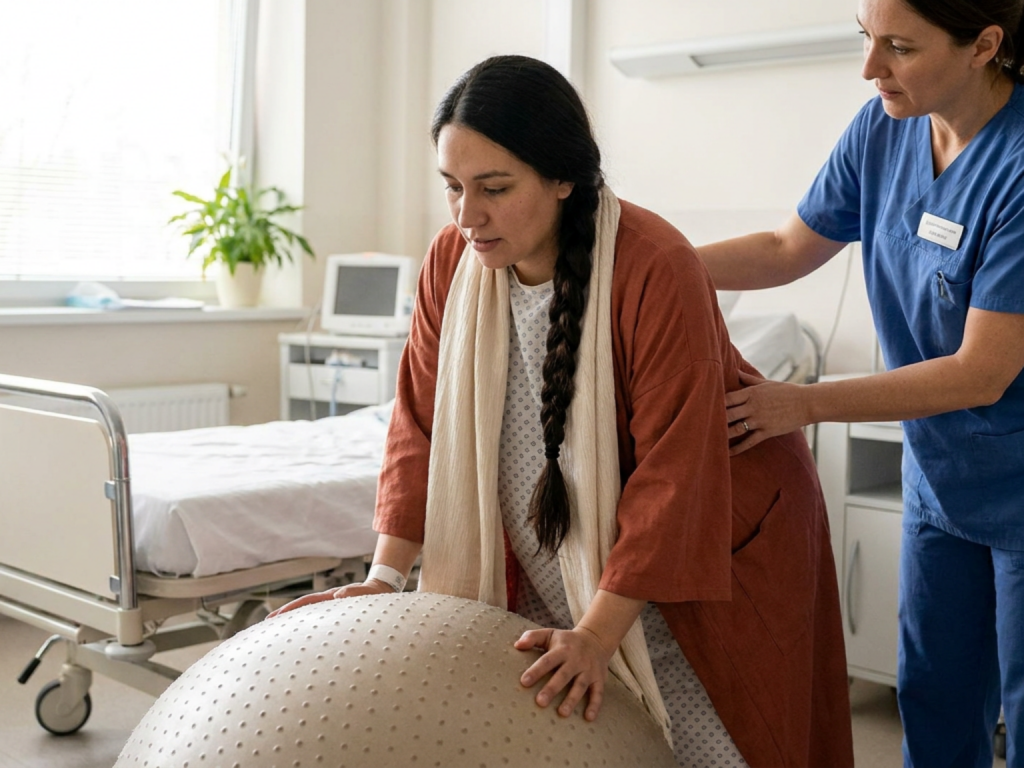
One effective choice is leaning over a birth ball. Kneel on a padded surface or sit on the edge of the bed, then rest the chest and arms over the ball. The belly is supported by gravity rather than compressed against the spine. Gentle rocking can be added if it feels good. Another option is leaning over the raised head of the hospital bed, a chair, or a stack of pillows.
Hands-and-knees position for back labor is also commonly used. The birthing person supports weight through the hands, forearms, or elbows while the knees are padded. This posture may relieve sacral pressure and make it easier for a support person to apply sacral counterpressure during contractions. Counterpressure should be firm, steady, and adjusted according to feedback; too much or poorly placed pressure can be uncomfortable.
If the wrists become sore, use forearms instead of hands, or place the upper body over a ball. If the knees ache, add padding or alternate with side-lying. The best position is the one that reduces pain without causing new strain.
Birth ball positions for pelvic movement
A birth ball can support upright posture while reducing the effort required to stand. Sitting on the ball with feet flat and knees apart allows the pelvis to remain mobile. Gentle circles, figure-eights, or forward-and-back rocking may help the pelvic floor relax and can make labor contractions feel less rigid.
To use a ball safely, it should be appropriately sized so the hips are at least level with, or slightly higher than, the knees. The ball should be stable, preferably on a non-slip surface, with a partner, rail, or bed nearby for balance. In a hospital, staff may place a mat or towel under it. If dizziness, heavy medication, numbness, or weakness is present, sitting unsupported on a ball may not be safe.
Birthing ball positioning can also be adapted for rest. A person can kneel and drape the upper body over the ball, or stand and lean the forearms onto the ball placed on the bed. These versions combine forward leaning with rhythmic motion. Some people find that small pelvic circles between contractions help them recover, while stillness during contractions feels better. Others prefer continuous gentle motion. Either response is valid.
Kneeling, lunging, and supported squatting
Kneeling can be a strong, grounded position during active labor. Upright kneeling on a bed, mat, or floor allows the pelvis to remain open while reducing weight on the feet. Leaning forward onto pillows, a birth ball, or the raised bed can make kneeling more sustainable. It is often useful when standing feels too tiring but lying down increases back pressure.
Lunging may help create pelvic asymmetry. One foot is placed on a low stool, step, or the bed while the other knee remains down or the person stands supported. During a contraction, the birthing person may gently lean toward the raised knee. This should be done carefully, with support, and only if it feels stable. It may be suggested when the baby needs more room to rotate or descend, but it should be guided by the care team if there are concerns about fetal position or monitoring.
Supported squatting in labor can widen the pelvic outlet and use gravity, especially during late labor or pushing. However, squatting is physically demanding and may increase fatigue if held too long. A squat bar, partner support, or a sheet anchored over the bed can help. People with significant pelvic girdle pain, dizziness, epidural-related leg weakness, or certain obstetric complications may need to avoid or modify squatting. Short, supported squats during contractions are often more realistic than prolonged deep squatting.
Side-lying for rest, epidural use, and controlled pushing
Side-lying position during contractions is often underestimated. It can be extremely helpful when the birthing person is exhausted, has an epidural, needs closer monitoring, or wants to reduce perineal pressure. Lying on the left or right side with pillows between the knees can promote rest while avoiding the flat-on-back position that may feel uncomfortable for some people.
Side-lying can still be active. The top leg may be supported by a partner, nurse, peanut ball, or stirrup to create space in the pelvis. Changing sides periodically can help avoid pressure points and may encourage fetal rotation. With an epidural, staff assistance is important because leg strength and sensation can be reduced. Position changes after epidural analgesia should be slow, supported, and coordinated with blood pressure monitoring and fetal assessment.
During pushing, side-lying may allow a more gradual birth of the baby’s head and can be useful if the birthing person wants to avoid prolonged breath-holding. It may also be chosen when there is a need for controlled delivery of the head or when upright pushing is not feasible. As with all pushing positions, the clinical context matters, including fetal heart rate, maternal fatigue, and the need for obstetric assistance.
Positions to use in bed when movement is limited
Needing to stay in or near the bed does not mean being stuck flat on the back. Many labor positions can be adapted to a hospital bed. The head of the bed can be raised for supported sitting or kneeling. The birthing person can lean over the elevated back of the bed, use pillows for asymmetrical side-lying, or place one leg on a peanut ball.
If continuous monitoring, intravenous lines, ruptured membranes with concerns, preeclampsia evaluation, or an epidural limits mobility, ask what safe options remain. Often, small changes still matter: turning from side to side, sitting upright, using a throne position, tilting the pelvis, or leaning forward over pillows. Even a few centimeters of postural change can reduce pressure on the sacrum or hips.
For people who feel vulnerable or discouraged when mobility is restricted, it can help to reframe the goal. The aim is not to use every position; it is to find the safest available position that supports coping. Nurses and midwives are often skilled at adapting positions around monitors, catheters, blood pressure cuffs, and epidural tubing.
How to choose the right position moment by moment
The best positions to reduce labor pain are usually discovered through feedback from the body. A useful pattern is to try a position for several contractions, then reassess: Is pain more manageable? Is breathing easier? Is the baby tolerating it? Is the birthing person becoming more relaxed or more tense? If a position increases pain, dizziness, numbness, panic, or exhaustion, it is reasonable to change.
Different phases often call for different strategies. In early labor, walking, showering, sitting on a ball, and resting may alternate. In active labor, forward leaning, kneeling, and upright positions may feel powerful. In transition, many people prefer close support, fewer instructions, and positions that minimize stimulation. During pushing, the best position depends on sensation, epidural use, fetal descent, and clinical priorities.
Communication is essential. Tell the care team where pain is strongest: back, hips, pubic bone, rectum, abdomen, or thighs. That information may guide position suggestions. If you have a birth plan, include preferences for mobility, birth ball use, hands-and-knees, side-lying, and support for changing positions in active labor. At the same time, allow flexibility. Labor is dynamic, and choosing a different position is not a failure; it is a skilled response to changing physiology.
When to ask for immediate clinical guidance
- Do not change positions without help if you feel faint, have leg numbness, or have an epidural affecting strength.
- Call your care team promptly for heavy bleeding, severe continuous pain between contractions, or sudden shortness of breath.
- If fetal monitoring shows concern, follow the clinician’s guidance about position changes and oxygenation strategies.
- Avoid unsupported squatting or standing if you are dizzy, heavily medicated, or at high risk of falling.
- If your waters have broken and you are told there are cord, fetal position, or infection concerns, ask which positions are safest.
Tools & Assistance
- Discuss mobility preferences with your obstetrician or midwife before labor.
- Ask the birth unit whether birth balls, peanut balls, squat bars, mats, or wireless monitoring are available.
- Practice several labor positions with your support person before the due date.
- Use pillows, towels, and bed adjustments to modify positions safely.
- Request hands-on help from a nurse, midwife, doula, or physiotherapist familiar with labor support.
FAQ
Is lying on my back bad during labor?
Not always, but many people find it increases back or pelvic pressure. If it is uncomfortable, ask about side-lying, upright sitting, or forward-leaning alternatives.
Can I use these positions with an epidural?
Often yes, but modifications and assistance are important because sensation, balance, and leg strength may be reduced. Side-lying, supported sitting, peanut ball use, and assisted turning are common options.
Which position is best for back labor?
Hands-and-knees, kneeling while leaning forward, and leaning over a birth ball often help reduce sacral pressure. Counterpressure may also help when applied safely by a trained support person or guided partner.
How often should I change positions?
There is no fixed rule. Many people reassess every few contractions or every 20 to 30 minutes, but fetal monitoring, fatigue, epidural use, and clinical guidance should shape the timing.
Can positions shorten labor?
Some upright and mobile positions may support descent and comfort, but labor length depends on many factors. Positioning is best viewed as a comfort and physiologic support strategy, not a guaranteed way to speed birth.
Sources
- Mayo Clinic — Labor positions
- Pregnancy, Birth and Baby — Positions for labour and birth
- Health Service Executive — Staying active and upright positions during labour
Disclaimer
This article is for general educational purposes and is not a substitute for individualized medical advice. Always follow guidance from your obstetrician, midwife, nurse, or emergency care team during labor.


















Please log in to leave a comment.