
Intro
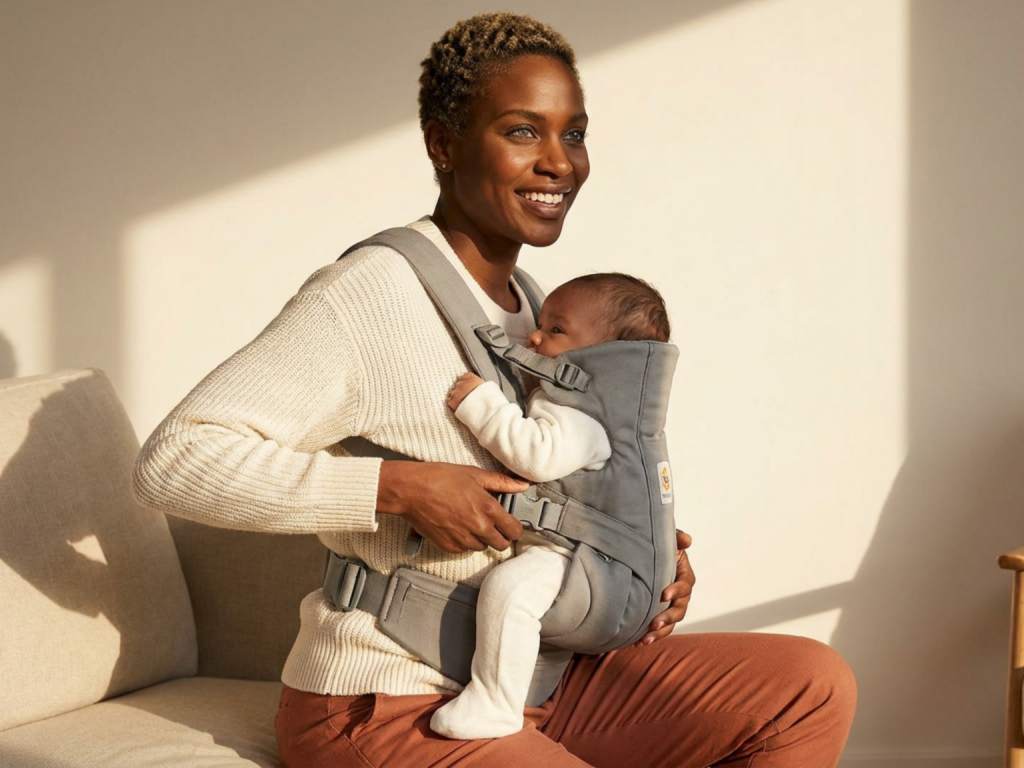
Ergonomic baby carriers are designed to support a baby’s developing body while helping the caregiver carry weight more comfortably. In practical terms, “ergonomic” means the carrier aims to keep the infant in a natural, supported posture, with weight distributed across the hips, spine, shoulders, and pelvis rather than concentrated in one pressure point.
For many families, babywearing is not just about convenience. It can support closeness, responsiveness, and day-to-day functioning during a physically and emotionally demanding phase of life. This article explains what makes a carrier ergonomic, how to recognize safer positioning, and what to look for when choosing and using one.
Highlights
Ergonomic carriers aim to support the baby’s natural posture and distribute weight evenly for the caregiver.
A wide, supportive seat and good hip support help reduce concentrated pressure on the crotch and thighs.
Snug fit, airway visibility, and head-and-neck support are core safety and comfort features.
Adjustability and breathable materials matter because fit, climate, and body shape vary widely.
A carrier can be comfortable without being medically appropriate if positioning is poor.
What “ergonomic” means in babywearing
In babywearing, an ergonomic carrier is one that supports the infant’s body in a developmentally appropriate way while also reducing strain on the caregiver. The concept is borrowed from ergonomics in other settings: the goal is to fit the tool to the body, not force the body into the tool.
For babies, this usually means support at the hips, pelvis, and spine, with the weight borne by the seat of the carrier rather than hanging from the crotch. For caregivers, it means the load should be spread across broader surfaces such as the shoulders, back, and waist, depending on the design.
The core features of an ergonomic carrier
Most ergonomic carriers share a few structural features. A wide seat helps the baby’s thighs rest comfortably and supports the hips in a stable position. Adjustable straps and panels make it easier to adapt the carrier to different caregiver bodies and to a growing infant.
Padding can improve comfort, but it is not a substitute for fit. Breathable materials are useful in warm environments or during prolonged wear, when heat buildup and moisture can make babywearing unpleasant. A good carrier should feel secure without compressing the infant or creating pressure points for the wearer.
- Wide, supportive seat
- Adjustable shoulder and waist components
- Stable hip support
- Breathable, comfortable fabric
- Balanced load distribution
Healthy infant positioning: the M-position and beyond
A common ergonomic target is the M-position, in which the knees are flexed and supported higher than the bottom, allowing the thighs to spread naturally. This position helps keep the hips aligned and supported rather than dangling straight down. It is often discussed in relation to hip-healthy babywearing.
Just as important is whole-body support. The baby’s back should be held in a gentle, secure curve, and the neck and head need support appropriate to age and developmental stage. The carrier should be snug enough that the infant does not slump, but not so tight that breathing, movement, or comfort is impaired.
When positioned well, the baby should appear settled and well supported, with the airway open and the face unobstructed. That combination is a useful practical checkpoint for many caregivers.
How ergonomic design helps the caregiver
Carrying a growing infant can create substantial musculoskeletal load, especially on the lumbar spine, shoulders, and upper back. Ergonomic carriers try to reduce that burden by distributing weight more evenly and keeping the baby close to the caregiver’s center of gravity. This can reduce the sense of being pulled forward or sideways.
For some people, this is a meaningful difference between short, tolerable wear and ongoing discomfort. A well-designed carrier may still require some adaptation, especially after birth or after a period of deconditioning, but a balanced fit generally feels more stable and less fatiguing over time.
Comfort is not merely subjective here. If the caregiver is constantly readjusting, leaning backward, or compensating with posture, the load may not be distributed well enough for sustained use.
How to recognize poor fit or positioning
Even a reputable carrier can be used in a non-ergonomic way if it is adjusted poorly. Warning signs include a baby that slouches deeply, seems to hang from the crotch, or has the knees lower than the hips for long periods. A very loose fit can allow the torso to collapse, while an overly tight fit may cause discomfort or restrict normal movement.
For caregivers, red flags include shoulder pinching, low-back strain, asymmetrical loading, or the feeling that the carrier is carrying the baby instead of the torso and hips sharing the load. If you find yourself repeatedly tightening straps without solving the problem, the design may not suit your body or your baby’s current stage.
Any sign that the baby’s face is pressed into fabric, the chin is forced toward the chest, or breathing looks difficult should be treated as urgent and corrected immediately.
- Baby slumps or curls excessively
- Knees hang lower than the hips
- Carrier feels unstable or shifts constantly
- Caregiver develops focal neck, shoulder, or back pain
- Airway visibility is reduced
Choosing a carrier that matches your needs
There is no single ideal carrier for every family. The right choice depends on the baby’s age and size, caregiver body shape, climate, and how long the carrier will be worn. Adjustable systems are often helpful because they can accommodate growth and allow more precise fitting.
Breathability matters in warmer climates or for babies who tend to overheat. Padding can be useful for longer wear, but excessive bulk may make adjustment harder. Many caregivers benefit from trying several styles and paying attention to whether the carrier keeps the baby high, close, and supported without forcing the wearer into a strained posture.
When in doubt, fit is more important than brand reputation. A simpler carrier that fits well is usually preferable to a more elaborate one that cannot be adjusted properly.
Using an ergonomic carrier safely and comfortably
Good design still depends on correct use. The carrier should be snug, the infant should be close enough to kiss, and the airway should remain clear. The baby’s back and neck should be supported according to developmental need, especially in younger infants who lack head control.
It can help to re-check fit after moving, sitting, nursing, or taking the baby in and out. Small changes in tension can alter posture significantly. If the infant falls asleep, reassess head position, airway visibility, and overall support, because relaxed tone can increase slumping.
Many caregivers find it helpful to treat babywearing as a skill that improves with repetition. Still, if positioning remains confusing or uncomfortable, professional guidance can be valuable.
When to seek expert advice
Consult a pediatric clinician, lactation consultant, physical therapist, or certified babywearing educator if your baby has known hip concerns, prematurity, low muscle tone, torticollis, or persistent difficulty maintaining posture in the carrier. Professional input is also useful if you have ongoing pain, a history of back or pelvic injury, or concerns about reflux, breathing, or airway alignment.
Medical advice is especially important if the baby seems distressed in every carrier, cannot settle into a supported position, or has any condition that could affect handling or positioning. The safest carrier is not just the one labeled ergonomic, but the one that fits the baby’s anatomy, developmental stage, and your caregiving context.
When to pause and get help
- Stop using the carrier if the baby’s airway looks compromised or the face is buried in fabric.
- Get help if your baby consistently slumps, twists, or cannot maintain a supported posture.
- Seek advice if you develop persistent neck, shoulder, pelvic, or back pain while babywearing.
- Use extra caution for premature infants or babies with medical or musculoskeletal concerns.
- Do not rely on labels alone; correct fit and positioning matter more than marketing terms.
Tools & Assistance
- Pediatrician or family doctor
- Certified babywearing educator
- Lactation consultant if feeding and carrying overlap
- Pediatric physical therapist or occupational therapist
- Manufacturer fitting guide for your exact carrier model
FAQ
What makes a baby carrier ergonomic?
An ergonomic carrier supports the baby’s natural posture, especially at the hips, pelvis, and spine, while distributing weight comfortably for the caregiver.
Is the M-position always required?
It is a common ergonomic goal because it supports the hips and thighs, but the overall fit, airway safety, and age-appropriate support are also important.
Can a carrier be comfortable but still not ergonomic?
Yes. Comfort alone does not guarantee good positioning. A carrier may feel soft yet still allow the baby to slump or hang from the crotch.
How tight should a baby carrier be?
Snug enough to keep the baby close and supported, but not so tight that breathing, movement, or comfort is restricted.
When should I ask a professional to check my carrier fit?
If your baby has medical concerns, if you have pain while carrying, or if you are unsure whether the airway and posture are adequately supported.
Sources
- Soul Slings — Ergonomics in Baby Carriers: A Comprehensive Guide
- Ergonomic Baby Carriers — What is an Ergonomic Baby Carrier ?
- BabyMaxi — Understanding Ergonomic Baby Carriers: Benefits and Proper Usage
Disclaimer
This article is for general educational purposes and is not a substitute for individualized medical advice. If you have concerns about your baby’s breathing, posture, hip development, or your own pain while carrying, consult a qualified healthcare professional.















Please log in to leave a comment.